Tag: DIA 17 documents
Search documents matching “DIA” →Free-text subjects the curators added. Unlike the other axes these are not necessarily from the documents' own vocabulary, so they are the loosest thing to browse by (and the most forgiving).
Graphs
By Banner
By Classification
Refine (combine with another filter, via search)
Sort: Title
Documents
-
DIA - Swimming Upstream in the SIGINT System SIDtoday [pdf]
NSA collects “medical SIGINT” from the communications of NGOs and treaty-monitoring organizations and is collaborating with the DIA’s Armed Forces Medical Intelligence Center at the Army’s bioweapons research facility at Fort Detrick for expertise in epidemiology.
The Intercept ↗ (2016-08-10) -
DIA Changing its Approach to Analysis (repost) SIDtoday [pdf]
(Repost) The author summarizes Vice Adm. Jake Jacoby's plan for changes coming to the Defense Intelligence Agency. To address specific concerns, the plan groups intelligence efforts in three categories: master, measure, and monitor. The DIA is beginning with a "thorough review of the IC's collective knowledge on North Korean nuclear development."
Marking: SECRETPeople: Jacoby, JakeThe Intercept ↗ (2017-04-24) -
DIA Honors Departing NSA Representative SIDtoday [pdf]
The Defense Intelligence Agency honored the departing representative from NSA who served on the Joint Intelligence Task Force for Combating Terrorism.
Marking: SECRETThe Intercept ↗ (2016-08-10) -
DIA Office Expands to Support Horizontal Integration SIDtoday [pdf]
The NSA is expanding its partnership with the Defense Intelligence Agency, whose team is moving into new office space at NSA. "DIA's strength to SIGINT production is its all-source subject-matter expertise and research methodologies applied to the NSA data."
The Intercept ↗ (2016-12-07) -
Analysis Innovation Resource Program Accepting Proposals SIDtoday [pdf]
Proposals sought for fresh ideas and innovative analytic approaches.
Programs: AIRPThe Intercept ↗ (2016-05-16) -
CLASSIFICATION GUIDE FOR THE NSA/CSS TARGET EXPLOITATION (TAREX) PROGRAM [pdf]
A 2012 NSA/CSS classification guide for the TAREX program — the agency's clandestine human intelligence and close-access signals intelligence unit — establishing what information about TAREX's operations, locations, methodologies, and interagency relationships must be protected, revealing forward-based presences in Germany, South Korea, and Beijing, and confirming that TAREX personnel operate undercover at U.S. embassies worldwide.
Programs: TAREXPeople: Shea, Teresa H. -
Decision Memorandum for the DNI on ICREACH [pdf]
This 2006 memorandum from the Director of the NSA, Keith B. Alexander, requests that the Director of National Intelligence authorize the NSA to create ICREACH, a new Intelligence Community-wide system for sharing communications metadata. The proposal designates the NSA as the executive agent for this new structure, which would replace the older, less scalable PROTON program and grant unprecedented data access to partner agencies.
People: Alexander, Keith B. -
FY2013 Congressional Budget Justification Bin Laden Excerpts [pdf]
This document includes excerpts from the 2013 National Intelligence Program budget justification describing the integrated intelligence community efforts that led to locating and raiding Osama bin Laden's compound, detailing contributions from NSA's signal intelligence, CIA's geolocation analysis, NGA's imagery modeling, and post-raid forensic DNA confirmation.
People: bin Laden, Osama -
In a Nutshell: Defense Watch Conditions (WATCHCONs) SIDtoday [pdf]
“Watch Conditions,” or WATCHCONs, are part of the Defense Intelligence Agency-managed Defense Indications and Warning System. They help members express a “degree of concern” and a time-risk assessment.
Marking: SECRETThe Intercept ↗ (2018-08-15) -
Intellipedia – BIOS Threats [pdf]
This from an internal wiki for the U.S. intelligence community, titled “BIOS Threats” details the use of malicious BIOS implants as a means of achieving persistent system compromise for cyber espionage and attack purposes. It discusses the history, technical challenges, detection limitations, and global development of BIOS-based malware by both state and non-state actors, including U.S. and Chinese cyber units.
-
Is There a Sustainable Ops Tempo in S2? How Can Analysts Deal with the Flood of Collection? SIDtoday [pdf]
The NSA's Deputy Director for Analysis and Production discusses the unsustainable operational tempo caused by overwhelming data collection volumes, advocating for "Analytic Modernization" that would shift from treating SIGINT as "radioactive" NSA-only material to sharing raw intelligence with other agencies for collaborative exploitation.
Programs: A-SPACE -
Israel-US 1999 Agreement [pdf]
This July 1999 top secret agreement between the U.S. Defense Intelligence Agency and Israel's Directorate of Military Intelligence establishes comprehensive intelligence-sharing arrangements covering Middle Eastern threats, terrorism, weapons of mass destruction, and foreign materiel exploitation, superseding previous agreements dating back to 1968 and including specific provisions for conferences, written requests, face-to-face analyst meetings, and security protocols.
-
Serving our customers [pdf]
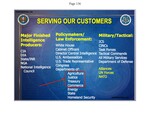
A briefing slide listing NSA's customers: the finished-intelligence producers (CIA, DIA, State/INR, NGA and the National Intelligence Council), policymakers and law enforcement from the White House to Congress and seven departments, and military users from the Joint Chiefs to NATO and UN forces.
-
SIGINT Users' Conference 2004 Wrap-Up SIDtoday [pdf]
An overview of the 2004 SIGINT Users' Conference. 175 attendees from across the intelligence community and the military attended, and there were 23 presentations, as well as panel discussions, demonstrations, tours, and training sessions. Attendees called it a success.
The Intercept ↗ (2017-04-24) -
Special Collection Service - Pacific SIGDEV Conference March 2011 [pdf]
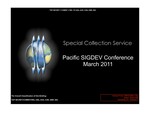
This document is a TOP SECRET briefing describing the Special Collection Service (SCS)—its organizational structure, global posture and strategic partnerships—and how SCS leverages advanced SIGINT and cyber capabilities (microwave, cellular, satellite, VPN/Internet exploitation, tools like INTERQUAKE/Einstein/Castanet/Birdwatcher) from embassy/PoP sites to collect, analyze and support intelligence and covert operations. It also outlines SCS modernization goals (unified IT core, cloud/virtualization, expanded cyber presence), operational authorities and mission advantages for enabling both SIGINT and HUMINT activities. See also Spiegel's 2013 reporting based on the same presentation (back then they only published two slides from this presentation): https://www.spiegel.de/international/germany/cover-story-how-nsa-spied-on-merkel-cell-phone-from-berlin-embassy-a-930205.html
-
The Next Frontier for Information Sharing SIDtoday [pdf]
NSA analysts are recently able to share more unpublished signals intelligence with the Joint Intelligence Task Force-Combating Terrorism, but “receiving analysts do not always completely understand the sensitivity of the shared details or how to determine with whom they can share the information they received.”
Marking: SECRETThe Intercept ↗ (2018-03-01) -
Uncovering North Korea Nuclear Programs SIDtoday [pdf]
Based on NSA SIGINT, the State Department confronted North Korean officials with evidence they were developing a uranium enrichment capability.
People: Fleisch, Frances J.The Intercept ↗ (2016-05-16)