PROJECT BULLRUN Classification Guide
Open PDFDocument date: 2010-06-16
Pages: 6
Genre: guide
Banner: TOP SECRET//SI//REL TO USA, FVEY
Classification: TOP SECRET SI
Dissemination: REL TO USA, FVEY
This BULLRUN classification guide outlines the NSA’s highly secretive methods for undermining and exploiting encryption technologies through a combination of cryptanalysis, industry collaboration, covert implants, and network exploitation. It specifies strict classification protocols for capabilities against protocols like TLS/SSL, VPNs, VoIP, and webmail, emphasizing secrecy around sources, methods, and industry partnerships that make commercial encryption systems deliberately vulnerable.
My notes
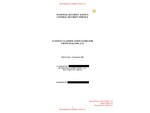
TOP SECRET//SI//REL TO USA, FVEY
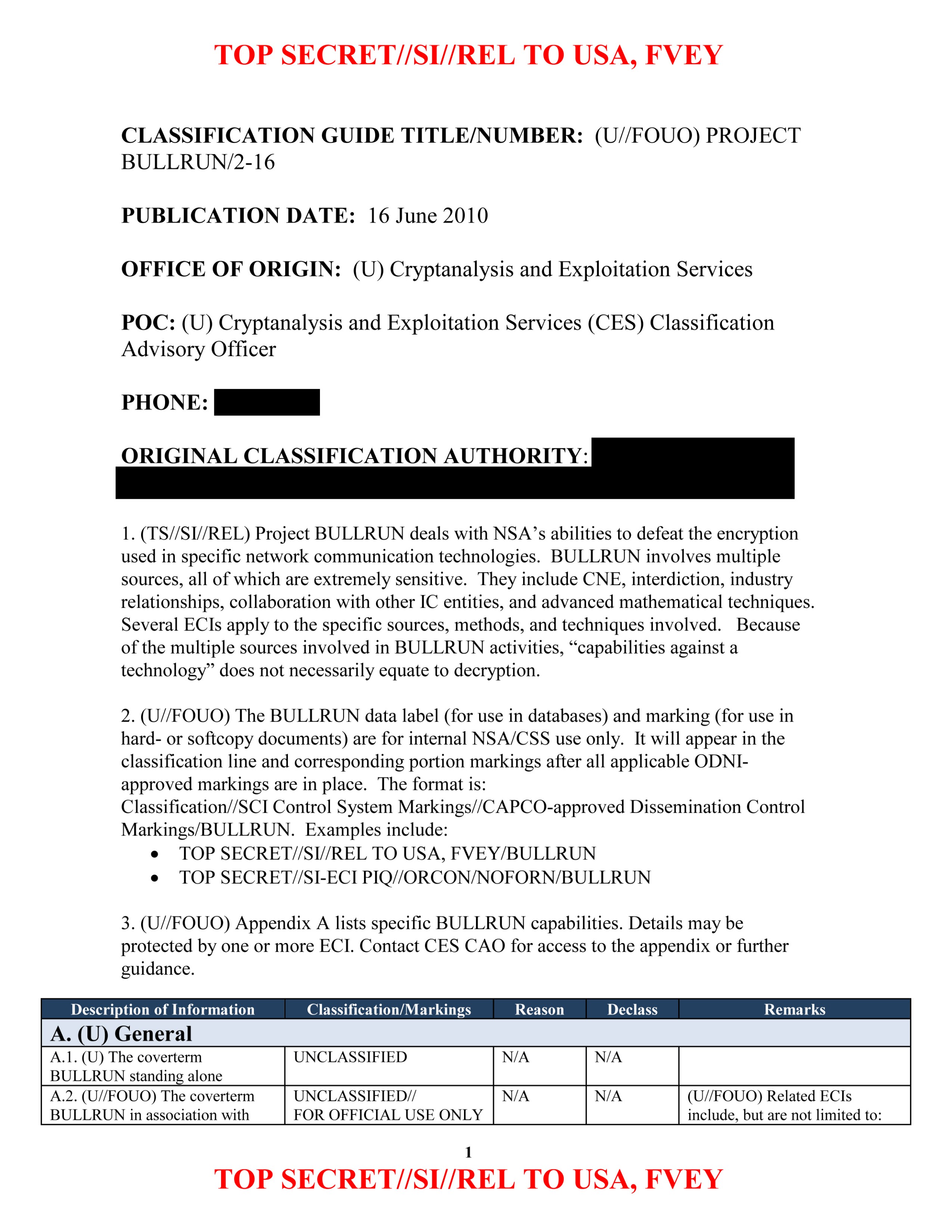
CLASSIFICATION GUIDE TITLE/NUMBER: (U//FOUO) PROJECT BULLRUN/2-16
PUBLICATION DATE: 16 June 2010
OFFICE OF ORIGIN: (U) Cryptanalysis and Exploitation Services
POC: (U) Cryptanalysis and Exploitation Services (CES) Classification Advisory Officer
PHONE: [REDACTED]
ORIGINAL CLASSIFICATION AUTHORITY: [REDACTED]
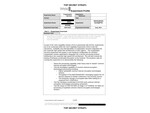
- (TS//SI//REL) Project BULLRUN deals with NSA's abilities to defeat the encryption used in specific network communication technologies. BULLRUN involves multiple sources, all of which are extremely sensitive. They include CNE, interdiction, industry relationships, collaboration with other IC entities, and advanced mathematical techniques. Several ECIs apply to the specific sources, methods, and techniques involved. Because of the multiple sources involved in BULLRUN activities, “capabilities against a technology" does not necessarily equate to decryption.
- (U//FOUO) The BULLRUN data label (for use in databases) and marking (for use in hard- or softcopy documents) are for internal NSA/CSS use only. It will appear in the classification line and corresponding portion markings after all applicable ODNI-approved markings are in place. The format is: Classification//SCI Control System Markings//CAPCO-approved Dissemination Control Markings/BULLRUN. Examples include:
- TOP SECRET//SI//REL TO USA, FVEY/BULLRUN
- TOP SECRET//SI-ECI PIQ//ORCON/NOFORN/BULLRUN
- (U//FOUO) Appendix A lists specific BULLRUN capabilities. Details may be protected by one or more ECI. Contact CES CAO for access to the appendix or further guidance.
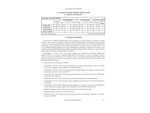
| Description of Information | Classification/Markings | Reason | Declass | Remarks |
|---|---|---|---|---|
| A. (U) General | ||||
| A.1. (U) The coverterm BULLRUN standing alone | UNCLASSIFIED | N/A | N/A | |
| A.2. (U//FOUO) The coverterm BULLRUN in association with | UNCLASSIFIED// FOR OFFICIAL USE ONLY | N/A | N/A | (U//FOUO) Related ECIs include, but are not limited to: |
1
TOP SECRET//SI//REL TO USA, FVEY
TOP SECRET//SI//REL TO USA, FVEY
| Description of Information | Classification/Markings | Reason | Declass | Remarks |
|---|---|---|---|---|
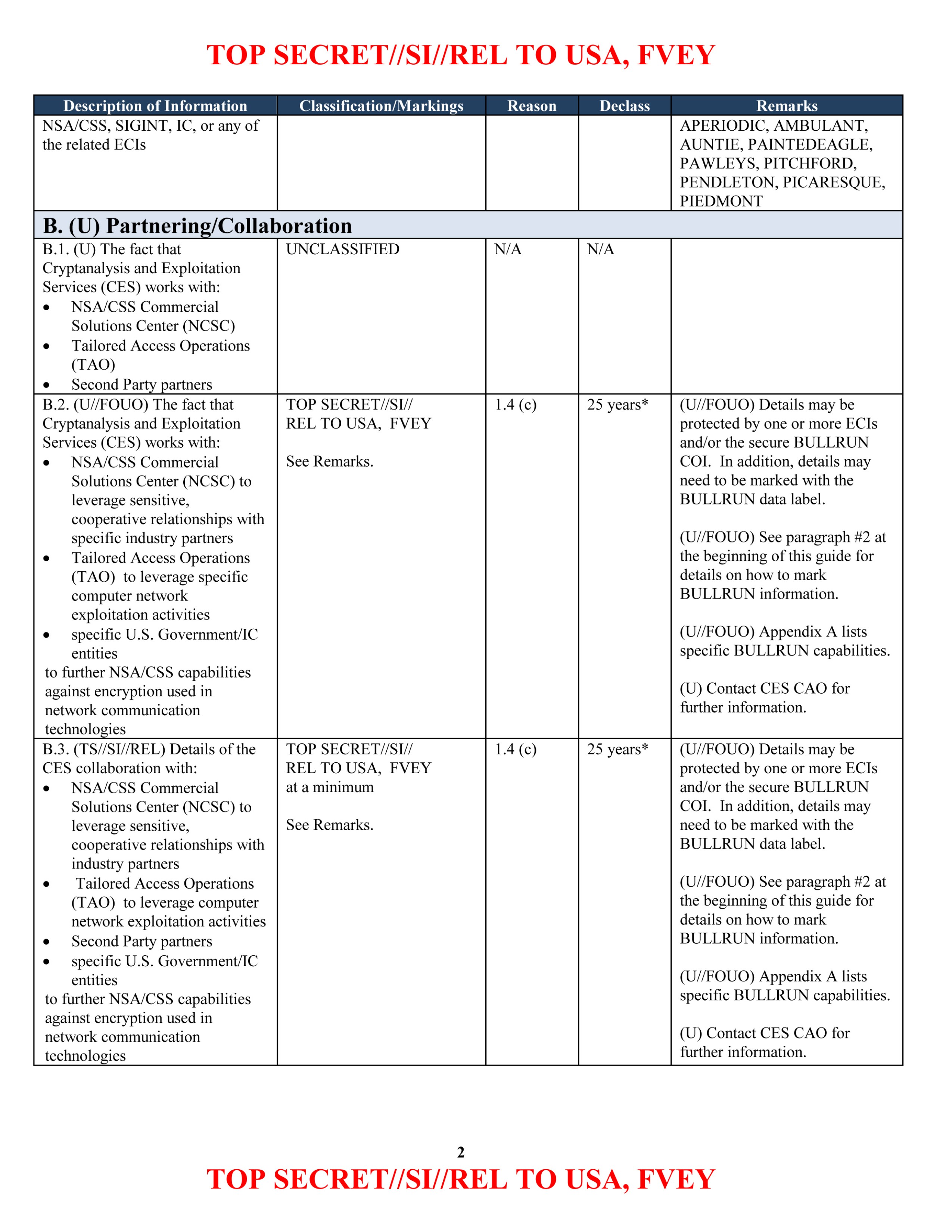
| NSA/CSS, SIGINT, IC, or any of the related ECIs | APERIODIC, AMBULANT, AUNTIE, PAINTEDEAGLE, PAWLEYS, PITCHFORD, PENDLETON, PICARESQUE, PIEDMONT | |||
| B. (U) Partnering/Collaboration | ||||
| B.1. (U) The fact that Cryptanalysis and Exploitation Services (CES) works with: * NSA/CSS Commercial Solutions Center (NCSC) * Tailored Access Operations (TAO) * Second Party partners | UNCLASSIFIED | N/A | N/A | |
| B.2. (U//FOUO) The fact that Cryptanalysis and Exploitation Services (CES) works with: * NSA/CSS Commercial Solutions Center (NCSC) to leverage sensitive, cooperative relationships with specific industry partners * Tailored Access Operations (TAO) to leverage specific computer network exploitation activities * specific U.S. Government/IC entities to further NSA/CSS capabilities against encryption used in network communication technologies | TOP SECRET//SI// REL TO USA, FVEY See Remarks. | 1.4 (c) | 25 years* | (U//FOUO) Details may be protected by one or more ECIs and/or the secure BULLRUN COI. In addition, details may need to be marked with the BULLRUN data label. (U//FOUO) See paragraph #2 at the beginning of this guide for details on how to mark BULLRUN information. (U//FOUO) Appendix A lists specific BULLRUN capabilities. (U) Contact CES CAO for further information. |
| B.3. (TS//SI//REL) Details of the CES collaboration with: * NSA/CSS Commercial Solutions Center (NCSC) to leverage sensitive, cooperative relationships with industry partners * Tailored Access Operations (TAO) to leverage computer network exploitation activities * Second Party partners * specific U.S. Government/IC entities to further NSA/CSS capabilities against encryption used in network communication technologies | TOP SECRET//SI// REL TO USA, FVEY at a minimum See Remarks. | 1.4 (c) | 25 years* | (U//FOUO) Details may be protected by one or more ECIs and/or the secure BULLRUN COI. In addition, details may need to be marked with the BULLRUN data label. (U//FOUO) See paragraph #2 at the beginning of this guide for details on how to mark BULLRUN information. (U//FOUO) Appendix A lists specific BULLRUN capabilities. (U) Contact CES CAO for further information. |
2
TOP SECRET//SI//REL TO USA, FVEY
TOP SECRET//SI//REL TO USA, FVEY
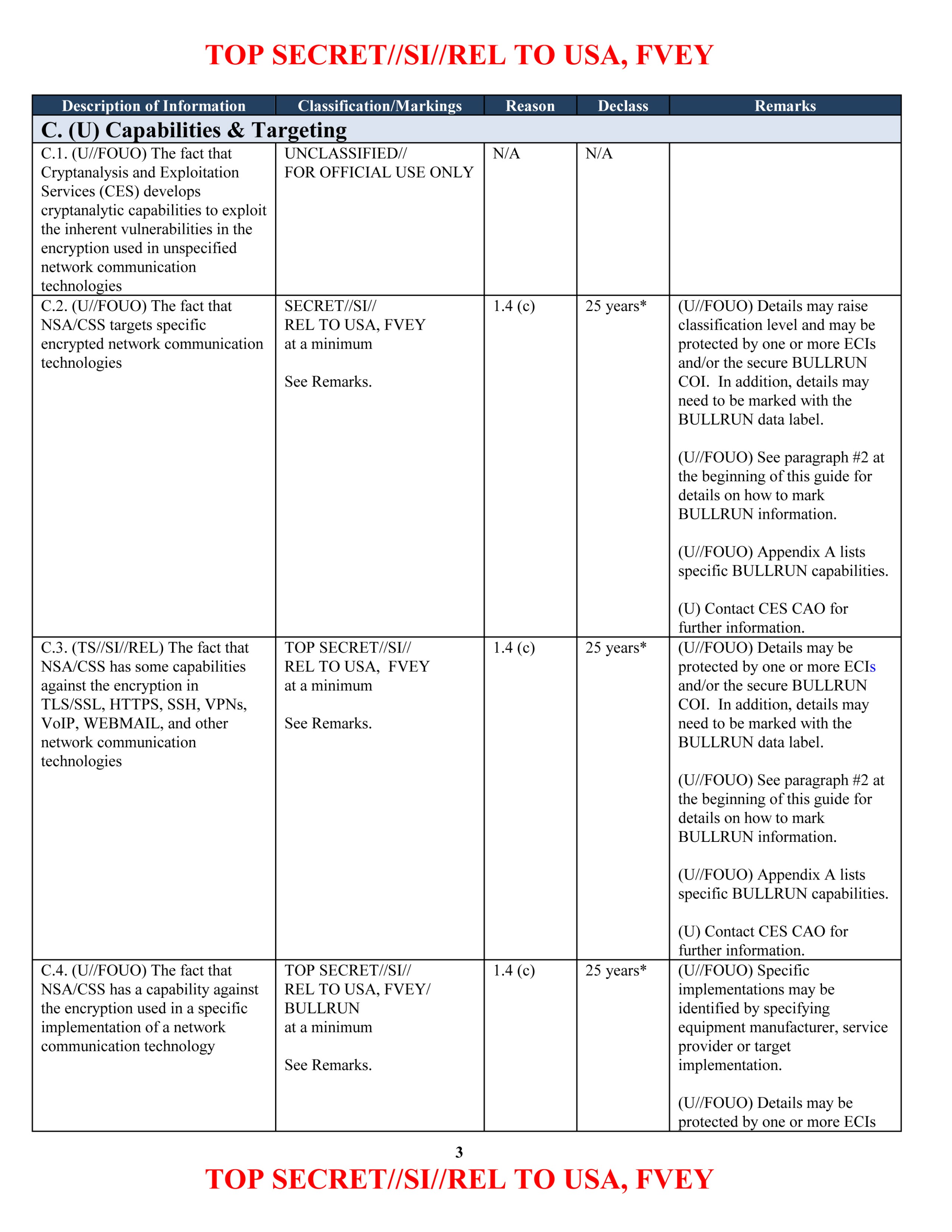
| Description of Information | Classification/Markings | Reason | Declass | Remarks |
|---|---|---|---|---|
| C. (U) Capabilities & Targeting | ||||
| C.1. (U//FOUO) The fact that Cryptanalysis and Exploitation Services (CES) develops cryptanalytic capabilities to exploit the inherent vulnerabilities in the encryption used in unspecified network communication technologies | UNCLASSIFIED// FOR OFFICIAL USE ONLY | N/A | N/A | |
| C.2. (U//FOUO) The fact that NSA/CSS targets specific encrypted network communication technologies | SECRET//SI// REL TO USA, FVEY at a minimum See Remarks. | 1.4 (c) | 25 years* | (U//FOUO) Details may raise classification level and may be protected by one or more ECIs and/or the secure BULLRUN COI. In addition, details may need to be marked with the BULLRUN data label. (U//FOUO) See paragraph #2 at the beginning of this guide for details on how to mark BULLRUN information. (U//FOUO) Appendix A lists specific BULLRUN capabilities. (U) Contact CES CAO for further information. |
| C.3. (TS//SI//REL) The fact that NSA/CSS has some capabilities against the encryption in TLS/SSL, HTTPS, SSH, VPNs, VoIP, WEBMAIL, and other network communication technologies | TOP SECRET//SI// REL TO USA, FVEY at a minimum See Remarks. | 1.4 (c) | 25 years* | (U//FOUO) Details may be protected by one or more ECIs and/or the secure BULLRUN COI. In addition, details may need to be marked with the BULLRUN data label. (U//FOUO) See paragraph #2 at the beginning of this guide for details on how to mark BULLRUN information. (U//FOUO) Appendix A lists specific BULLRUN capabilities. (U) Contact CES CAO for further information. |
| C.4. (U//FOUO) The fact that NSA/CSS has a capability against the encryption used in a specific implementation of a network communication technology | TOP SECRET//SI// REL TO USA, FVEY/ BULLRUN at a minimum See Remarks. | 1.4 (c) | 25 years* | (U//FOUO) Specific implementations may be identified by specifying equipment manufacturer, service provider or target implementation. (U//FOUO) Details may be protected by one or more ECIs |
3
TOP SECRET//SI//REL TO USA, FVEY
TOP SECRET//SI//REL TO USA, FVEY
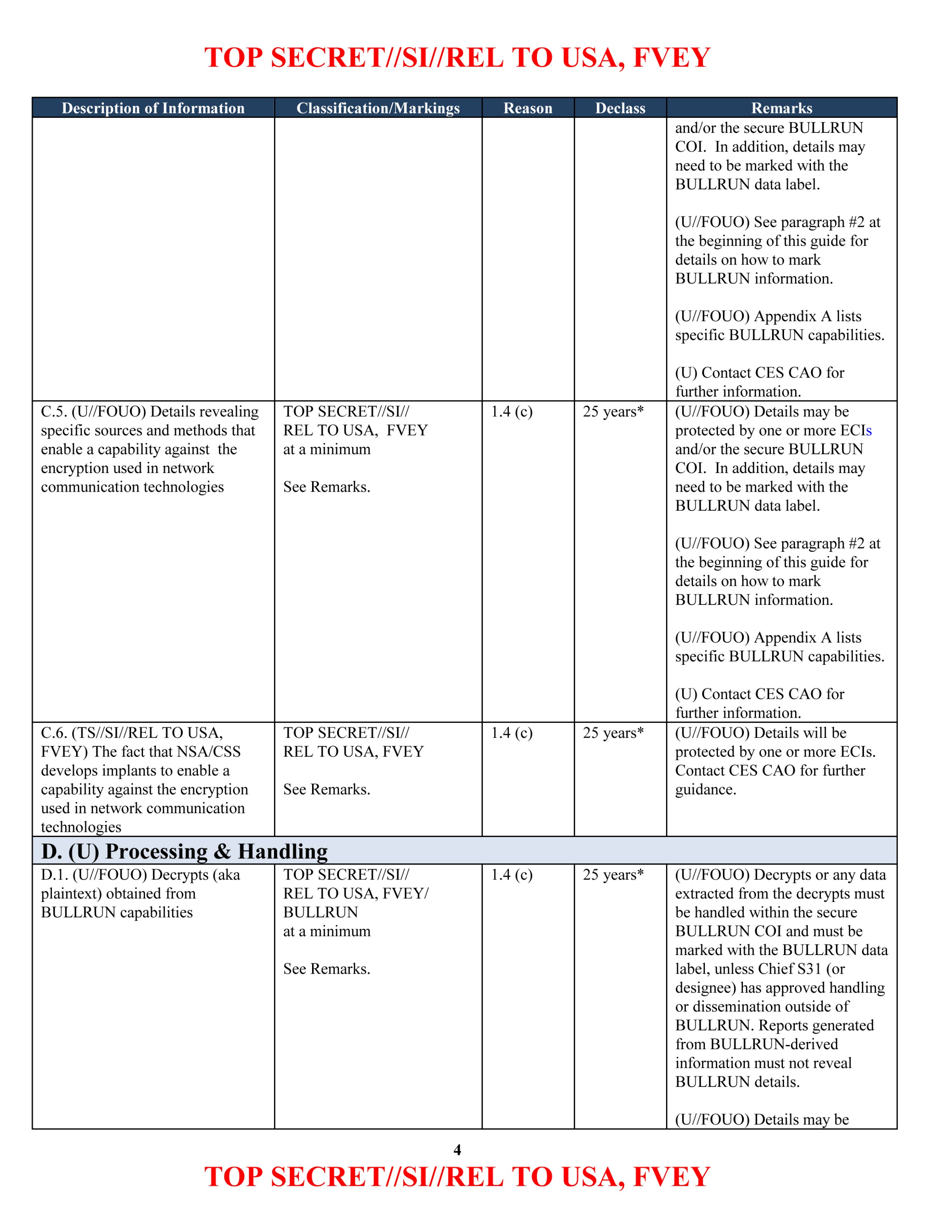
| Description of Information | Classification/Markings | Reason | Declass | Remarks |
|---|---|---|---|---|
| and/or the secure BULLRUN COI. In addition, details may need to be marked with the BULLRUN data label. (U//FOUO) See paragraph #2 at the beginning of this guide for details on how to mark BULLRUN information. (U//FOUO) Appendix A lists specific BULLRUN capabilities. (U) Contact CES CAO for further information. | ||||
| C.5. (U//FOUO) Details revealing specific sources and methods that enable a capability against the encryption used in network communication technologies | TOP SECRET//SI// REL TO USA, FVEY at a minimum See Remarks. | 1.4 (c) | 25 years* | (U//FOUO) Details may be protected by one or more ECIs and/or the secure BULLRUN COI. In addition, details may need to be marked with the BULLRUN data label. (U//FOUO) See paragraph #2 at the beginning of this guide for details on how to mark BULLRUN information. (U//FOUO) Appendix A lists specific BULLRUN capabilities. (U) Contact CES CAO for further information. |
| C.6. (TS//SI//REL TO USA, FVEY) The fact that NSA/CSS develops implants to enable a capability against the encryption used in network communication technologies | TOP SECRET//SI// REL TO USA, FVEY See Remarks. | 1.4 (c) | 25 years* | (U//FOUO) Details will be protected by one or more ECIs. Contact CES CAO for further guidance. |
| D. (U) Processing & Handling | ||||
| D.1. (U//FOUO) Decrypts (aka plaintext) obtained from BULLRUN capabilities | TOP SECRET//SI// REL TO USA, FVEY/ BULLRUN at a minimum See Remarks. | 1.4 (c) | 25 years* | (U//FOUO) Decrypts or any data extracted from the decrypts must be handled within the secure BULLRUN COI and must be marked with the BULLRUN data label, unless Chief S31 (or designee) has approved handling or dissemination outside of BULLRUN. Reports generated from BULLRUN-derived information must not reveal BULLRUN details. (U//FOUO) Details may be |
4
TOP SECRET//SI//REL TO USA, FVEY
TOP SECRET//SI//REL TO USA, FVEY
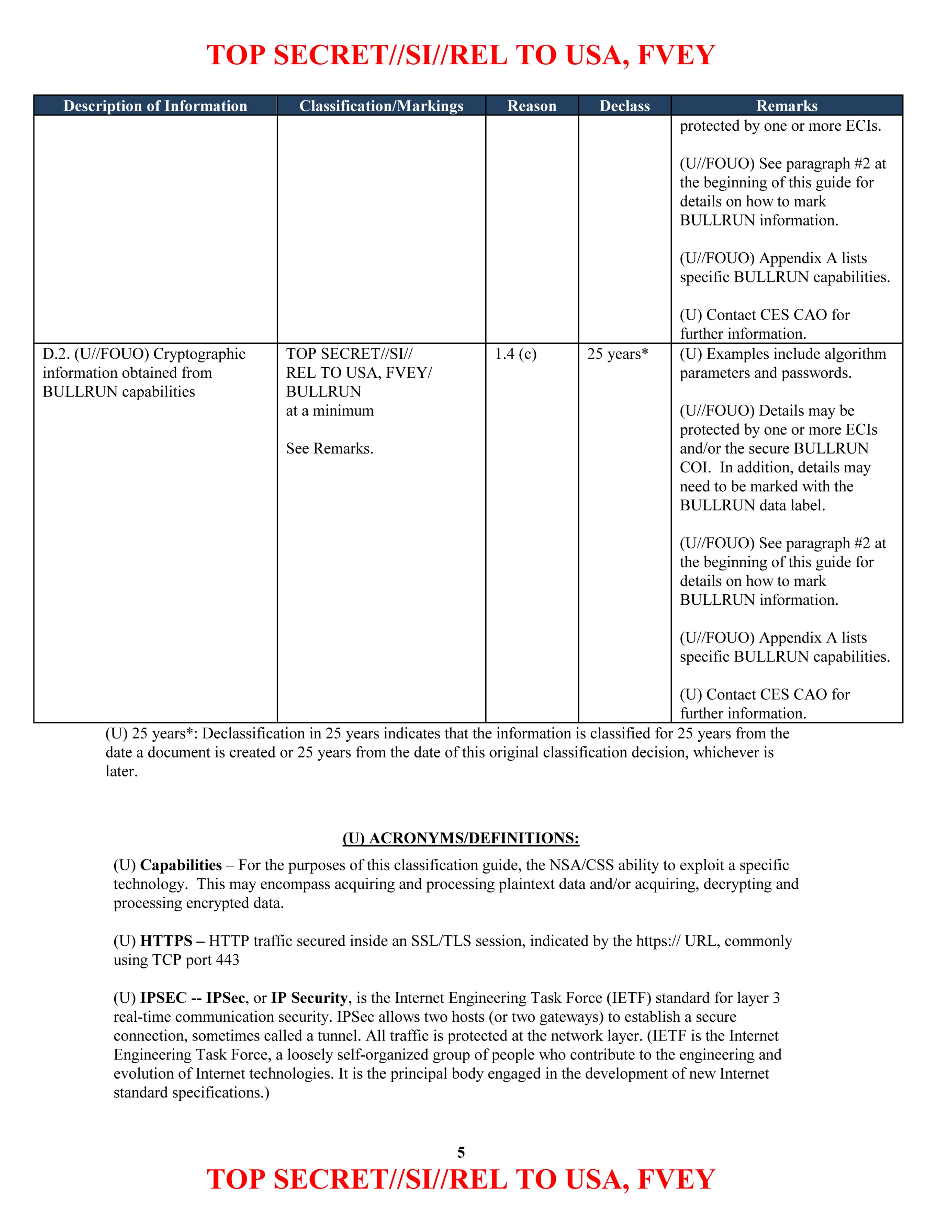
| Description of Information | Classification/Markings | Reason | Declass | Remarks |
|---|---|---|---|---|
| protected by one or more ECIs. (U//FOUO) See paragraph #2 at the beginning of this guide for details on how to mark BULLRUN information. (U//FOUO) Appendix A lists specific BULLRUN capabilities. (U) Contact CES CAO for further information. | ||||
| D.2. (U//FOUO) Cryptographic information obtained from BULLRUN capabilities | TOP SECRET//SI// REL TO USA, FVEY/ BULLRUN at a minimum See Remarks. | 1.4 (c) | 25 years* | (U) Examples include algorithm parameters and passwords. (U//FOUO) Details may be protected by one or more ECIs and/or the secure BULLRUN COI. In addition, details may need to be marked with the BULLRUN data label. (U//FOUO) See paragraph #2 at the beginning of this guide for details on how to mark BULLRUN information. (U//FOUO) Appendix A lists specific BULLRUN capabilities. (U) Contact CES CAO for further information. |
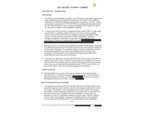
(U) 25 years*: Declassification in 25 years indicates that the information is classified for 25 years from the date a document is created or 25 years from the date of this original classification decision, whichever is later.
(U) ACRONYMS/DEFINITIONS:
(U) Capabilities – For the purposes of this classification guide, the NSA/CSS ability to exploit a specific technology. This may encompass acquiring and processing plaintext data and/or acquiring, decrypting and processing encrypted data.
(U) HTTPS – HTTP traffic secured inside an SSL/TLS session, indicated by the https:// URL, commonly using TCP port 443
(U) IPSEC -- IPSec, or IP Security, is the Internet Engineering Task Force (IETF) standard for layer 3 real-time communication security. IPSec allows two hosts (or two gateways) to establish a secure connection, sometimes called a tunnel. All traffic is protected at the network layer. (IETF is the Internet Engineering Task Force, a loosely self-organized group of people who contribute to the engineering and evolution of Internet technologies. It is the principal body engaged in the development of new Internet standard specifications.)
5
TOP SECRET//SI//REL TO USA, FVEY
TOP SECRET//SI//REL TO USA, FVEY
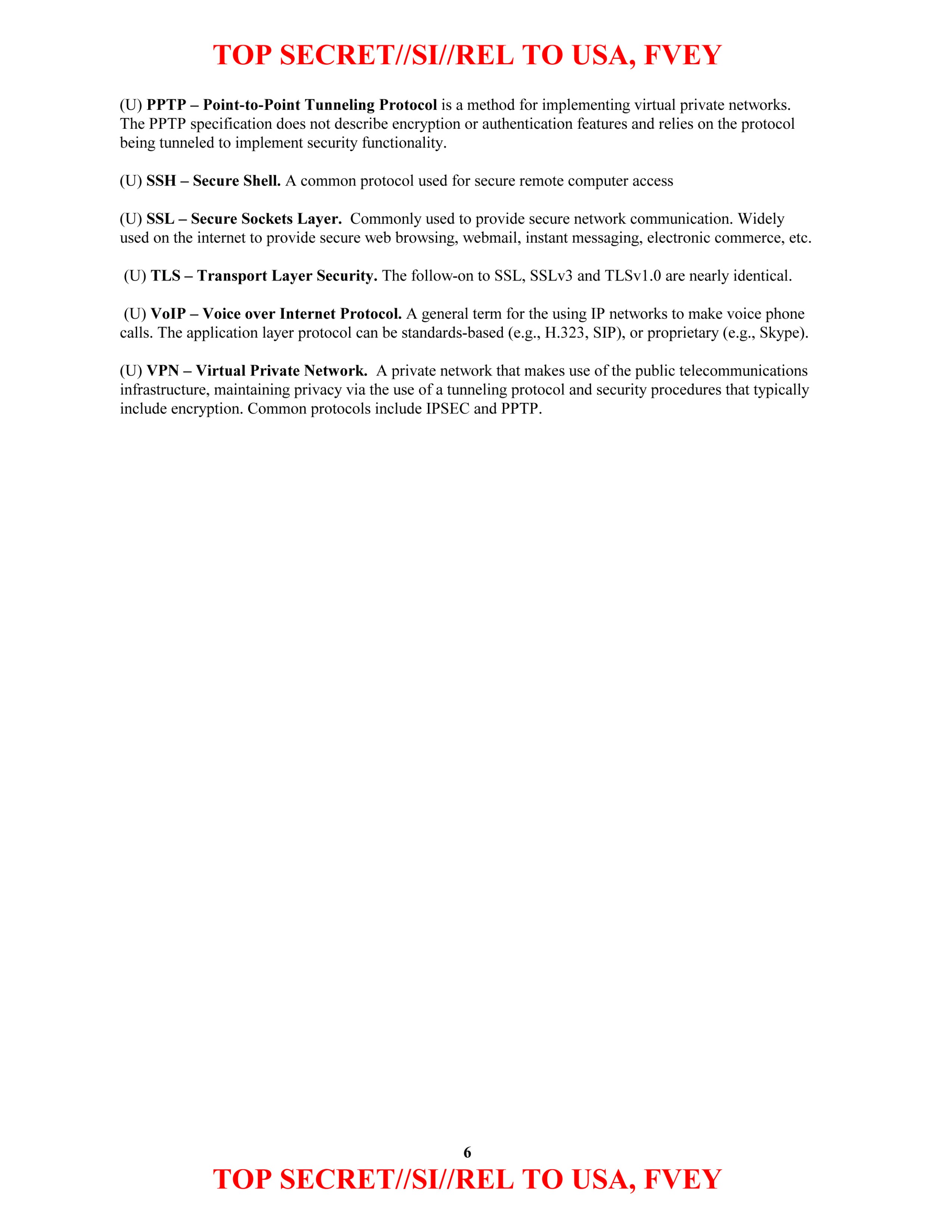
(U) PPTP – Point-to-Point Tunneling Protocol is a method for implementing virtual private networks. The PPTP specification does not describe encryption or authentication features and relies on the protocol being tunneled to implement security functionality.
(U) SSH - Secure Shell. A common protocol used for secure remote computer access
(U) SSL - Secure Sockets Layer. Commonly used to provide secure network communication. Widely used on the internet to provide secure web browsing, webmail, instant messaging, electronic commerce, etc.
(U) TLS - Transport Layer Security. The follow-on to SSL, SSLv3 and TLSv1.0 are nearly identical.
(U) VoIP - Voice over Internet Protocol. A general term for the using IP networks to make voice phone calls. The application layer protocol can be standards-based (e.g., H.323, SIP), or proprietary (e.g., Skype).
(U) VPN – Virtual Private Network. A private network that makes use of the public telecommunications infrastructure, maintaining privacy via the use of a tunneling protocol and security procedures that typically include encryption. Common protocols include IPSEC and PPTP.
6
TOP SECRET//SI//REL TO USA, FVEY
Published in the Same Report
(4 documents)
-
CLASSIFICATION GUIDE FOR CRYPTANALYSIS, 2-12 [pdf]
An NSA/CSS classification guide for cryptanalysis establishing the precise classification level for each type of information about NSA's capabilities to exploit commercial and indigenous encryption systems — from the unclassified acknowledgement that NSA exploits cryptographic devices, through to the Top Secret protection of cryptographic modifications made to commercial products to render them exploitable and industry relationships used to obtain cryptographic details.
“Revealed: how US and UK spy agencies defeat internet privacy and security” - The Guardian ↗ (2013-09-05) · “Prying Eyes: Inside the NSA's War on Internet Security” - Der Spiegel ↗ (2014-12-28) · Ball, James · Borger, Julian · Greenwald, Glenn · Appelbaum, Jacob · Gibson, Aaron · Grothoff, Christian · Müller-Maguhn, Andy · Poitras, Laura · Sontheimer, Michael · Stöcker, Christian -
SIGINT Enabling Project [pdf]
A classified NSA budget document requesting $254.9 million for FY2013 for the SIGINT Enabling Project — a covert program that works with U.S. and foreign technology companies to deliberately insert backdoors and vulnerabilities into commercial encryption products, networking equipment, and communications systems to make them secretly exploitable for surveillance.
“Revealed: The NSA's Secret Campaign to Crack, Undermine Internet Security” - ProPublica ↗ (2013-09-05) · “N.S.A. Able to Foil Basic Safeguards of Privacy on Web” - The New York Times ↗ (2013-09-05) · “Revealed: how US and UK spy agencies defeat internet privacy and security” - The Guardian ↗ (2013-09-05) · Larson, Jeff · Perlroth, Nicole · Shane, Scott · Ball, James · Borger, Julian · Greenwald, Glenn -
Innov8 Experiment Profile Template [pdf]
A TOP SECRET STRAP1 joint NSA/GCHQ experiment profile documenting a 2010-2011 Joint Capability Experiment to test hardware-accelerated bulk decryption of common internet encryption technologies at scale, integrating TURMOIL's passive collection with NSA's LONGHAUL key recovery service via the ISLANDTRANSPORT messaging system, as part of the broader BULLRUN assault on internet encryption.
“Prying Eyes: Inside the NSA's War on Internet Security” - Der Spiegel ↗ (2014-12-28) · “Revealed: how US and UK spy agencies defeat internet privacy and security” - The Guardian ↗ (2013-09-05) · Appelbaum, Jacob · Gibson, Aaron · Grothoff, Christian · Müller-Maguhn, Andy · Poitras, Laura · Sontheimer, Michael · Stöcker, Christian · Ball, James · Borger, Julian · Greenwald, Glenn -
BULLRUN CoI - Briefing Sheet [pdf]
A GCHQ briefing sheet introducing the BULLRUN Community of Interest — the access control framework protecting Five Eyes capabilities to defeat encryption across TLS/SSL, HTTPS, SSH, VPNs, IPSec, encrypted chat and encrypted VoIP — covering the classification structure, handling procedures and protective marking guidance for intelligence derived from cryptanalytic exploitation.
“N.S.A. Able to Foil Basic Safeguards of Privacy on Web” - The New York Times ↗ (2013-09-05) · “Revealed: The NSA's Secret Campaign to Crack, Undermine Internet Security” - ProPublica ↗ (2013-09-05) · “Prying Eyes: Inside the NSA's War on Internet Security” - Der Spiegel ↗ (2014-12-28) · Perlroth, Nicole · Larson, Jeff · Shane, Scott · Appelbaum, Jacob · Gibson, Aaron · Grothoff, Christian · Müller-Maguhn, Andy · Poitras, Laura · Sontheimer, Michael · Stöcker, Christian
Related Documents
-
Exceptionally Controlled Information Compartments (January 2013) [pdf]
This document, dated January 2013, provides a list of Exceptionally Controlled Information (ECI) compartments utilized by the NSA and its Five Eyes partners. This document categorizes highly sensitive intelligence programs by their codenames, three-letter trigraphs, and the specific organizations responsible for them. The primary organizations listed include TAO, NCSC, and CES. These compartments represent the highest level of information security, designed to restrict access to sensitive technical data and specific intelligence sources even among individuals with high-level security clearances.
Programs: AMBULANT · APERIODIC · AUNTIE · BLACKANT · BLACKAXE · BLACKBALL · BLACKCLOUD · BLACKHOLE · BLACKJACK · BLACKTIE · BLACKVULTURE · BLACKWIDOW · BOXWOOD · CELESTIALGLOBE · CHIEFDOM · CLICKUMBER · CRIMSONREGENT · CRIMSTONSTEAL · CRUMPET · DECKSTOP · DEVILFISH · DIXIESPRING · DOMINATE · FASTIDIOUS · FIRESCREEN · FIRSTDOWN · FISSURESALUTE · FLYLEAF · FORBIDDEN · FORBORNE · FOXHEAT · FREELUNCH · FROTHYTWOPACK · FURTIVERELIANCE · GOLDENCALF · HELLFIRE · HISTORY · HYSSOP · INVEIGH · KESSELRUN · LIGHTNINGTHIEF · LITTLECROWN · LONGSERPENT · MAGICSTROKE · MERCURYTAO · MUSICBOX · NITEHAWK · OCELLUS · PAINTEDEAGLE · PAWLEYS · PAWNSHOP · PENDLETON · PENDRAGON · PERKYAUTUMN · PHENYLDOUR · PICARESQUE · PICAROON · PIEDMONT · PITCHFORD · PLACEBO · POMPANO · PRESSURETWIN · REDHARVEST · REEFPOINT · REFRACTOR · REVELRY · RIVERROAD · RUBIOUS · SAILWINDS · SCABBARD · SILVERCLOUD · SINKGOAL · STAIRWELL · STARCHART · SUITESWIVEL · TRICKSHOT · WAXOFF · WHIPGENIE -
BULLRUN [pdf]
A GCHQ TOP SECRET STRAP1 briefing presentation on BULLRUN — summarising the programme's purpose, the network security technologies it targets, the sensitivities surrounding cryptanalytic capabilities, and the access control framework protecting both technical details and the "fact of" capability — notable for explicitly naming three ECIs protecting the technical underpinnings: PICARESQUE, PAWLEYS and AMBULANT.
-
NSA/CSS EXCEPTIONALLY CONTROLLED INFORMATION (ECI) 2003 [pdf]
This document acts as the definitive "master list" of the NSA’s Exceptionally Controlled Information (ECI) compartments as of September 2003. While standard Top Secret information is shared among those with the appropriate clearance and a "need to know," ECIs are even more restricted—they are "silos" of information where access is granted only by the Director of the NSA (DIRNSA). This list provides a rare architectural view of the NSA's most sensitive secrets, ranging from illegal money laundering stings to the subversion of global encryption standards.
Programs: PAWLEYS · ABEYANT · APERIODIC · AUNTIE · AMBULANT · FIRSTDOWN · BOATMEN · BOXWOOD · BULLET · CHILLY · CLERIC · CONQUERER · KLAMATH · DECKSTOP · DICHOTOMY · DILEMMA · RAMPART-M · DOMINATE · FLEXURE · ENSIGN · STAIRWELL · ESCAPEE · STATEROOM · EVADEYIELD · FORBIDDEN · FORBORNE · GRAYSCALE · HELLFIRE · HISTORY · INVEIGH · INVENT · LYSERGIC · MISCHIEF · RAGTIME · BLARNEY · OPALESCE · TAREX · PENDLETON · PIEDMONT · PITCHFORD · REFRACTOR · RUBIOUS · STEREO · STRESSFUl · TAXONOMY · VISITOR · WASHBURN -
SIGINT Enabling Project [pdf]
A classified NSA budget document requesting $254.9 million for FY2013 for the SIGINT Enabling Project — a covert program that works with U.S. and foreign technology companies to deliberately insert backdoors and vulnerabilities into commercial encryption products, networking equipment, and communications systems to make them secretly exploitable for surveillance.
“Revealed: The NSA's Secret Campaign to Crack, Undermine Internet Security” - ProPublica ↗ (2013-09-05) · “N.S.A. Able to Foil Basic Safeguards of Privacy on Web” - The New York Times ↗ (2013-09-05) · “Revealed: how US and UK spy agencies defeat internet privacy and security” - The Guardian ↗ (2013-09-05) · Larson, Jeff · Perlroth, Nicole · Shane, Scott · Ball, James · Borger, Julian · Greenwald, Glenn -
BULLRUN CoI - Briefing Sheet [pdf]
A GCHQ briefing sheet introducing the BULLRUN Community of Interest — the access control framework protecting Five Eyes capabilities to defeat encryption across TLS/SSL, HTTPS, SSH, VPNs, IPSec, encrypted chat and encrypted VoIP — covering the classification structure, handling procedures and protective marking guidance for intelligence derived from cryptanalytic exploitation.
“N.S.A. Able to Foil Basic Safeguards of Privacy on Web” - The New York Times ↗ (2013-09-05) · “Revealed: The NSA's Secret Campaign to Crack, Undermine Internet Security” - ProPublica ↗ (2013-09-05) · “Prying Eyes: Inside the NSA's War on Internet Security” - Der Spiegel ↗ (2014-12-28) · Perlroth, Nicole · Larson, Jeff · Shane, Scott · Appelbaum, Jacob · Gibson, Aaron · Grothoff, Christian · Müller-Maguhn, Andy · Poitras, Laura · Sontheimer, Michael · Stöcker, Christian