Tag: backdoors 13 documents
Search documents matching “backdoors” →Free-text subjects the curators added. Unlike the other axes these are not necessarily from the documents' own vocabulary, so they are the loosest thing to browse by (and the most forgiving).
Graphs
By Banner
By Classification
Refine (combine with another filter, via search)
Sort: Title
Documents
-
CLASSIFICATION GUIDE FOR CRYPTANALYSIS, 2-12 [pdf]
An NSA/CSS classification guide for cryptanalysis establishing the precise classification level for each type of information about NSA's capabilities to exploit commercial and indigenous encryption systems — from the unclassified acknowledgement that NSA exploits cryptographic devices, through to the Top Secret protection of cryptographic modifications made to commercial products to render them exploitable and industry relationships used to obtain cryptographic details.
“Revealed: how US and UK spy agencies defeat internet privacy and security” - The Guardian ↗ (2013-09-05) · “Prying Eyes: Inside the NSA's War on Internet Security” - Der Spiegel ↗ (2014-12-28) · Ball, James · Borger, Julian · Greenwald, Glenn · Appelbaum, Jacob · Gibson, Aaron · Grothoff, Christian · Müller-Maguhn, Andy · Poitras, Laura · Sontheimer, Michael · Stöcker, Christian -
DoD 2011 Strategy for Operating in Cyberspace – Supply Chain Excerpts [pdf]
The classified 2011 Department of Defense strategy warns that U.S. reliance on foreign manufacturing—especially from countries like China—creates major cybersecurity risks, including the potential insertion of malicious hardware or software into critical systems. It outlines a government-wide plan to mitigate these supply chain vulnerabilities through coordinated policies, risk management strategies, and collaboration with industry.
-
FOXACID Overall Briefing [pdf]
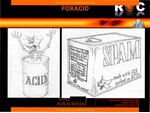
FOXACID is the NSA's exploit server infrastructure designed to gain "initial access" to target computers by tricking them into visiting malicious websites through spam emails, man-in-the-middle attacks, or split-second packet injection techniques that redirect legitimate web traffic. The document reveals how the agency has evolved from low-success spam operations (less than 1% success rate) to sophisticated "QUANTUM" techniques that achieve up to 80% success rates by exploiting web browsers through services like Yahoo and Facebook, allowing the NSA to compromise any target whose web traffic passes through monitored network chokepoints—with the chilling assessment that "if we can get the target to visit us in some sort of web browser, we can probably own them."
Programs: FOXACID · WILLOWVIXEN · GENUINEDRAFT · SECONDDATE · QUANTUMTHEORY · TURMOIL · TURBINE · WEBSNIPER · QUANTUMINSERT · QUANTUMBISCUIT · QUANTUMDIRK · QUANTUM · VALIDATOR · OLYMPUS · MISTYVEAL · SSO · STRAIGHTBIZARRE · ISLANDTRANSPORT -
Intellipedia – Air Gapped Network Threats [pdf]
This document from an internal wiki for the U.S. intelligence community, surveys threats to so-called air-gapped systems, arguing that supply-chain compromises, physical implants (BIOS, KVMs, peripherals), infected removable media, and enabled wireless/emanations present realistic paths for adversaries to bridge isolated networks. It assesses likelihoods and attack vectors (including insider help and CDS/guard exploitation), highlights specific historic incidents (Agent.BTZ/MAKERSMARK), and recommends strict removable-media policies, TEMPEST countermeasures, and rigorous cross-domain guard protections to mitigate the risk.
People: Witte, Griff · Warren, Peter · Streeter, Michael · Watson, Paul · Louchard, Bjørn · Crawford, George · Rudge, David · Terrazas, Michael -
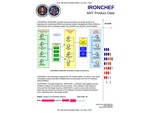
NSA ANT Catalog [pdf]
The NSA ANT catalog is a leaked confidential collection of sophisticated surveillance and hacking tools developed by the agency’s Tailored Access Operations unit (TAO), detailing hardware and software implants capable of covertly infiltrating computers, networks, and mobile devices. It revealed the NSA’s ability to conduct remote surveillance, implant malware, and maintain persistent access to targeted systems without users’ knowledge.
Programs: IRONCHEF · PROTOSS · STRONGMITE · GECKO II · STRAITBIZARRE · WAGONBED · UNITEDRAKE · DEITYBOUNCE · ARKSTREAM · TUNING FORK · GODSURGE · FLUXBABBITT · JETPLOW · BANANAGLEE · HALLUXWATER · TURBOPANDA · FEEDTROUGH · ZESTYLEAK · GOURMETTROUGH · SOUFFLETROUGH · HEADWATER · HAMMERMILL · HIT · SIERRAMONTANA · VALIDATOR · SCHOOLMONTANA · STUCCOMONTANA · CTX4000 · PHOTOANGLO · LOUDAUTO · ANGRYNEIGHBOR · NIGHTWATCHER · VIEWPLATE · LFS-2 · TAWDRYYARD · RAGEMASTER · CROSSBEAM · CHIMNEYPOOL · ROCKYKNOB · CANDYGRAM · CYCLONE Hx9 · TYPHON · EBSR · LANDSHARK · ENTOURAGE · HOLLOWPOINT · GALAXY · GENESIS · NEBULA · TYPHON HX · WATERWITCH · NIGHTSTAND · SPARROW II · BLINDDATE · DROPOUTJEEP · ARTEMIS · DROPMIRE · STRAITBIZZARE · FREEFLOW · TURBULENCE · GOPHERSET · MONKEYCALENDAR · TOTECHASER · TOTEGHOSTLY · PICASSO · TOTEGHOSTLY 2.0 · FRIEZERAMP · GENIE · VAGRANT · GOTHAM · SURLYSPAWN · GINSU · BULLDOZER · KONGUR · OMNIGAT · IRATEMONK · SERUM · SLICKERVICAR · RETURNSPRING · WISTFULTOLL · JIMSQ · SEAGULLFARO · SWAP · SNEAKERNET · TWISTEDKILT · HOWLERMONKEY · SUTURESAILOR · YELLOWPIN · CONJECTURE · SPECULATION · JUNIORMINT · MAESTRO · MAESTRO-II · SOMBERKNAVE · OLYMPUS · TRINITY · COTTONMOUTH-I · COTTONMOUTH-II · TURBINE · COTTONMOUTH-III · FIREWALK · DANDERSPRITZ -
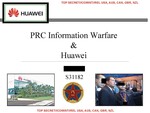
PRC Information Warfare & Huawei [pdf]
This NSA intelligence briefing on Huawei analyzes Huawei’s global telecommunications presence and its potential links to the People’s Liberation Army (PLA) and Chinese government intelligence activities. It highlights concerns that Huawei’s international market expansion — including its subcontracted 2008 upgrade of the TAT-14 transatlantic cable carrying U.S. and defense communications — could be exploited by China for signals intelligence (SIGINT) purposes.
People: Chávez, Hugo -
PROJECT BULLRUN Classification Guide [pdf]
This BULLRUN classification guide outlines the NSA’s highly secretive methods for undermining and exploiting encryption technologies through a combination of cryptanalysis, industry collaboration, covert implants, and network exploitation. It specifies strict classification protocols for capabilities against protocols like TLS/SSL, VPNs, VoIP, and webmail, emphasizing secrecy around sources, methods, and industry partnerships that make commercial encryption systems deliberately vulnerable.
Programs: BULLRUN · APERIODIC · AMBULANT · AUNTIE · PAINTEDEAGLE · PAWLEYS · PITCHFORD · PENDLETON · PICARESQUE · PIEDMONT“Revealed: how US and UK spy agencies defeat internet privacy and security” - The Guardian ↗ (2013-09-05) · “N.S.A. Able to Foil Basic Safeguards of Privacy on Web” - The New York Times ↗ (2013-09-05) · “Revealed: The NSA's Secret Campaign to Crack, Undermine Internet Security” - ProPublica ↗ (2013-09-05) · Ball, James · Borger, Julian · Greenwald, Glenn · Perlroth, Nicole · Larson, Jeff · Shane, Scott -
Sentry Eagle Brief Sheet [pdf]
A classified NSA/JFCC-NW briefing document formally inducting cleared personnel into Sentry Eagle — the agency's most sensitive umbrella program protecting core secrets about its cyber operations — and enumerating, tier by tier, what the NSA conceals about its covert industry partnerships, encryption sabotage, network hacking, computer network defense, and human intelligence relationships.
Programs: SENTRYEAGLE · SPARECHANGE · WHIPGENIE · AUNTIE · AMBULANT · OPALESCE · REVELRY · REFRACTOR · SENTRYHAWK · SENTRYFALCON · SENTRYOSPREY · SENTRYRAVEN · SENTRYCONDOR · SENTRYOWL · BLUESASH · TAREX -
SIGINT Enabling Project [pdf]
A classified NSA budget document requesting $254.9 million for FY2013 for the SIGINT Enabling Project — a covert program that works with U.S. and foreign technology companies to deliberately insert backdoors and vulnerabilities into commercial encryption products, networking equipment, and communications systems to make them secretly exploitable for surveillance.
“Revealed: The NSA's Secret Campaign to Crack, Undermine Internet Security” - ProPublica ↗ (2013-09-05) · “N.S.A. Able to Foil Basic Safeguards of Privacy on Web” - The New York Times ↗ (2013-09-05) · “Revealed: how US and UK spy agencies defeat internet privacy and security” - The Guardian ↗ (2013-09-05) · Larson, Jeff · Perlroth, Nicole · Shane, Scott · Ball, James · Borger, Julian · Greenwald, Glenn -
SNIPs of SIGINT [pdf]
A monthly notes entry from June 2012 by an NSA analyst on exchange at DSD Australia, describing two CNA/CNE tool development projects — PITIEDFOOL, a Windows file system destruction suite that kills the MFT and volume shadow copies and was successfully tested inside FUZZYEBOLA, and PANT SPARTY, an OpenSSH daemon backdoor granting covert root access while suppressing log entries — alongside a briefing to the US Ambassador to Australia on CNA/CNE work and TAO collaboration.
-
Strawhorse: Attacking the MacOS and iOS Software Development Kit [pdf]
Abstract from the 2012 CIA Trusted Computing Base Jamboree, presented by Sandia National Laboratories, describing successful modification of Apple's Xcode 4.1 SDK to create a covert injection vector capable of embedding backdoors, exfiltrating developer private keys, forcing data transmission to intelligence listening posts, disabling ASLR in kernel extensions, and installing a keylogger via a modified OS X updater.
People: Thompson, Ken“The CIA Campaign to Steal Apple's Secrets” - The Intercept ↗ (2015-03-10) · Scahill, Jeremy · Begley, Josh -
Tailored Access Operations, FOXACID, QUANTUM [pdf]
These NSA presentation slides detail "QUANTUM," a sophisticated system that allows the agency to intercept internet traffic and inject malware onto target computers with up to 80% success rates, far exceeding traditional spam-based methods. The system works by monitoring internet traffic for specific identifiers (like Yahoo or Facebook cookies), then racing to inject malicious code before legitimate web servers can respond, thereby compromising targets' computers without their knowledge and establishing persistent backdoor access.
Programs: FOXACID · QUANTUM · QUANTUMTHEORY · QUANTUMBISCUIT · VALIDATOR · OLYMPUS · UNITEDRAKE · OLYMPUSFIRE · SSO · FORESTPLACE -
Writing XKS Fingerprints [pdf]
This internal NSA training manual serves as a technical guide for analysts using the X-KEYSCORE (XKS) system. It provides a comprehensive breakdown of how to write, name, and test "fingerprints"—the specific code signatures used to identify, tag, and categorize various types of internet traffic across the agency's global collection points. The manual transitions from basic naming conventions to advanced Boolean logic and context-sensitive scanning, illustrating how the NSA automates the discovery of high-value targets, such as those using specific encryption tools or those involved in weapons procurement.