Tag: HTTP 30 documents
Search documents matching “HTTP” →Free-text subjects the curators added. Unlike the other axes these are not necessarily from the documents' own vocabulary, so they are the loosest thing to browse by (and the most forgiving).
Graphs
By Banner
By Classification
Refine (combine with another filter, via search)
Sort: Title
Documents
-
Advanced HTTP Activity Analysis [pdf]
This NSA training document from 2009 teaches intelligence analysts how to analyze HTTP internet traffic and exploit it using the XKEYSCORE surveillance system to monitor and identify internet users globally.
“XKEYSCORE: NSA’s Google for the World’s Private Communications” - The Intercept ↗ (2015-07-01) · “No Place to Hide” - Metropolitan Books ↗ (2014-05-13) · Marquis-Boire, Morgan · Greenwald, Glenn · Lee, Micah -
Full Log vs HTTP [pdf]
This 2009 NSA training presentation explains the difference between using the "Full Log" and "HTTP Activity" queries in the XKEYSCORE surveillance system, showing analysts how to use both in tandem to gain a complete picture of a target's online activities, including identifying the use of anonymizing proxies.
-
HTTP Activity in XKEYSCORE [pdf]
This training presentation from March 2009 provides NSA and Five Eyes analysts with detailed instructions on exploiting HTTP web browsing activity collected by XKEYSCORE, explaining how to differentiate client-to-server requests (GET/POST) from server-to-client responses, extract metadata like search terms, URLs, cookies, language, and browser types, and use this data to discover new surveillance targets, track individuals' online behavior, and conduct "pattern of life" analysis.
-
Analyzing Mobile/Cellular DNI in XKEYSCORE, May 2009 [pdf]
The XKEYSCORE document explains how the agency analyzes mobile/cellular device internet usage by collecting and processing both converged DNI/DNR data within cellular networks and traditional internet traffic, using various tools and indicators to identify mobile users even when their device type isn't immediately evident. The document demonstrates how the system can track mobile internet activity across applications like Yahoo Mail and identifies devices through various technical "hints" including MSISDN codes, browser fingerprints, and user agent strings.
-
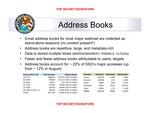
Bulk collection of webmail address books and emerging protocols [pdf]
TOP SECRET NSA document details the large-scale collection of email address books and contact lists from major webmail and social media providers, emphasizing their metadata value despite low attribution rates to known targets. It also highlights ongoing efforts to identify and analyze emerging communication protocols, such as those used by Hotmail Messenger.
-
BULLRUN [pdf]
A GCHQ TOP SECRET STRAP1 briefing presentation on BULLRUN — summarising the programme's purpose, the network security technologies it targets, the sensitivities surrounding cryptanalytic capabilities, and the access control framework protecting both technical details and the "fact of" capability — notable for explicitly naming three ECIs protecting the technical underpinnings: PICARESQUE, PAWLEYS and AMBULANT.
-
BULLRUN CoI - Briefing Sheet [pdf]
A GCHQ briefing sheet introducing the BULLRUN Community of Interest — the access control framework protecting Five Eyes capabilities to defeat encryption across TLS/SSL, HTTPS, SSH, VPNs, IPSec, encrypted chat and encrypted VoIP — covering the classification structure, handling procedures and protective marking guidance for intelligence derived from cryptanalytic exploitation.
“N.S.A. Able to Foil Basic Safeguards of Privacy on Web” - The New York Times ↗ (2013-09-05) · “Revealed: The NSA's Secret Campaign to Crack, Undermine Internet Security” - ProPublica ↗ (2013-09-05) · “Prying Eyes: Inside the NSA's War on Internet Security” - Der Spiegel ↗ (2014-12-28) · Perlroth, Nicole · Larson, Jeff · Shane, Scott · Appelbaum, Jacob · Gibson, Aaron · Grothoff, Christian · Müller-Maguhn, Andy · Poitras, Laura · Sontheimer, Michael · Stöcker, Christian -
CASCADE - Joint Cyber Sensor Architecture [pdf]
This presentation outlines the Communications Security Establishment’s (CSE) plans to unify and expand its cyber sensor networks (ITS and SIGINT) to create a comprehensive, multi-layered national cyber defense system, enabling threat detection, intelligence collection, and defensive operations across Canadian and foreign networks. It emphasizes standardizing sensor deployments, integrating analytic capabilities, and preparing for “Effects” operations to mitigate cyber threats by 2015. The presentation is duplicated from page 33 onwards - three slides of the duplicated slides have internal CSE comments.
Programs: CASCADE · PHOTONICPRISM · EONBLUE · INDUCTION · THIRDEYE · CRUCIBLE · CHOKEPOINT · SUNWHEEL · CASSIOPEIA · SCNET · JAZZFLUTE · GAZEBO · SEEDSPHERE · TEXPRO · SSO -
CNE Analysis in XKEYSCORE [pdf]
This document is an NSA training presentation from October 2009 demonstrating how XKEYSCORE integrates with Computer Network Exploitation (CNE) operations, allowing analysts to search and analyze data extracted from compromised computers including keystrokes, browser history, registry files, documents, emails, and directory structures collected through implants like UNITEDRAKE and OLYMPUS.
Programs: XKEYSCORE · OLYMPUS · UNITEDRAKE · PINWALE · TUNINGFORK · TURBOCHASER · MARINA · JOLLYROGER · TREASUREMAP · TURBINE · PRESSUREWAVE · MAD · TUCKER · EXPANDINGPULLY · UNIX · SEARCHLIGHT · KEYLOGGER · PILBEAM · FOXACID · WAYTIDE · SHADOWQUEST · SEAGULLFARO · DARKHELMET · LUTEUSICARUS · FOGGYBOTTOM · GREENCHAOS · RADIUS · NKB · VALIDATOR -
Crypt Discovery Joint Collaboration Activity 20 January 2011 [pdf]
A TOP SECRET NSA/GCHQ joint collaboration activity plan from January 2011 describing a research programme to understand and mitigate the threat that rising encryption adoption poses to target discovery and development — measuring encryption prevalence across SIGINT collection, assessing the impact on metadata-based targeting tradecraft, and developing new techniques for identifying targets behind encrypted traffic using a joint cloud environment fed by MUTANT BROTH, BEARDED PIGGY, KARMA POLICE, MEMORY HOLE, MARBLED GECKO, SOCIAL ANIMAL and ASDF metadata.
Marking: TOP SECRETPrograms: TICKETWINDOW · MUTANTBROTH · BEARDEDPIGGY · KARMAPOLICE · MEMORYHOLE · MARBLEDGECKO · SOCIALANIMAL · XKEYSCORE · ASDF“Prying Eyes: Inside the NSA's War on Internet Security” - Der Spiegel ↗ (2014-12-28) · “Profiled: From Radio to Porn, British Spies Track Web Users' Online Identities” - The Intercept ↗ (2015-09-25) · Appelbaum, Jacob · Gibson, Aaron · Grothoff, Christian · Müller-Maguhn, Andy · Poitras, Laura · Sontheimer, Michael · Stöcker, Christian · Gallagher, Ryan -
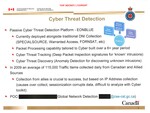
CSEC Cyber Threat Detection [pdf]
This document details the Communications Security Establishment’s (CSEC) cyber threat detection and intelligence infrastructure, including systems like EONBLUE, CROSSBOW, CRUCIBLE, and LODESTONE, which enable passive monitoring, anomaly detection, and botnet identification through metadata and deep packet inspection. It outlines how CSEC integrates SIGINT, cryptanalysis, and network forensics to detect and mitigate cyber intrusions using both SIGINT and domestic sensors, while collaborating with Five Eyes partners to enhance Canada’s cyber defense and situational awareness. The presentation is duplicated from page 7 onwards - one of the duplicated slide has internal CSE comments.
Programs: EONBLUE · SPECIALSOURCE · WARRANTEDACCESS · COVENANT · SEEDSPHERE · DIESELRATTLE · SIENNABLUE · DOWNGRADE · CROSSBOW · CRUCIBLE · LODESTONE -
CSEC ITS/N2E Cyber Threat Discovery [pdf]
A CSEC IT Security presentation to the DISCOCON 2010 conference, given with speakers' notes, on how the agency's cyber threat discovery team hunts for intrusions in the traffic it collects from Government of Canada networks. It describes the PonyExpress email processing system, which the notes record as handling 400,000 emails a day, the 8Ball attachment scanner and the Stripsearch binary analyser, and reports experiments in reducing the volume of metadata analysts see — including a machine learning model that discards 85% of email before deep scanning.
Marking: TOP SECRETPrograms: PONYEXPRESS · 8BALL · STRIPSEARCH · POPQUIZ · SLIPSTREAM · FINDMASK · SAWUNEH · TROPPUSNU · N2E · DISCOCON -
Event (SIGINT) [pdf]
5 p.This document explains that within GCHQ and NSA SIGINT operations, an “Event” refers to metadata about observable communications or user actions rather than message content, categorized into types like Communications, Presence, Social, and Geo-reference Events. These events are collected, stored in various databases, and analyzed through convergence and correlation processes, with standardized formats defined by Interface Control Documents such as INTERSTELLAR DUST (IDUST) and Actor Action (AA).
Programs: INTERSTELLAR DUST · HAUSTORIUM · SOCIAL ANTHROPOID · ACTOR-ACTION · SAMREF · GEOFUSION · HARD ASSOC · SALAMANCA · ASSOCIATION · BANYAN · MAINWAY · FASCIA · CULTWEAVE II · VOICESAIL · TEEDALE · PILBEAM · MUTANTBROTH · AUTOASSOC · MARBLEDGECKO · KARMAPOLICE · HRMAP · MEMORYHOLE · INFINITEMONKEYS · SOCIALANIMAL · AUTOTDI · SAMUELPEPYS · Mobile Applications Project · NGE · PPF · SLR -
Exploiting Facebook traffic in the passive environment to obtain specific information [pdf]
A GCHQ Global Telecommunications Exploitation presentation on extracting information about Facebook users from passively collected traffic: why online social networks are a rich source, how Facebook's use of the Akamai content delivery network exposes a user's ID inside image URLs, and how profile and album images are then obtained through SPRING BISHOP, GODFATHER and JTRIG.
-
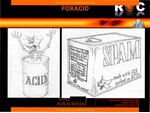
FOXACID Overall Briefing [pdf]
FOXACID is the NSA's exploit server infrastructure designed to gain "initial access" to target computers by tricking them into visiting malicious websites through spam emails, man-in-the-middle attacks, or split-second packet injection techniques that redirect legitimate web traffic. The document reveals how the agency has evolved from low-success spam operations (less than 1% success rate) to sophisticated "QUANTUM" techniques that achieve up to 80% success rates by exploiting web browsers through services like Yahoo and Facebook, allowing the NSA to compromise any target whose web traffic passes through monitored network chokepoints—with the chilling assessment that "if we can get the target to visit us in some sort of web browser, we can probably own them."
Programs: FOXACID · WILLOWVIXEN · GENUINEDRAFT · SECONDDATE · QUANTUMTHEORY · TURMOIL · TURBINE · WEBSNIPER · QUANTUMINSERT · QUANTUMBISCUIT · QUANTUMDIRK · QUANTUM · VALIDATOR · OLYMPUS · MISTYVEAL · SSO · STRAIGHTBIZARRE · ISLANDTRANSPORT -
Free File Uploaders [pdf]
This 2009 NSA training presentation for the XKEYSCORE system details how analysts can monitor Free File Uploader (FFU) websites like Zshare and RapidShare, which are difficult to track due to a lack of strong selectors. The guide introduces the "Web File Transfer" plug-in, a specialized tool designed to extract key metadata like original filenames and download/delete links from FFU web traffic.
-
Guide to Using Contexts in XKS Fingerprints [pdf]
This technical guide explains how NSA analysts use "contexts" within XKEYSCORE fingerprints to create highly targeted surveillance queries by restricting searches to specific scopes (e.g., web searches, document bodies, geographic locations), enabling precision targeting such as finding "all people in Kabul performing web searches on Jihad" while avoiding the overwhelming noise of broader keyword searches.
-
Hackers are Humans too - Cyber leads to CI leads [pdf]
This document from Canada’s Communications Security Establishment (CSE) analyzes the Russian hacking team MAKERSMARK, highlighting how its operators misused technically sophisticated but poorly secured infrastructure, mixing personal and operational activity, which made them traceable despite their advanced tools. It details CSE’s methods for attributing cyber intrusions, monitoring malware-infected systems, and exploiting operational security lapses to gain intelligence on Russian cyber operations.
-
HIDDENSALAMANDER - Alerting and Characterization of Botnet Activity in TURMOIL [pdf]
This NSA briefing describes HIDDENSALAMANDER, a TURMOIL component that detects, tracks, and characterizes botnet command-and-control traffic on passive collection sensors worldwide, generating enriched metadata about bot herders, infected machines, attack commands, and malware families while providing low-latency defensive alerts when botnet activity involves high-value targets or protected networks. The system extends beyond traditional signature matching by decrypting Zeus RC4-encrypted traffic, extracting payload details like target IPs and DDoS commands, tracking C2 servers across multiple sessions, and categorizing botnet lifecycle stages (configuration, infection, reconnaissance, C&C communication, attack, exfiltration) to support both offensive attribution and defensive response.
Programs: HIDDENSALAMANDER · TURMOIL · CLOUDSHIELD · NETEZZA · TUTELAGE · GMPLACE · RONIN · CYBERCLOUD · MARINA · GHOSTMACHINE · QBOT · ASDF · MARIPOSA · XKEYSCORE · GOGADGET · TURQI · TRAFFICTHIEF · FALLOUT · POUNDSAND · BLUESMOKE · AEG · TURNABOUT · QUANTUMBOT -
Introduction to BADDECISION [pdf]
This presentation details the use of the NSA program BADDECISION, which is a computer network exploitation tool (CNE) that uses a frame injection technique to redirect the target client to a FOXACID server.