Tag: cell phones 25 documents
Search documents matching “cell phones” →Free-text subjects the curators added. Unlike the other axes these are not necessarily from the documents' own vocabulary, so they are the loosest thing to browse by (and the most forgiving).
Graphs
By Banner
By Classification
Refine (combine with another filter, via search)
Sort: Title
Documents
-
Brown Bag Session: Exploiting Video from Third-Generation Cell Phones SIDtoday [pdf]
A brown bag session on “how to best search, analyze and use camera cell phone video data” will be held.
People: Aldridge, DanThe Intercept ↗ (2018-08-15) -
3G: impact and update - SDF Nov 09 [pdf]
This 2009 top-secret presentation from Australia’s Defence Signals Directorate (DSD) detailing 3G mobile network rollouts in Southeast Asia and identifying Indonesian President Susilo Bambang Yudhoyono, his wife, and senior officials as surveillance targets. It includes handset information, call data records, intercepted call attempts, and outlines plans for continued interception of Indonesian leadership communications.
-
A New Source of SIGINT: Exploiting Video from 3G Phones SIDtoday [pdf]
An NSA research group is exploring a new signals intelligence source: cellphone videos. It has surfaced such videos by searching existing collections for email attachments with distinctive file extensions, as well as distinctive email addresses. Targets use such videos to transmit footage of future attack locations, to offer contraband for sale, and to discuss paperwork related to negotiations.
People: Aldridge, DanThe Intercept ↗ (2018-08-15) -
Collaboration Tool Is Used to Set Up Collection at Distant Site SIDtoday [pdf]
A Special Collection Service staffer at the US Embassy in Phnom Penh needed assistance with an SS7 cell phone signal but no one was available to travel to Cambodia. So an operator in Maryland used Microsoft NetMeeting to remotely access the staffer's desktop, and to map and tweak the signals.
The Intercept ↗ (2018-08-15) -
Converging Networks SIDtoday [pdf]
The widespread use of laptops, cellphones, web portals, and satellite phones presents a challenge to the NSA's exploitation technologies. It is working to find a solution.
Programs: OCTAVEThe Intercept ↗ (2016-12-07) -
Customers Can Help SID Obtain Targetable Phone Numbers SIDtoday [pdf]
US officials sometimes supply SID with their rolodexes. Although some of these numbers are public and others are not used to discuss sensitive information, they have lead the NSA to other useful numbers.
Marking: CONFIDENTIALPrograms: OCTAVEThe Intercept ↗ (2019-05-29) · “NSA monitored calls of 35 world leaders after US official handed over contacts” - The Guardian ↗ (2013-10-24) · Ball, James -
Digby geolocation [pdf]
The document reveals that RAF Digby was equipped with advanced profiling and analytics tools to enable (near) real-time co-location of GSM handsets, supporting intelligence operations across the Middle East and North Africa. It highlights the operational use of the RUM PUNCH algorithm on the DISTILLERY framework, which was jointly developed through an NSA–IBM–GCHQ partnership, allowing large-scale stream mining and independent analyst-led tracking operations. Enhancements at Digby extended beyond communications interception to include a new cyber mission, with capabilities to geo-locate emitters linked to IED arming and detonation under the FLAKJACKET mission, expanding the site’s role from surveillance to active battlefield support.
-
Event RARE weekly summaries [pdf]
This document outlines GCHQ's ongoing surveillance efforts in Libya, focusing on intercepting and analyzing communications from the Libyan regime, including military command and control via mobile satellite phones and other communication channels. It details the use of advanced SIGINT tools and close cooperation with the NSA, US, and Canadian intelligence agencies to monitor key military targets and opposition forces, supporting both tactical military operations and strategic intelligence objectives.
People: Gaddafi, Muammar -
Full-Spectrum Cyber Effects [pdf]
The leaked 2012 GCHQ JTRIG “Full-Spectrum Cyber Effects” presentation outlines the UK’s offensive cyber capabilities, detailing strategies to destroy, deny, degrade, disrupt, deceive, and influence targets across digital and physical domains. It describes a wide range of operations—from network attacks, spoofing, and psychological operations on social media to hotel surveillance (Royal Concierge), mobile tracking, and advanced vulnerability exploitation—demonstrating how GCHQ integrates cyber operations, intelligence, and information warfare on a global scale.
Programs: JTRIG · SALAMANCA · RADIUS · ROYAL CONCIERGE · BLACKHOLE · GUILTY SPARK · MIDDLESEX GREEN · PPF · HOTWIRE -
GCHQ - PCS Harvesting [pdf]
A TOP SECRET STRAP1 report details how GCHQ industrialized the theft of GSM subscriber authentication keys (Ki) by automating trawls of bulk “C2C” content to extract IMSI/Ki pairs from emails and FTP transfers between SIM personalisation centers and mobile operators. It shows the program scaling key harvesting across networks and countries, complementing computer network exploitation against core mobile infrastructure to suppress billing and lift authentication secrets.
-
GCHQ Covert Mobile Phones Policy [pdf]
A 2010 GCHQ policy lays out strict, granular rules for covert mobile phone use by traveling operatives, mandating geofenced device discipline around Cheltenham, non-attributable communications, and hard separations from personal devices to minimize traceability and exposure. It’s a clinical OPSEC playbook for the management plane of human mobility—battery pulls, charging only at the airport or destination, out‑of‑area routing—designed to reduce the digital exhaust that links officers to headquarters.
Marking: SECRETPrograms: TRYST -
GCHQ NAC review – July to September (2011) [pdf]
The GCHQ NAC review (Jul–Sep 2011) outlines the continued support by NAC following the successful OP SOCIALIST operation, focusing on mapping Belgacom’s internal network and identifying key internal GRX routers to establish man-in-the-middle (MitM) platforms targeting roaming mobile handsets.
“Operation Socialist: The Inside Story of How British Spies Hacked Belgium’s Largest Telco” - The Intercept ↗ (2014-12-13) · “Lees hier hoe de Britse geheime dienst GCHQ Belgacom aanviel” - NRC ↗ (2014-12-13) · “Britse geheime dienst bespioneerde jarenlang Belgacom-klanten” - De Standaard ↗ (2014-12-13) · Gallagher, Ryan · Modderkolk, Huib · Vanhecke, Nikolas · Eeckhaut, Mark -
Graph theory in the operational environment – GCHQ [pdf]
This document details GCHQ’s research on identifying “closed loops” of communication, where targets use a small set of phones to communicate exclusively among themselves, often with cheap, disposable handsets like the Nokia 1100. It explains the methodology for analyzing anonymized metadata, constructing contact graphs, and extracting non-giant, non-tree components to discover operationally relevant closed loops for intelligence and counterterrorism purposes.
Programs: VOICESAILPeople: Rumsfeld, Donald -
How the NSA Pinpoints a Mobile Device [pdf]
This document is an internal National Security Agency classification guide outlining the agency's abilities to intercept cellular communications.
Programs: ARCVIEW -
How to tell if a target is 'foreign' [pdf]
The document describes a human intelligence (HUMINT) report indicating that a specific intelligence target, identified by a Foreign Source ID, is located outside the U.S., including details such as email, telephone number, and mobile network type, with checks confirming no U.S. roaming over a 60-day period. It illustrates the use of HUMINT to corroborate foreign location data for surveillance purposes.
-
Location Cookies [pdf]
These slides contain excerpts from an April 2013 National Security Agency presentation detailing signal surveillance techniques and successes. They reveal that the NSA and its British counterpart, Government Communications Headquarters (GCHQ), use a Google-specific tracking cookie to pinpoint targets for hacking.
-
Mobile Theme Briefing (May 28, 2010) [pdf]
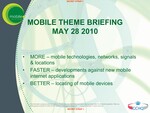
This 2010 GCHQ briefing document outlines the “Mobile Applications Project,” which aims to expand intelligence capabilities to exploit the growing shift from fixed to mobile internet usage. It details objectives for targeting mobile apps and roaming network traffic (GRX), enabling converged analysis of voice, text, command-and-control, and geolocation data across multiple mobile platforms such as iPhone, Symbian, Android, and Windows Mobile. See also: EFF_-_20140128-guard-leaky_phone_apps_0 (includes other slides from the same slideset)
Programs: Mobile Applications Project -
New SID Senior Manager for Wireless SIDtoday [pdf]
Teresa Shea has been appointed as Signals Intelligence Directorate Senior Manager for Wireless.
The Intercept ↗ (2017-09-13) -
NSA's Wireless Portfolio SIDtoday [pdf]
The author describes SID's comprehensive strategy to attack wireless technology -- personal communication devices like cell phones, satellite phones, trunk mobile radio, and Wi-Fi -- which were rapidly growing in popularity. By the end of 2002, the Wireless Portfolio Management Office was established, and they have since spent considerable resources and have made considerable progress.
The Intercept ↗ (2017-04-24) -
PHANTOM PARROT [pdf]
This document discusses PHANTOM PARROT, a GTAC tool used for querying mobile phone data collected from individuals stopped at UK ports as part of the ITT Op WILDWAY initiative. The tool allows intelligence analysts to access phonebook, SMS, and call log data from these stops, which can be used for counter-terrorism efforts. Data is obtained under the Terrorism Act 2000, and the tool is part of a broader intelligence-gathering effort, eventually to be integrated into the LUCKY STRIKE project.
Programs: PHANTOM PARROT · WILDWAY · RANNOCH MOOR · LUCKY STRIKE · LOOKING GLASS · DISHFIRE · CORINTH · MOONRAKER · RUSSETT