Converging Networks
Open PDFDocument date: 2004-01-13
Type: SIDtoday
Pages: 2
Genre: newsletter
Banner: DYNAMIC PAGE -- HIGHEST POSSIBLE CLASSIFICATION IS TOP SECRET // SI / TK // REL TO USA AUS CAN GBR NZL
Classification: TOP SECRET SI
Dissemination: -
The widespread use of laptops, cellphones, web portals, and satellite phones presents a challenge to the NSA's exploitation technologies. It is working to find a solution.
My notes
DYNAMIC PAGE -- HIGHEST POSSIBLE CLASSIFICATION IS
TOP SECRET // SI / TK // REL TO USA AUS CAN GBR NZL
SIDtoday
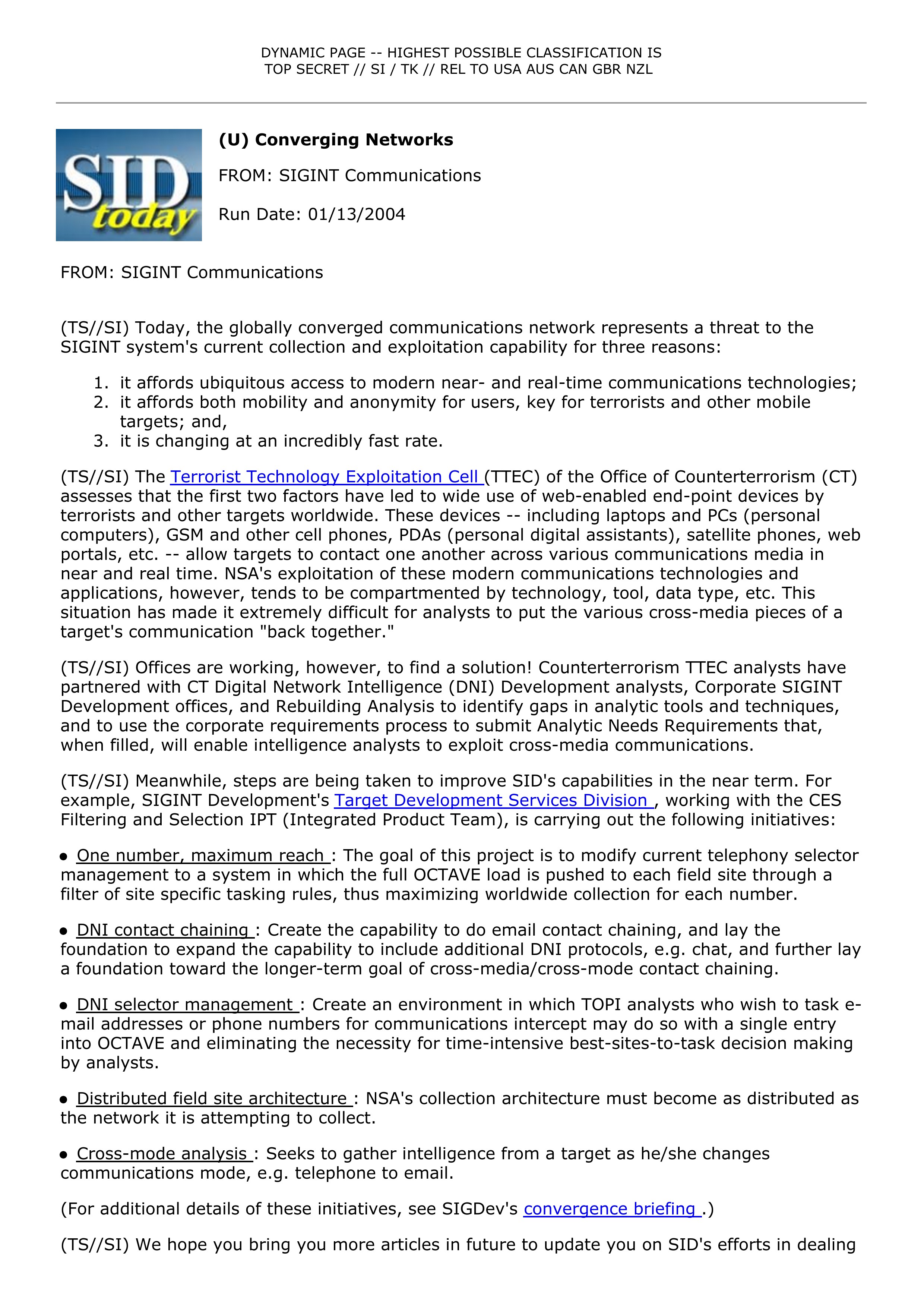
(U) Converging Networks
FROM: SIGINT Communications
Run Date: 01/13/2004
FROM: SIGINT Communications
(TS//SI) Today, the globally converged communications network represents a threat to the
SIGINT system's current collection and exploitation capability for three reasons:
- it affords ubiquitous access to modern near- and real-time communications technologies;
- it affords both mobility and anonymity for users, key for terrorists and other mobile
targets; and, - it is changing at an incredibly fast rate.
(TS//SI) The Terrorist Technology Exploitation Cell (TTEC) of the Office of Counterterrorism (CT)
assesses that the first two factors have led to wide use of web-enabled end-point devices by
terrorists and other targets worldwide. These devices -- including laptops and PCs (personal
computers), GSM and other cell phones, PDAs (personal digital assistants), satellite phones, web
portals, etc. -- allow targets to contact one another across various communications media in
near and real time. NSA's exploitation of these modern communications technologies and
applications, however, tends to be compartmented by technology, tool, data type, etc. This
situation has made it extremely difficult for analysts to put the various cross-media pieces of a
target's communication "back together."
(TS//SI) Offices are working, however, to find a solution! Counterterrorism TTEC analysts have
partnered with CT Digital Network Intelligence (DNI) Development analysts, Corporate SIGINT
Development offices, and Rebuilding Analysis to identify gaps in analytic tools and techniques,
and to use the corporate requirements process to submit Analytic Needs Requirements that,
when filled, will enable intelligence analysts to exploit cross-media communications.
(TS//SI) Meanwhile, steps are being taken to improve SID's capabilities in the near term. For
example, SIGINT Development's Target Development Services Division , working with the CES
Filtering and Selection IPT (Integrated Product Team), is carrying out the following initiatives:
- One number, maximum reach : The goal of this project is to modify current telephony selector management to a system in which the full OCTAVE load is pushed to each field site through a filter of site specific tasking rules, thus maximizing worldwide collection for each number.
- DNI contact chaining : Create the capability to do email contact chaining, and lay the foundation to expand the capability to include additional DNI protocols, e.g. chat, and further lay a foundation toward the longer-term goal of cross-media/cross-mode contact chaining.
- DNI selector management : Create an environment in which TOPI analysts who wish to task email addresses or phone numbers for communications intercept may do so with a single entry into OCTAVE and eliminating the necessity for time-intensive best-sites-to-task decision making by analysts.
- Distributed field site architecture : NSA's collection architecture must become as distributed as the network it is attempting to collect.
- Cross-mode analysis : Seeks to gather intelligence from a target as he/she changes communications mode, e.g. telephone to email.
(For additional details of these initiatives, see SIGDev's convergence briefing .)
(TS//SI) We hope you bring you more articles in future to update you on SID's efforts in dealing
with converging networks!
(U//FOUO) For further information on the above topic, please contact the following pocs:
TTEC (S2I34): [REDACTED] - [REDACTED] nsa, [REDACTED] (s)
Target Development Services (S2S3): [REDACTED] - [REDACTED] @nsa, [REDACTED] s)
"(U//FOUO) SIDtoday articles may not be republished or reposted outside NSANet
without the consent of S0121 (DL sid_comms)."
DYNAMIC PAGE -- HIGHEST POSSIBLE CLASSIFICATION IS
TOP SECRET // SI / TK // REL TO USA AUS CAN GBR NZL
DERIVED FROM: NSA/CSSM 1-52, DATED 08 JAN 2007 DECLASSIFY ON: 20320108
Related Documents
-
The TAC's Metadata Analysis Cell (MAC) SIDtoday [pdf]
Description of the Metadata Analysis Cell, starting with a success story about a counterterrorism analyst using tools MAC provided to discover six terrorism-related phone numbers. MAC specializes in contact chaining procedures.
The Intercept ↗ (2016-12-07) -
TAC's Target Development Services (TDS): In the Spotlight and Behind the Scenes SIDtoday [pdf]
A profile of Target Development Services, which offers training in "traffic analytic techniques and SIGINT exploitation of advanced communications technologies" and runs tools used by over 4,000 analysts for contact chaining and SMS analysis. The author includes a list of success stories.
People: Mohammed, Khalid SheikhThe Intercept ↗ (2016-12-07) -
Real-Time Regional Gateway Cloud Analytics for Forward Users [pdf]
This document outlines the NSA’s Real-Time Regional Gateway (RT-RG) program, a global cloud-based signals intelligence system designed to provide near real-time data analysis and targeting support for military and intelligence operations. It details the transition to scalable cloud architectures such as GHOSTMACHINE and Cloudbase, enabling massive data retention, exploitation, advanced geolocation, and automated analytics for tracking high-value targets across multiple theaters, including Afghanistan, Iraq, and the Horn of Africa.
Programs: RT-RG · GOLDMINER · GEOT · AGENTLOGIC · SHARKFINN · SKS · PANOPTICON · DRT · CIDNE · JUGGERNAUT · LOPERS · TALIS · MATTERHORN · AIRHANDLER · LYCANTHROPE · VOICESAIL · RETURNSPRING · SORTINGLEAD · GHOSTMACHINE · GMROYALE · GMREGAL · GMGEIST · GMIDEA · GMTOTE · GMPEN · GMPAC · GMCALM · GMMATE · GMAPPLE · GMCAVE · GMPEACH · GMDEN · GMMOUNT · GMALAMO · GMLIGHT · GMBALTIC · GMPLACE · GMPARK · GMHALO · GMCARBON · DRAGONFIRE · DOMEEXPOSE · GIANTSQUID · MAINWAY · FURIOUSCHAINSAW · SHARKFURY · NIAGARAFILES · SHARKQUERY · SHARKDOCS · OCTAVE · UTT · BEDDOWN · CHEEKYMONKEY · LAYERCAKE · CYBERTRANS · GMSEMINOLE · GMGULF · GMZILLA · HLT · JEMA · NEVIS · SEDB · CLOUDBASE · MAPREDUCE · CASPORT · WAVELEGAL“Mission Creep: How the NSA’s Game-Changing Targeting System Built for Iraq and Afghanistan Ended Up on the Mexico Border” - The Intercept ↗ (2019-05-29) · “Norges hemmelige krig i Afghanistan” - NRK ↗ (2019-05-29) · Moltke, Henrik · Skille, Øyvind Bye · Døvik, Olav · Hansen, Ståle Ellingsgard · Fjørtoft, Martin -
SSO dictionary relevant entries [pdf]
This document provides a detailed list of relevant entries related to NSA's Special Source Operations (SSO), highlighting various NSA surveillance and data collection systems used to monitor global communications. It includes descriptions of programs such as BIGBIRD and DISHFIRE, which focus on cable and SMS interception, as well as tools like LOPERS and COURIERSKILL for processing telephony metadata and refining target selection. The entries emphasize the extensive and automated nature of the NSA's intelligence-gathering operations, particularly in relation to undersea cables and telecommunication networks, and underscore the secretive and expansive scope of SSO's global surveillance activities.
Programs: ARTIFICE · BIGBIRD · FAIRVIEW · SSO · POORWILL · PINECONE · BLACKBELT · CADENCE · BLACKNIGHT · SHIPMASTER · COURIERSKILL · THEORYMASTER · WEALTHYCLUSTER · CLIFFSIDE · DISHFIRE · MARINA · MAINWAY · NUCLEON · PINWALE · FASCIA · BANYAN · LAMPSHADE · ASSOCIATION · HOMEBASE · SEDB · FRIAR · KEYCARD · TURMOIL · TURBULENCE · UTT · IRISHBEAUTY · OCTAVE · KOZYKOVE · LITHIUM · BLARNEY · LOPERS · MAILORDER · LUMBERYARD · MERLIN · NODDY · SAGUARO · NUTHATCH · CONTRAOCTAVE · XKEYSCORE · PLANK · RODEOSTAR · SAGURA · SERENADE · STARGATE · SILVERCOLLAM · SEALION · SEAGULL · SLIVER · SORA-2 · TITANPOINTE · TUBE · VPCS · STONEGATE“NSA Spying Relies on AT&T’s ‘Extreme Willingness to Help’” - ProPublica ↗ (2015-08-15) · “AT&T Helped U.S. Spy on Internet on a Vast Scale” - The New York Times ↗ (2015-08-15) · “The Wiretap Rooms: The NSA’s Hidden Spy Hubs in Eight U.S. Cities” - The Intercept ↗ (2018-06-25) · Angwin, Julia · Larson, Jeff · Savage, Charlie · Moltke, Henrik · Poitras, Laura · Risen, James · Gallagher, Ryan -
Brown Bag Presentation: Exploiting Converging Networks SIDtoday [pdf]
Announcement for a brown bag presentation about Exploiting Converging Networks, classified secret.
The Intercept ↗ (2017-04-24)