GCHQ Covert Mobile Phones Policy
Open PDFDocument date: 2010-06-28
Pages: 6
Genre: report
Banner: SECRET
Classification: SECRET
Dissemination: -
A 2010 GCHQ policy lays out strict, granular rules for covert mobile phone use by traveling operatives, mandating geofenced device discipline around Cheltenham, non-attributable communications, and hard separations from personal devices to minimize traceability and exposure. It’s a clinical OPSEC playbook for the management plane of human mobility—battery pulls, charging only at the airport or destination, out‑of‑area routing—designed to reduce the digital exhaust that links officers to headquarters.
My notes
SECRET
Ref: DOT/1636/5040/102
28 June 2010
GCHQ
OPA~TAS Covert
Mobile Phones Policy
Author: [REDACTED]
Issue 1.0
Page 1 of 6
SECRET
This information is exempt from disclosure under the Freedom of Information Act 2000 and may be subject to exemption under other UK information legislation. Refer disclosure requests to GCHQ on [REDACTED] (non-sec) or email [REDACTED]@gchq
SECRET
Ref: DOT/1636/5040/102
28 June 2010
Document History
| Issue 0.1 | First Draft – 15th April 2010 |
| Issue 0.2 | Comments by PASECGIAS – 26 April 2010 |
| Issue 0.3 | Revision – 29 April 2010 |
| Issue 1.0 | Final version – 28th June 2010 |
| Issue 1.1 | |
| Issue 1.2 | |
| Issue 2.0 |
Approved and signed on original by:
GCHQ Comsec Manager
[REDACTED] PISECGIAS
GCHQ Operations Manager
[REDACTED] - OPA-TAS Business Manager
Page 2 of 6
SECRET
This information is exempt from disclosure under the Freedom of Information Act 2000 and may be subject to exemption under other UK information legislation. Refer disclosure requests to GCHQ on [REDACTED] (non-sec) or email [REDACTED]@gchq
SECRET
Ref: DOT/1636/5040/102
28 June 2010
References
A. Mobile Telephone Security Policy – R/4993RL/1158/01 dated 17 August 2007.
B. Information Security Policy - Voice and Facsimile Communications Security: http://www.gchq/security/information_security_policy/ch17.shtml.
C. DOT/1637/5040/102 Statement of Security - OPA~TAS Management of Operational Mobile Phones dated 28th June 2010
Page 3 of 6
SECRET
This information is exempt from disclosure under the Freedom of Information Act 2000 and may be subject to exemption under other UK information legislation. Refer disclosure requests to GCHQ on [REDACTED] (non-sec) or email [REDACTED]@gchq
SECRET
Ref: DOT/1636/5040/102
28 June 2010
Contents
CONTENTS 4
- POLICY STATEMENT 5
1.1 INTRODUCTION 5 - OPERATING RULES 5
- PROCEDURES 6
- WELFARE 6
Page 4 of 6
SECRET
This information is exempt from disclosure under the Freedom of Information Act 2000 and may be subject to exemption under other UK information legislation. Refer disclosure requests to GCHQ on [REDACTED] (non-sec) or email [REDACTED]@gchq
SECRET
Ref: DOT/1636/5040/102
28 June 2010
- POLICY STATEMENT
1.1 Introduction
1.1.1 This policy defines the use of mobile phones by Tryst Travellers deployed overseas. It has been agreed between OPA-TAS and PISECGIAS and is to be read by all officers prior to deployment overseas.
1.1.2 It is OPA-TAS policy for officers to adopt best practice in the use of covert mobile phones when deployed overseas in order to ensure both their own personal security and GCHQ's operational security. This policy dictates the use of FCO provided non-attributable official and personal mobile phones by officers while on deployment.
- Operating Rules
1.1.3 Official mobile phones are accountable items and must be signed for when taken from the OPA-TAS secure store.
1.1.4 The mobile phones and the accessories must be returned to OPA-TAS on return to the UK. Failure to do so may preclude future travel.
1.1.5 Official phones are to be used only for official business in country and MUST not be used to make personal calls to the UK. If a call is unavoidable then only out of area numbers can be called, these are:
- GSOC TRYST OOA – 0207 [REDACTED]
- TAS TRYST OOA – 0207 [REDACTED]
1.1.6 To avoid compromise the following must be adhered to:
- The covert mobile phones are equipped with BLUETOOTH and therefore they MUST not be switched on or used within a 50-mile radius of Cheltenham and within this radius the battery must be removed from the phone.
- The covert mobile phone MUST NOT be recharged at the officer's home address or at temporary residence e.g. a hotel room, if it is within the 50 miles radius. If a phone needs to be charged then it is acceptable to do so either at the airport or at your destination.
Page 5 of 6
SECRET
This information is exempt from disclosure under the Freedom of Information Act 2000 and may be subject to exemption under other UK information legislation. Refer disclosure requests to GCHQ on [REDACTED] (non-sec) or email [REDACTED]@gchq
SECRET
Ref: DOT/1636/5040/102
28 June 2010
- All contact with GCHQ should be via the OUT OF AREA numbers listed above.
- Calls are not allowed between a covert mobile phone and a family or friends home or mobile phone registered to an address within 50 miles of Cheltenham
- If you are carrying a covert mobile phone, you MUST NOT carry any personal communications device e.g. mobile phone, ipad, notebooks, PDAs, laptops etc.
- Calls between covert mobiles are permissible provided both are more than 50 miles from Cheltenham.
- If you believe the phone to have been compromised, stop using it and report the incident to TAS staff as soon as possible i.e. on return to the UK.
- Procedures
1.1.7 The procedures for the storage and issue of the cover mobile phones are contained in Reference C.
- Welfare
1.1.8 It is recognised that officers who are departing from, or have recently arrived in the UK may wish to advise family or friends of disruption to their travel plans. In such cases the officer must use payphones that are available in the airport. If a phone is not available at the airport, then during office hours contact the OPA-TAS OOA number, who will pass on the message onto the family member.
Page 6 of 6
SECRET
This information is exempt from disclosure under the Freedom of Information Act 2000 and may be subject to exemption under other UK information legislation. Refer disclosure requests to GCHQ on [REDACTED] (non-sec) or email [REDACTED]@gchq
Related Documents
-
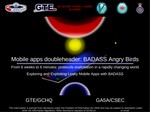
Mobile apps doubleheader: BADASS Angry Birds [pdf]
A joint GCHQ/GTE/CSEC presentation describing BADASS — the BEGAL Automated Deployment and Survey System for rapidly developing and deploying mobile app exploitation rules — illustrated through detailed analysis of Angry Birds' Dataflurry analytics traffic leaking IMEI, IMSI, cell network metadata and device identifiers, alongside AdMob, Mobclix and Mydas ad network traffic leaking UDIDs and IMEIs across iOS, Android, BlackBerry and Windows Phone 7 platforms.
Programs: BADASS · BEGAL · SEM · UNIQUELYCHALLENGED · BLACKHOLE · MOUNTAINVIEW · VOB · BABELFISH · BISHOP · MVR · PPF · AEG · DATAFLURRY -
PHANTOM PARROT [pdf]
This document discusses PHANTOM PARROT, a GTAC tool used for querying mobile phone data collected from individuals stopped at UK ports as part of the ITT Op WILDWAY initiative. The tool allows intelligence analysts to access phonebook, SMS, and call log data from these stops, which can be used for counter-terrorism efforts. Data is obtained under the Terrorism Act 2000, and the tool is part of a broader intelligence-gathering effort, eventually to be integrated into the LUCKY STRIKE project.
Programs: PHANTOM PARROT · WILDWAY · RANNOCH MOOR · LUCKY STRIKE · LOOKING GLASS · DISHFIRE · CORINTH · MOONRAKER · RUSSETT -
GCHQ - PCS Harvesting [pdf]
A TOP SECRET STRAP1 report details how GCHQ industrialized the theft of GSM subscriber authentication keys (Ki) by automating trawls of bulk “C2C” content to extract IMSI/Ki pairs from emails and FTP transfers between SIM personalisation centers and mobile operators. It shows the program scaling key harvesting across networks and countries, complementing computer network exploitation against core mobile infrastructure to suppress billing and lift authentication secrets.
-
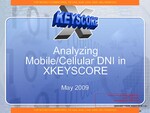
Analyzing Mobile/Cellular DNI in XKEYSCORE, May 2009 [pdf]
The XKEYSCORE document explains how the agency analyzes mobile/cellular device internet usage by collecting and processing both converged DNI/DNR data within cellular networks and traditional internet traffic, using various tools and indicators to identify mobile users even when their device type isn't immediately evident. The document demonstrates how the system can track mobile internet activity across applications like Yahoo Mail and identifies devices through various technical "hints" including MSISDN codes, browser fingerprints, and user agent strings.
-
Summary of DNR and DNI Co-Travel Analytics [pdf]
The document outlines the NSA’s development and testing of multiple “co-traveler” analytics—sophisticated tools that analyze bulk mobile location data to identify people who travel together or follow similar patterns, even if they are not known intelligence targets. It details various analytic systems, their data sources (such as FASCIA, VLR, GCID), architectures, scoring methods, and future enhancements, illustrating a large-scale surveillance framework for mapping human movement and relationships.
Programs: CO-TRAVELER · CHALKFUN · TMI · PACT · RT-RG · SORTINGLEAD · FASCIA · Hectic Snare · DRT · Juggernaut · GM-PLACE · Fast Follower · MGSC · ELKPRINTS · VOICESAIL · CULTWEAVE · OCTAVE · OCTSKYWARD · SEDB · JEMA · The Café · UTT · ASDF · GHOSTMACHINE · CLOUDBASE · FASTSCOPE · GOLDMINER · CHET · GEOT · TMAC · SPCMA · MAPREDUCE · ACCUMULO · GAMBIT · ICREACH