Tag: IP addresses 27 documents
Search documents matching “IP addresses” →Free-text subjects the curators added. Unlike the other axes these are not necessarily from the documents' own vocabulary, so they are the loosest thing to browse by (and the most forgiving).
Graphs
By Banner
By Classification
Refine (combine with another filter, via search)
Sort: Title
Documents
-
AURORAGOLD Working Group [pdf]
The "AURORAGOLD Working Group" briefing is a highly classified SIGINT development presentation from June 2012 that outlines the NSA's progress in mapping the global mobile landscape (GSM/UMTS/LTE). It focuses on the project's "value proposition": providing an exhaustive database of network identifiers and technical configurations—often obtained by intercepting internal company documents—to support tactical military operations and long-term surveillance forecasting.
Programs: AURORAGOLD · UTT · XKEYSCORE · CADENCE · JUBILEECORONA · RONIN · NKB · GLOBALTIPPER · PINWALE -
BLACK HOLE ANALYTICS, ADD/SD briefing, September 2009 [pdf]
This September 2009 GCHQ briefing describes the BLACK HOLE analytics infrastructure and Next Generation Events (NGE) project, which planned to scale from ~8 10-gigabit connections to ~200 10Gs by March 2011, storing intercepted data in massive flat-file repositories at Benhall and Bude before loading it into "Question Focused Dataset" (QFD) databases that power surveillance tools like MUTANT BROTH, KARMA POLICE, INFINITE MONKEYS, and others. The document outlines how "probes" extract Target Detection Identifiers (TDIs) from intercepted data feeds, store them in BLACK HOLE repositories, then enable analysts to profile targets' online activities, create social networks, investigate websites and forums, track web searches and Google Earth usage, and perform large-scale data mining across internet and telephony data.
Programs: BLACKHOLE · MUTANTBROTH · AUTOASSOC · INFINITEMONKEYS · KARMAPOLICE · SOCIALANIMAL · HRMAP · MEMORYHOLE · MARBLEDGECKO · HARDASSOC · SAMUELPEPYS · BLAZINGSADDLES · TELLURIAN · BUFFER · DISTILLERY · LOOKINGGLASS · NGEPeople: bin Laden, Osama -
Content-Metadata Matrix [pdf]
GCHQ's internal taxonomy sorts intercepted data into "content" or "metadata" to determine what can be searched without individual warrants—email subject lines, full URLs, and buddy lists fall on opposite sides of the line, enabling analysts to mine massive troves of IP addresses, phone numbers, location data, and browsing history with just a few keystrokes and a brief justification.
-
Cyber Defence Operations Legal Policy [pdf]
GCHQ's internal wiki laying out the legal plumbing for its Cyber Defence Operations (formerly NDIST)—detailing warrant types (RIPA, ISA, CNE), data retention schedules, targeting rules for UK/Five Eyes infrastructure, XKEYSCORE query protocols, and the bureaucratic hoops analysts must jump through to search attacker IPs, fingerprint UK networks, and share malware intelligence without tripping over location/nationality safeguards or commercial sensitivities.
Programs: JTRIG · SPAY · GORDIANKNOT · CHORDAL · DISCOVER · EVENTS · CASPORT · XKEYSCORE · CONTENT CLOUD · SQUEAL · MIRAGE · MUTANTBROTH · ANXIOUS · HALTERHITCH · BROADOAK · DONKEYKONG · ZOOL · PALANTIR · OVERLINK · RT · GATEKEEPER · IRONHAND · HARUSPEX · B3M · LOOKINGGLASS · GOLDENEYE · BLAZINGSADDLES · MOONRAKER · TRITON -
Demystifying NGE Rock Ridge [pdf]
This presentation outlines the ROCK RIDGE project, which delivers a suite of "Question Focused Databases" (QFDs) like MUTANT BROTH and KARMA POLICE to analyze massive internet event data. These specialized databases are designed to answer specific intelligence questions and are developed using the BLACK HOLE data repository, a key component of the ROUGH DIAMOND program.
Programs: ROCKRIDGE · ROUGHDIAMONG · BLACKHOLE · HAUSTORIUM · HRMAP · MUTANTBROTH · KARMAPOLICE · GOOBZS · INFINITEMONKEYS · AUTOASSOC · SOCIALANIMAL · MARBLEDGECKO · MEMORYHOLE · SAMUELPEPYS · SALAMANCA · MONOPOLY · RADIUS · HARBOURPILOT · LOOKINGGLASS · FIRESTORM · SUPERDRAKE · BLAZINGSADDLES · BLUESHIFT · SUPPORTINGINO · TERRAINS · GEOFUSION · NGEPeople: Lobban, Iain -
DNI101 [pdf]
This TOP SECRET training guide, "DNI 101," provides a workflow for Digital Network Intelligence analysts on how to investigate a target's email address, detailing the specific tools, databases, and methodology used, and stressing the critical difference between initial open-source/classified research and the active "targeting" of raw SIGINT repositories like XKEYSCORE, PINWALE, and MARINA.
Programs: NKB · FOXTRAIL · FOREMAN · PINWALE · LIONHEART · XKEYSCORE · DISHFIRE · MARINA · MECWEB · MAINWAY · TRAFFICTHIEF · MAUI · ANCHORY · M3 · INTELLINK · HOMEBASE · PROTON · UTT · CADENCE · SPEEDBUMP · TUNINGFORK · MASTERSHAKE · BLACKPEARL · JACKSPARROW · ROADBED · STORYDUTY · LIONROAR · DOPHONE · UIS -
Email Address vs User Activity [pdf]
This 2009 NSA training presentation explains how to use the XKEYSCORE system to search raw SIGINT, detailing the differences between the "Email Address" query, which finds email addresses in full content, and the more flexible "User Activity" query, which can search for selectors like cookies, usernames, and phone numbers.
“XKEYSCORE: NSA’s Google for the World’s Private Communications” - The Intercept ↗ (2015-07-01) · “No Place to Hide” - Metropolitan Books ↗ (2014-05-13) · Marquis-Boire, Morgan · Greenwald, Glenn · Lee, Micah -
Entry From SSODictionary v1.0 [pdf]
This document outlines a pending access point for MONKEYROCKET under the OAKSTAR program, focusing on full-take data collection from selected counter-terrorism (CT) targets using a non-Western anonymous browsing service. The collection will include user data, such as billing information and IP addresses, and support NSA's long-term strategy targeting terrorism and other criminal activities, with data gathered under Executive Order 12333. The system used for collection will be vPCS or XKS, and the operation is codenamed "THUNDERISLAND."
-
Full Log vs HTTP [pdf]
This 2009 NSA training presentation explains the difference between using the "Full Log" and "HTTP Activity" queries in the XKEYSCORE surveillance system, showing analysts how to use both in tandem to gain a complete picture of a target's online activities, including identifying the use of anonymizing proxies.
-
GCHQ Analytic Cloud Challenges [pdf]
The 2012 GCHQ Analytic Cloud document outlines a sophisticated data processing infrastructure handling approximately 50 billion daily events across multiple sites, utilizing QFD databases and HADOOP clusters for various analytic capabilities targeting intelligence gathering and analysis. It describes architectural components, challenges in scaling and enabling analysts to cope with data complexity, and proposes future technology options including consolidation approaches and new cloud architectures to enhance capabilities.
Programs: EVOLVEDMUTANTBROTH · MUTANTBROTH · HARDASSOC · HRMAP · KARMAPOLICE · SOCIALANTHROPOID · AUTOASSOC · GEOFUSION · MVR · TERRAIN · SALAMANCA · BLACKHOLE · SAMUELPEPYS · BROKER · VAIL · GUIDINGLIGHT · FIRSTCONTACT · CLOUDYCOBRA · RUMOURMILL · EVERYASSOC · EVERYPOLICE · EVERYCREATURE · EVERYEAD · EVERYCIPHER · GREYFOX · SILVERFOX · GOLDENAXE · TRIBALCARNEM · PUBLICANEMONE · EPICFAIL · STERLINGMOTH · FOGHORN · LOOKINGGLASS · FIREENGINE · NGGEO · ALPHACENTAURI · CLOUDBASE · ACCUMULO · ASEM · SEM · HAKIM · STREAMING · HBASE · LAUREL · SKINNYCLOUD · HARDY · GCHQCORE -
Guide to Using Contexts in XKS Fingerprints [pdf]
This technical guide explains how NSA analysts use "contexts" within XKEYSCORE fingerprints to create highly targeted surveillance queries by restricting searches to specific scopes (e.g., web searches, document bodies, geographic locations), enabling precision targeting such as finding "all people in Kabul performing web searches on Jihad" while avoiding the overwhelming noise of broader keyword searches.
-
HIDDENSALAMANDER - Alerting and Characterization of Botnet Activity in TURMOIL [pdf]
This NSA briefing describes HIDDENSALAMANDER, a TURMOIL component that detects, tracks, and characterizes botnet command-and-control traffic on passive collection sensors worldwide, generating enriched metadata about bot herders, infected machines, attack commands, and malware families while providing low-latency defensive alerts when botnet activity involves high-value targets or protected networks. The system extends beyond traditional signature matching by decrypting Zeus RC4-encrypted traffic, extracting payload details like target IPs and DDoS commands, tracking C2 servers across multiple sessions, and categorizing botnet lifecycle stages (configuration, infection, reconnaissance, C&C communication, attack, exfiltration) to support both offensive attribution and defensive response.
Programs: HIDDENSALAMANDER · TURMOIL · CLOUDSHIELD · NETEZZA · TUTELAGE · GMPLACE · RONIN · CYBERCLOUD · MARINA · GHOSTMACHINE · QBOT · ASDF · MARIPOSA · XKEYSCORE · GOGADGET · TURQI · TRAFFICTHIEF · FALLOUT · POUNDSAND · BLUESMOKE · AEG · TURNABOUT · QUANTUMBOT -
Intrusion Analysis – GCHQ [pdf]
An internal GCHQ write-up defines the Intrusion Analysis team’s remit inside the Joint Electronic Attack Cell: all‑source analysis of emerging and active electronic attacks, stewardship of electronic attack signatures, and SIGINT‑driven targeting under EITT oversight. It details sources, reporting channels, legal authorities, and auditing controls that govern how signatures are deployed and how selectors are managed.
-
Location Cookies [pdf]
These slides contain excerpts from an April 2013 National Security Agency presentation detailing signal surveillance techniques and successes. They reveal that the NSA and its British counterpart, Government Communications Headquarters (GCHQ), use a Google-specific tracking cookie to pinpoint targets for hacking.
-
NAC BUDE Partnership - SATELLITE TELEPORT KNOWLEDGE (GCHQ) [pdf]
A top secret GCHQ Network Analysis Centre document from GCHQ Bude detailing comprehensive intelligence profiles of three German satellite teleport operators — Stellar, Ce-Tel, and IABG — including their network infrastructure, router configurations, IP ranges, employee identities, satellite customers, and login credentials, compiled to identify access chokepoints for SIGINT collection against German IP transit infrastructure.
People: Steffen, Christian · Sommer, Christoph · Fares, Ali · Grave, Richard · Steffen, Simona · Skaletz, Oliver -
Network Shaping 101 [pdf]
An NSA top-secret training presentation that uses Yemen as a case study to explain how to "shape" a nation's Internet traffic by exploiting Autonomous Systems, upstream providers, BGP routing, and physical link topology to redirect or collect communications. The slide deck walks through practical router/IP/link details, passive SIGINT collection points and limitations, and warns that many assumptions are fabricated for the lesson and that real-world capabilities and link behavior can vary.
-
New FAA702 Certification in the Works - Cyber Threat [pdf]
A 23 March 2012 SSO article on a draft FAA 702 certification for cyber threats. It would let analysts task selectors tied to malicious cyber activity without attributing them to a foreign government or terrorist group, and would codify tasking of IP addresses and code strings through PRISM and the upstream accesses.
-
NSA's collection processing and dissemination of allied communications [pdf]
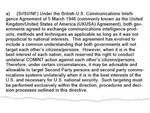
A secret 2007 deal between the US and UK allowed the NSA to collect, store, and analyze personal data of British citizens — including those not suspected of wrongdoing — marking a significant expansion of mass surveillance powers and breaking prior Five-Eyes agreements on mutual non-targeting.
-
PRISM tasking slide (PRISM briefing 2) [pdf]
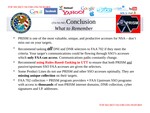
A PRISM slide headed 'Conclusion: What to Remember'. It says PRISM is among the most valuable NSA accesses, recommends tasking all DNI and DNR selectors to FAA 702 where they meet the criteria, and recommends Rules-Based Tasking in UTT so that PRISM and upstream SSO accesses both get the selectors.
-
Putting the 'Gap' in AIRGAP SIDtoday [pdf]
AIRGAP is the NSA's "non-attribution Internet access" program that allows users to do research on the open internet. In 2005, it was run by "one of the world's largest ISPs," and the system was shared by the whole U.S. intelligence community. Some users were concerned that all of this internet traffic comes from the same IP address, which could be used to attribute internet traffic to the NSA, however technically there were often multiple IP addresses. The NSA is working on building its own new version of AIRGAP, that it doesn't share with the rest of the intelligence community. "Despite rules and warnings to the contrary, all too frequently users will use AIRGAP for registering on web sites or for services, logging into other sites and services and even ordering personal items from on-line vendors. By doing so, these users reveal information about themselves and, potentially, other users on the network. So much for 'non-attribution.'"
Marking: CONFIDENTIALThe Intercept ↗ (2017-09-13)