NSA's collection processing and dissemination of allied communications
Open PDFDocument date: 2007-05-16
Pages: 4
Genre: newsletter
Classification: SECRET SI
Dissemination: NOFORN
A secret 2007 deal between the US and UK allowed the NSA to collect, store, and analyze personal data of British citizens — including those not suspected of wrongdoing — marking a significant expansion of mass surveillance powers and breaking prior Five-Eyes agreements on mutual non-targeting.
My notes
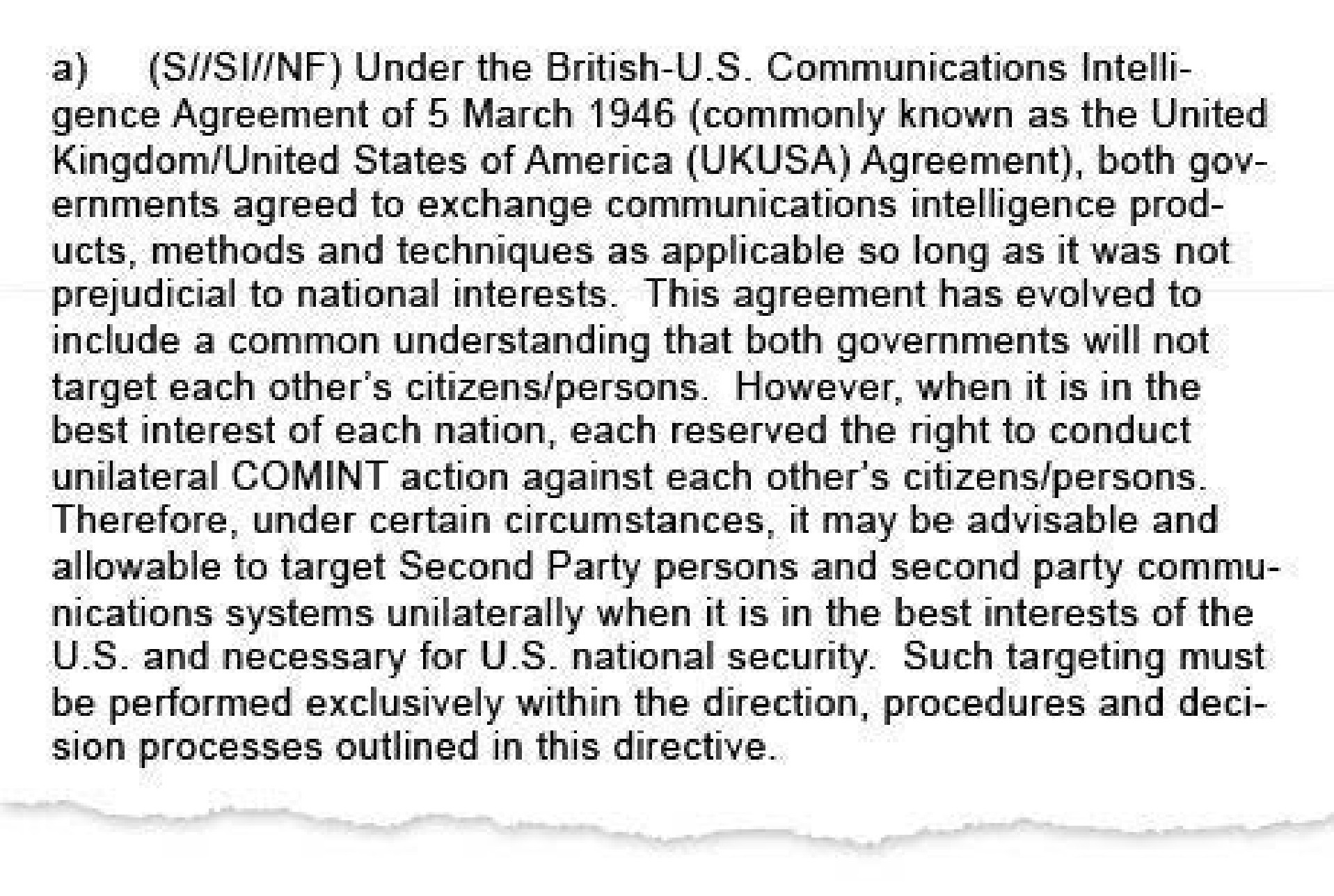
a) (S//SI//NF) Under the British-U.S. Communications Intelli-
gence Agreement of 5 March 1946 (commonly known as the United
Kingdom/United States of America (UKUSA) Agreement), both gov-
ernments agreed to exchange communications intelligence prod-
ucts, methods and techniques as applicable so long as it was not
prejudicial to national interests. This agreement has evolved to
include a common understanding that both governments will not
target each other's citizens/persons. However, when it is in the
best interest of each nation, each reserved the right to conduct
unilateral COMINT action against each other's citizens/persons.
Therefore, under certain circumstances, it may be advisable and
allowable to target Second Party persons and second party commu-
nications systems unilaterally when it is in the best interests of the
U.S. and necessary for U.S. national security. Such targeting must
be performed exclusively within the direction, procedures and deci-
sion processes outlined in this directive.
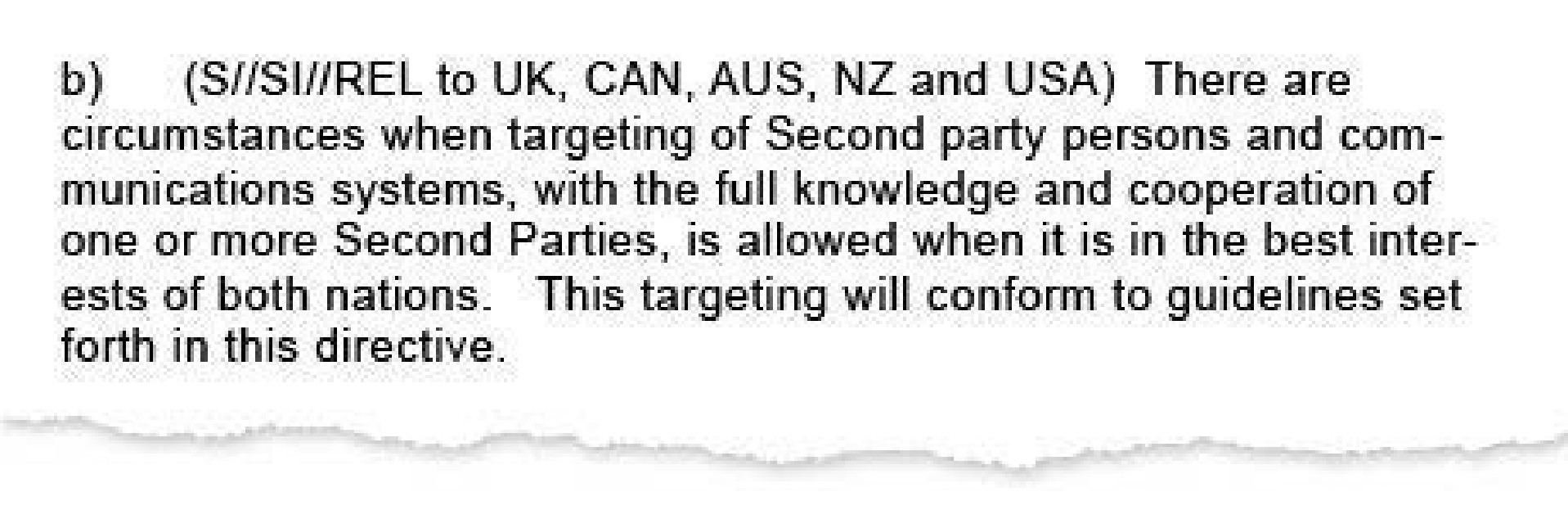
b) (S//SI//REL to UK, CAN, AUS, NZ and USA) There are
circumstances when targeting of Second party persons and com-
munications systems, with the full knowledge and cooperation of
one or more Second Parties, is allowed when it is in the best inter-
ests of both nations. This targeting will conform to guidelines set
forth in this directive.
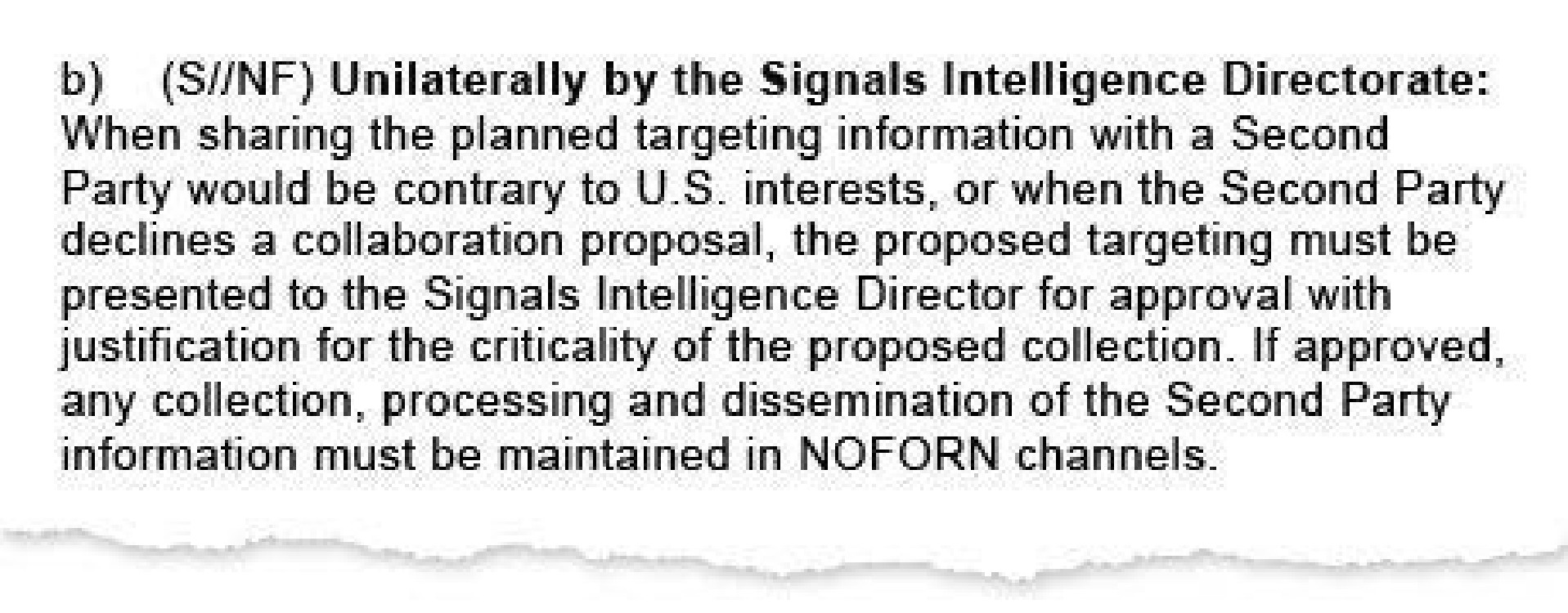
b) (S//NF) Unilaterally by the Signals Intelligence Directorate:
When sharing the planned targeting information with a Second
Party would be contrary to U.S. interests, or when the Second Party
declines a collaboration proposal, the proposed targeting must be
presented to the Signals Intelligence Director for approval with
justification for the criticality of the proposed collection. If approved,
any collection, processing and dissemination of the Second Party
information must be maintained in NOFORN channels.
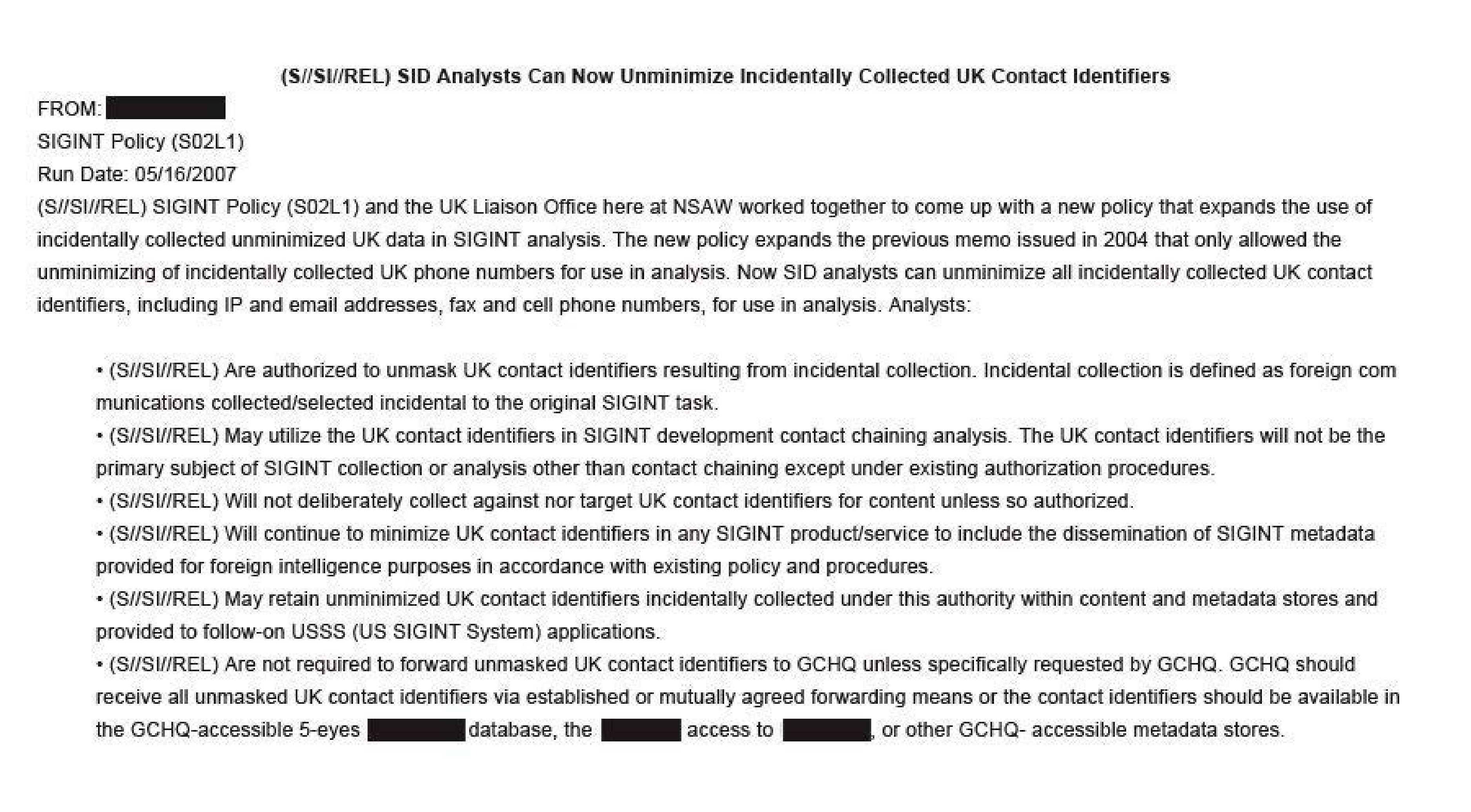
(S//SI//REL) SID Analysts Can Now Unminimize Incidentally Collected UK Contact Identifiers
FROM: [REDACTED]
SIGINT Policy (S02L1)
Run Date: 05/16/2007
(S//SI//REL) SIGINT Policy (S02L1) and the UK Liaison Office here at NSAW worked together to come up with a new policy that expands the use of
incidentally collected unminimized UK data in SIGINT analysis. The new policy expands the previous memo issued in 2004 that only allowed the
unminimizing of incidentally collected UK phone numbers for use in analysis. Now SID analysts can unminimize all incidentally collected UK contact
identifiers, including IP and email addresses, fax and cell phone numbers, for use in analysis. Analysts:
- (S//SI//REL) Are authorized to unmask UK contact identifiers resulting from incidental collection. Incidental collection is defined as foreign com
munications collected/selected incidental to the original SIGINT task. - (S//SI//REL) May utilize the UK contact identifiers in SIGINT development contact chaining analysis. The UK contact identifiers will not be the
primary subject of SIGINT collection or analysis other than contact chaining except under existing authorization procedures. - (S//SI//REL) Will not deliberately collect against nor target UK contact identifiers for content unless so authorized.
- (S//SI//REL) Will continue to minimize UK contact identifiers in any SIGINT product/service to include the dissemination of SIGINT metadata
provided for foreign intelligence purposes in accordance with existing policy and procedures. - (S//SI//REL) May retain unminimized UK contact identifiers incidentally collected under this authority within content and metadata stores and
provided to follow-on USSS (US SIGINT System) applications. - (S//SI//REL) Are not required to forward unmasked UK contact identifiers to GCHQ unless specifically requested by GCHQ. GCHQ should
receive all unmasked UK contact identifiers via established or mutually agreed forwarding means or the contact identifiers should be available in
the GCHQ-accessible 5-eyes [REDACTED] database, the [REDACTED] access to [REDACTED], or other GCHQ- accessible metadata stores.
Related Documents
-
Traffic Series: Is Your Collection Surveyed or Sustained? SIDtoday [pdf]
This NSA internal newsletter article explains how analysts can determine whether their collected signals intelligence traffic comes from sustained, ongoing collection (tasked through formal requirements) or temporary "survey" activities where satellite collection sites scan for new targets. The article teaches analysts how to read "case notations" (CASNs) to identify whether traffic spikes are from permanent collection or just temporary surveys—warning that valuable intelligence can suddenly disappear when survey activities end unless analysts formally request sustained collection through the SURREY system.
-
Bulk collection of webmail address books and emerging protocols [pdf]
TOP SECRET NSA document details the large-scale collection of email address books and contact lists from major webmail and social media providers, emphasizing their metadata value despite low attribution rates to known targets. It also highlights ongoing efforts to identify and analyze emerging communication protocols, such as those used by Hotmail Messenger.
-
Entry From SSODictionary v1.0 [pdf]
This document outlines a pending access point for MONKEYROCKET under the OAKSTAR program, focusing on full-take data collection from selected counter-terrorism (CT) targets using a non-Western anonymous browsing service. The collection will include user data, such as billing information and IP addresses, and support NSA's long-term strategy targeting terrorism and other criminal activities, with data gathered under Executive Order 12333. The system used for collection will be vPCS or XKS, and the operation is codenamed "THUNDERISLAND."
-
Email Address vs User Activity [pdf]
This 2009 NSA training presentation explains how to use the XKEYSCORE system to search raw SIGINT, detailing the differences between the "Email Address" query, which finds email addresses in full content, and the more flexible "User Activity" query, which can search for selectors like cookies, usernames, and phone numbers.
“XKEYSCORE: NSA’s Google for the World’s Private Communications” - The Intercept ↗ (2015-07-01) · “No Place to Hide” - Metropolitan Books ↗ (2014-05-13) · Marquis-Boire, Morgan · Greenwald, Glenn · Lee, Micah -
BLACK HOLE ANALYTICS, ADD/SD briefing, September 2009 [pdf]
This September 2009 GCHQ briefing describes the BLACK HOLE analytics infrastructure and Next Generation Events (NGE) project, which planned to scale from ~8 10-gigabit connections to ~200 10Gs by March 2011, storing intercepted data in massive flat-file repositories at Benhall and Bude before loading it into "Question Focused Dataset" (QFD) databases that power surveillance tools like MUTANT BROTH, KARMA POLICE, INFINITE MONKEYS, and others. The document outlines how "probes" extract Target Detection Identifiers (TDIs) from intercepted data feeds, store them in BLACK HOLE repositories, then enable analysts to profile targets' online activities, create social networks, investigate websites and forums, track web searches and Google Earth usage, and perform large-scale data mining across internet and telephony data.
Programs: BLACKHOLE · MUTANTBROTH · AUTOASSOC · INFINITEMONKEYS · KARMAPOLICE · SOCIALANIMAL · HRMAP · MEMORYHOLE · MARBLEDGECKO · HARDASSOC · SAMUELPEPYS · BLAZINGSADDLES · TELLURIAN · BUFFER · DISTILLERY · LOOKINGGLASS · NGEPeople: bin Laden, Osama