Tag: Computer Network Attack 30 documents
Search documents matching “Computer Network Attack” →Free-text subjects the curators added. Unlike the other axes these are not necessarily from the documents' own vocabulary, so they are the loosest thing to browse by (and the most forgiving).
Graphs
By Banner
By Classification
Refine (combine with another filter, via search)
Sort: Title
Documents
-
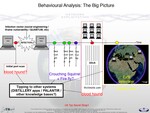
Behavioural Analysis: The Big Picture (Palantir could be used as part of a CNE) [pdf]
This diagram from GCHQ outlines the lifecycle of a CNE and identifies where Palantir fits into the intelligence workflow. The slide, titled "Behavioural Analysis: The Big Picture," illustrates a timeline of network exploitation from the initial infection of a target host to the eventual exfiltration of data. Crucially, it positions Palantir as a key "knowledge base" used for "Tipping to other systems." This indicates that Palantir’s software was used to aggregate data from successful hacks, allowing analysts to visualize connections and pivot (or "tip") that information toward further surveillance or offensive operations.
-
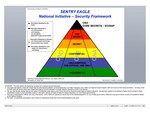
CNO Core Secrets Security Structure [pdf]
A 3-slide NSA presentation outlining the classification architecture of Sentry Eagle, a national cyber operations initiative, showing how its most sensitive components — covering network hacking, encryption sabotage, and covert industry relationships — are locked behind ECI and SAP designations accessible only to a tiny circle of government officials.
Programs: SENTRYEAGLE · SENTRYHAWK · SENTRYFALCON · SENTRYOSPREY · SENTRYRAVEN · SENTRYCONDOR · SENTRYOWL -
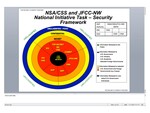
CNO Core Secrets Slide Slices [pdf]
This document outlines the Security Framework for a joint national initiative between the NSA/CSS and JFCC-NW, detailing the highly compartmented structure used to protect cyber and intelligence secrets. It utilizes a concentric security framework diagram to visualize the layers of sensitivity, placing the most critical technical capabilities at the absolute center of the intelligence community's protection.
Programs: SENTRY-EAGLE · SENTRYHAWK · SENTRYFALCON · SENTRYOSPREY · SENTRYRAVEN · SENTRYCONDOR · SENTRYOWL -
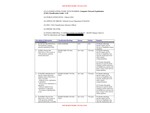
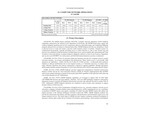
Computer Network Exploitation (CNE) Classification Guide / 2-59 [pdf]
A NSA/TAO classification guide establishing the precise classification level for 41 categories of information about computer network exploitation operations — covering remote and physical subversion methods, CNE tools and techniques, supply chain operations, hardware implants, off-net field operations, zero-day vulnerabilities, and cryptographic material acquired through CNE.
“Core Secrets: NSA Saboteurs in China and Germany” - The Intercept ↗ (2014-10-10) · “The Digital Arms Race: NSA Preps America for Future Battle” - Der Spiegel ↗ (2015-01-17) · Maass, Peter · Poitras, Laura · Appelbaum, Jacob · Gibson, Aaron · Guarnieri, Claudio · Müller-Maguhn, Andy · Rosenbach, Marcel · Ryge, Leif · Schmundt, Hilmar · Sontheimer, Michael -
Computer Network Exploitation Comes to NSA/CSS Georgia SIDtoday [pdf]
The Georgia Tailored Access Operations’s Remote Operations Center is officially opened — with a fiber-optic cable-cutting ceremony. The plan is to go from three operators doing computer network exploitation to a total of between 80 and 100 staffers, and to add computer network defense and attack capabilities.
The Intercept ↗ (2018-08-15) -
COMPUTER NETWORK OPERATIONS - GENIE [pdf]
A TOP SECRET Congressional Budget Justification entry for the NSA/CSS GENIE project — the Tailored Access Operations programme underpinning all endpoint Computer Network Operations — requesting $651.7 million and 1,870 military and civilian positions for FY2013, with plans to maintain 85,000-96,000 implant points-of-presence worldwide and 9,000-10,000 active accesses, including $25.1 million for covert purchase of software vulnerabilities and a $3.4 million supply chain implant operation targeting al-Qaeda.
-
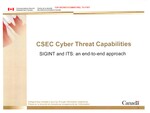
CSEC Cyber Threat Capabilities [pdf]
This document details CSEC’s full-spectrum cyber operations architecture, integrating SIGINT and IT Security to conduct both defensive and offensive activities under the guise of “information superiority.” While early sections emphasize detection, anomaly analysis, and collaboration with Five Eyes partners, later portions reveal active measures including network infiltration (implant deployment), command-and-control tracking, traffic manipulation and redirection, DNS interference, and potential disruption or deception operations—illustrating CSEC’s capacity not only to defend Canadian networks but also to surveil, exploit, and influence foreign and domestic digital infrastructure.
Programs: EONBLUE · CYBERDMZ · SEEDSPHERE · PHOTONICPRISM · SPECIALSOURCE · SUPERDRAKE · DARKSPACE · QUANTUM · MANDATE · STREAMING SENTRY · SSO · TKB · COVENANT -
Farewell, but Forever in the Fight! SIDtoday [pdf]
NSA chief of the National Tactical Integration Office retires after almost 40 years in SIGINT.
People: Flynn, ThomasThe Intercept ↗ (2016-08-10) -
Full-Spectrum Cyber Effects [pdf]
The leaked 2012 GCHQ JTRIG “Full-Spectrum Cyber Effects” presentation outlines the UK’s offensive cyber capabilities, detailing strategies to destroy, deny, degrade, disrupt, deceive, and influence targets across digital and physical domains. It describes a wide range of operations—from network attacks, spoofing, and psychological operations on social media to hotel surveillance (Royal Concierge), mobile tracking, and advanced vulnerability exploitation—demonstrating how GCHQ integrates cyber operations, intelligence, and information warfare on a global scale.
Programs: JTRIG · SALAMANCA · RADIUS · ROYAL CONCIERGE · BLACKHOLE · GUILTY SPARK · MIDDLESEX GREEN · PPF · HOTWIRE -
Getting Close to the Adversary – Forward-based Defense with QFIRE (June 3, 2011) [pdf]
This document describes the QFIRE project which is designed to give the NSA a global, low-latency platform for “forward-based defense”, enabling real-time detection and manipulation of Internet traffic close to its source. By co-locating passive sensors (TURMOIL), decision logic (TURBINE), and injection capabilities, QFIRE can rapidly reset connections, redirect targets for exploitation, inject malicious payloads, and even seize control of botnets. It operates as part of the broader QUANTUMTHEORY architecture, leveraging both cooperative and non-cooperative infrastructure worldwide to enable CNE/CND/CNA effects with minimal delay.
Programs: QFIRE · QUANTUMTHEORY · TURBULENCE · TURMOIL · TURBINE · TUTELAGE · QUANTUM · QUANTUMSKY · QUANTUMINSERT · QUANTUMBOT · QUANTUMCOPPER · STRAIGHTBIZARRE · BLINDDATE · TUMULT · ISLANDTRANSPORT · SURPLUSHANGAR · MIDDLEMAN · SCSnet · WEALTHYCLUSTER · SSO -
HIMR Data Mining Research Problem Book [pdf]
This document is a research roadmap created by GCHQ for the Heilbronn Institute for Mathematical Research (HIMR). Its purpose is to guide long-term mathematical and data-mining research that could improve signals intelligence (SIGINT) capabilities. It outlines key research problems, datasets, and collaboration plans between intelligence agencies and academic researchers. The main goal is to develop new algorithms and mathematical tools to analyze extremely large communications datasets produced by modern surveillance systems.
Programs: CLOUD · DISTILLERY · DISCOVER · PRESTON · LECKWITH · TERRAIN · BROADOAK · NGE · FIVEALIVE · CHARTBREAKER · FIRSTCONTACT · GEOFUSION · RADONSHARPEN-B · PRIMETIME · HIDDENOTTER · BAKERSDOZEN · CLASP · SALTYOTTER · BIRCH · SOLIDINK · FLUIDINK · MAMBA · GRINNINGROACH · PIRATECAREBEAR · AUTOASSOC · CROUCHINGSQUIRREL · HRMAP · KACHINA · SQUEAL · QUESTA · METEORSHOWER · SUNSTORM · GOLDMINE · HAGERAWEL · WOODY · BUZZ · SILVERLIBRARY · SILVERLINING · VALHALLA · MOUNTMCKINLEY · SEPANG · BLACKHOLE · SALAMANCA · HAGELAWEL · LUCKYSTRIKE · SPIKYROCK · MYOFIBRIL · INJUNCTION · PSYCHICSALMON · RAGINGBULLFROG · ROBOTICFISH · TIMIDTOAD · AURA · CARBONCOPY · CASK · CHORDAL · CRAN · INSTINCT · MADFORGE · SWAMP · VOLSUNGA · WHITERAVEN · MVR · PPF · JTRIG · MAPREDUCE · MAILORDERPeople: Tukey, John -
Inquiring Minds ... What Does Governance Mean? SIDtoday [pdf]
Governance is management, according to the Signals Intelligence Communications team. A new framework from senior leadership has four governance tasks and 17 subordinate responsibilities. Task #4 is “support the development of Computer Network Attack (CNA) capabilities and operations.”
The Intercept ↗ (2018-03-01) -
Intellipedia – BIOS Threats [pdf]
This from an internal wiki for the U.S. intelligence community, titled “BIOS Threats” details the use of malicious BIOS implants as a means of achieving persistent system compromise for cyber espionage and attack purposes. It discusses the history, technical challenges, detection limitations, and global development of BIOS-based malware by both state and non-state actors, including U.S. and Chinese cyber units.
-
MORECOWBELL [pdf]
This document describes how NSA is covertly monitoring DNS resolutions and target websites in near real-time using covertly rented servers in Malaysia, Germany and Denmark.
-
National Intelligence Estimate 2009 Global Cyber Threat – Supply Chain Excerpts [pdf]
These Supply Chain Excerpts from the 2009 National Intelligence Estimate, assesses that the U.S. faces a growing cyber threat from state actors, particularly Russia and China, who have the capability and strategic intent to exploit or disrupt U.S. and allied information systems. It emphasizes vulnerabilities from supply chains, insider threats, and technology trends that favor offensive operations, while noting the difficulty of detecting and fully defending against these sophisticated cyber threats.
-
NATO Civilian Intelligence Council – Cyber Panel – US Talking Points [pdf]
This 2011 US intelligence assessment for NATO identifies cyber espionage as the principal threat to Alliance networks, ranking Russia and China as the most significant nation-state actors and advocating for a shift to a consequence-based defense model that prioritizes the protection of NATO's most critical data.
-
New Staff Supports Network Attack SIDtoday [pdf]
In the summer of 2004, DIRNSA got new responsibilities. In addition to computer network exploitation, which involved hacking networks and extracting information, NSA will be in charge of computer network attack, which are "operations to disrupt, deny, degrade, or destroy information resident in computers and computer networks, or the computers and networks themselves." Lt. Gen. Michael Hayden established the Network Attack Support Staff organization to support these responsibilities.
The Intercept ↗ (2017-04-24) -
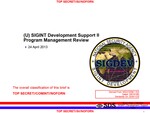
NSA Supply Chain Attack From PMR 4-24-13 [pdf]
This document is a top-secret NSA report detailing a SIGINT development operation in which a classified Voice-over-IP network shipment was intercepted and subjected to a supply-chain interdiction, allowing NSA and its intelligence community partners to gain access to the hardware and intelligence. It describes the operational process, including tracking the shipment through China, coordinating with Tailored Access Operations (TAO), and using tools like XKEYSCORE to identify targeting selectors, ultimately enabling detailed surveillance and future operational opportunities.
-
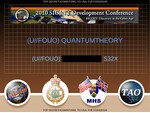
QUANTUMTHEORY (2010 SIGINT Development Conference) [pdf]
This 2010 NSA presentation reveals QUANTUMTHEORY, a suite of "man-on-the-side" network attack technologies that enable real-time injection and manipulation of TCP/IP connections through passive surveillance infrastructure. The system encompasses multiple specialized attack techniques including HTML redirection, DNS hijacking, botnet takeover, and database injection, deployed at Five Eyes surveillance sites worldwide.
Programs: QUANTUMTHEORY · TRAFFICTHIEF · TURMOIL · TURBINE · QUANTUM · NINJANIC · ISLANDTRANSPORT · SURPLUSHANGER · DAREDEVIL · STRAIGHTBIZARRE · QUANTUMINSERT · QUANTUMSKY · QUANTUMBOT · QUANTUMBISCUIT · QUANTUMDNS · QUANTUMBOT2 · QUANTUMCOPPER · QUANTUMMUSH · HUFFMUSH · QUANTUMSPIM · QUANTUMSQUEEL · QUANTUMSQUIRREL · INCENSOR · SMOKEYSINK · SARATOGA · QUANTUMDEFENSE · TURBULENCE“How the NSA Plans to Infect ‘Millions’ of Computers with Malware” - The Intercept ↗ (2014-03-12) · “The Digital Arms Race: NSA Preps America for Future Battle” - Der Spiegel ↗ (2015-01-17) · Gallagher, Ryan · Greenwald, Glenn · Appelbaum, Jacob · Gibson, Aaron · Guarnieri, Claudio · Müller-Maguhn, Andy · Poitras, Laura · Rosenbach, Marcel · Ryge, Leif · Schmundt, Hilmar · Sontheimer, Michael -
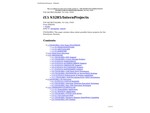
S3285/InternProjects [pdf]
A WikiInfo page from NSA's Persistence Division (S3285) listing intern project proposals covering firmware implants, BIOS-level persistence, hard drive exploitation and CNA capabilities — including IRATEMONK hard drive firmware implants across multiple vendors, POLITERAIN destructive attack tools, BERSERKR BIOS-resident backdoor, GOPHERRAGE hypervisor implant and CASTLECRASHER Windows payload execution.
Programs: POLITERAIN · PASSIONATEPOLKA · ARGYLEALIEN · BARNFIRE · IRATEMONK · SADDLEBACK · ALTEREDCARBON · FAKEDOUBT · PLUCKHAGEN · EASYKRAKEN · CASTLECRASHER · JUMPDOLLAR · MOPNGO · BERSERKR · GOPHERRAGE · WISTFULTOLL · CENTRICDUD · STYLISHCHAMP · SIERRAMIST · WICKEDVICAR · SPITEFULANGEL · ROGUESAMURAI · SIERRAMISTFREE · VALIDATOR · MOUSETRAP · BORGERKING · KIRKBOMB · SODAPRESSED · BENTWHISTLE · TWISTEDKILT · TORNSTEAK