Publisher: The Intercept 54 documents
Search documents matching “The Intercept” →Who published each document. Mostly a news outlet, but sometimes a book. A partner outlet that reported the story without publishing the documents keeps its byline and its article, but is not a publisher here.
Showing the documents The Intercept itself published in 2017 - all years.
Graphs
By Banner
By Classification
Refine (combine with another filter, via search)
Sort: Title
Documents
-
2009: A Watershed Year in the Fight Against Terrorism SIDtoday [pdf]
SIDtoday celebrated “a watershed period in the fight against terrorism and radical extremist groups,” noting that the NSA first discovered Najibullah Zazi’s email connections to Al-Qaeda operatives in Pakistan.
Programs: SCQAWKPeople: Zazi, Najibullah -
A Behind-the-Scenes Look at the NSA-Ethiopian Relationship SIDtoday [pdf]
This SIDtoday article details the NSA's growing collaboration with Ethiopian security agencies, particularly through the Operation Lion's Pride SIGINT program. It highlights a successful training session where Ethiopian soldiers and civilians learned traffic analysis, strengthening the relationship between the NSA, Ethiopian National Defense Forces (ENDF), and the Information Network Security Agency (INSA).
Programs: LIONSPRIDE -
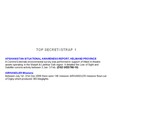
AIRHANDLER missions Feb 2010 [pdf]
A communications survey in Helmand Province (Jan–Feb 2010) mapped line-of-sight and satellite activity to support allied operations. Between July and December 2009, RAF Digby conducted 148 AIRHANDLER drone surveillance missions, generating 363 intelligence reports.
Programs: AIRHANDLER -
AZTECTOMB32 DMW Install and ESH Package [pdf]
This document is a top-secret NSA internal project log detailing restrictions on installing new implants on machines running Kaspersky 2010+ due to the software’s cloud functionality, which prevents safe deployment of NSA malware. It records the suspension and eventual closure of a project (AZTECTOMB32/DEMENTIAWHEEL) that would have targeted such systems.
-
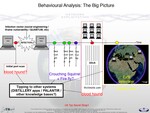
Behavioural Analysis: The Big Picture (Palantir could be used as part of a CNE) [pdf]
This diagram from GCHQ outlines the lifecycle of a CNE and identifies where Palantir fits into the intelligence workflow. The slide, titled "Behavioural Analysis: The Big Picture," illustrates a timeline of network exploitation from the initial infection of a target host to the eventual exfiltration of data. Crucially, it positions Palantir as a key "knowledge base" used for "Tipping to other systems." This indicates that Palantir’s software was used to aggregate data from successful hacks, allowing analysts to visualize connections and pivot (or "tip") that information toward further surveillance or offensive operations.
-
Classification Guide for FISA, the Protect America Act and the FISA Amendments Act [pdf]
The Foreign Intelligence Surveillance Act regulates spying for national security purposes on domestic soil. This guide lays out secrecy restrictions for various aspects of those programs. Among other things, it mentions the Large Content FISA order, a term that has not previously been disclosed.
-
Classification Guide Title/Number: Cuban Missile Crisis, 10-18 [pdf]
A 2008 NSA classification guide governing what may be disclosed about the agency's SIGINT activity during the Cuban Missile Crisis, showing that elements of 1960s collection against Cuba and the USSR were still controlled decades later.
-
Cryptologic shore support [pdf]
The document describes the Maritime Cryptologic Integration Centres (MCICs), which provide global SIGINT support to naval, air, and land units. Three MCICs operate within U.S. Fleet Information Operation Centres, while the fourth, uniquely joint U.K.–U.S. (RN/USN), is at RAF Digby in Lincolnshire, responsible for 24/7 cryptologic support to U.K. and allied missions across the North Atlantic, Barents, Baltic, and Black Seas, as well as North and Sub-Saharan Africa.
Marking: CONFIDENTIAL -
Digby geolocation [pdf]
The document reveals that RAF Digby was equipped with advanced profiling and analytics tools to enable (near) real-time co-location of GSM handsets, supporting intelligence operations across the Middle East and North Africa. It highlights the operational use of the RUM PUNCH algorithm on the DISTILLERY framework, which was jointly developed through an NSA–IBM–GCHQ partnership, allowing large-scale stream mining and independent analyst-led tracking operations. Enhancements at Digby extended beyond communications interception to include a new cyber mission, with capabilities to geo-locate emitters linked to IED arming and detonation under the FLAKJACKET mission, expanding the site’s role from surveillance to active battlefield support.
-
EP-3E Collision: Cryptologic Damage Assessment and Incident Review [pdf]
A joint US Navy and NSA report from July 2001, prepared three months after a US spy plane was forced to land in China, assessing how far surveillance sources and methods were compromised and reviewing the emergency destruction that failed to prevent it. Damage to tactical SIGINT against the PRC is rated medium and overall SIGINT damage low, with the greatest loss the LUNCHBOX PROFORMA processor and MARTES signals analysis tools; COMSEC damage is rated low because keying material was superseded within 15 hours.
Programs: LUNCHBOX · MARTES · NICKELBACK · SENSOR PACER · PROFORMA · HULTEC · STRUM · TEXTA · RASIN · CRITIC · KLIEGLIGHT · XBIT · BLACKMAGIC · NOIWON · ZIRCON · MIDB · EOB-LITE · NIMROD · ARIEL · COBRA BALL · COMBAT SENT · RIVET JOINT · SEABOOT · SETTEE · KAMPUS · DRUID · RORIPA · MARKHAM · FOREJUDGE · SAM HEARTBURN · NOVELETTE · RSBN · BEGGAR HAWK · BEGGAR SHADOW · CAPSULE JACK · DISTANT WIND · DISTANT SENT · CHILING · RIBBED · UNACCENTED · SLIPSTICK · SIERRA ONEPeople: Meals, Charlie -
Event RARE weekly summaries [pdf]
This document outlines GCHQ's ongoing surveillance efforts in Libya, focusing on intercepting and analyzing communications from the Libyan regime, including military command and control via mobile satellite phones and other communication channels. It details the use of advanced SIGINT tools and close cooperation with the NSA, US, and Canadian intelligence agencies to monitor key military targets and opposition forces, supporting both tactical military operations and strategic intelligence objectives.
People: Gaddafi, Muammar -
Excerpt from Hpc Overview 1011 [pdf]
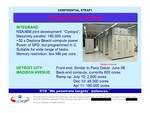
This document outlines the development of a highly advanced, massively parallel computing system, referred to as "Cyclops", a joint project between NSA and IBM. It is designed to perform complex tasks related to signals intelligence and code-breaking, with significant computing power, ramping up to 180,000 cores, and is referenced as a critical tool in penetrating target defenses.
-
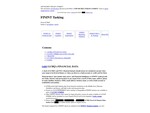
FININT Tasking [pdf]
This document outlines GCHQ's financial intelligence (FININT) operations, detailing the use of tools like LUCKY STRIKE and LUCKY ESCAPE to search and fuse datasets from financial and travel sources. It also describes procedures for requesting financial checks on individuals and mentions the collection of bulk banking and credit card data from specific regions.
Programs: TRACFIN · LUCKY STRIKE · LUCKY ESCAPE · TAPERLAY · TMM · MOON RAKER · BROADOAK · FININTTRACKER · FINTOOLS · FOLLOWTHEMONEY · PLATINUMPLUS · RUSSETT -
GCHQ VisWeek 2008 Conference Report [pdf]
This GCHQ document summarizes key findings from the VisWeek 2008 visualization conference in Ohio, highlighting techniques and tools relevant to SIGINT analysis including collaborative analysis capabilities, graph visualization methods, and the Palantir Government platform. The report recommends incorporating features like analyst notebooks for tracking investigations, collaborative workspaces for multiple analysts, and various graph layout algorithms into GCHQ's MONTE VISTA visualization system.
Programs: MONTE VISTA · MAMBA · CHARTBREAKER · PIGS EAR · KNIME · RAPTOR · BROAD OAK · HAUSTORIUM · SALAMANCA · IIB · INFOVIS · PALANTIR -
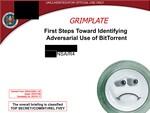
GRIMPLATE - First Steps Toward Identifying Adversarial Use of BitTorrent [pdf]
This document outlines the NSA's GRIMPLATE program, which was developed to monitor and analyze BitTorrent traffic on the Department of Defense's NIPRnet to identify potentially malicious activity. The program focuses on crawling the Distributed Hash Table (DHT) of BitTorrent networks to gather data on file-sharing nodes and peer connections, in order to detect and mitigate threats while building a case for halting unauthorized P2P usage on secure networks.
-
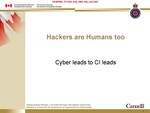
Hackers are Humans too - Cyber leads to CI leads [pdf]
This document from Canada’s Communications Security Establishment (CSE) analyzes the Russian hacking team MAKERSMARK, highlighting how its operators misused technically sophisticated but poorly secured infrastructure, mixing personal and operational activity, which made them traceable despite their advanced tools. It details CSE’s methods for attributing cyber intrusions, monitoring malware-infected systems, and exploiting operational security lapses to gain intelligence on Russian cyber operations.
-
Instability creates opportunity against counter-terrorism targets SIDtoday [pdf]
This document reveals how the NSA’s collaboration with Ethiopia during and after the 2006 Ethiopian invasion of Somalia was leveraged to advance U.S. counterterrorism objectives, using SIGINT tools and shared intelligence to track and eliminate al-Qaida targets across the Horn of Africa.
-
Japan official NSA visit, cyber briefing [pdf]
This document outlines cooperation between the NSA and Japan’s Directorate for SIGINT (DFS) to develop Japan’s capabilities for providing signals intelligence (SIGINT) support to cyber defense operations, particularly against Chinese cyber activities. It details meetings, training, and data-sharing efforts from 2012–2013 aimed at enhancing Japan’s cyber intelligence capacity under U.S. guidance.
“Japan Made Secret Deals With the NSA That Expanded Global Surveillance” - The Intercept ↗ (2017-04-24) · “アメリカに監視される日本 ~スノーデン“未公開ファイル”の衝撃” - NHK ↗ (2017-04-24) · Gallagher, Ryan · Ikegami, Akira -
Japan official NSA visit, HF briefing [pdf]
The document describes ongoing NSA efforts to renew high-frequency direction-finding (HFDF) collaboration with Japan’s Directorate for SIGINT (DFS) after Japan withdrew from the CROSSHAIR network in 2009. By 2012–2013, both sides were manually exchanging HFDF data, and the NSA sought to advance toward automated data sharing via its BORESIGHT system while reassuring Japan that it would not replace or override its existing technology.
“Japan Made Secret Deals With the NSA That Expanded Global Surveillance” - The Intercept ↗ (2017-04-24) · “アメリカに監視される日本 ~スノーデン“未公開ファイル”の衝撃” - NHK ↗ (2017-04-24) · Gallagher, Ryan · Ikegami, Akira -
Japan provided with XKEYSCORE [pdf]
This document outlines a request for approval to provide training to the Japanese Directorate for SIGINT (DFS) on using advanced SIGINT systems, including XKEYSCORE, to enhance Japan's cyber network defense capabilities. This training, scheduled for April 2013, aligns with U.S. strategic goals to bolster the cyber defense abilities of allied nations, highlighting ongoing NSA collaboration with Japan on surveillance and cybersecurity.
“Japan Made Secret Deals With the NSA That Expanded Global Surveillance” - The Intercept ↗ (2017-04-24) · “アメリカに監視される日本 ~スノーデン“未公開ファイル”の衝撃” - NHK ↗ (2017-04-24) · Gallagher, Ryan · Ikegami, Akira