Cryptologic shore support
Open PDFDocument date: -
Pages: 1
Genre: report
Banner: UK CONFIDENTIAL
Classification: CONFIDENTIAL
Dissemination: -
The document describes the Maritime Cryptologic Integration Centres (MCICs), which provide global SIGINT support to naval, air, and land units. Three MCICs operate within U.S. Fleet Information Operation Centres, while the fourth, uniquely joint U.K.–U.S. (RN/USN), is at RAF Digby in Lincolnshire, responsible for 24/7 cryptologic support to U.K. and allied missions across the North Atlantic, Barents, Baltic, and Black Seas, as well as North and Sub-Saharan Africa.
My notes
UK CONFIDENTIAL
SECTION THREE
CHAPTER FIFTEEN
RN CRYPTOLOGIC SHORE SUPPORT
INTRODUCTION
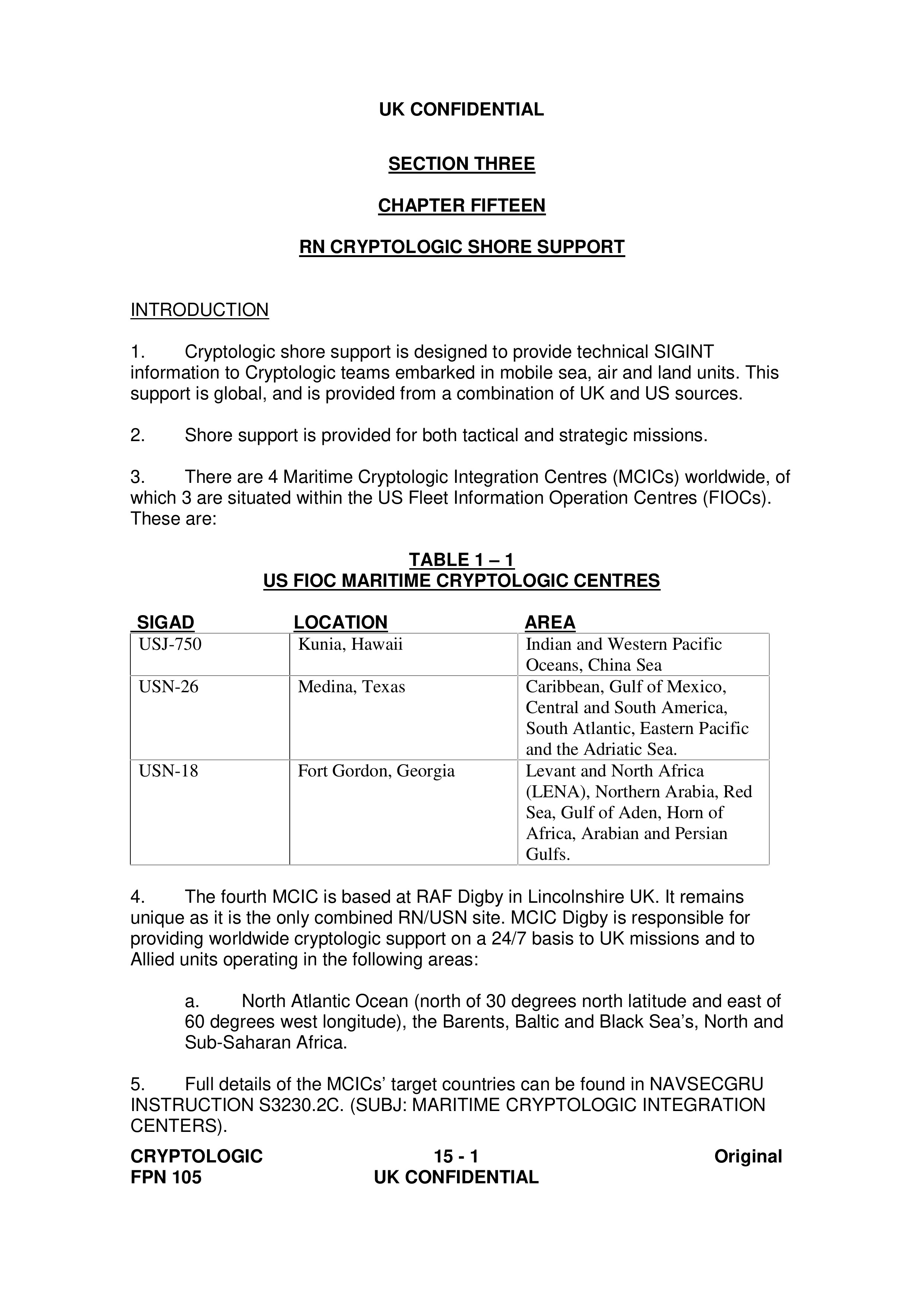
- Cryptologic shore support is designed to provide technical SIGINT information to Cryptologic teams embarked in mobile sea, air and land units. This support is global, and is provided from a combination of UK and US sources.
- Shore support is provided for both tactical and strategic missions.
- There are 4 Maritime Cryptologic Integration Centres (MCICs) worldwide, of which 3 are situated within the US Fleet Information Operation Centres (FIOCs). These are:
TABLE 1-1
US FIOC MARITIME CRYPTOLOGIC CENTRES
| SIGAD | LOCATION | AREA |
|---|---|---|
| USJ-750 | Kunia, Hawaii | Indian and Western Pacific Oceans, China Sea |
| USN-26 | Medina, Texas | Caribbean, Gulf of Mexico, Central and South America, South Atlantic, Eastern Pacific and the Adriatic Sea. |
| USN-18 | Fort Gordon, Georgia | Levant and North Africa (LENA), Northern Arabia, Red Sea, Gulf of Aden, Horn of Africa, Arabian and Persian Gulfs. |
- The fourth MCIC is based at RAF Digby in Lincolnshire UK. It remains unique as it is the only combined RN/USN site. MCIC Digby is responsible for providing worldwide cryptologic support on a 24/7 basis to UK missions and to Allied units operating in the following areas:
a. North Atlantic Ocean (north of 30 degrees north latitude and east of 60 degrees west longitude), the Barents, Baltic and Black Sea's, North and Sub-Saharan Africa.
- Full details of the MCICs' target countries can be found in NAVSECGRU INSTRUCTION S3230.2C. (SUBJ: MARITIME CRYPTOLOGIC INTEGRATION CENTERS).
CRYPTOLOGIC 15 - 1
FPN 105 UK CONFIDENTIAL Original
Published in the Same Report
(7 documents)
-
AIRHANDLER missions Feb 2010 [pdf]
A communications survey in Helmand Province (Jan–Feb 2010) mapped line-of-sight and satellite activity to support allied operations. Between July and December 2009, RAF Digby conducted 148 AIRHANDLER drone surveillance missions, generating 363 intelligence reports.
Programs: AIRHANDLER -
Digby geolocation [pdf]
The document reveals that RAF Digby was equipped with advanced profiling and analytics tools to enable (near) real-time co-location of GSM handsets, supporting intelligence operations across the Middle East and North Africa. It highlights the operational use of the RUM PUNCH algorithm on the DISTILLERY framework, which was jointly developed through an NSA–IBM–GCHQ partnership, allowing large-scale stream mining and independent analyst-led tracking operations. Enhancements at Digby extended beyond communications interception to include a new cyber mission, with capabilities to geo-locate emitters linked to IED arming and detonation under the FLAKJACKET mission, expanding the site’s role from surveillance to active battlefield support.
-
Event RARE weekly summaries [pdf]
This document outlines GCHQ's ongoing surveillance efforts in Libya, focusing on intercepting and analyzing communications from the Libyan regime, including military command and control via mobile satellite phones and other communication channels. It details the use of advanced SIGINT tools and close cooperation with the NSA, US, and Canadian intelligence agencies to monitor key military targets and opposition forces, supporting both tactical military operations and strategic intelligence objectives.
People: Gaddafi, Muammar -
NSA posture on Syria [pdf]
This document outlines the NSA’s intelligence assessment and operational posture regarding the Syrian civil war in 2013, emphasizing ongoing SIGINT cooperation with GCHQ to monitor both the Syrian government and its military and opposition forces. It highlights limited insight into communications, stronger access to opposition networks, and joint U.S.–U.K. efforts—particularly from GCHQ sites like Digby and Mt. Troodos—to track regional instability and chemical weapons security.
-
UKUSA at its Best: Producing the Best Possible SIGINT on Sudan SIDtoday [pdf]
This document reveals the close operational collaboration between NSA and GCHQ at sites including RAF Digby, detailing how American and British intelligence personnel worked jointly on signals intelligence (SIGINT) in regions such as Sudan, North Africa, and the Middle East, combining language training, quality control, and target monitoring to produce timely and accurate intelligence for high-level military and government customers. It highlights the strategic integration of UKUSA resources and personnel to optimize intelligence collection and analysis in conflict zones.
Programs: ZIRCON -
Virtual Teaming Pays Off SIDtoday [pdf]
This SIDtoday document describes the successful formation of a "virtual team" between NSA Georgia and the UK's Joint Service Signal Unit (JSSU) Digby to enhance surveillance and intelligence collection efforts against Lebanese and Palestinian security forces. This collaboration, initiated in July 2008, allowed for continuous real-time monitoring, with the team providing three reports to national-level policymakers and military commanders, demonstrating the efficiency and effectiveness of cross-national teamwork in intelligence operations.
-
UK AIRHANDLER trainees [pdf]
This GCHQ document from 2008 describes British AIRHANDLER trainees at NSA Georgia receiving recognition for their operational performance supporting drone surveillance missions, with personnel from UK's Joint Service Signal Unit Digby being trained to operate SIGINT collection packages on Predator unmanned aerial vehicles. The document reveals that Digby was being established as only the second site worldwide (after NSA Georgia) capable of handling the "back end" processing of Predator drone intelligence collection after the UK purchased three Predator drones.
Marking: SECRETPrograms: AIRHANDLER
Related Documents
-
UKUSA at its Best: Producing the Best Possible SIGINT on Sudan SIDtoday [pdf]
This document reveals the close operational collaboration between NSA and GCHQ at sites including RAF Digby, detailing how American and British intelligence personnel worked jointly on signals intelligence (SIGINT) in regions such as Sudan, North Africa, and the Middle East, combining language training, quality control, and target monitoring to produce timely and accurate intelligence for high-level military and government customers. It highlights the strategic integration of UKUSA resources and personnel to optimize intelligence collection and analysis in conflict zones.
Programs: ZIRCON -
Event RARE weekly summaries [pdf]
This document outlines GCHQ's ongoing surveillance efforts in Libya, focusing on intercepting and analyzing communications from the Libyan regime, including military command and control via mobile satellite phones and other communication channels. It details the use of advanced SIGINT tools and close cooperation with the NSA, US, and Canadian intelligence agencies to monitor key military targets and opposition forces, supporting both tactical military operations and strategic intelligence objectives.
People: Gaddafi, Muammar -
Ghosthunter and the geolocating of internet cafes [pdf]
This document announces an NSA “R Spotlight” webcast introducing GHOSTHUNTER, a multi-agency geolocation program designed to locate Time Division Multiple Access (TDMA) VSAT Internet access points, particularly internet cafés across the Middle East and North Africa in support of U.S. military operations. By mid-2009, GHOSTHUNTER had successfully geolocated over 5,000 VSAT terminals across Middle East demonstrating its operational effectiveness and integration with broader intelligence efforts.
Programs: GHOSTHUNTER -
Responsibility 3B: Implications of Technology & Geopolitical Trends [pdf]
This document outlines a classified NSA report on geopolitical trends from 2011 to 2016, highlighting key issues like global energy security, military modernization in China and Russia, cyber threats, and the rise of extremism. Notably, climate change is ranked 31st out of 34 priorities, reflecting its relatively low importance compared to issues.
-
GHOSTHUNTER Tasking Process [pdf]
The document outlines the GHOSTHUNTER (GH) tasking process at Menwith Hill Station, describing how geolocation requests for VSAT terminals and internet-connected targets are managed through coordination with the NSA’s Network Analysis Centre (NAC) and other sites. It details priority levels, task submission procedures, use of locational data from MASTERSHAKE, integration with imagery, and how results are shared with GCHQ and other authorized parties.