Genre: slides 272 documents
Search documents matching “slides” →What kind of document it is: slides, report, wiki, manual, guide, newsletter.
Graphs
By document date (10 years)
By Banner
By Classification
Refine (combine with another filter, via search)
Sort: Title
Documents
-
GCHQ Analytic Cloud Challenges [pdf]
The 2012 GCHQ Analytic Cloud document outlines a sophisticated data processing infrastructure handling approximately 50 billion daily events across multiple sites, utilizing QFD databases and HADOOP clusters for various analytic capabilities targeting intelligence gathering and analysis. It describes architectural components, challenges in scaling and enabling analysts to cope with data complexity, and proposes future technology options including consolidation approaches and new cloud architectures to enhance capabilities.
Programs: EVOLVEDMUTANTBROTH · MUTANTBROTH · HARDASSOC · HRMAP · KARMAPOLICE · SOCIALANTHROPOID · AUTOASSOC · GEOFUSION · MVR · TERRAIN · SALAMANCA · BLACKHOLE · SAMUELPEPYS · BROKER · VAIL · GUIDINGLIGHT · FIRSTCONTACT · CLOUDYCOBRA · RUMOURMILL · EVERYASSOC · EVERYPOLICE · EVERYCREATURE · EVERYEAD · EVERYCIPHER · GREYFOX · SILVERFOX · GOLDENAXE · TRIBALCARNEM · PUBLICANEMONE · EPICFAIL · STERLINGMOTH · FOGHORN · LOOKINGGLASS · FIREENGINE · NGGEO · ALPHACENTAURI · CLOUDBASE · ACCUMULO · ASEM · SEM · HAKIM · STREAMING · HBASE · LAUREL · SKINNYCLOUD · HARDY · GCHQCORE -
GCHQ Cyber Operations Against Anonymous and Hacktivist Groups [pdf]
The leaked 2012 GCHQ presentation reveals that the agency’s JTRIG unit conducted offensive cyber operations against Anonymous and other hacktivist groups, including DDOS attacks (codenamed “Rolling Thunder”), online infiltration, and covert intelligence collection to disrupt their communications and identify key members.
-
GCHQ – Computer Network Exploitation [pdf]
This document outlines GCHQ’s Computer Network Exploitation (CNE) capabilities, detailing how teams remotely access computers and networks without owners’ consent to gather intelligence, support operations, and conduct effects. It also covers operational tools, techniques, infrastructure, joint working with partners, deconfliction, and challenges such as avoiding detection and meeting increasing intelligence demands.
-
GCHQ – Making network sense of the encryption problem (2011) [pdf]
GCHQ’s Network Analysis Centre convened a 2011 roundtable on “making network sense” of encryption, pushing a metadata-first strategy to triage SSL/TLS, IKE, OpenVPN, and SSH flows, pivot from “seed” indicators, and zero in on targets and subnets worth decrypting. The playbook leans on enrichment, AS-level scoping (explicitly citing Belgacom AS6774 GRX VPNs), and “access optimisation” to collect data pre‑encryption—passively or actively.
Programs: SQUEAL · BEARDEDPIGGY · CLOUD · IRASCIBLEHARE · IRASCIBLERABBIT · IRASCIBLEMOOSE · IRASCIBLEEMITT“Operation Socialist: The Inside Story of How British Spies Hacked Belgium’s Largest Telco” - The Intercept ↗ (2014-12-13) · “Lees hier hoe de Britse geheime dienst GCHQ Belgacom aanviel” - NRC ↗ (2014-12-13) · “Britse geheime dienst bespioneerde jarenlang Belgacom-klanten” - De Standaard ↗ (2014-12-13) · Gallagher, Ryan · Modderkolk, Huib · Vanhecke, Nikolas · Eeckhaut, Mark -
GCSB Update - 21 March 2012 [pdf]
This GCSB briefing from March 2012 reviews key developments at the IRONSAND (Waihopai) base, including senior management changes, ongoing legal challenges, the crucial satellite target shift from IS-701 to IS-18 which altered the coverage beams, and the introduction of new technologies like SILVER PEAK WAN optimization and Huawei VoIP systems impacting South Pacific collection.
Programs: IRONSAND · SHAREDQUEST · SILVERPEAK · SPEARGUN · DARKQUEST · FALLOWHAUNT · KEYCARD · APPARITION · SHADOWCATPeople: Fletcher, Ian -
GCSB Update - 22 April 2010 [pdf]
This GCSB briefing from April 2010 provides an internal update on the operational status and development pathway for the Waihopai satellite surveillance station (codenamed IRONSAND). It reports near-perfect system availability statistics for numerous NSA/GCSB systems like LEGALREPTILE and JUGGERNAUT, details collaboration on virtualization and collection initiatives, and notes consequences arising from external court decisions.
Programs: IRONSAND · CALIX · COMMONGROUND · DUALTIRE · FLUTE · FRESNELEFFECT · JACKHAMMER · JUGGERNAUT · KILOMISER · KRAUSS · LATENTHEAT · LEGALREPTILE · LOPERS · MOONSCAPE · SEMITONE · SSA · STONEGATE · SURFBOARD · VENUSAFFECT · VINEYARD · VINTAGE · WEALTHYCLUSTER · VQUEST · TORUS · SHAREDQUEST -
Getting Close to the Adversary – Forward-based Defense with QFIRE (June 3, 2011) [pdf]
This document describes the QFIRE project which is designed to give the NSA a global, low-latency platform for “forward-based defense”, enabling real-time detection and manipulation of Internet traffic close to its source. By co-locating passive sensors (TURMOIL), decision logic (TURBINE), and injection capabilities, QFIRE can rapidly reset connections, redirect targets for exploitation, inject malicious payloads, and even seize control of botnets. It operates as part of the broader QUANTUMTHEORY architecture, leveraging both cooperative and non-cooperative infrastructure worldwide to enable CNE/CND/CNA effects with minimal delay.
Programs: QFIRE · QUANTUMTHEORY · TURBULENCE · TURMOIL · TURBINE · TUTELAGE · QUANTUM · QUANTUMSKY · QUANTUMINSERT · QUANTUMBOT · QUANTUMCOPPER · STRAIGHTBIZARRE · BLINDDATE · TUMULT · ISLANDTRANSPORT · SURPLUSHANGAR · MIDDLEMAN · SCSnet · WEALTHYCLUSTER · SSO -
GHOSTMACHINE: Identifier Lead Triage with ECHOBASE [pdf]
This June 2012 presentation introduces ECHOBASE, an NSA analytic architecture designed to automate the triage of massive identifier lead lists (ranging from 50 to 10,000+ entries). By applying behavior-based analytics and "yes/no" behavioral queries against raw SIGINT, the system allows analysts to prioritize high-interest targets and discard irrelevant leads at scale.
Programs: GHOSTMACHINE · ECHOBASE · IDENTIFIERSCOREBOARD · FOREMAN · CONTRAOCTAVE · OCTAVE · UTT · WAVELEGAL · CASPORT · PSC -
Graph theory in the operational environment – GCHQ [pdf]
This document details GCHQ’s research on identifying “closed loops” of communication, where targets use a small set of phones to communicate exclusively among themselves, often with cheap, disposable handsets like the Nokia 1100. It explains the methodology for analyzing anonymized metadata, constructing contact graphs, and extracting non-giant, non-tree components to discover operationally relevant closed loops for intelligence and counterterrorism purposes.
Programs: VOICESAILPeople: Rumsfeld, Donald -
GRIMPLATE - First Steps Toward Identifying Adversarial Use of BitTorrent [pdf]
This document outlines the NSA's GRIMPLATE program, which was developed to monitor and analyze BitTorrent traffic on the Department of Defense's NIPRnet to identify potentially malicious activity. The program focuses on crawling the Distributed Hash Table (DHT) of BitTorrent networks to gather data on file-sharing nodes and peer connections, in order to detect and mitigate threats while building a case for halting unauthorized P2P usage on secure networks.
-
Hackers are Humans too - Cyber leads to CI leads [pdf]
This document from Canada’s Communications Security Establishment (CSE) analyzes the Russian hacking team MAKERSMARK, highlighting how its operators misused technically sophisticated but poorly secured infrastructure, mixing personal and operational activity, which made them traceable despite their advanced tools. It details CSE’s methods for attributing cyber intrusions, monitoring malware-infected systems, and exploiting operational security lapses to gain intelligence on Russian cyber operations.
-
HIDDENSALAMANDER - Alerting and Characterization of Botnet Activity in TURMOIL [pdf]
This NSA briefing describes HIDDENSALAMANDER, a TURMOIL component that detects, tracks, and characterizes botnet command-and-control traffic on passive collection sensors worldwide, generating enriched metadata about bot herders, infected machines, attack commands, and malware families while providing low-latency defensive alerts when botnet activity involves high-value targets or protected networks. The system extends beyond traditional signature matching by decrypting Zeus RC4-encrypted traffic, extracting payload details like target IPs and DDoS commands, tracking C2 servers across multiple sessions, and categorizing botnet lifecycle stages (configuration, infection, reconnaissance, C&C communication, attack, exfiltration) to support both offensive attribution and defensive response.
Programs: HIDDENSALAMANDER · TURMOIL · CLOUDSHIELD · NETEZZA · TUTELAGE · GMPLACE · RONIN · CYBERCLOUD · MARINA · GHOSTMACHINE · QBOT · ASDF · MARIPOSA · XKEYSCORE · GOGADGET · TURQI · TRAFFICTHIEF · FALLOUT · POUNDSAND · BLUESMOKE · AEG · TURNABOUT · QUANTUMBOT -
HOMING PIGEON [pdf]
Slides on a query-focused dataset that would correlate GSM handsets seen on two or more aircraft flights with their subscribers.
“US and Britain refine their ability to tap into airline passenger’s mobile phones while they are in the air” - Le Monde ↗ (2016-12-07) · “American and British Spy Agencies Targeted In-Flight Mobile Phone Use” - The Intercept ↗ (2016-12-07) · “No Place to Hide” - Metropolitan Books ↗ (2014-05-13) · Follorou, Jacques · Greenwald, Glenn -
How do we do SIGDEV or private networks? [pdf]
Top Secret SIGINT Development (SIGDEV) briefing explains how analysts conduct reconnaissance on private networks, noting that many targets rely on them and that 30–40% of traffic surveyed in BLACKPEARL has at least one private endpoint. It demonstrates the ROYALNET tool and its analytics for identifying network features, NetStrings, and links likely to carry a target’s traffic, with named targets and feature sets including Google’s infrastructure, the SWIFT banking network, the French Ministry of Foreign Affairs, Brazil’s Petrobras, and Huawei.
People: Higgins, Jean -
How the NSA Accesses Smartphone Data [pdf]
This document reveals how the NSA and its Five Eyes partners developed sophisticated methods to exploit iPhone location services and BlackBerry communications, framing smartphone users as “zombies” willingly sharing data. It includes examples of intercepted geolocation data and decrypted BlackBerry emails, illustrating targeted surveillance capabilities against both consumer and government communications.
-
HTTP Activity in XKEYSCORE [pdf]
This training presentation from March 2009 provides NSA and Five Eyes analysts with detailed instructions on exploiting HTTP web browsing activity collected by XKEYSCORE, explaining how to differentiate client-to-server requests (GET/POST) from server-to-client responses, extract metadata like search terms, URLs, cookies, language, and browser types, and use this data to discover new surveillance targets, track individuals' online behavior, and conduct "pattern of life" analysis.
-
HTTP Activity vs User Activity [pdf]
This NSA training document from June 2009 explains the distinction between HTTP Activity (general web browsing data) and User Activity (communications metadata from specific protocols like webmail and chat) within the XKEYSCORE surveillance system, demonstrating through Iranian examples how analysts combine both search types to develop comprehensive intelligence on targets.
Programs: XKEYSCORE · MARINA · FOXTRAIL · DECODEORDAIN · YACHTSHOP · BRUTUS · WINDCHASER · NKB · UIS · STARPROC -
Huawei - Social Network Analysis [pdf]
This document describes Social Network Analysis targeting top leadership at Huawei. By tracking the email selectors of CEO Ren Zhengfei and Chairwoman Sun Yafang, the agency mapped their professional and personal connections.
“NSA: Imperiale Visionen” - Der Spiegel ↗ (2014-03-23) · Rosenbach, Marcel · Stark, Holger · Zand, Bernhard -
I hunt sys admins [pdf]
These internal documents outline the NSA’s strategy for identifying and targeting foreign system administrators to gain "keys to the kingdom" access to global network infrastructure. By correlating disparate datasets—such as passive telnet/SSH metadata and personal social media/webmail logins—the agency identifies personal accounts to facilitate QUANTUM-based hacking operations and network "pwnage."
-
ICTR Cloud Efforts [pdf]
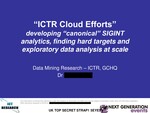
A GCHQ presentation details how the agency developed cloud-based big data analytics to achieve "population scale" surveillance—processing trillions of internet events to build geographic and behavioral profiles on every online identifier worldwide, enabling discovery of unknown targets through pattern analysis rather than traditional keyword searches.
Programs: EVERYASSOC · PROBABILITYCLOUD · SILVERLINING · CULTWEAVE · KARMAPOLICE · EVERYPOLICE · AWKWARDTURTLE · GORDIANKNOT · SANDIA · BLOODHOUND · FIVEALIVE · NGE · MAPREDUCE