AURORAGOLD Working Aid
Open PDFDocument date: 2012-05-17
Pages: 4
Genre: guide
Banner: SECRET//SI//REL TO FVEY
Classification: SECRET SI
Dissemination: REL TO FVEY
This document is a technical reference guide for analysts that categorizes the specific data fields extracted from mobile network documents (IR.21s) and commercial databases. It serves as a manual for translating telecommunications infrastructure data—such as encryption types, network layer protocols, and hardware versions—into actionable intelligence for target development and cyber exploitation.
My notes
SECRET//SI//REL TO FVEY
NATIONAL SECURITY AGENCY
SIGDEV
SIGINT DEVELOPMENT
TARGET TECHNOLOGY TRENDS CENTER
T3C
PREDICT PLAN PREVENT
AURORAGOLD
WORKING AID (UPDATED 17 MAY 2012)
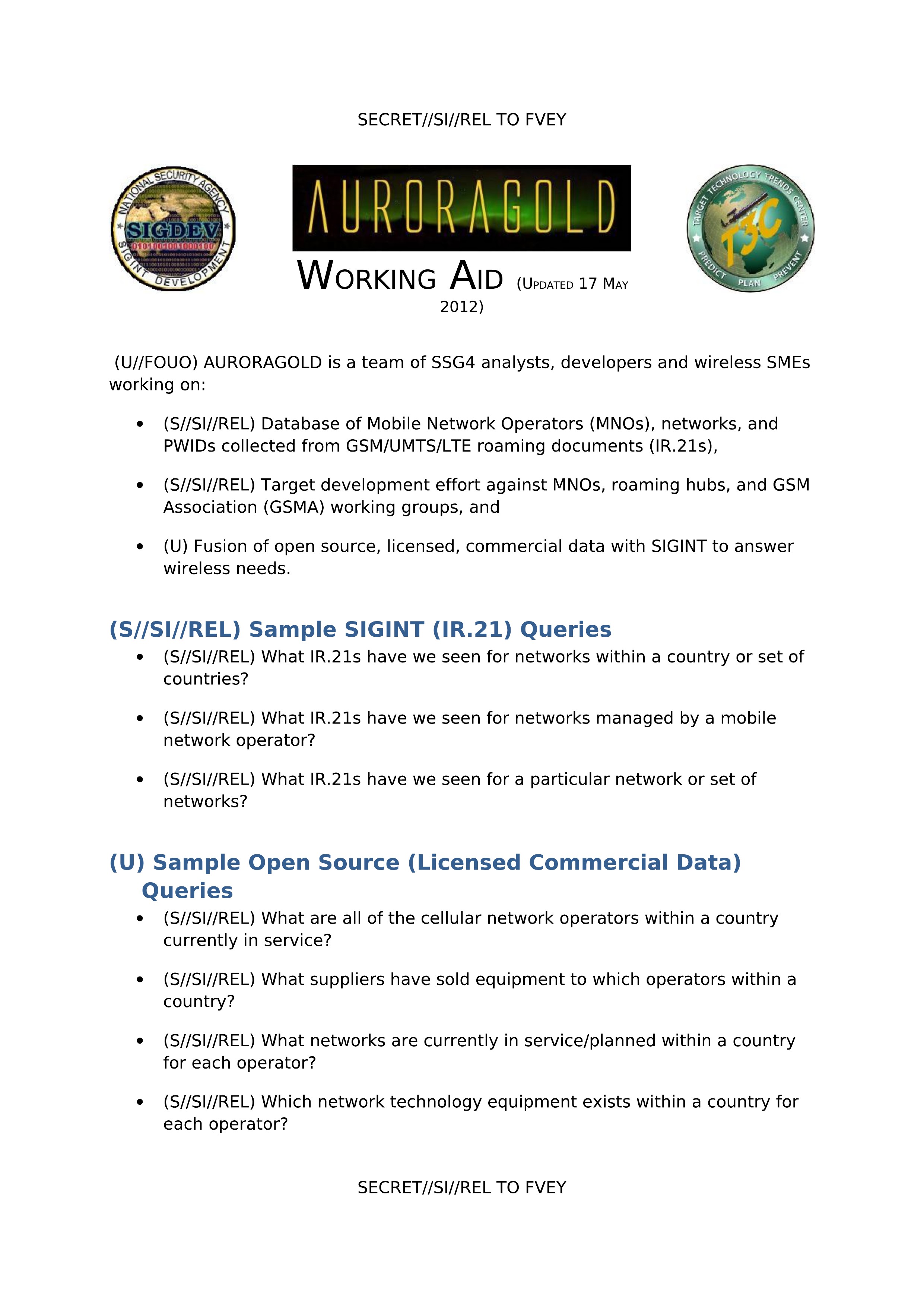
(U//FOUO) AURORAGOLD is a team of SSG4 analysts, developers and wireless SMEs working on:
- (S//SI//REL) Database of Mobile Network Operators (MNOs), networks, and PWIDs collected from GSM/UMTS/LTE roaming documents (IR.21s),
- (S//SI//REL) Target development effort against MNOs, roaming hubs, and GSM Association (GSMA) working groups, and
- (U) Fusion of open source, licensed, commercial data with SIGINT to answer wireless needs.
(S//SI//REL) Sample SIGINT (IR.21) Queries
- (S//SI//REL) What IR.21s have we seen for networks within a country or set of countries?
- (S//SI//REL) What IR.21s have we seen for networks managed by a mobile network operator?
- (S//SI//REL) What IR.21s have we seen for a particular network or set of networks?
(U) Sample Open Source (Licensed Commercial Data) Queries
- (S//SI//REL) What are all of the cellular network operators within a country currently in service?
- (S//SI//REL) What suppliers have sold equipment to which operators within a country?
- (S//SI//REL) What networks are currently in service/planned within a country for each operator?
- (S//SI//REL) Which network technology equipment exists within a country for each operator?
SECRET//SI//REL TO FVEY
SECRET//SI//REL TO FVEY
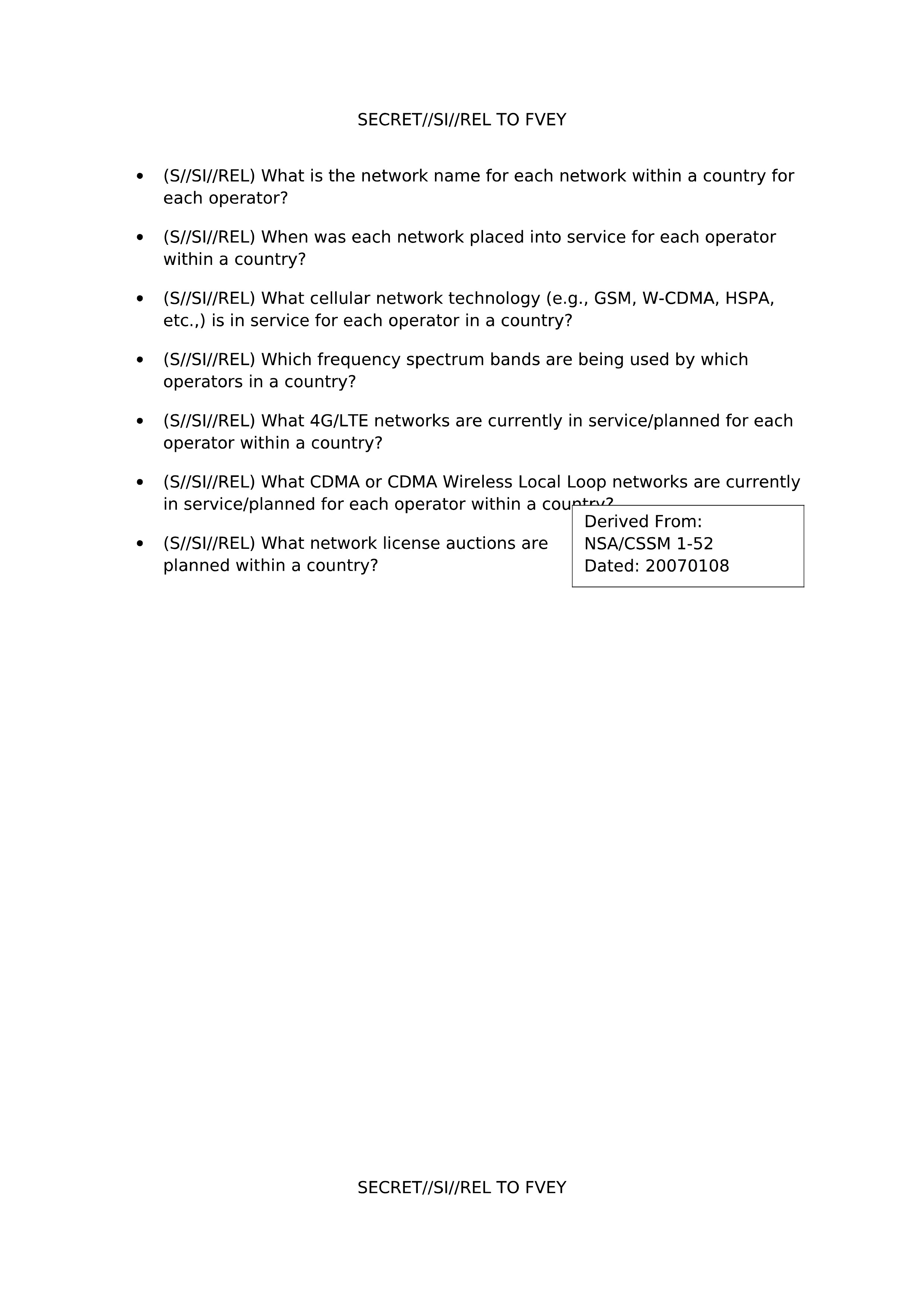
- (S//SI//REL) What is the network name for each network within a country for each operator?
- (S//SI//REL) When was each network placed into service for each operator within a country?
- (S//SI//REL) What cellular network technology (e.g., GSM, W-CDMA, HSPA, etc.,) is in service for each operator in a country?
- (S//SI//REL) Which frequency spectrum bands are being used by which operators in a country?
- (S//SI//REL) What 4G/LTE networks are currently in service/planned for each operator within a country?
- (S//SI//REL) What CDMA or CDMA Wireless Local Loop networks are currently in service/planned for each operator within a country?
- (S//SI//REL) What network license auctions are planned within a country?
Derived From:
NSA/CSSM 1-52
Dated: 20070108
SECRET//SI//REL TO FVEY
SECRET//SI//REL TO FVEY
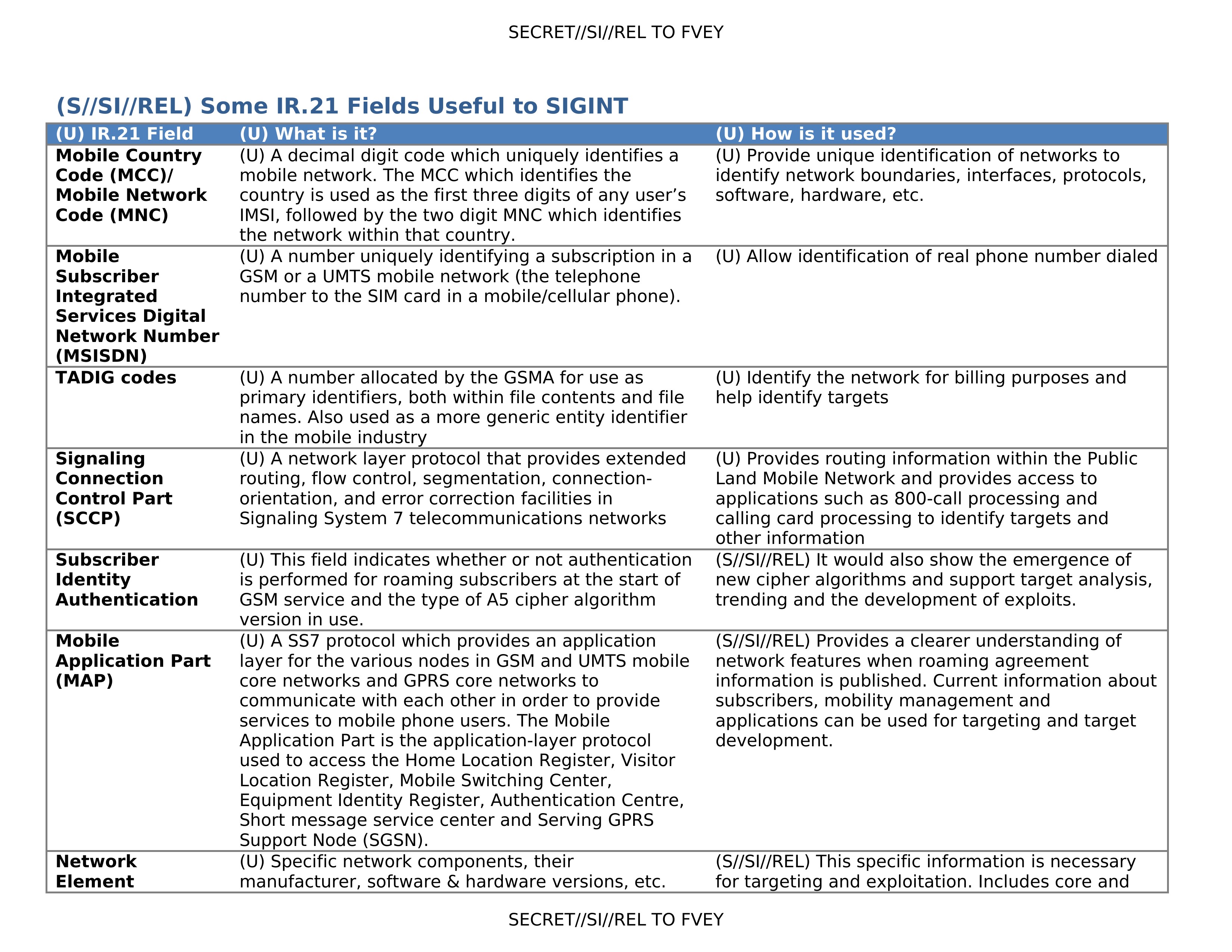
(S//SI//REL) Some IR.21 Fields Useful to SIGINT
| (U) IR.21 Field | (U) What is it? | (U) How is it used? |
|---|---|---|
| Mobile Country Code (MCC)/Mobile Network Code (MNC) | (U) A decimal digit code which uniquely identifies a mobile network. The MCC which identifies the country is used as the first three digits of any user's IMSI, followed by the two digit MNC which identifies the network within that country. | (U) Provide unique identification of networks to identify network boundaries, interfaces, protocols, software, hardware, etc. |
| Mobile Subscriber Integrated Services Digital Network Number (MSISDN) | (U) A number uniquely identifying a subscription in a GSM or a UMTS mobile network (the telephone number to the SIM card in a mobile/cellular phone). | (U) Allow identification of real phone number dialed |
| TADIG codes | (U) A number allocated by the GSMA for use as primary identifiers, both within file contents and file names. Also used as a more generic entity identifier in the mobile industry | (U) Identify the network for billing purposes and help identify targets |
| Signaling Connection Control Part (SCCP) | (U) A network layer protocol that provides extended routing, flow control, segmentation, connection-orientation, and error correction facilities in Signaling System 7 telecommunications networks | (U) Provides routing information within the Public Land Mobile Network and provides access to applications such as 800-call processing and calling card processing to identify targets and other information |
| Subscriber Identity Authentication | (U) This field indicates whether or not authentication is performed for roaming subscribers at the start of GSM service and the type of A5 cipher algorithm version in use. | (S//SI//REL) It would also show the emergence of new cipher algorithms and support target analysis, trending and the development of exploits. |
| Mobile Application Part (MAP) | (U) A SS7 protocol which provides an application layer for the various nodes in GSM and UMTS mobile core networks and GPRS core networks to communicate with each other in order to provide services to mobile phone users. The Mobile Application Part is the application-layer protocol used to access the Home Location Register, Visitor Location Register, Mobile Switching Center, Equipment Identity Register, Authentication Centre, Short message service center and Serving GPRS Support Node (SGSN). | (S//SI//REL) Provides a clearer understanding of network features when roaming agreement information is published. Current information about subscribers, mobility management and applications can be used for targeting and target development. |
| Network Element | (U) Specific network components, their manufacturer, software & hardware versions, etc. | (S//SI//REL) This specific information is necessary for targeting and exploitation. Includes core and |
SECRET//SI//REL TO FVEY
SECRET//SI//REL TO FVEY
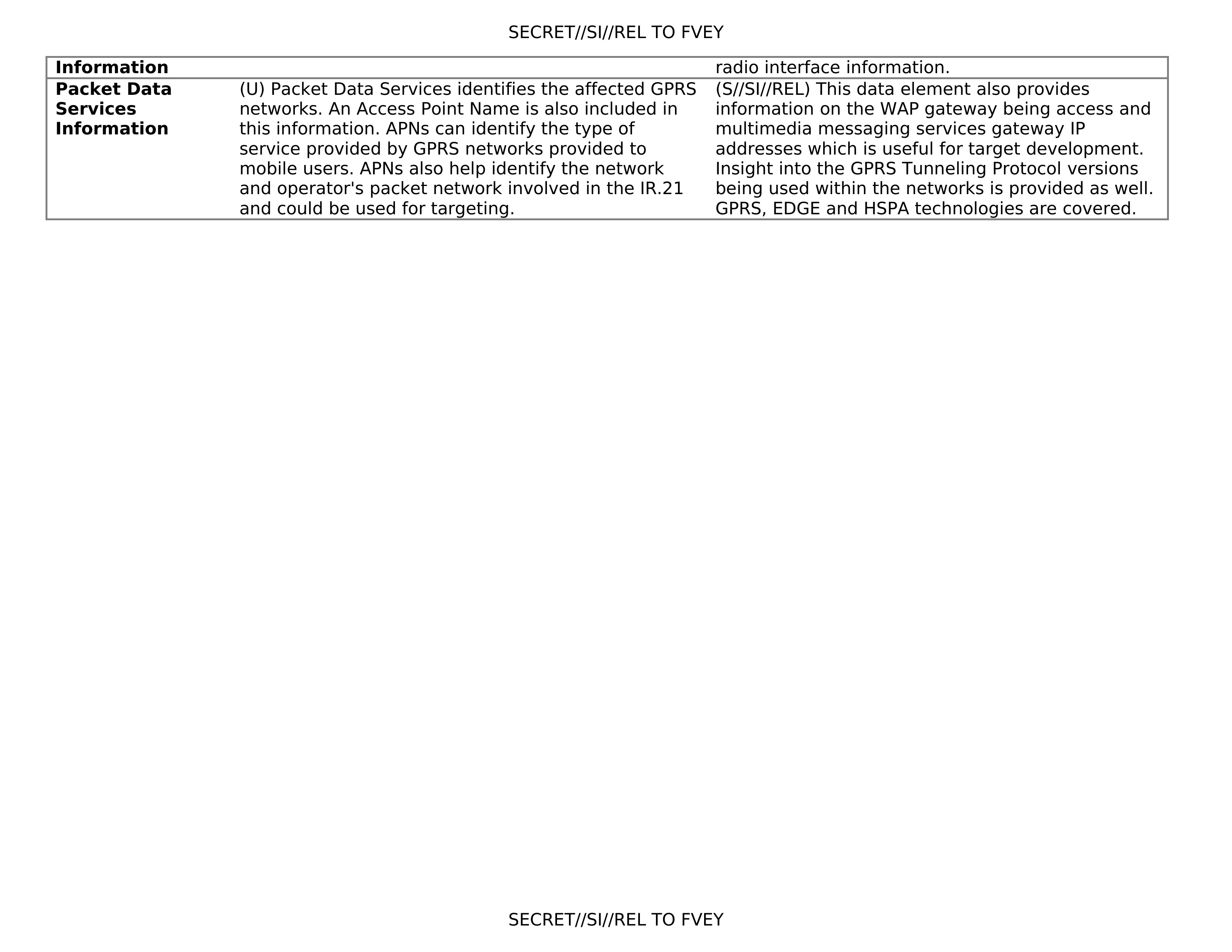
| Information | radio interface information. | |
| Packet Data Services Information | (U) Packet Data Services identifies the affected GPRS networks. An Access Point Name is also included in this information. APNs can identify the type of service provided by GPRS networks provided to mobile users. APNs also help identify the network and operator's packet network involved in the IR.21 and could be used for targeting. | (S//SI//REL) This data element also provides information on the WAP gateway being access and multimedia messaging services gateway IP addresses which is useful for target development. Insight into the GPRS Tunneling Protocol versions being used within the networks is provided as well. GPRS, EDGE and HSPA technologies are covered. |
SECRET//SI//REL TO FVEY
Published in the Same Report
(8 documents)
-
AURORAGOLD – Project Overview [pdf]
A technical briefing document outlining an NSA SIGINT initiative designed to map, monitor, and forecast the evolution of global mobile networks. It details the project's infrastructure, which aggregates both unclassified commercial data and classified intelligence intercepted from international roaming agreements to identify technical trends and exploitation opportunities.
-
AURORAGOLD – Target Technology Trends Center support to WPMO [pdf]
This briefing details the technical architecture and data pipeline used to process global cellular network information. It specifically highlights the synergy between data gathering on GSM/UMTS networks and the implementation of "Auto-Minimization" to ensure the resulting SIGINT reporting complies with NSA legal and policy requirements.
-
AURORAGOLD Working Group [pdf]
The "AURORAGOLD Working Group" briefing is a highly classified SIGINT development presentation from June 2012 that outlines the NSA's progress in mapping the global mobile landscape (GSM/UMTS/LTE). It focuses on the project's "value proposition": providing an exhaustive database of network identifiers and technical configurations—often obtained by intercepting internal company documents—to support tactical military operations and long-term surveillance forecasting.
Programs: AURORAGOLD · UTT · XKEYSCORE · CADENCE · JUBILEECORONA · RONIN · NKB · GLOBALTIPPER · PINWALE -
NSA/GCHQ/CSEC Network Tradecraft Advancement Team [pdf]
The "NSA/GCHQ/CSEC Network Tradecraft Advancement Team (NTAT) 2010" document describes a collaborative mission between the US, UK, and Canada to synchronize and advance SIGINT techniques. The NTAT focused on "Network Analysis Tradecraft," specifically integrating analysis tools such as IRASCIABLE RABBIT and TOYGRIPPE into CSEC's OLYMPIA and developing standardized "use cases" for tracking mobile networks and virtual private networks (VPNs).
-
IR.21 – A Technology Warning Mechanism [pdf]
This 2010 TOP SECRET NSA briefing defines the IR.21 roaming document as a critical tool for "horizon scanning" and "forecasting" global telecommunications shifts. The document outlines how the NSA uses these technical files to proactively identify emerging 3G and 4G technologies, pinpointing vulnerabilities for exploitation before new systems are even fully deployed.
-
OPULENT PUP Encryption Attack [pdf]
"OPULENT PUP encryption attack (GCHQ)" is a 2009 technical planning document from the British intelligence agency GCHQ. It outlines a "proof-of-concept demonstrator" for a new capability to intercept and decrypt GSM communications protected by the A5/3 algorithm, requiring a complete overhaul of the existing processing chain used for the older A5/1 standard.
Programs: OPULENTPUP -
NSA First-Ever Collect of High-Interest 4G Cellular Signal [pdf]
The memorandum documents a technical milestone achieved in January 2010: the first successful interception of Time Division-Long Term Evolution (TD-LTE) 4G communications. This collection was conducted at the RAINFALL site (the unclassified cover term for the Joint Defence Facility Pine Gap in Australia) and marked the transition of intelligence priority from 2G/3G systems to all-Internet Protocol (IP) 4G networks.
Programs: RAINFALL -
WOLFRAMITE Encryption Attack [pdf]
The "WOLFRAMITE Encryption Attack" is a GCHQ strategic annex from March 2011 detailing a joint effort with the NSA to compromise the A5/3 encryption standard. The document outlines a specialized research and development program aimed at scaling up handset exploitation and securing funding—estimated at approximately £4 million—to prototype a functional decryption attack against modern mobile broadband security.
Related Documents
-
AURORAGOLD Working Group [pdf]
The "AURORAGOLD Working Group" briefing is a highly classified SIGINT development presentation from June 2012 that outlines the NSA's progress in mapping the global mobile landscape (GSM/UMTS/LTE). It focuses on the project's "value proposition": providing an exhaustive database of network identifiers and technical configurations—often obtained by intercepting internal company documents—to support tactical military operations and long-term surveillance forecasting.
Programs: AURORAGOLD · UTT · XKEYSCORE · CADENCE · JUBILEECORONA · RONIN · NKB · GLOBALTIPPER · PINWALE -
AURORAGOLD – Target Technology Trends Center support to WPMO [pdf]
This briefing details the technical architecture and data pipeline used to process global cellular network information. It specifically highlights the synergy between data gathering on GSM/UMTS networks and the implementation of "Auto-Minimization" to ensure the resulting SIGINT reporting complies with NSA legal and policy requirements.
-
AURORAGOLD – Project Overview [pdf]
A technical briefing document outlining an NSA SIGINT initiative designed to map, monitor, and forecast the evolution of global mobile networks. It details the project's infrastructure, which aggregates both unclassified commercial data and classified intelligence intercepted from international roaming agreements to identify technical trends and exploitation opportunities.
-
IR.21 – A Technology Warning Mechanism [pdf]
This 2010 TOP SECRET NSA briefing defines the IR.21 roaming document as a critical tool for "horizon scanning" and "forecasting" global telecommunications shifts. The document outlines how the NSA uses these technical files to proactively identify emerging 3G and 4G technologies, pinpointing vulnerabilities for exploitation before new systems are even fully deployed.
-
NSA/GCHQ/CSEC Network Tradecraft Advancement Team [pdf]
The "NSA/GCHQ/CSEC Network Tradecraft Advancement Team (NTAT) 2010" document describes a collaborative mission between the US, UK, and Canada to synchronize and advance SIGINT techniques. The NTAT focused on "Network Analysis Tradecraft," specifically integrating analysis tools such as IRASCIABLE RABBIT and TOYGRIPPE into CSEC's OLYMPIA and developing standardized "use cases" for tracking mobile networks and virtual private networks (VPNs).