Cryptographic Modernization (CryptoMod) Classification Guide 3-9
Open PDFDocument date: 2010-02-01
Pages: 4
Genre: guide
Banner: TOP SECRET//REL TO USA, AUS, CAN, GBR, NZL
Classification: TOP SECRET
Dissemination: REL TO USA, AUS, CAN, GBR, NZL
A partial NSA/CSS classification guide for the Cryptographic Modernisation (CryptoMod) programme — establishing classification levels for information about NSA's transition of US cryptographic products to modern algorithms, Positive Access Control parameters, software signing, and the association of specific algorithms with critical year and life-of-use assessments.
My notes
UNCLASSIFIED//FOR OFFICIAL USE ONLY
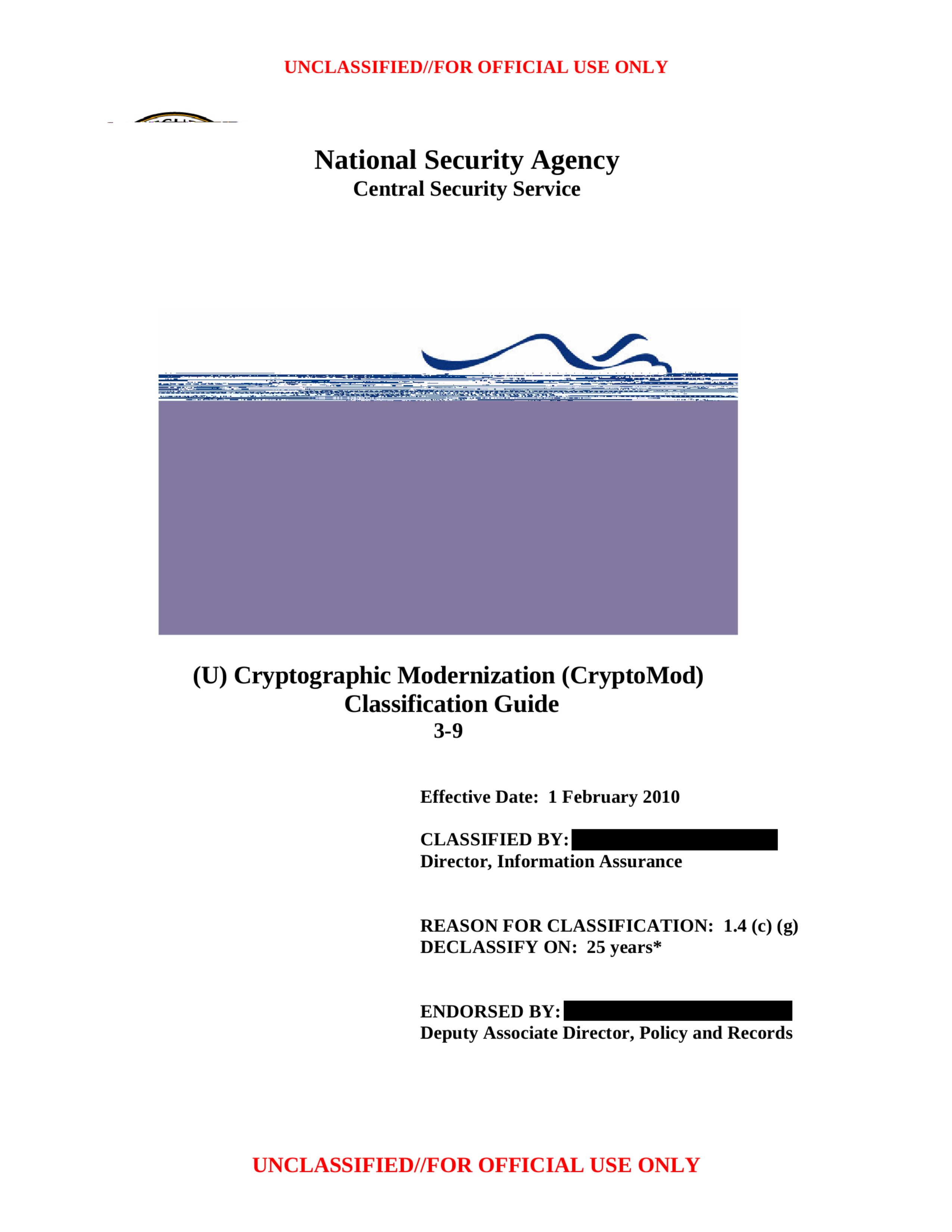
National Security Agency
Central Security Service
(U) Cryptographic Modernization (CryptoMod)
Classification Guide
3-9
Effective Date: 1 February 2010
CLASSIFIED BY: [REDACTED]
Director, Information Assurance
REASON FOR CLASSIFICATION: 1.4 (c) (g)
DECLASSIFY ON: 25 years*
ENDORSED BY: [REDACTED]
Deputy Associate Director, Policy and Records
UNCLASSIFIED//FOR OFFICIAL USE ONLY
UNCLASSIFIED//FOR OFFICIAL USE ONLY
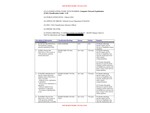
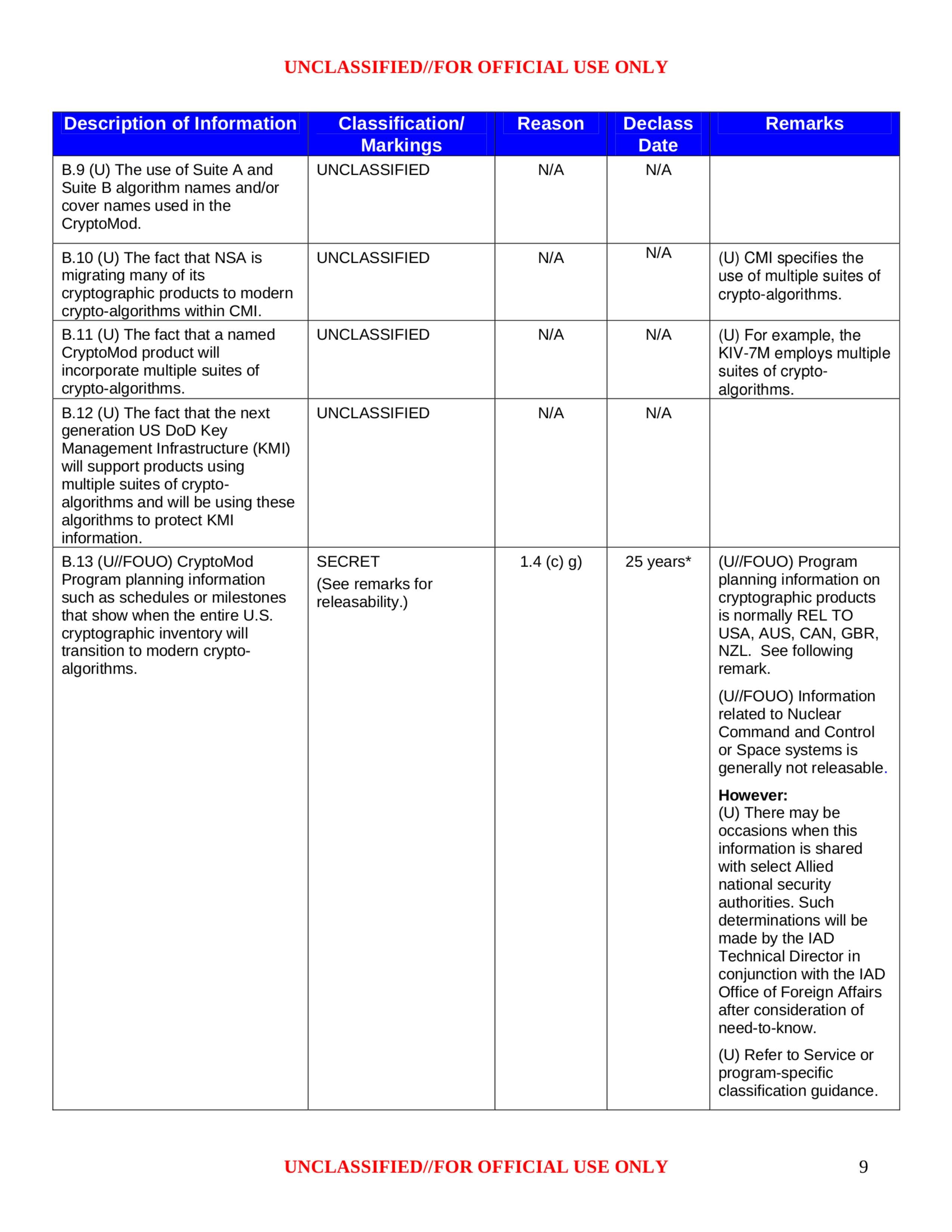
| Description of Information | Classification/ Markings | Reason | Declass Date | Remarks |
|---|---|---|---|---|
| B.9 (U) The use of Suite A and Suite B algorithm names and/or cover names used in the CryptoMod. | UNCLASSIFIED | N/A | N/A | |
| B.10 (U) The fact that NSA is migrating many of its cryptographic products to modern crypto-algorithms within CMI. | UNCLASSIFIED | N/A | N/A | (U) CMI specifies the use of multiple suites of crypto-algorithms. |
| B.11 (U) The fact that a named CryptoMod product will incorporate multiple suites of crypto-algorithms. | UNCLASSIFIED | N/A | N/A | (U) For example, the KIV-7M employs multiple suites of crypto-algorithms. |
| B.12 (U) The fact that the next generation US DoD Key Management Infrastructure (KMI) will support products using multiple suites of crypto-algorithms and will be using these algorithms to protect KMI information. | UNCLASSIFIED | N/A | N/A | |
| B.13 (U//FOUO) CryptoMod Program planning information such as schedules or milestones that show when the entire U.S. cryptographic inventory will transition to modern crypto-algorithms. | SECRET (See remarks for releasability.) | 1.4 (c) g) | 25 years* | (U//FOUO) Program planning information on cryptographic products is normally REL TO USA, AUS, CAN, GBR, NZL. See following remark. (U//FOUO) Information related to Nuclear Command and Control or Space systems is generally not releasable. However: (U) There may be occasions when this information is shared with select Allied national security authorities. Such determinations will be made by the IAD Technical Director in conjunction with the IAD Office of Foreign Affairs after consideration of need-to-know. (U) Refer to Service or program-specific classification guidance. |
UNCLASSIFIED//FOR OFFICIAL USE ONLY
9
UNCLASSIFIED//FOR OFFICIAL USE ONLY
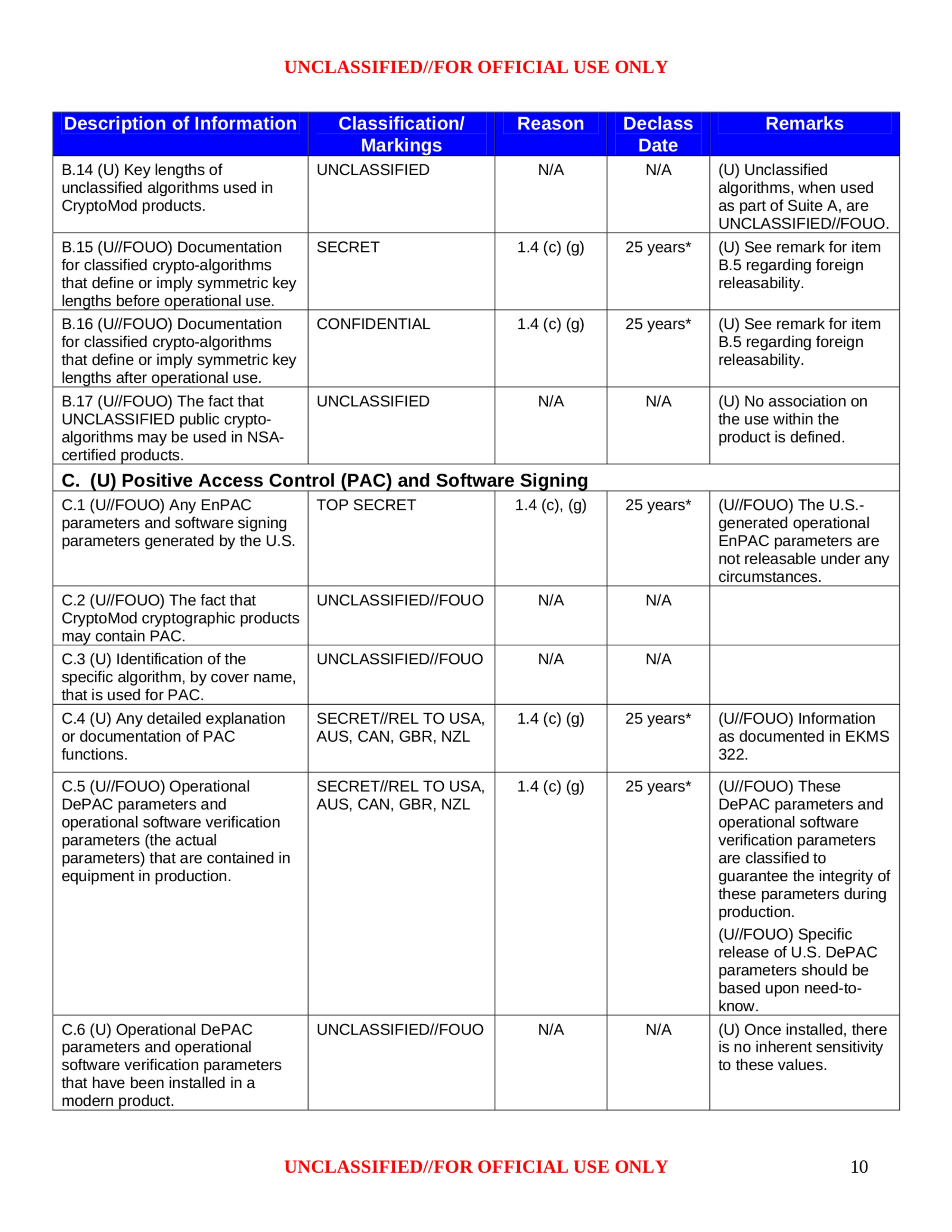
| Description of Information | Classification/ Markings | Reason | Declass Date | Remarks |
|---|---|---|---|---|
| B.14 (U) Key lengths of unclassified algorithms used in CryptoMod products. | UNCLASSIFIED | N/A | N/A | (U) Unclassified algorithms, when used as part of Suite A, are UNCLASSIFIED//FOUO. |
| B.15 (U//FOUO) Documentation for classified crypto-algorithms that define or imply symmetric key lengths before operational use. | SECRET | 1.4 (c) (g) | 25 years* | (U) See remark for item B.5 regarding foreign releasability. |
| B.16 (U//FOUO) Documentation for classified crypto-algorithms that define or imply symmetric key lengths after operational use. | CONFIDENTIAL | 1.4 (c) (g) | 25 years* | (U) See remark for item B.5 regarding foreign releasability. |
| B.17 (U//FOUO) The fact that UNCLASSIFIED public crypto-algorithms may be used in NSA-certified products. | UNCLASSIFIED | N/A | N/A | (U) No association on the use within the product is defined. |
| C. (U) Positive Access Control (PAC) and Software Signing | ||||
| C.1 (U//FOUO) Any EnPAC parameters and software signing parameters generated by the U.S. | TOP SECRET | 1.4 (c), (g) | 25 years* | (U//FOUO) The U.S.-generated operational EnPAC parameters are not releasable under any circumstances. |
| C.2 (U//FOUO) The fact that CryptoMod cryptographic products may contain PAC. | UNCLASSIFIED//FOUO | N/A | N/A | |
| C.3 (U) Identification of the specific algorithm, by cover name, that is used for PAC. | UNCLASSIFIED//FOUO | N/A | N/A | |
| C.4 (U) Any detailed explanation or documentation of PAC functions. | SECRET//REL TO USA, AUS, CAN, GBR, NZL | 1.4 (c) (g) | 25 years* | (U//FOUO) Information as documented in EKMS 322. |
| C.5 (U//FOUO) Operational DePAC parameters and operational software verification parameters (the actual parameters) that are contained in equipment in production. | SECRET//REL TO USA, AUS, CAN, GBR, NZL | 1.4 (c) (g) | 25 years* | (U//FOUO) These DePAC parameters and operational software verification parameters are classified to guarantee the integrity of these parameters during production. (U//FOUO) Specific release of U.S. DePAC parameters should be based upon need-to-know. |
| C.6 (U) Operational DePAC parameters and operational software verification parameters that have been installed in a modern product. | UNCLASSIFIED//FOUO | N/A | N/A | (U) Once installed, there is no inherent sensitivity to these values. |
UNCLASSIFIED//FOR OFFICIAL USE ONLY
10
UNCLASSIFIED//FOR OFFICIAL USE ONLY
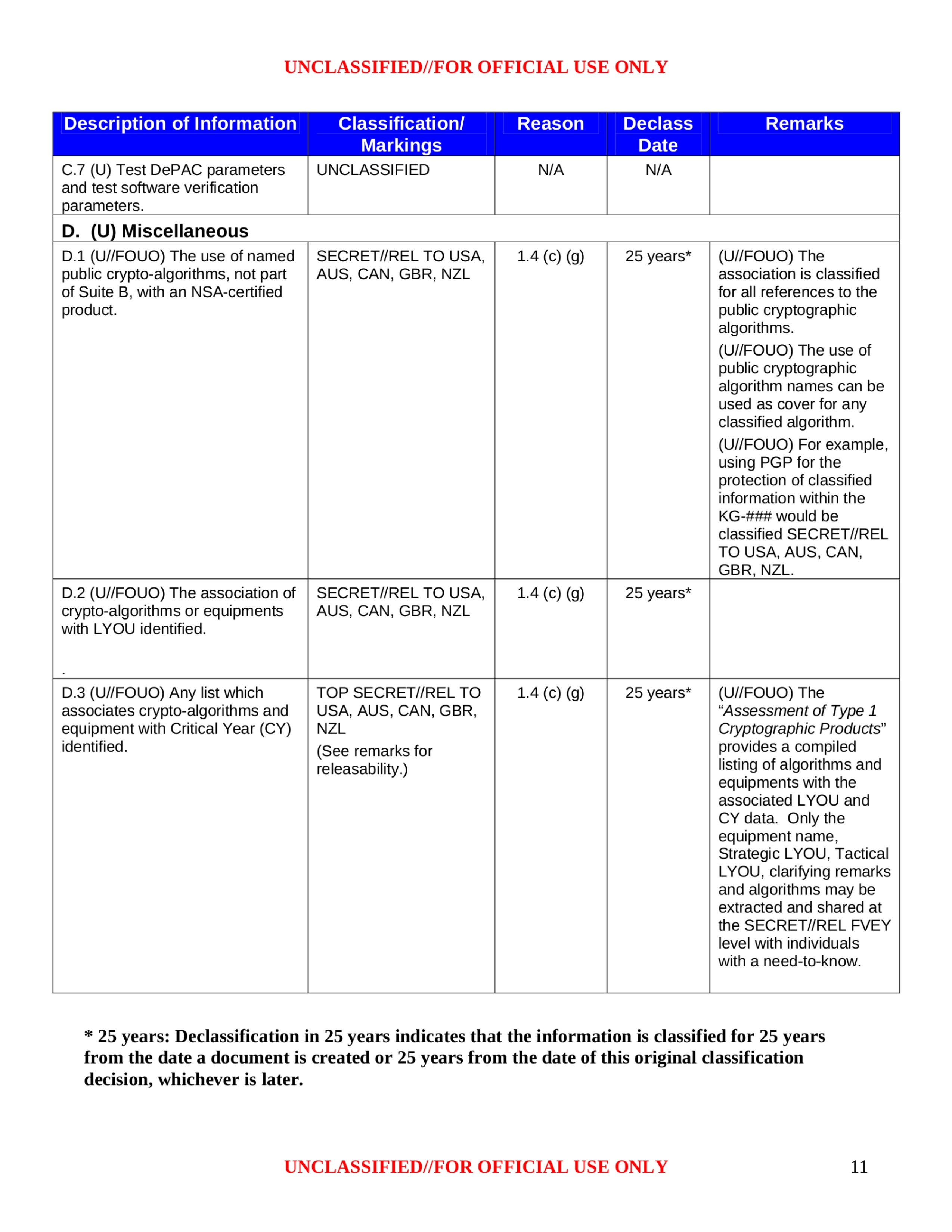
| Description of Information | Classification/ Markings | Reason | Declass Date | Remarks |
|---|---|---|---|---|
| C.7 (U) Test DePAC parameters and test software verification parameters. | UNCLASSIFIED | N/A | N/A | |
| D. (U) Miscellaneous | ||||
| D.1 (U//FOUO) The use of named public crypto-algorithms, not part of Suite B, with an NSA-certified product. | SECRET//REL TO USA, AUS, CAN, GBR, NZL | 1.4 (c) (g) | 25 years* | (U//FOUO) The association is classified for all references to the public cryptographic algorithms. (U//FOUO) The use of public cryptographic algorithm names can be used as cover for any classified algorithm. (U//FOUO) For example, using PGP for the protection of classified information within the KG-### would be classified SECRET//REL TO USA, AUS, CAN, GBR, NZL. |
| D.2 (U//FOUO) The association of crypto-algorithms or equipments with LYOU identified. | SECRET//REL TO USA, AUS, CAN, GBR, NZL | 1.4 (c) (g) | 25 years* | |
| D.3 (U//FOUO) Any list which associates crypto-algorithms and equipment with Critical Year (CY) identified. | TOP SECRET//REL TO USA, AUS, CAN, GBR, NZL (See remarks for releasability.) | 1.4 (c) (g) | 25 years* | (U//FOUO) The "Assessment of Type 1 Cryptographic Products" provides a compiled listing of algorithms and equipments with the associated LYOU and CY data. Only the equipment name, Strategic LYOU, Tactical LYOU, clarifying remarks and algorithms may be extracted and shared at the SECRET//REL FVEY level with individuals with a need-to-know. |
- 25 years: Declassification in 25 years indicates that the information is classified for 25 years from the date a document is created or 25 years from the date of this original classification decision, whichever is later.
UNCLASSIFIED//FOR OFFICIAL USE ONLY
11
Published in the Same Report
(10 of 43 documents)
-
BULLRUN CoI - Briefing Sheet [pdf]
A GCHQ briefing sheet introducing the BULLRUN Community of Interest — the access control framework protecting Five Eyes capabilities to defeat encryption across TLS/SSL, HTTPS, SSH, VPNs, IPSec, encrypted chat and encrypted VoIP — covering the classification structure, handling procedures and protective marking guidance for intelligence derived from cryptanalytic exploitation.
“N.S.A. Able to Foil Basic Safeguards of Privacy on Web” - The New York Times ↗ (2013-09-05) · “Revealed: The NSA's Secret Campaign to Crack, Undermine Internet Security” - ProPublica ↗ (2013-09-05) · “Prying Eyes: Inside the NSA's War on Internet Security” - Der Spiegel ↗ (2014-12-28) · Perlroth, Nicole · Larson, Jeff · Shane, Scott · Appelbaum, Jacob · Gibson, Aaron · Grothoff, Christian · Müller-Maguhn, Andy · Poitras, Laura · Sontheimer, Michael · Stöcker, Christian -
CLASSIFICATION GUIDE FOR CRYPTANALYSIS, 2-12 [pdf]
An NSA/CSS classification guide for cryptanalysis establishing the precise classification level for each type of information about NSA's capabilities to exploit commercial and indigenous encryption systems — from the unclassified acknowledgement that NSA exploits cryptographic devices, through to the Top Secret protection of cryptographic modifications made to commercial products to render them exploitable and industry relationships used to obtain cryptographic details.
“Revealed: how US and UK spy agencies defeat internet privacy and security” - The Guardian ↗ (2013-09-05) · “Prying Eyes: Inside the NSA's War on Internet Security” - Der Spiegel ↗ (2014-12-28) · Ball, James · Borger, Julian · Greenwald, Glenn · Appelbaum, Jacob · Gibson, Aaron · Grothoff, Christian · Müller-Maguhn, Andy · Poitras, Laura · Sontheimer, Michael · Stöcker, Christian -
Innov8 Experiment Profile Template [pdf]
A TOP SECRET STRAP1 joint NSA/GCHQ experiment profile documenting a 2010-2011 Joint Capability Experiment to test hardware-accelerated bulk decryption of common internet encryption technologies at scale, integrating TURMOIL's passive collection with NSA's LONGHAUL key recovery service via the ISLANDTRANSPORT messaging system, as part of the broader BULLRUN assault on internet encryption.
“Prying Eyes: Inside the NSA's War on Internet Security” - Der Spiegel ↗ (2014-12-28) · “Revealed: how US and UK spy agencies defeat internet privacy and security” - The Guardian ↗ (2013-09-05) · Appelbaum, Jacob · Gibson, Aaron · Grothoff, Christian · Müller-Maguhn, Andy · Poitras, Laura · Sontheimer, Michael · Stöcker, Christian · Ball, James · Borger, Julian · Greenwald, Glenn -
TLS Trends: A roundtable discussion on current usage and future directions [pdf]
A presentation by Canada's Communications Security Establishment describing their TLS trend analysis programme, which systematically tracked SSL/TLS encryption parameters across warranted collection and Special Source access to identify cryptanalytic opportunities, monitor target behaviour and collaborate with GCHQ on exploiting weaknesses in widely-used encryption implementations.
-
Secure Sockets Layer (SSL) / Transport Layer Security (TLS) [pdf]
A classified NSA Network Security Products training presentation providing a comprehensive technical overview of SSL/TLS protocol mechanics and NSA's exploitation approaches, including observed usage statistics from intercepted traffic, RSA key exchange decryption methodology, exploitation of the Debian OpenSSL RNG weakness, and the practical challenges of decrypting millions of SSL sessions per day at scale.
Programs: SCARLETFEVER -
TLS trends at GCHQ [pdf]
A GCHQ presentation describing their TLS trends analysis programme, which processed approximately 10 billion SSL/TLS Server Hello events per week from Special Source cable tapping and COMSAT collection to produce weekly trend reports, alongside two operational tools — TargeTLS for matching TLS events against BROAD OAK target profiles, and FLYING PIG, a TLS knowledge base enabling analysts to query certificate, IP and client data across the full intercept base.
-
TURMOIL/APEX/APEX High Level Description Document [pdf]
NSA WikiInfo page providing the high-level design description of APEX — the Active-Passive Integration capability integrating HAMMERMILL router implants with TURMOIL passive collection — enabling real-time exfiltration of targeted VPN (HAMMERSTEIN) and VoIP (HAMMERCHANT) traffic from compromised routers directly into NSA's passive collection and cryptanalytic attack infrastructure, with TURBINE providing automated command and control of the combined active-passive system.
Programs: TURMOIL · APEX · HAMMERMILL · HAMMERCHANT · HAMMERSTEIN · FASHIONCLEFT · TURBINE · TOYGRIPPE · METROTUBE · CHIMNEYPOOL · PIQBLADE · KEYCARD · FASCIA · ISLANDTRANSPORT · PRESSUREWAVE · ASDF · CONVEYANCE · TURBULENCE -
GALLANTWAVE [pdf]
NSA presentation describing GALLANTWAVE — a LONGHAUL capability for VPN decryption — specifically its scaling architecture to handle increased collection volumes and a peering mechanism allowing partner agencies to share single-sided VPN key exchange events so that LONGHAUL can complete decryption attempts that would otherwise fail due to one-sided collection.
-
Intro to the VPN Exploitation Process [pdf]
NSA introduction to the VPN exploitation process from September 2010, presented by the OTP VPN Exploitation Team, covering the full workflow from initial collection through to sustained decryption of IPSec, PPTP, SSL and SSH traffic, with named exploitation successes including airlines, diplomatic missions, banks and intelligence services across Iran, Jordan, Russia, Turkey, Pakistan, Afghanistan, Somalia, Indonesia and Mexico.
Programs: BLEAKINQUIRY · TOYGRIPPE · XKEYSCORE · MAILORDER · CORALREEF · VULCANDEATHGRIP · SCISSORS · TURTLEPOWER · PINWALE · FOURSCORE · CADENCE · UTT · VULCANMINDMELD · CAPRIOS · AGILITY · NKB · FOLLOWTHEMONEY -
Analytic Challenges from Active-Passive Integration [pdf]
This NSA briefing addresses the technical and administrative friction caused by "shaping" operations. Shaping occurs when an active malware implant, typically situated on network infrastructure like a router, copies specific data streams and redirects them past a passive surveillance sensor such as TURMOIL. While this ensures the capture of data that might otherwise be missed, it creates a "double metadata" conflict where a single piece of intelligence carries two competing sets of identifiers: one from the active Tailored Access Operations (TAO) implant and another from the passive collection site. The document tasks analysts with finding a way to reconcile these source notations to ensure the data remains searchable and legally compliant within legacy databases.
Programs: BRAVENICKEL · HAMMERMILL · APEX · TURMOIL · HAMMERSTONE · PRESSUREWAVE · METROTUBE · TOYGRIPPE · TURBULENCE · METAWAVE · MARINA · SSO · CONVEYANCE · NUCLEON · FASCIA · HAMMERCHANT
Related Documents
-
CLASSIFICATION GUIDE FOR CRYPTANALYSIS, 2-12 [pdf]
An NSA/CSS classification guide for cryptanalysis establishing the precise classification level for each type of information about NSA's capabilities to exploit commercial and indigenous encryption systems — from the unclassified acknowledgement that NSA exploits cryptographic devices, through to the Top Secret protection of cryptographic modifications made to commercial products to render them exploitable and industry relationships used to obtain cryptographic details.
“Revealed: how US and UK spy agencies defeat internet privacy and security” - The Guardian ↗ (2013-09-05) · “Prying Eyes: Inside the NSA's War on Internet Security” - Der Spiegel ↗ (2014-12-28) · Ball, James · Borger, Julian · Greenwald, Glenn · Appelbaum, Jacob · Gibson, Aaron · Grothoff, Christian · Müller-Maguhn, Andy · Poitras, Laura · Sontheimer, Michael · Stöcker, Christian -
Computer Network Exploitation (CNE) Classification Guide / 2-59 [pdf]
A NSA/TAO classification guide establishing the precise classification level for 41 categories of information about computer network exploitation operations — covering remote and physical subversion methods, CNE tools and techniques, supply chain operations, hardware implants, off-net field operations, zero-day vulnerabilities, and cryptographic material acquired through CNE.
“Core Secrets: NSA Saboteurs in China and Germany” - The Intercept ↗ (2014-10-10) · “The Digital Arms Race: NSA Preps America for Future Battle” - Der Spiegel ↗ (2015-01-17) · Maass, Peter · Poitras, Laura · Appelbaum, Jacob · Gibson, Aaron · Guarnieri, Claudio · Müller-Maguhn, Andy · Rosenbach, Marcel · Ryge, Leif · Schmundt, Hilmar · Sontheimer, Michael -
User's Guide For PRISM Skype Collection - August 2012 [pdf]
An NSA analyst user guide for PRISM Skype collection, explaining how to task Skype selectors, locate collected content across PINWALE, NUCLEON and MARINA, interpret common collection artefacts, and troubleshoot issues with video synchronisation, timestamp discrepancies and incomplete file transfers — covering peer-to-peer, in/out and conference call collection modes from PRISM coverage that began in February 2011.
-
BULLRUN CoI - Briefing Sheet [pdf]
A GCHQ briefing sheet introducing the BULLRUN Community of Interest — the access control framework protecting Five Eyes capabilities to defeat encryption across TLS/SSL, HTTPS, SSH, VPNs, IPSec, encrypted chat and encrypted VoIP — covering the classification structure, handling procedures and protective marking guidance for intelligence derived from cryptanalytic exploitation.
“N.S.A. Able to Foil Basic Safeguards of Privacy on Web” - The New York Times ↗ (2013-09-05) · “Revealed: The NSA's Secret Campaign to Crack, Undermine Internet Security” - ProPublica ↗ (2013-09-05) · “Prying Eyes: Inside the NSA's War on Internet Security” - Der Spiegel ↗ (2014-12-28) · Perlroth, Nicole · Larson, Jeff · Shane, Scott · Appelbaum, Jacob · Gibson, Aaron · Grothoff, Christian · Müller-Maguhn, Andy · Poitras, Laura · Sontheimer, Michael · Stöcker, Christian -
BULLRUN [pdf]
A GCHQ TOP SECRET STRAP1 briefing presentation on BULLRUN — summarising the programme's purpose, the network security technologies it targets, the sensitivities surrounding cryptanalytic capabilities, and the access control framework protecting both technical details and the "fact of" capability — notable for explicitly naming three ECIs protecting the technical underpinnings: PICARESQUE, PAWLEYS and AMBULANT.