Tag: data fusion 11 documents
Search documents matching “data fusion” →Free-text subjects the curators added. Unlike the other axes these are not necessarily from the documents' own vocabulary, so they are the loosest thing to browse by (and the most forgiving).
Graphs
By Banner
By Classification
Refine (combine with another filter, via search)
Sort: Title
Documents
-
FININT Tasking [pdf]
This document outlines GCHQ's financial intelligence (FININT) operations, detailing the use of tools like LUCKY STRIKE and LUCKY ESCAPE to search and fuse datasets from financial and travel sources. It also describes procedures for requesting financial checks on individuals and mentions the collection of bulk banking and credit card data from specific regions.
Programs: TRACFIN · LUCKY STRIKE · LUCKY ESCAPE · TAPERLAY · TMM · MOON RAKER · BROADOAK · FININTTRACKER · FINTOOLS · FOLLOWTHEMONEY · PLATINUMPLUS · RUSSETT -
Fusing Signals Data, with WARGODDESS SIDtoday [pdf]
WARGODDESS is a system that fuses multiple sources of signal data to help characterize targets and threats and produce estimates about targets and their intentions.
Programs: WARGODDESSThe Intercept ↗ (2016-05-16) -
Intrusion Analysis – GCHQ [pdf]
An internal GCHQ write-up defines the Intrusion Analysis team’s remit inside the Joint Electronic Attack Cell: all‑source analysis of emerging and active electronic attacks, stewardship of electronic attack signatures, and SIGINT‑driven targeting under EITT oversight. It details sources, reporting channels, legal authorities, and auditing controls that govern how signatures are deployed and how selectors are managed.
-
NSA and NGA - Collaboration and Expansion SIDtoday [pdf]
Collaboration has increased between NSA and the National Geospatial-Intelligence Agency, with 78 NGA personnel now integrated at NSA, up from three several years ago. NSA, meanwhile, now has nine integrees at NGA, up from one.
The Intercept ↗ (2016-12-07) -
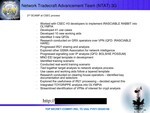
NSA/GCHQ/CSEC Network Tradecraft Advancement Team [pdf]
The "NSA/GCHQ/CSEC Network Tradecraft Advancement Team (NTAT) 2010" document describes a collaborative mission between the US, UK, and Canada to synchronize and advance SIGINT techniques. The NTAT focused on "Network Analysis Tradecraft," specifically integrating analysis tools such as IRASCIABLE RABBIT and TOYGRIPPE into CSEC's OLYMPIA and developing standardized "use cases" for tracking mobile networks and virtual private networks (VPNs).
-
Officer-In-Charge Needed in Afghanistan SIDtoday [pdf]
Job description for an officer-in-charge of NSA SIGINT operations to support Task Force 121.2 in Afghanistan.
Marking: SECRETThe Intercept ↗ (2016-12-07) -
Report on Architectural Risk 2012 - Summary [pdf]
This 2012 GCHQ report identifies that a historical under-investment in IT architecture has created significant risk, especially with new challenges like massive data growth, cyber defense, and increased partnering. The document recommends immediate, prioritized investment in big data strategies, integrated analytics frameworks, and security services to address the strain on the system.
Programs: BLACKHOLE -
Seeing into the Global SIGINT System - A View from the Field SIDtoday [pdf]
The Signals Intelligence Directorate's technical director sums up his thoughts on the visit to the expeditionary signals intelligence units in Iraq, Qatar, and Afghanistan.
People: Hurry, DaveThe Intercept ↗ (2017-09-13) -
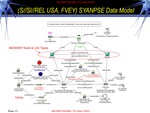
SYANPSE Data Model [pdf]
This document outlines the NSA’s SYANPSE Data Model, a classified metadata framework used for mapping relationships between people, organizations, devices, and intelligence designators. It details how various entities (e.g., phone numbers, email addresses, reports, and organizational units) are linked through structured graph relationships to support SIGINT analysis and tasking across the Five Eyes intelligence alliance.
-
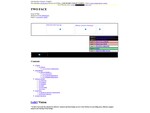
TWO FACE [pdf]
This document describes the GCHQ's TWO FACE project, a part of the Cyber Defence mission, which focuses on enhancing analysis and knowledge sharing tools using Palantir software. It outlines various data sources integrated with Palantir, such as XKEYSCORE and GEOFUSION, and the project's goals to automate and improve data importation, analysis capabilities, and user interface performance. The document also discusses training, user access, and collaboration within the Five Eyes intelligence community, as well as ongoing development to address gaps in existing cyber defense tools. It provides detailed instructions for using Palantir's capabilities to analyze and visualize data from multiple sources, with a focus on cyber defense and network defense operations. Key features include handling large datasets, running complex queries, and automating data integration. The document also highlights ongoing improvements, such as the addition of new data sources and the refinement of analytic tools to better support the cyber defense mission.
Programs: TWOFACE · PALANTIR · FRACTALJOKER · FRACTALWEB · PENSIVEGIRAFFE · XKEYSCORE · LIVE · AUTOASSOC · SOCIALANTHROPOID · INFINITEMONKEYS · KARMAPOLICE · SAMPEPYS · HRMAP · MUTANTBROTH · GEOFUSION · HACIENDA · FOXTRAIL · CROUCHINGSQUIRREL · PITCHFORD · HALTERHITCH · GORDIANKNOT · SAMUELPEPYS · MUGSHOT · RAPIDTAPIR · FIVEALIVE · GOOGLEFUSION · INTEGERSPIN · DEADSEA · MOONRAKER · OBERON · DISCOVER · 8BALL · CASK -
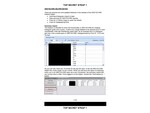
XKEYSCORE Helper Notes [pdf]
This GCHQ document describes new features in the XKEYSCORE Palantir helper tool, including summary/histogram import capabilities that reduce large datasets by aggregating connection data rather than creating individual events for each entry, and data sourcing features that track which XKEYSCORE queries imported specific data into Palantir. The document provides step-by-step screenshots showing how analysts can histogram network traffic by source IP, destination IP, and ports, then import aggregated results showing metadata like total session sizes and connection counts.
Programs: XKEYSCORE