Malware Analysis & Reverse Engineering – ACNO Skill Levels
Open PDFDocument date: -
Pages: 2
Genre: report
Banner: SECRET
Classification: SECRET
Dissemination: -
A GCHQ competency profile defines the “Malware Analysis & Reverse Engineering” skill (ACNO Skill 12), detailing required knowledge, hands-on abilities, and a graded proficiency ladder from novice to community-recognized expert. It codifies tradecraft spanning exploitation, static/dynamic analysis, anti-analysis countermeasures, and tooling (including IDA Pro), aligning outcomes from detection through mitigation advice.
My notes
SECRET
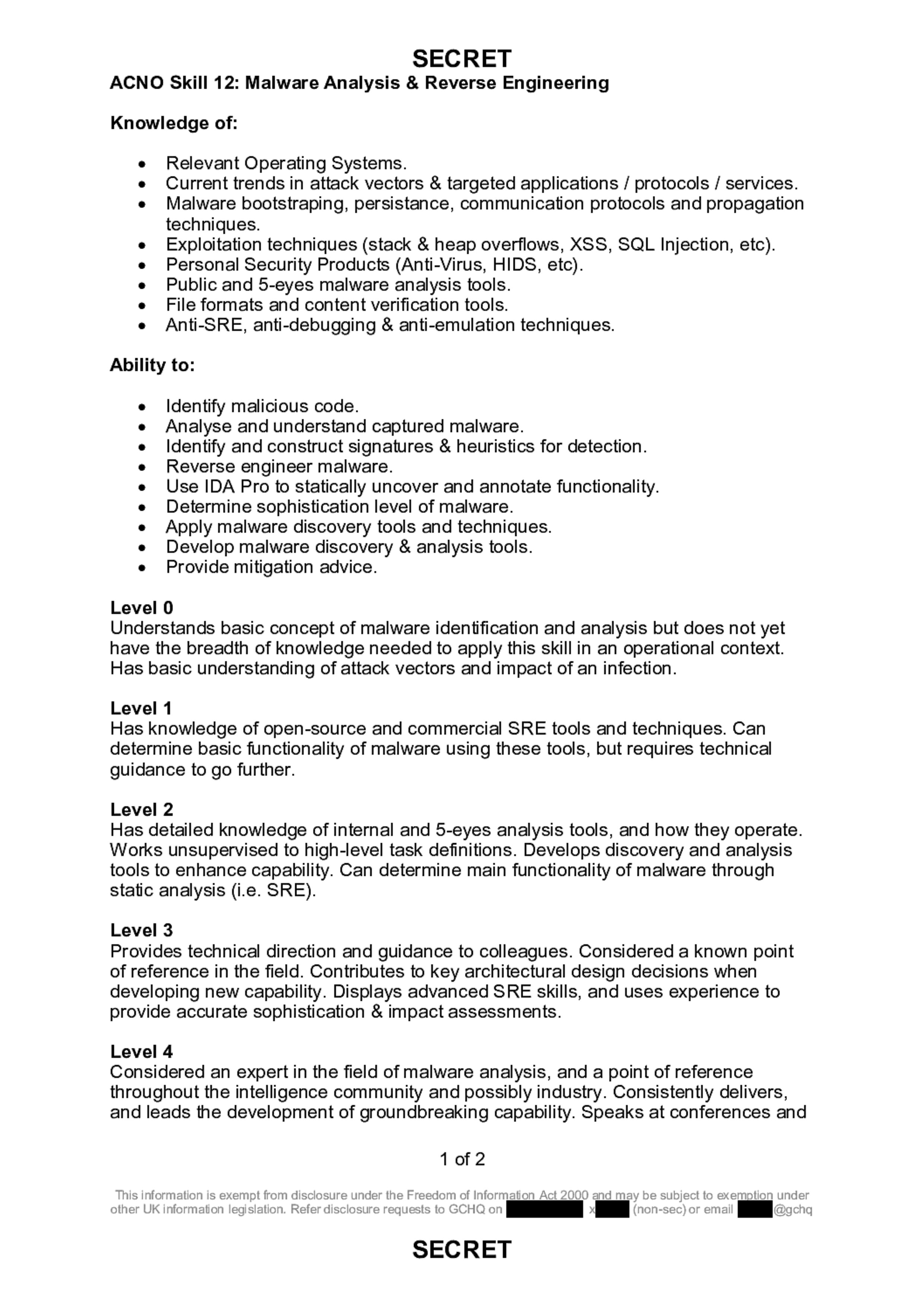
ACNO Skill 12: Malware Analysis & Reverse Engineering
Knowledge of:
- Relevant Operating Systems.
- Current trends in attack vectors & targeted applications / protocols / services.
- Malware bootstraping, persistance, communication protocols and propagation techniques.
- Exploitation techniques (stack & heap overflows, XSS, SQL Injection, etc).
- Personal Security Products (Anti-Virus, HIDS, etc).
- Public and 5-eyes malware analysis tools.
- File formats and content verification tools.
- Anti-SRE, anti-debugging & anti-emulation techniques.
Ability to:
- Identify malicious code.
- Analyse and understand captured malware.
- Identify and construct signatures & heuristics for detection.
- Reverse engineer malware.
- Use IDA Pro to statically uncover and annotate functionality.
- Determine sophistication level of malware.
- Apply malware discovery tools and techniques.
- Develop malware discovery & analysis tools.
- Provide mitigation advice.
Level 0
Understands basic concept of malware identification and analysis but does not yet have the breadth of knowledge needed to apply this skill in an operational context. Has basic understanding of attack vectors and impact of an infection.
Level 1
Has knowledge of open-source and commercial SRE tools and techniques. Can determine basic functionality of malware using these tools, but requires technical guidance to go further.
Level 2
Has detailed knowledge of internal and 5-eyes analysis tools, and how they operate. Works unsupervised to high-level task definitions. Develops discovery and analysis tools to enhance capability. Can determine main functionality of malware through static analysis (i.e. SRE).
Level 3
Provides technical direction and guidance to colleagues. Considered a known point of reference in the field. Contributes to key architectural design decisions when developing new capability. Displays advanced SRE skills, and uses experience to provide accurate sophistication & impact assessments.
Level 4
Considered an expert in the field of malware analysis, and a point of reference throughout the intelligence community and possibly industry. Consistently delivers, and leads the development of groundbreaking capability. Speaks at conferences and
1 of 2
This information is exempt from disclosure under the Freedom of Information Act 2000 and may be subject to exemption under other UK information legislation. Refer disclosure requests to GCHQ on [REDACTED] (non-sec) or email [REDACTED]@gchq
SECRET
SECRET
delivers specialised training in the field. Has a wealth of experience relating to malware trends & evolving techniques.
2 of 2
This information is exempt from disclosure under the Freedom of Information Act 2000 and may be subject to exemption under other UK information legislation. Refer disclosure requests to GCHQ on [REDACTED] (non-sec) or email [REDACTED]@gchq
SECRET
Published in the Same Report
(7 documents)
-
Intrusion Analysis – GCHQ [pdf]
An internal GCHQ write-up defines the Intrusion Analysis team’s remit inside the Joint Electronic Attack Cell: all‑source analysis of emerging and active electronic attacks, stewardship of electronic attack signatures, and SIGINT‑driven targeting under EITT oversight. It details sources, reporting channels, legal authorities, and auditing controls that govern how signatures are deployed and how selectors are managed.
-
Operational Legalities – GCHQ Powerpoint Presentation [pdf]
GCHQ’s “Operational Legalities” deck is an internal compliance playbook that translates the UK’s surveillance laws into day‑to‑day SIGINT procedure—drilling staff on authorisation, necessity, and proportionality, and walking through warrants, targeting justifications, database queries, dissemination, and oversight. Half slides and half speaker notes, it shows how analysts are trained to document, audit, and defend operations under ISA, RIPA, HRA, and WTA while navigating edge cases like location, nationality, second‑party constraints, and “indirect targeting.”
-
GCHQ Application for Renewal of Warrant GPW/1160 [pdf]
GCHQ’s 2008 application to renew warrant GPW/1160 seeks blanket cover under ISA section 5 to reverse engineer and modify commercial software—explicitly breaching copyright and licensing—to enable CNE, vulnerability research, and even police forensics. It catalogues concrete ops against web forums, routers, and antivirus, and asserts a novel legal theory blessed by the Intelligence Services Commissioner to immunize intellectual‑property interference.
-
Reverse Engineering – GCHQ Wiki [pdf]
GCHQ’s internal GCWiki page sketches the TEA Reverse Engineering unit inside the TECA Product Centre: a lab team built to dissect hardware and embedded crypto devices, defeat smartcard‑class microprocessors, and turn black boxes into SIGINT‑ready emulators. It doubles as a training hub and liaison node, with kit lists, tours, and SRE exchanges—most real work pushed behind higher‑compartment CAWiki pages.
Marking: UK SECRETPrograms: RUSSETT -
Software Reverse Engineering – GCHQ [pdf]
GCHQ’s Network Defence unit runs software reverse engineering across both malicious and commercial code to map vulnerabilities, validate security claims, and feed CESG’s advice on electronic attack. Malicious code is fair game, but commercial RE hinges on GCHQ’s ISA s5 SRE warrant (GPW/1160), with local authorisers and audits—after a documented lapse in 2008 was retro‑authorised.
Marking: TOP SECRET -
TECA Product Centre — Wiki [pdf]
The TECA Product Centre is a GCHQ unit, within the Technical Enabling Covert Access group (TEA), whose mission is to develop and exploit specialist technologies and physical access methods to gain intelligence or SIGINT access where conventional methods fail. It works closely with SIS (MI6) on technical operations and deployment, offering bespoke managed services rather than direct products.
-
TSI — Legal Authorisation Flowcharts: Targeting & Collection [pdf]
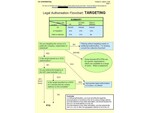
This document contains internal GCHQ flowcharts outlining the mandatory legal authorization required for both Targeting specific entities and Collection (interception) of communications content, based primarily on the target's location, nationality, and whether the activity involves UK or "Second Party" countries, primarily referencing the Regulation of Investigatory Powers Act (RIPA).
Marking: UK CONFIDENTIAL
Related Documents
-
Software Reverse Engineering – GCHQ [pdf]
GCHQ’s Network Defence unit runs software reverse engineering across both malicious and commercial code to map vulnerabilities, validate security claims, and feed CESG’s advice on electronic attack. Malicious code is fair game, but commercial RE hinges on GCHQ’s ISA s5 SRE warrant (GPW/1160), with local authorisers and audits—after a documented lapse in 2008 was retro‑authorised.
Marking: TOP SECRET -
Reverse Engineering – GCHQ Wiki [pdf]
GCHQ’s internal GCWiki page sketches the TEA Reverse Engineering unit inside the TECA Product Centre: a lab team built to dissect hardware and embedded crypto devices, defeat smartcard‑class microprocessors, and turn black boxes into SIGINT‑ready emulators. It doubles as a training hub and liaison node, with kit lists, tours, and SRE exchanges—most real work pushed behind higher‑compartment CAWiki pages.
Marking: UK SECRETPrograms: RUSSETT -
GCHQ Application for Renewal of Warrant GPW/1160 [pdf]
GCHQ’s 2008 application to renew warrant GPW/1160 seeks blanket cover under ISA section 5 to reverse engineer and modify commercial software—explicitly breaching copyright and licensing—to enable CNE, vulnerability research, and even police forensics. It catalogues concrete ops against web forums, routers, and antivirus, and asserts a novel legal theory blessed by the Intelligence Services Commissioner to immunize intellectual‑property interference.
-
TECA Product Centre — Wiki [pdf]
The TECA Product Centre is a GCHQ unit, within the Technical Enabling Covert Access group (TEA), whose mission is to develop and exploit specialist technologies and physical access methods to gain intelligence or SIGINT access where conventional methods fail. It works closely with SIS (MI6) on technical operations and deployment, offering bespoke managed services rather than direct products.
-
DSD Delves into Reverse Engineering SIDtoday [pdf]
A Signals Intelligence Directorate mathematician deployed to Australia collaborated with Defence Signals Directorate staff to establish a formal capacity to reverse-engineer communications systems for exploitation.
The Intercept ↗ (2017-09-13)