Tag: mobile phones 37 documents
Search documents matching “mobile phones” →Free-text subjects the curators added. Unlike the other axes these are not necessarily from the documents' own vocabulary, so they are the loosest thing to browse by (and the most forgiving).
Graphs
By Banner
By Classification
Refine (combine with another filter, via search)
Sort: Title
Documents
-
3G: impact and update - SDF Nov 09 [pdf]
This 2009 top-secret presentation from Australia’s Defence Signals Directorate (DSD) detailing 3G mobile network rollouts in Southeast Asia and identifying Indonesian President Susilo Bambang Yudhoyono, his wife, and senior officials as surveillance targets. It includes handset information, call data records, intercepted call attempts, and outlines plans for continued interception of Indonesian leadership communications.
-
AURORAGOLD Working Aid [pdf]
This document is a technical reference guide for analysts that categorizes the specific data fields extracted from mobile network documents (IR.21s) and commercial databases. It serves as a manual for translating telecommunications infrastructure data—such as encryption types, network layer protocols, and hardware versions—into actionable intelligence for target development and cyber exploitation.
Programs: AURORAGOLD -
AURORAGOLD Working Group [pdf]
The "AURORAGOLD Working Group" briefing is a highly classified SIGINT development presentation from June 2012 that outlines the NSA's progress in mapping the global mobile landscape (GSM/UMTS/LTE). It focuses on the project's "value proposition": providing an exhaustive database of network identifiers and technical configurations—often obtained by intercepting internal company documents—to support tactical military operations and long-term surveillance forecasting.
Programs: AURORAGOLD · UTT · XKEYSCORE · CADENCE · JUBILEECORONA · RONIN · NKB · GLOBALTIPPER · PINWALE -
CASCADE - Joint Cyber Sensor Architecture [pdf]
This presentation outlines the Communications Security Establishment’s (CSE) plans to unify and expand its cyber sensor networks (ITS and SIGINT) to create a comprehensive, multi-layered national cyber defense system, enabling threat detection, intelligence collection, and defensive operations across Canadian and foreign networks. It emphasizes standardizing sensor deployments, integrating analytic capabilities, and preparing for “Effects” operations to mitigate cyber threats by 2015. The presentation is duplicated from page 33 onwards - three slides of the duplicated slides have internal CSE comments.
Programs: CASCADE · PHOTONICPRISM · EONBLUE · INDUCTION · THIRDEYE · CRUCIBLE · CHOKEPOINT · SUNWHEEL · CASSIOPEIA · SCNET · JAZZFLUTE · GAZEBO · SEEDSPHERE · TEXPRO · SSO -
CIA Colleagues Enthusiastically Welcome NSA Training [pdf]
The NSA has successfully integrated technical training into the CIA’s workspace, providing CIA Target Analysts with the tools to use telephony metadata and GSM technology insights for HUMINT development. A key component of this initiative was the introduction of the ICREACH database, a massive metadata-sharing platform used by over 1,000 analysts across 23 U.S. intelligence agencies.
Programs: ICREACH -
COMPUTER NETWORK OPERATIONS - GENIE [pdf]
A TOP SECRET Congressional Budget Justification entry for the NSA/CSS GENIE project — the Tailored Access Operations programme underpinning all endpoint Computer Network Operations — requesting $651.7 million and 1,870 military and civilian positions for FY2013, with plans to maintain 85,000-96,000 implant points-of-presence worldwide and 9,000-10,000 active accesses, including $25.1 million for covert purchase of software vulnerabilities and a $3.4 million supply chain implant operation targeting al-Qaeda.
-
Content Acquisition Optimization PowerPoint Slides [pdf]
An NSA presentation on content acquisition optimisation — describing how incidental bulk collection from Yahoo Webmessenger, email address books, buddy lists and webmail inboxes was generating massive unintended collection volumes.
-
Content Extraction Enhancements For Target Analytics: SMS Text Messages: A Goldmine to Exploit (9 June 2011) [pdf]
The document describes the NSA’s Dishfire program, which collects hundreds of millions of global SMS messages daily, and the PREFER system, which extracts detailed metadata—including contacts, geolocation, travel, and financial information—from these messages for analytic purposes. It highlights the scale, operational processes, and types of data exploited to support intelligence and target analysis.
-
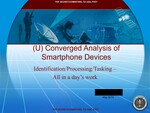
Converged Analysis of Smartphone Devices [pdf]
This 2010 document outlines NSA methods for identifying, processing, and exploiting data from smartphones by targeting both telephony and digital network intelligence (DNI). It details how analysts use tools like XKEYSCORE and metadata extraction to collect geolocation, app data, call logs, unique identifiers, and user activity from popular mobile apps and services (e.g., Google Maps, Facebook, Flickr), emphasizing the intelligence potential of smartphones as rich surveillance targets.
People: Kuruc, Paula -
Customers Can Help SID Obtain Targetable Phone Numbers SIDtoday [pdf]
US officials sometimes supply SID with their rolodexes. Although some of these numbers are public and others are not used to discuss sensitive information, they have lead the NSA to other useful numbers.
Marking: CONFIDENTIALPrograms: OCTAVEThe Intercept ↗ (2019-05-29) · “NSA monitored calls of 35 world leaders after US official handed over contacts” - The Guardian ↗ (2013-10-24) · Ball, James -
Digby geolocation [pdf]
The document reveals that RAF Digby was equipped with advanced profiling and analytics tools to enable (near) real-time co-location of GSM handsets, supporting intelligence operations across the Middle East and North Africa. It highlights the operational use of the RUM PUNCH algorithm on the DISTILLERY framework, which was jointly developed through an NSA–IBM–GCHQ partnership, allowing large-scale stream mining and independent analyst-led tracking operations. Enhancements at Digby extended beyond communications interception to include a new cyber mission, with capabilities to geo-locate emitters linked to IED arming and detonation under the FLAKJACKET mission, expanding the site’s role from surveillance to active battlefield support.
-
Event (SIGINT) [pdf]
5 p.This document explains that within GCHQ and NSA SIGINT operations, an “Event” refers to metadata about observable communications or user actions rather than message content, categorized into types like Communications, Presence, Social, and Geo-reference Events. These events are collected, stored in various databases, and analyzed through convergence and correlation processes, with standardized formats defined by Interface Control Documents such as INTERSTELLAR DUST (IDUST) and Actor Action (AA).
Programs: INTERSTELLAR DUST · HAUSTORIUM · SOCIAL ANTHROPOID · ACTOR-ACTION · SAMREF · GEOFUSION · HARD ASSOC · SALAMANCA · ASSOCIATION · BANYAN · MAINWAY · FASCIA · CULTWEAVE II · VOICESAIL · TEEDALE · PILBEAM · MUTANTBROTH · AUTOASSOC · MARBLEDGECKO · KARMAPOLICE · HRMAP · MEMORYHOLE · INFINITEMONKEYS · SOCIALANIMAL · AUTOTDI · SAMUELPEPYS · Mobile Applications Project · NGE · PPF · SLR -
Event RARE weekly summaries [pdf]
This document outlines GCHQ's ongoing surveillance efforts in Libya, focusing on intercepting and analyzing communications from the Libyan regime, including military command and control via mobile satellite phones and other communication channels. It details the use of advanced SIGINT tools and close cooperation with the NSA, US, and Canadian intelligence agencies to monitor key military targets and opposition forces, supporting both tactical military operations and strategic intelligence objectives.
People: Gaddafi, Muammar -
Excerpt of May 2008 NSA Afghanistan Dataflow Analysis [pdf]
The document outlines how the NSA’s Real Time Regional Gateway (RT-RG) in Afghanistan progressively expanded from late 2007 through 2008 to ingest massive amounts of GSM, VHF, HF, and telephony metadata from dozens of locations across Afghanistan, supplemented by third-party “dirtbox” collection from allied nations such as the Netherlands, Denmark, Norway, Germany, and Spain. It details the specific collection sites, data types, and timelines (SPIN 9, 10, 11, etc.), illustrating how partner contributions and multiple signals sources fed into the RT-RG system to enable real-time intelligence.
Programs: FOURCORNERS · FORTRESS · WARRIOR · ECHIDNA · CASSIEOPIA · KARUS · SOUNDER · SNICK · TEMPOWOLFE · CALYPSO · TATTERAN · AIRBORNE · LEAVEBEHIND · UDEAUS · NELEUS · CROSSHAIR · SSO · DRT · RIVET JOINT · VOICESAIL“Mission Creep: How the NSA’s Game-Changing Targeting System Built for Iraq and Afghanistan Ended Up on the Mexico Border” - The Intercept ↗ (2019-05-29) · “Norges hemmelige krig i Afghanistan” - NRK ↗ (2019-05-29) · Moltke, Henrik · Skille, Øyvind Bye · Døvik, Olav · Hansen, Ståle Ellingsgard · Fjørtoft, Martin -
FAA702 Glossary - Section 702 of the Fisa Amendments Act (FAA) [pdf]
This document outlines NSA rules under Section 702 of the FISA Amendments Act, which prohibit directly targeting U.S. persons or individuals inside the U.S., but quietly note a 2011 rule change allowing analysts to use U.S. person identifiers to query data already collected under 702—pending internal oversight. This effectively establishes a “backdoor search” capability enabling warrantless searches of Americans’ communications stored in NSA databases. Section 702 also gives the NSA authority to target without warrant the communications of foreign targets.
-
Full-Spectrum Cyber Effects [pdf]
The leaked 2012 GCHQ JTRIG “Full-Spectrum Cyber Effects” presentation outlines the UK’s offensive cyber capabilities, detailing strategies to destroy, deny, degrade, disrupt, deceive, and influence targets across digital and physical domains. It describes a wide range of operations—from network attacks, spoofing, and psychological operations on social media to hotel surveillance (Royal Concierge), mobile tracking, and advanced vulnerability exploitation—demonstrating how GCHQ integrates cyber operations, intelligence, and information warfare on a global scale.
Programs: JTRIG · SALAMANCA · RADIUS · ROYAL CONCIERGE · BLACKHOLE · GUILTY SPARK · MIDDLESEX GREEN · PPF · HOTWIRE -
GCHQ - PCS Harvesting [pdf]
A TOP SECRET STRAP1 report details how GCHQ industrialized the theft of GSM subscriber authentication keys (Ki) by automating trawls of bulk “C2C” content to extract IMSI/Ki pairs from emails and FTP transfers between SIM personalisation centers and mobile operators. It shows the program scaling key harvesting across networks and countries, complementing computer network exploitation against core mobile infrastructure to suppress billing and lift authentication secrets.
-
GCHQ NAC review – July to September (2011) [pdf]
The GCHQ NAC review (Jul–Sep 2011) outlines the continued support by NAC following the successful OP SOCIALIST operation, focusing on mapping Belgacom’s internal network and identifying key internal GRX routers to establish man-in-the-middle (MitM) platforms targeting roaming mobile handsets.
“Operation Socialist: The Inside Story of How British Spies Hacked Belgium’s Largest Telco” - The Intercept ↗ (2014-12-13) · “Lees hier hoe de Britse geheime dienst GCHQ Belgacom aanviel” - NRC ↗ (2014-12-13) · “Britse geheime dienst bespioneerde jarenlang Belgacom-klanten” - De Standaard ↗ (2014-12-13) · Gallagher, Ryan · Modderkolk, Huib · Vanhecke, Nikolas · Eeckhaut, Mark -
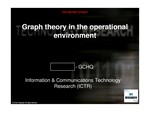
Graph theory in the operational environment – GCHQ [pdf]
This document details GCHQ’s research on identifying “closed loops” of communication, where targets use a small set of phones to communicate exclusively among themselves, often with cheap, disposable handsets like the Nokia 1100. It explains the methodology for analyzing anonymized metadata, constructing contact graphs, and extracting non-giant, non-tree components to discover operationally relevant closed loops for intelligence and counterterrorism purposes.
Programs: VOICESAILPeople: Rumsfeld, Donald -
How SIGINT Helped Liberate an American Hostage in Iraq SIDtoday [pdf]
A cryptologic support team identified mobile phone handsets involved in kidnappings in Iraq, which allowed special forces to capture and interrogate individuals with information regarding the hostage Roy Hallums, leading to his rescue.
The Intercept ↗ (2018-03-01)