Content Acquisition Optimization PowerPoint Slides
Open PDFDocument date: -
Pages: 9
Genre: slides
Banner: TOP SECRET//SI//NOFORN
Classification: TOP SECRET SI
Dissemination: NOFORN
An NSA presentation on content acquisition optimisation — describing how incidental bulk collection from Yahoo Webmessenger, email address books, buddy lists and webmail inboxes was generating massive unintended collection volumes.
My notes
TOP SECRET//SI//NOFORN
SPECIAL SOURCE OPERATIONS
Special Source Operations
Content Acquisition Optimization
[REDACTED]
[REDACTED]
[REDACTED]
TOP SECRET//SI//NOFORN
TOP SECRET//SI//NOFORN
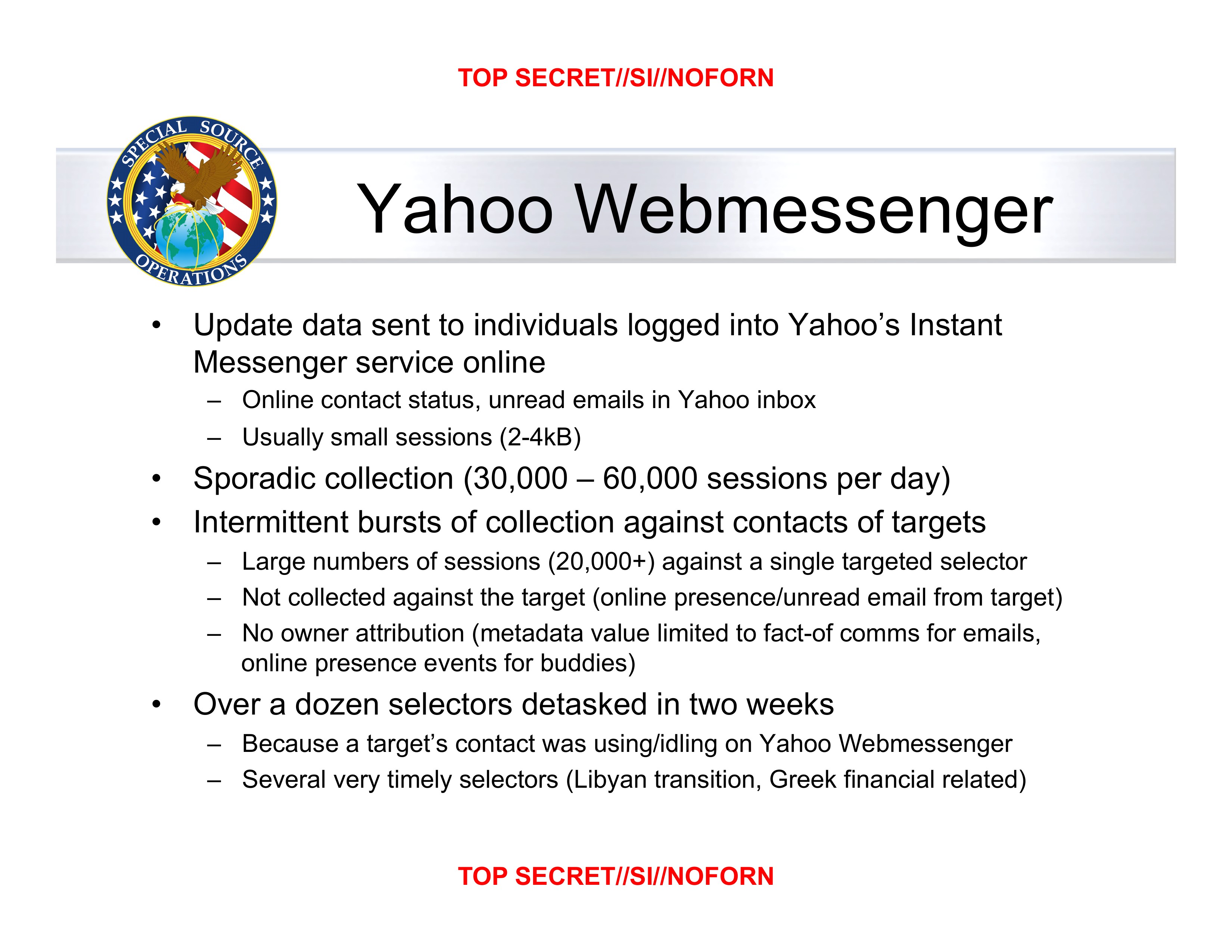
Yahoo Webmessenger
- Update data sent to individuals logged into Yahoo's Instant Messenger service online
- Online contact status, unread emails in Yahoo inbox
- Usually small sessions (2-4kB)
- Sporadic collection (30,000 – 60,000 sessions per day)
- Intermittent bursts of collection against contacts of targets
- Large numbers of sessions (20,000+) against a single targeted selector
- Not collected against the target (online presence/unread email from target)
- No owner attribution (metadata value limited to fact-of comms for emails, online presence events for buddies)
- Over a dozen selectors detasked in two weeks
- Because a target's contact was using/idling on Yahoo Webmessenger
- Several very timely selectors (Libyan transition, Greek financial related)
TOP SECRET//SI//NOFORN
TOP SECRET//SI//NOFORN
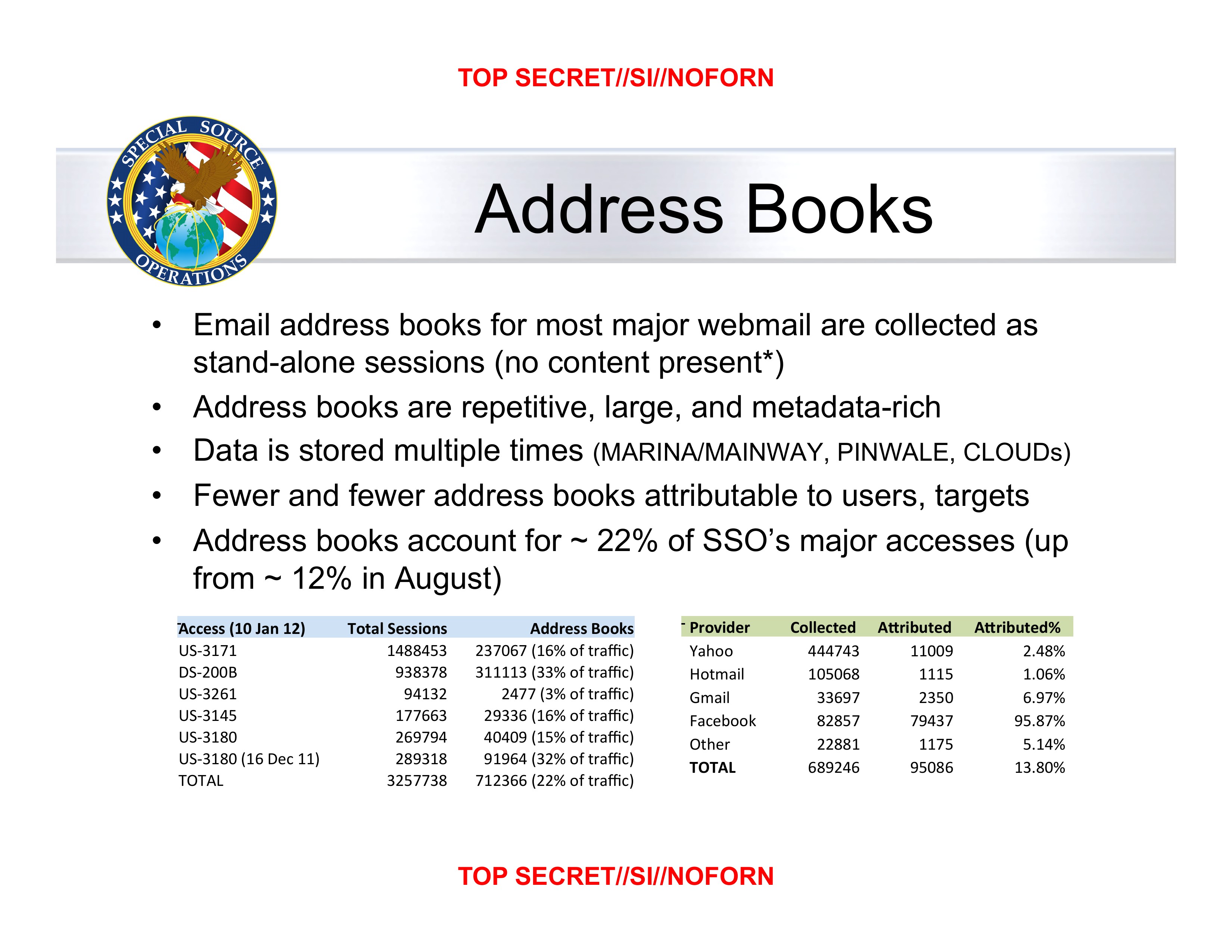
Address Books
- Email address books for most major webmail are collected as stand-alone sessions (no content present*)
- Address books are repetitive, large, and metadata-rich
- Data is stored multiple times (MARINA/MAINWAY, PINWALE, CLOUDs)
- Fewer and fewer address books attributable to users, targets
- Address books account for ~ 22% of SSO's major accesses (up from ~ 12% in August)
| Access (10 Jan 12) | Total Sessions | Address Books |
|---|---|---|
| US-3171 | 1488453 | 237067 (16% of traffic) |
| DS-200B | 938378 | 311113 (33% of traffic) |
| US-3261 | 94132 | 2477 (3% of traffic) |
| US-3145 | 177663 | 29336 (16% of traffic) |
| US-3180 | 269794 | 40409 (15% of traffic) |
| US-3180 (16 Dec 11) | 289318 | 91964 (32% of traffic) |
| TOTAL | 3257738 | 712366 (22% of traffic) |
| Provider | Collected | Attributed | Attributed% |
|---|---|---|---|
| Yahoo | 444743 | 11009 | 2.48% |
| Hotmail | 105068 | 1115 | 1.06% |
| Gmail | 33697 | 2350 | 6.97% |
| 82857 | 79437 | 95.87% | |
| Other | 22881 | 1175 | 5.14% |
| TOTAL | 689246 | 95086 | 13.80% |
TOP SECRET//SI//NOFORN
TOP SECRET//SI//NOFORN
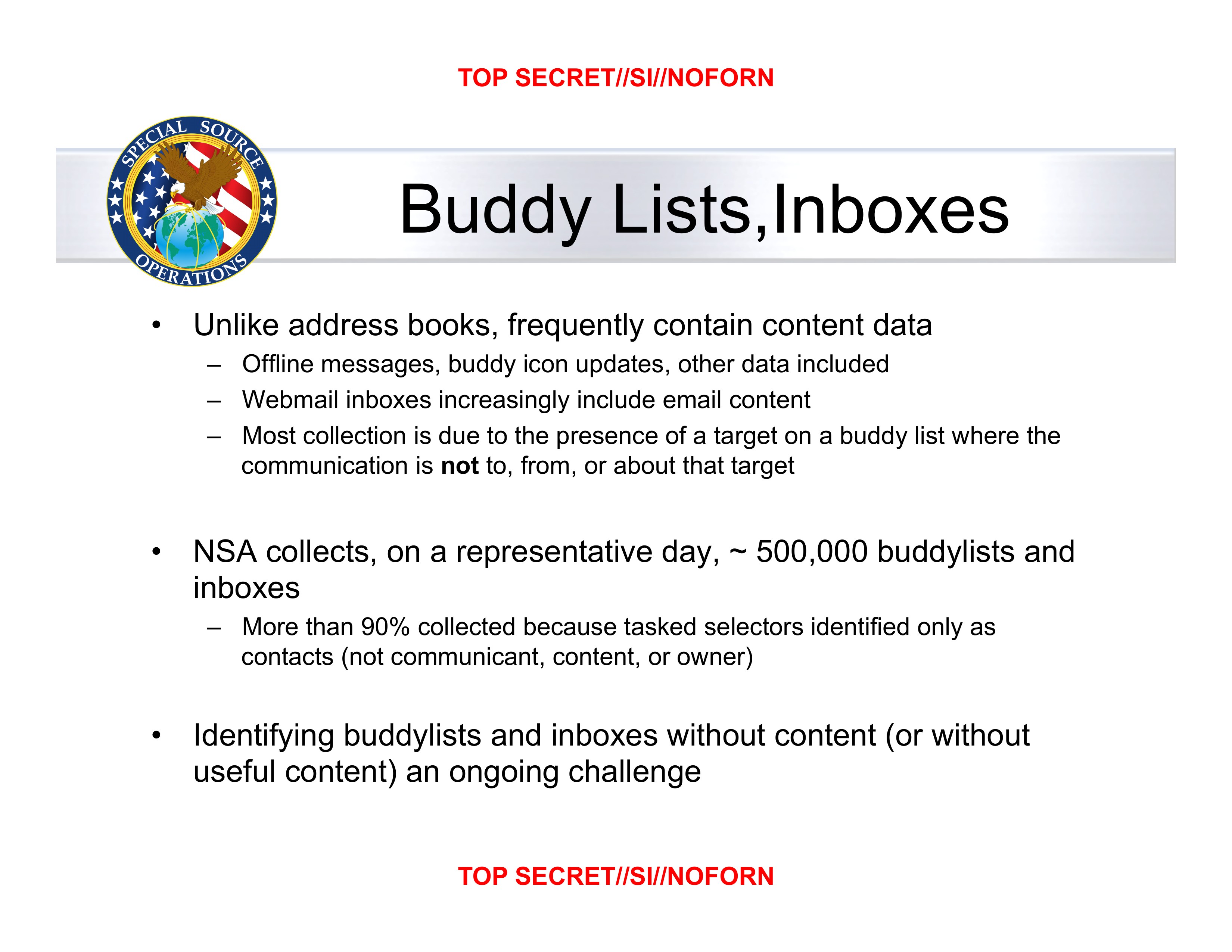
Buddy Lists,Inboxes
- Unlike address books, frequently contain content data
- Offline messages, buddy icon updates, other data included
- Webmail inboxes increasingly include email content
- Most collection is due to the presence of a target on a buddy list where the communication is not to, from, or about that target
- NSA collects, on a representative day, ~ 500,000 buddylists and inboxes
- More than 90% collected because tasked selectors identified only as contacts (not communicant, content, or owner)
- Identifying buddylists and inboxes without content (or without useful content) an ongoing challenge
TOP SECRET//SI//NOFORN
TOP SECRET//SI//NOFORN
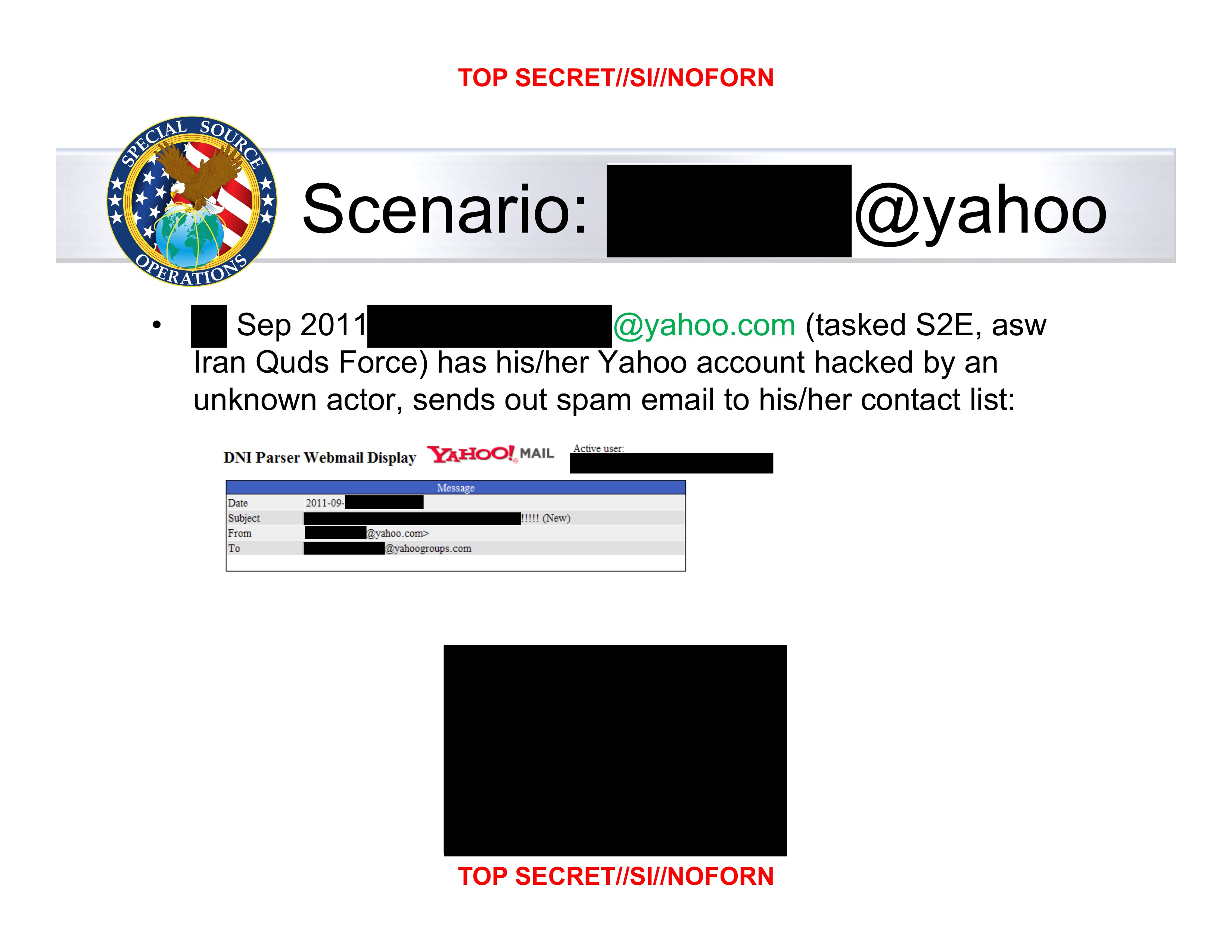
Scenario: [REDACTED]@yahoo
- [REDACTED] Sep 2011 [REDACTED]@yahoo.com (tasked S2E, asw Iran Quds Force) has his/her Yahoo account hacked by an unknown actor, sends out spam email to his/her contact list:
DNI Parser Webmail Display YAHOO! MAIL
Active user: [REDACTED]

Message

Date 2011-09-[REDACTED]
Subject [REDACTED]!!!!! (New)
From [REDACTED]@yahoo.com>
To [REDACTED]@yahoogroups.com
[REDACTED]
TOP SECRET//SI//NOFORN
TOP SECRET//SI//NOFORN
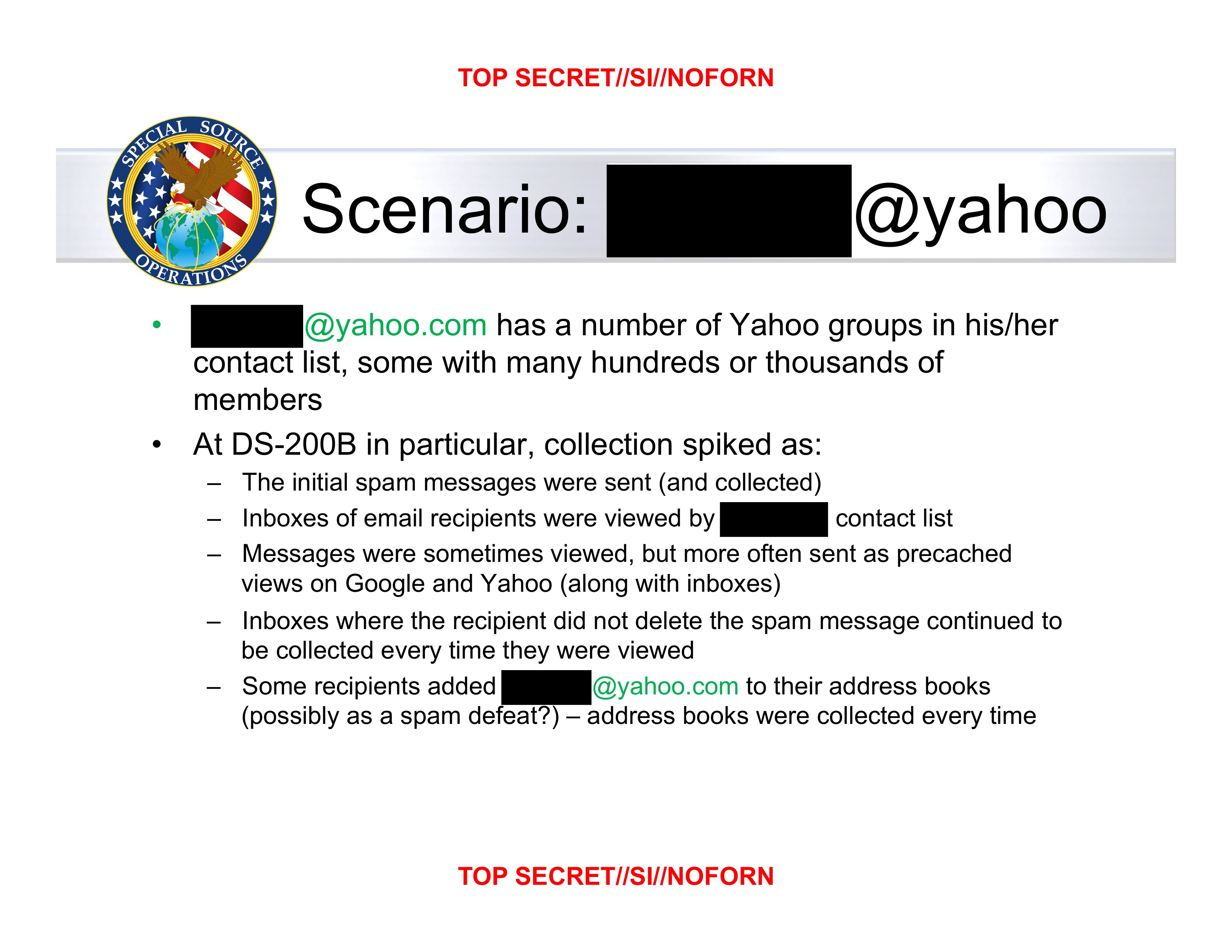
Scenario: [REDACTED]@yahoo
- [REDACTED]@yahoo.com has a number of Yahoo groups in his/her contact list, some with many hundreds or thousands of members
- At DS-200B in particular, collection spiked as:
- The initial spam messages were sent (and collected)
- Inboxes of email recipients were viewed by [REDACTED] contact list
- Messages were sometimes viewed, but more often sent as precached views on Google and Yahoo (along with inboxes)
- Inboxes where the recipient did not delete the spam message continued to be collected every time they were viewed
- Some recipients added [REDACTED]@yahoo.com to their address books (possibly as a spam defeat?) – address books were collected every time
TOP SECRET//SI//NOFORN
TOP SECRET//SI//NOFORN
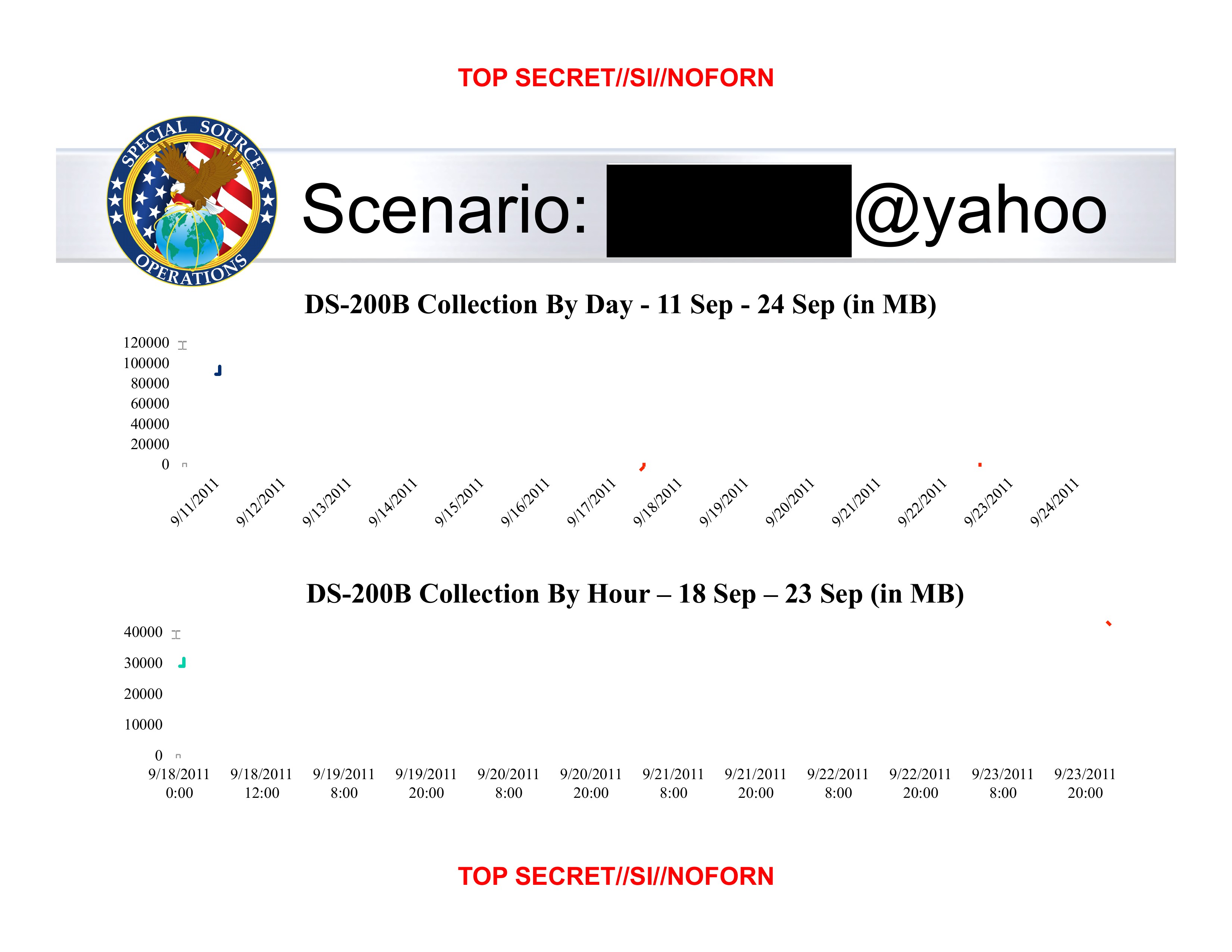
Scenario: [REDACTED]@yahoo
DS-200B Collection By Day - 11 Sep - 24 Sep (in MB)
120000
100000
80000
60000
40000
20000
0
9/11/2011 9/12/2011 9/13/2011 9/14/2011 9/15/2011 9/16/2011 9/17/2011 9/18/2011 9/19/2011 9/20/2011 9/21/2011 9/22/2011 9/23/2011 9/24/2011
DS-200B Collection By Hour – 18 Sep – 23 Sep (in MB)
40000
30000
20000
10000
0
9/18/2011 0:00 9/18/2011 12:00 9/19/2011 8:00 9/19/2011 20:00 9/20/2011 8:00 9/20/2011 20:00 9/21/2011 8:00 9/21/2011 20:00 9/22/2011 8:00 9/22/2011 20:00 9/23/2011 8:00 9/23/2011 20:00
TOP SECRET//SI//NOFORN
TOP SECRET//SI//NOFORN
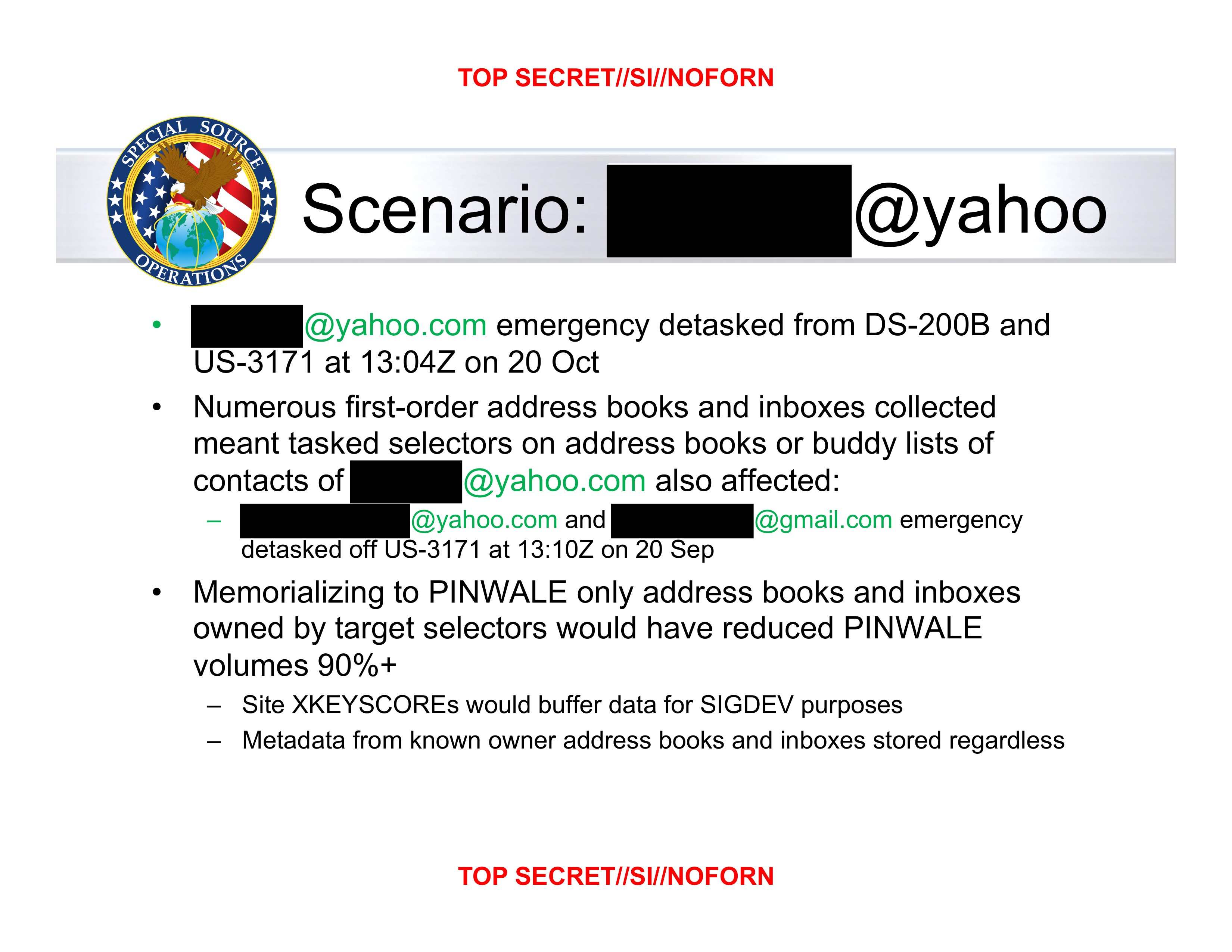
Scenario: [REDACTED]@yahoo
- [REDACTED]@yahoo.com emergency detasked from DS-200B and US-3171 at 13:04Z on 20 Oct
- Numerous first-order address books and inboxes collected meant tasked selectors on address books or buddy lists of contacts of [REDACTED]@yahoo.com also affected:
- [REDACTED]@yahoo.com and [REDACTED]@gmail.com emergency detasked off US-3171 at 13:10Z on 20 Sep
- Memorializing to PINWALE only address books and inboxes owned by target selectors would have reduced PINWALE volumes 90%+
- Site XKEYSCOREs would buffer data for SIGDEV purposes
- Metadata from known owner address books and inboxes stored regardless
TOP SECRET//SI//NOFORN
TOP SECRET//SI//NOFORN
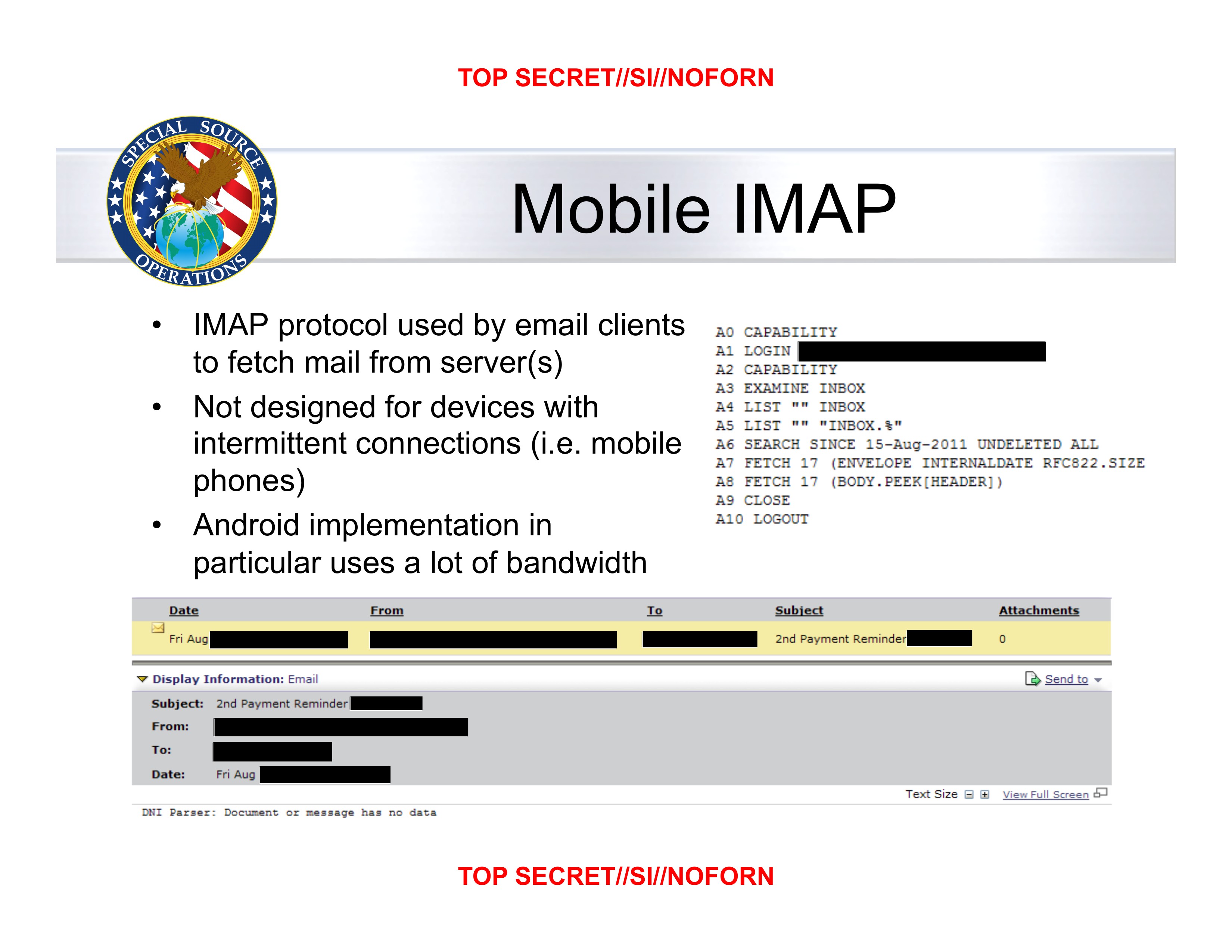
Mobile IMAP
- IMAP protocol used by email clients to fetch mail from server(s)
- Not designed for devices with intermittent connections (i.e. mobile phones)
- Android implementation in particular uses a lot of bandwidth
A0 CAPABILITY
A1 LOGIN [REDACTED]
A2 CAPABILITY
A3 EXAMINE INBOX
A4 LIST "" INBOX
A5 LIST "" "INBOX.%"
A6 SEARCH SINCE 15-Aug-2011 UNDELETED ALL
A7 FETCH 17 (ENVELOPE INTERNALDATE RFC822.SIZE
A8 FETCH 17 (BODY.PEEK[HEADER])
A9 CLOSE
A10 LOGOUT
| Date | From | To | Subject | Attachments |
|---|---|---|---|---|
| Fri Aug [REDACTED] | [REDACTED] | [REDACTED] | 2nd Payment Reminder [REDACTED] | 0 |
Display Information: Email
  Subject: 2nd Payment Reminder [REDACTED]
  From: [REDACTED]
  To: [REDACTED]
  Date: Fri Aug [REDACTED]

DNI Parser: Document or message has no data

Text Size  View Full Screen
TOP SECRET//SI//NOFORN
Published in the Same Report
(2 documents)
-
SSO Collection Optimization Overview [pdf]
This excerpt is from an article in the NSA's "Intellipedia," a classified system built with the same open-source software used by Wikipedia. Like the other documents, it describes the problem of high-volume, low-value data collection — and the NSA's response — with a focus on Internet contact lists.
-
SSO Collection Optimization [pdf]
This is another presentation on problems with the National Security Agency's overcollection of address books and buddy lists and its efforts to weed out useless content. See also EFF_-_20131104-wapo-optimization_google
Related Documents
-
SSO Collection Optimization [pdf]
This is another presentation on problems with the National Security Agency's overcollection of address books and buddy lists and its efforts to weed out useless content. See also EFF_-_20131104-wapo-optimization_google
-
Bulk collection of webmail address books and emerging protocols [pdf]
TOP SECRET NSA document details the large-scale collection of email address books and contact lists from major webmail and social media providers, emphasizing their metadata value despite low attribution rates to known targets. It also highlights ongoing efforts to identify and analyze emerging communication protocols, such as those used by Hotmail Messenger.
-
SSO Collection Optimization Overview [pdf]
This excerpt is from an article in the NSA's "Intellipedia," a classified system built with the same open-source software used by Wikipedia. Like the other documents, it describes the problem of high-volume, low-value data collection — and the NSA's response — with a focus on Internet contact lists.
-
WINDSTOP/2P System Highlights [pdf]
A March 2013 NSA Special Source Operations internal report describing a volume management problem at MUSCULAR — the joint NSA/GCHQ programme tapping Yahoo and Google inter-datacenter fiber links — specifically concerning Yahoo's proprietary Narchive email transfer format, which was generating 15GB/day of mostly stale email data representing 25% of the collection site's daily allocation.
-
SSO Collection Optimization [pdf]
The documents reveal that the NSA, in collaboration with GCHQ, accessed private internal networks of Google and Yahoo by intercepting data in transit between their data centers, without breaking into user accounts or servers. This involved analyzing proprietary formats and protocols, such as Google’s Gaia authentication system, using specialized tools to extract intelligence while operating primarily under foreign jurisdiction with fewer legal restrictions.