Tag: geolocation 124 documents
Search documents matching “geolocation” →Free-text subjects the curators added. Unlike the other axes these are not necessarily from the documents' own vocabulary, so they are the loosest thing to browse by (and the most forgiving).
Graphs
By document date (11 years)
By Banner
By Classification
Refine (combine with another filter, via search)
Sort: Title
Documents
-
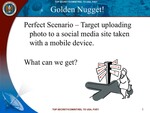
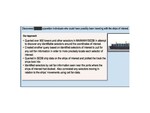
How the NSA Pinpoints a Mobile Device [pdf]
This document is an internal National Security Agency classification guide outlining the agency's abilities to intercept cellular communications.
Programs: ARCVIEW -
ICTR Cloud Efforts [pdf]
A GCHQ presentation details how the agency developed cloud-based big data analytics to achieve "population scale" surveillance—processing trillions of internet events to build geographic and behavioral profiles on every online identifier worldwide, enabling discovery of unknown targets through pattern analysis rather than traditional keyword searches.
Programs: EVERYASSOC · PROBABILITYCLOUD · SILVERLINING · CULTWEAVE · KARMAPOLICE · EVERYPOLICE · AWKWARDTURTLE · GORDIANKNOT · SANDIA · BLOODHOUND · FIVEALIVE · NGE · MAPREDUCE -
Identity Intelligence: Image Is Everything [pdf]
This document is a highly classified NSA/CSS briefing detailing Identity Intelligence (i2), a comprehensive methodology for exploiting unique fragments of information to track, identify, and exploit targets of interest. It outlines an expansive architecture for data collection that spans Biometric/Biologic, Biographic, and Contextual/Behavioral domains, essentially mapping every conceivable data point of an individual's physical existence and digital/social footprint.
-
Intercepted: Letter for Zarqawi from al-Qa'ida Senior Leaders SIDtoday [pdf]
NSA analysts obtained a “15-page document outlining al-Qaida’s strategic vision for Iraq” after tracking down the “human bridge” between Ayman al-Zawahiri, Al Qaeda’s second-in-command, and Abu Musab al-Zarqawi, Al Qaeda’s “chief operative in Iraq.” U.S. forces also captured an al-Zarqawi courier.
The Intercept ↗ (2018-08-15) -
Introduction to Context Sensitive Scanning with X-KEYSCORE Fingerprints [pdf]
This May 2010 NSA training document introduces XKEYSCORE's context-sensitive scanning capabilities using "fingerprints"—customizable detection rules that allow analysts to surgically target specific types of Internet traffic without needing prior knowledge of email addresses or other strong selectors, using over 70 unique contexts to identify patterns in communications and behaviors.
-
Is NSA Going Deaf? What Is 'Golf Cart Reporting'? -- An Interview With REDACTED SIDtoday [pdf]
SIDtoday interviews the deputy chief of the Middle East and North Africa product line. His team faces a personnel shortage and has to creatively onboard new staff who receive little training. He believes that new communications technology presents an advantage to the NSA, as the agency can spy on more intimate, firsthand communications from targets.
Programs: VOICESAILThe Intercept ↗ (2018-03-01) -
June Analytic Showcase Scheduled SIDtoday [pdf]
Staff will present two papers on new techniques. One enables the NSA to spy on traffic from Iraqi internet cafes to identify unique users and "support SIGINT-enabled surveillance and rendition operations," while the other, THERAPYCHEATER, helps analysts pick new targets for surveillance by looking at activity patterns in the draft folders of web accounts.
People: Mercurio, JoeThe Intercept ↗ (2017-09-13) -
Kudos from CENTCOM SIDtoday [pdf]
CENTCOM’s director of intelligence commended NSA for signals intelligence contributing to the success of operations in Iraq and also highlighted “great and timely reporting” by the NSA’s United Nations team.
People: Fast, BarbaraThe Intercept ↗ (2016-08-10) -
Leaky phone apps [pdf]
These GCHQ slides describe the "WARRIOR PRIDE" mobile intrusion capability being ported to iPhone and Android, with plugins for power management, remote microphone, high‑precision geolocation, kernel stealth, and self‑protection. It claims the ability to retrieve almost any content from infected phones (SMS/MMS, email, call records, photos, calendar, etc.). Part of GCHQ's project "Mobile Applications Project".
Programs: Mobile Applications Project · WARRIORPRIDE · DREAMYSMURF · NOSEYSMURF · TRACKERSMURF · PORUS · PARANOIDSMURF -
Learn About Cutting-Edge Analysis Tools SIDtoday [pdf]
New analysis tools developed by Tailored Access Operations help locate and visualize target devices.
The Intercept ↗ (2018-08-15) -
Location Cookies [pdf]
These slides contain excerpts from an April 2013 National Security Agency presentation detailing signal surveillance techniques and successes. They reveal that the NSA and its British counterpart, Government Communications Headquarters (GCHQ), use a Google-specific tracking cookie to pinpoint targets for hacking.
-
MASTERSHAKE: Locating Terrorists at Internet Cafés SIDtoday [pdf]
In the hunt for terrorists in Iraq, the "MASTERSHAKE" system uses detailed information on geolocation of modems installed in internet cafes, including the identification of a particular seat in some locations. The system has been used in more than 80 operations resulting in many arrests.
People: Quirk, RichardThe Intercept ↗ (2017-09-13) -
Media Leaks - Part 1 SIDtoday [pdf]
NSA refers to media leaks as “cryptologic insecurities.” This article lists several examples from 2000-2002 (from CBS News, “New York Times Daily News,” the Washington Times, and WorldNetDaily) along with damage assessments and follow-on actions, like reporting to the DOJ and requesting an FBI investigation.
People: bin Laden, OsamaThe Intercept ↗ (2016-08-10) -
Media Leaks - Part I (repost) SIDtoday [pdf]
(Repost) NSA refers to media leaks as “cryptologic insecurities.” This article lists several examples from 2000-2002 (from CBS News, “New York Times Daily News,” the Washington Times, and WorldNetDaily) along with damage assessments and follow-on actions, like reporting to the DOJ and requesting an FBI investigation.
People: bin Laden, OsamaThe Intercept ↗ (2016-08-10) -
Medical Pattern of Life - Targeting High Value Individual #1 - (SIGINT Enabling HUMINT / Targeting) [pdf]
This presentation dates from June 2010 and outlines a highly specialized intelligence strategy: using a target's medical needs as a "geospatial beacon" to bypass traditional security measures. In this context, High Value Individual #1 (HVI #1) refers to Osama bin Laden (UBL), and the document details a plan to track him via his suspected chronic kidney disease and related medical supplies.
People: bin Laden, Osama -
Menwith initiatives maximizing our access [pdf]
11 p.This document details Menwith Hill Station’s initiatives to maximize and optimize SIGINT collection, processing, and exploitation, including large-scale monitoring of internet and communications traffic, metadata analysis, and cross-platform target tracking. It describes programs and techniques for surveying, processing, and exploiting signals, enabling analysts to identify, geolocate, and track targets across multiple networks and devices.
Programs: ASPHALT · BLACKTOP · TARMAC · GTE · INDEX · ROADBED · DARKQUEST · EVIL EYE · Spider · SHAREDVISION · QUEST · NOSEYPARKER · XKEYSCORE · GRANDPIANO · FOGHORN · BASSQUEST · APPARITION · MUTANT BROTH · KARMAPOLICE · SOCIALANIMAL · MEMORY HOLE · TURBULENCE · TELLURIAN · MAILORDER · AUTO ASSOC · SLR · BLACKHOLE · JTRIG · PPF · LECKWITH · SCEPTRE · CLOUDPeople: Alexander, Keith B.“GCHQ taps fibre-optic cables for secret access to world's communications” - The Guardian ↗ (2013-06-21) · “Inside Menwith Hill: The NSA’s British Base at the Heart of U.S. Targeted Killing” - The Intercept ↗ (2016-09-06) · MacAskill, Ewen · Borger, Julian · Hopkins, Nick · Davies, Nick · Ball, James · Gallagher, Ryan -
Metadata Sharing Memorandum (2005) [pdf]
This 2005 NSA memorandum outlines plans to expand and formalize intelligence community–wide sharing of SIGINT-derived metadata beyond NSA, centering on the CRISSCROSS/PROTON program while balancing legal, operational, and source-protection concerns. It proposes a federated query model to increase access without further duplicating sensitive data outside NSA.
-
Metadata-Driven Drone Strikes SIDtoday [pdf]
These documents describe the NSA and CIA’s use of geolocation technology, particularly via UAV-mounted systems like GILGAMESH and VICTORYDANCE, to track mobile devices for targeted drone strikes, including operations that killed U.S. citizen Anwar Nasser Aulaqi. These programs rely heavily on signals intelligence rather than human confirmation, raising concerns about reliability, civilian casualties, and the accuracy of targeting. See also: SIDtoday/documents/2005/2005-01-18_SIDToday_-_New_Tactical_Collection_System_Joins_the_War_on_Terroris
-
MHS System Locates High Interest Internet Cafes, Some Used by Al-Qa'ida in Iraq SIDtoday [pdf]
Menwith Hill Station has had success in locating Iraqi Internet cafes used by terrorist targets using tools developed under the GHOSTHUNTER project. In an August 2006 mission, Menwith Hill was able to quickly confirm the sites where associates of the top Al Qaeda in Iraq leader were using computers. More recently multiple tips have led Menwith Hill to geolocate network sites and connect with high resolution imagery to identify exact locations.
The Intercept ↗ (2019-05-29) -
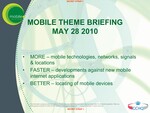
Mobile Theme Briefing (May 28, 2010) [pdf]
This 2010 GCHQ briefing document outlines the “Mobile Applications Project,” which aims to expand intelligence capabilities to exploit the growing shift from fixed to mobile internet usage. It details objectives for targeting mobile apps and roaming network traffic (GRX), enabling converged analysis of voice, text, command-and-control, and geolocation data across multiple mobile platforms such as iPhone, Symbian, Android, and Windows Mobile. See also: EFF_-_20140128-guard-leaky_phone_apps_0 (includes other slides from the same slideset)
Programs: Mobile Applications Project