Metadata-Driven Drone Strikes
Open PDFDocument date: 2012-03-03
Type: SIDtoday
Pages: 5
Genre: newsletter
Classification: TOP SECRET SI
Dissemination: NOFORN
These documents describe the NSA and CIA’s use of geolocation technology, particularly via UAV-mounted systems like GILGAMESH and VICTORYDANCE, to track mobile devices for targeted drone strikes, including operations that killed U.S. citizen Anwar Nasser Aulaqi. These programs rely heavily on signals intelligence rather than human confirmation, raising concerns about reliability, civilian casualties, and the accuracy of targeting. See also: SIDtoday/documents/2005/2005-01-18_SIDToday_-_New_Tactical_Collection_System_Joins_the_War_on_Terroris
My notes
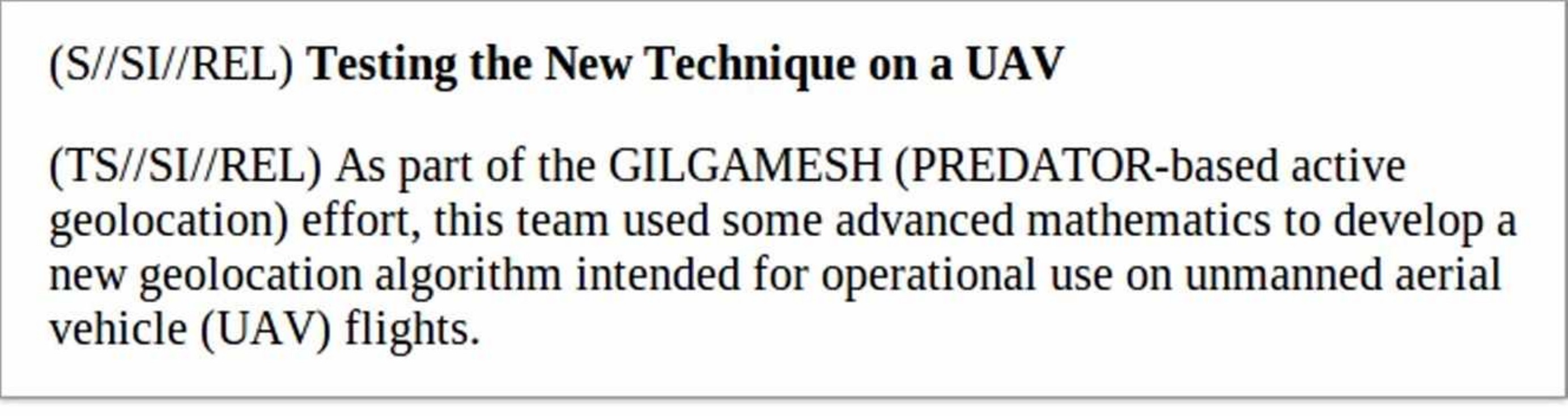


(S//SI//REL) Testing the New Technique on a UAV
(TS//SI//REL) As part of the GILGAMESH (PREDATOR-based active geolocation) effort, this team used some advanced mathematics to develop a new geolocation algorithm intended for operational use on unmanned aerial vehicle (UAV) flights.
(TS//SI//NF) The VICTORYDANCE mission was a great experience. It was truly a joint interagency effort between CIA and NSA. Flights and targets were coordinated with both CIAers and NSAers. The mission lasted 6 months, during which 43 flights were flown.
Our mission (VICTORYDANCE) mapped the Wi-Fi fingerprint of nearly every major town in Yemen
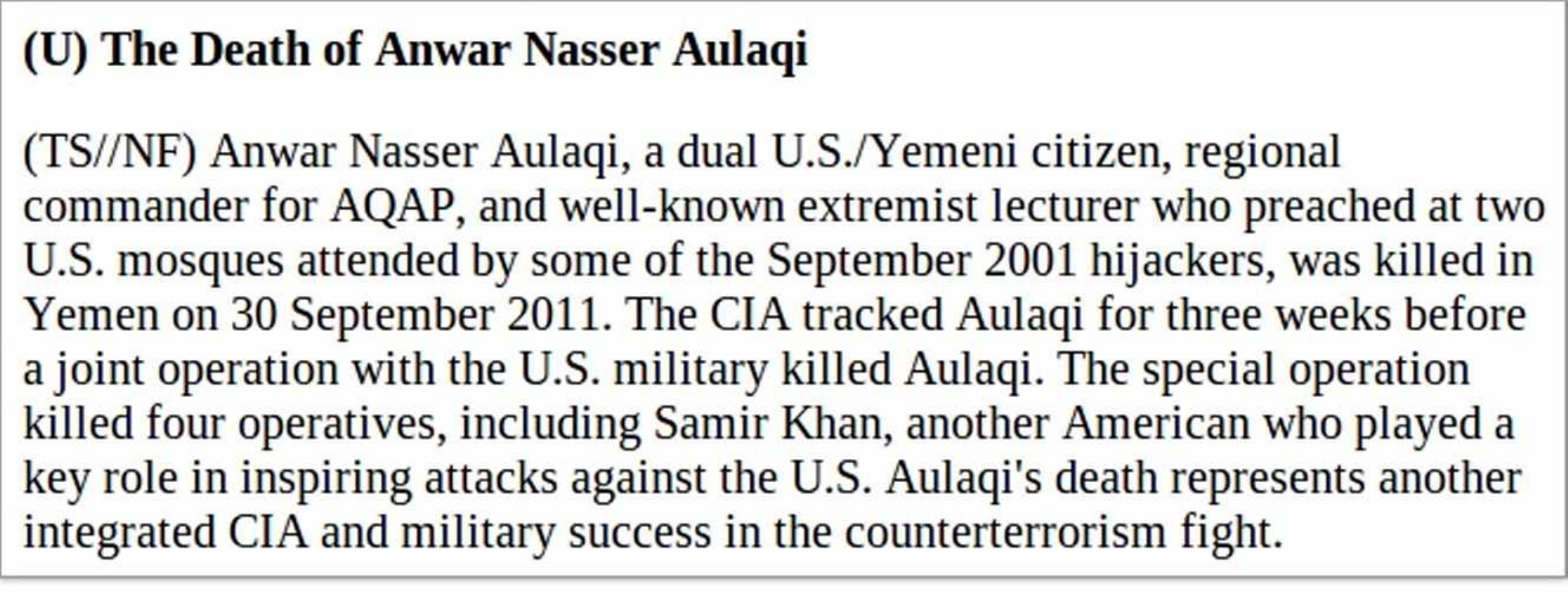
(U) The Death of Anwar Nasser Aulaqi
(TS//NF) Anwar Nasser Aulaqi, a dual U.S./Yemeni citizen, regional commander for AQAP, and well-known extremist lecturer who preached at two U.S. mosques attended by some of the September 2001 hijackers, was killed in Yemen on 30 September 2011. The CIA tracked Aulaqi for three weeks before a joint operation with the U.S. military killed Aulaqi. The special operation killed four operatives, including Samir Khan, another American who played a key role in inspiring attacks against the U.S. Aulaqi's death represents another integrated CIA and military success in the counterterrorism fight.
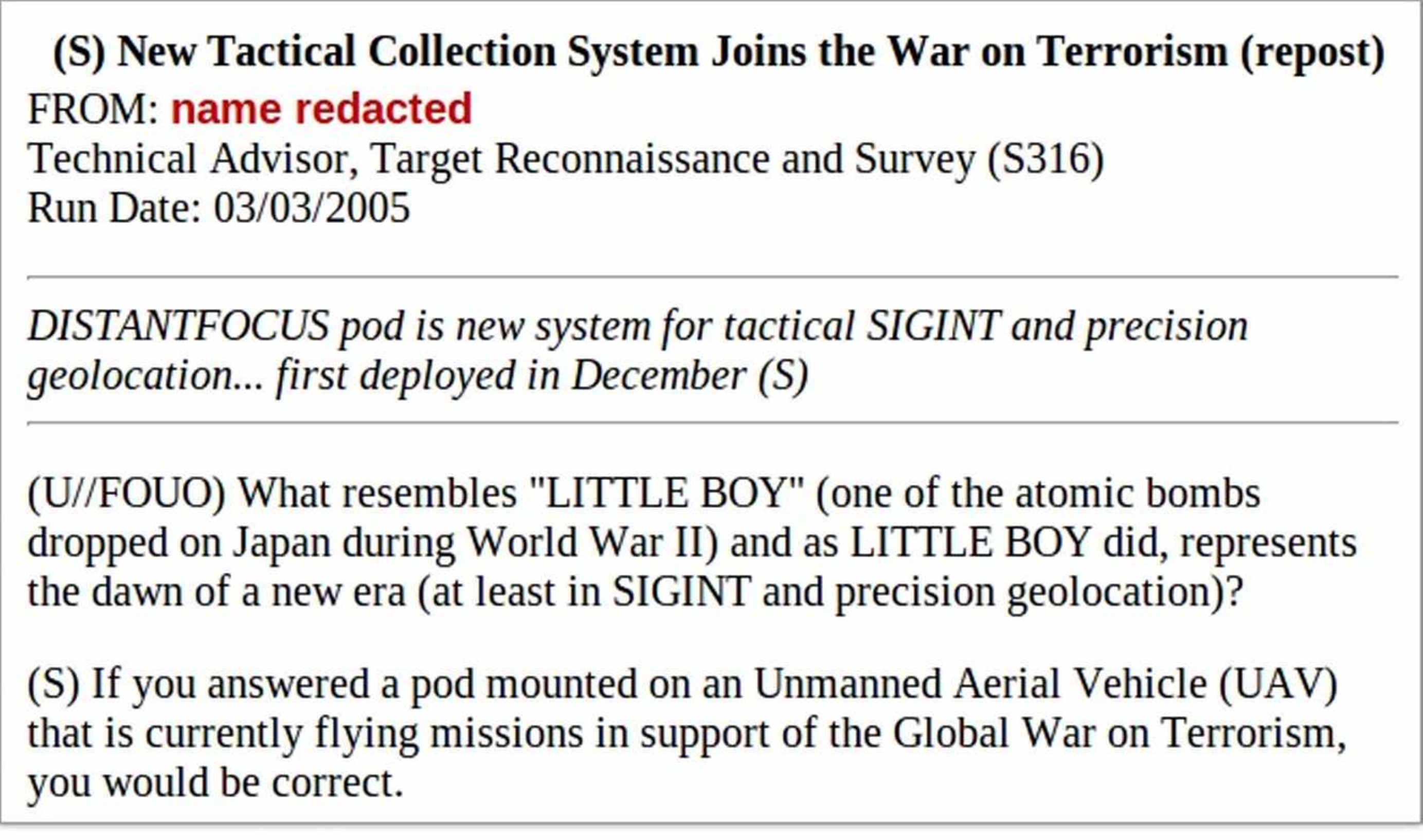
(S) New Tactical Collection System Joins the War on Terrorism (repost)
FROM: name redacted
Technical Advisor, Target Reconnaissance and Survey (S316)
Run Date: 03/03/2005
DISTANTFOCUS pod is new system for tactical SIGINT and precision geolocation... first deployed in December (S)
(U//FOUO) What resembles "LITTLE BOY" (one of the atomic bombs dropped on Japan during World War II) and as LITTLE BOY did, represents the dawn of a new era (at least in SIGINT and precision geolocation)?
(S) If you answered a pod mounted on an Unmanned Aerial Vehicle (UAV) that is currently flying missions in support of the Global War on Terrorism, you would be correct.
Published in the Same Report
(1 documents)
-
SHENANIGANS operator SIDtoday [pdf]
A March 2013 TOP SECRET SIDToday article written by an operator of SHENANIGANS — an airborne NSA collection system carried on CIA drones — describing the VICTORYDANCE mission that mapped the Wi-Fi signature of nearly every major town in Yemen to geolocate the wireless devices of Al Qaeda in the Arabian Peninsula, including detail on the tool's operation and confirmation that NSA Washington, NSA Georgia, the Special Collection Service and the Utah Regional Operations Center provided SIGINT support to the 30 September 2011 strike that killed Anwar al-Awlaki.
Programs: SHENANIGANS
Related Documents
-
SHENANIGANS operator SIDtoday [pdf]
A March 2013 TOP SECRET SIDToday article written by an operator of SHENANIGANS — an airborne NSA collection system carried on CIA drones — describing the VICTORYDANCE mission that mapped the Wi-Fi signature of nearly every major town in Yemen to geolocate the wireless devices of Al Qaeda in the Arabian Peninsula, including detail on the tool's operation and confirmation that NSA Washington, NSA Georgia, the Special Collection Service and the Utah Regional Operations Center provided SIGINT support to the 30 September 2011 strike that killed Anwar al-Awlaki.
Programs: SHENANIGANS -
New Tactical Collection System Joins the War on Terrorism SIDtoday [pdf]
"DISTANTFOCUS," a system mounted on Predator drones in the global war on terrorism, brings "the dawn of a new era" for signals intelligence and precision geolocation. Operators at NSA's headquarters have been remotely receiving encrypted real-time audio and geolocation data from Central Command's area of responsibility since December 2004.
The Intercept ↗ (2017-09-13) -
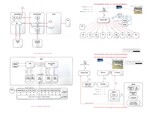
Architecture of U.S. Drone Operations [pdf]
“Germany is the Tell-Tale Heart of America's Drone War” - The Intercept ↗ (2015-04-17) · “Ramstein Air-Base: US-Drohneneinsätze aus Deutschland gesteuert” - Der Spiegel ↗ (2015-04-17) · Scahill, Jeremy · Bartsch, Matthias · Baumgärtner, Maik · Blome, Nikolaus · Darnstädt, Thomas · Gebauer, Matthias · Gude, Hubert · Rosenbach, Marcel · Schindler, Jörg · Schmid, Fidelius · Stark, Holger · Weinzierl, Alfred -
Targeted Killing: Policy, Legal and Ethical Controversy [pdf]
Intellipedia article surveying the policy, legal, and ethical controversy surrounding targeted killing, drone strikes, and related counterterrorism practices by the US, Israel, and NATO, outlining the international and domestic legal justifications offered by officials alongside the growing opposition from human rights groups, the UN, the ACLU, and international law experts. It catalogs key legal cases, government defenses, and debates—from the Awlaki lawsuits and the bin Ladin raid to challenges against CIA and British intelligence personnel—while noting related controversies over surveillance, detention, and interrogation.
People: Shehada, Salah · Sharon, Ariel · Alston, Phillip · Panetta, Leon · Koh, Harold · Leiter, Michael · Obama, Barack · Holder, Eric · Romero, Anthony D. · al-Awlaki, Anwar · Gates, Robert M. · Bates, John · Khan, Samir · Gaddafi, Aisha · Gaddafi, Muammar · Brossollet, Luc · Gaddafi, Saif al-Arab · Mastoura · Seif · Carthage · Heyns, Christof · Scheinin, Martin · Bouchard, Charles · Fox, Liam · Rizzo, John · Stafford Smith, Clive · Sadaullah · Khan, Kareem · Khan, Noor · Moses, Alan · Calderon · Eichensehr, Kristen · Melzer, Nils · bin Laden, Osama -
New Tactical Collection System Joins the War on Terrorism (repost) SIDtoday [pdf]
"DISTANTFOCUS," a system mounted on Predator drones in the global war on terrorism, brings "the dawn of a new era" for signals intelligence and precision geolocation. Operators at NSA's headquarters have been remotely receiving encrypted real-time audio and geolocation data from Central Command's area of responsibility since December 2004.
The Intercept ↗ (2017-09-13)