Metadata Sharing Memorandum (2005)
Open PDFDocument date: 2005-07-06
Pages: 4
Genre: report
Banner: SECRET//NOFORN//MR
Classification: SECRET MR
Dissemination: NOFORN
This 2005 NSA memorandum outlines plans to expand and formalize intelligence community–wide sharing of SIGINT-derived metadata beyond NSA, centering on the CRISSCROSS/PROTON program while balancing legal, operational, and source-protection concerns. It proposes a federated query model to increase access without further duplicating sensitive data outside NSA.
My notes
SECRET//NOFORN//MR
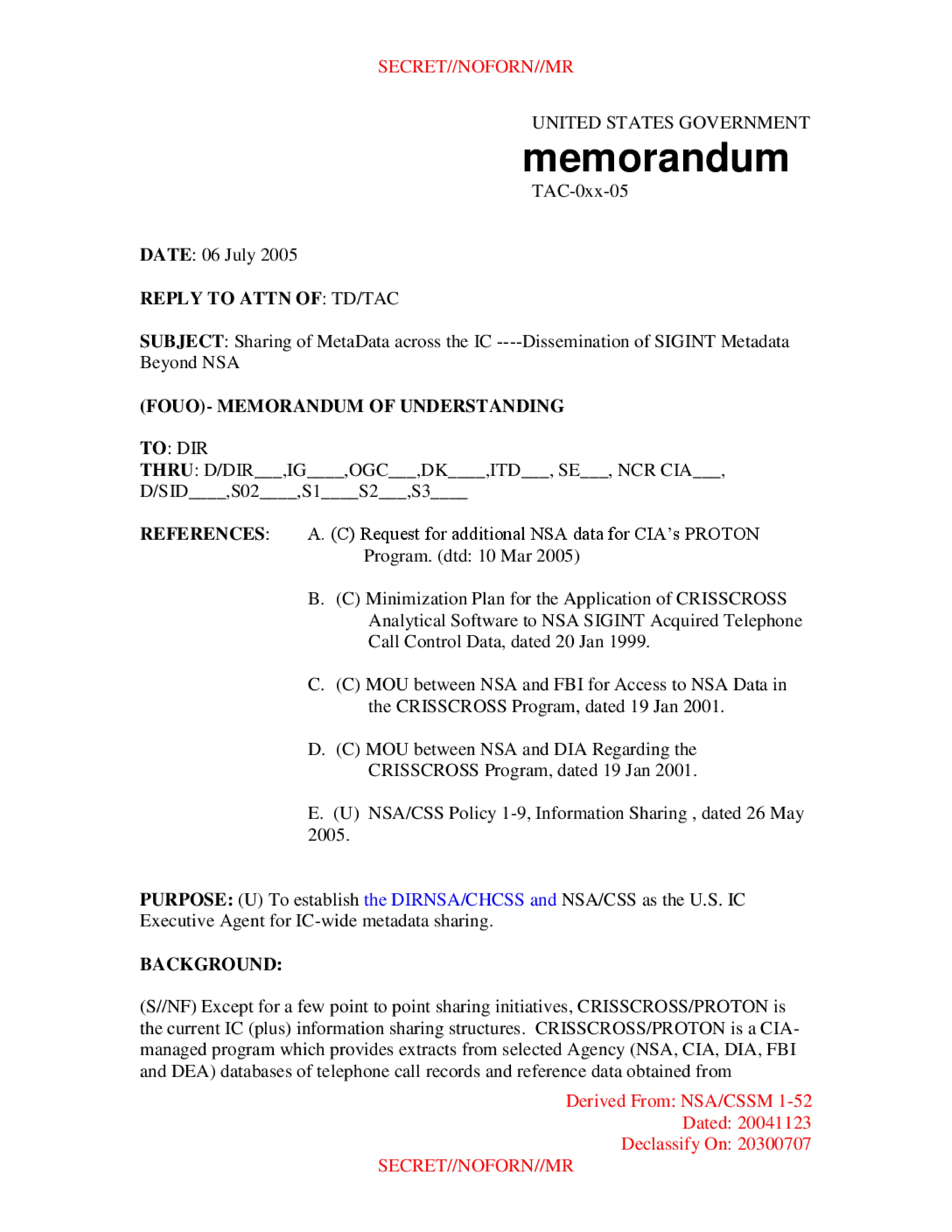
UNITED STATES GOVERNMENT
memorandum
TAC-0xx-05
DATE: 06 July 2005
REPLY TO ATTN OF: TD/TAC
SUBJECT: Sharing of MetaData across the IC ----Dissemination of SIGINT Metadata Beyond NSA
(FOUO) - MEMORANDUM OF UNDERSTANDING
TO: DIR
THRU: D/DIR____,IG_____,OGC___,DK___,ITD_____,SE_____,NCR CIA______, D/SID_____,S02_____,S1_____,S2_____,S3______
REFERENCES:
A. (C) Request for additional NSA data for CIA's PROTON Program. (dtd: 10 Mar 2005)
B. (C) Minimization Plan for the Application of CRISSCROSS Analytical Software to NSA SIGINT Acquired Telephone Call Control Data, dated 20 Jan 1999.
C. (C) MOU between NSA and FBI for Access to NSA Data in the CRISSCROSS Program, dated 19 Jan 2001.
D. (C) MOU between NSA and DIA Regarding the CRISSCROSS Program, dated 19 Jan 2001.
E. (U) NSA/CSS Policy 1-9, Information Sharing, dated 26 May 2005.
PURPOSE: (U) To establish the DIRNSA/CHCSS and NSA/CSS as the U.S. IC Executive Agent for IC-wide metadata sharing.
BACKGROUND:
(S//NF) Except for a few point to point sharing initiatives, CRISSCROSS/PROTON is the current IC (plus) information sharing structures. CRISSCROSS/PROTON is a CIA-managed program which provides extracts from selected Agency (NSA, CIA, DIA, FBI and DEA) databases of telephone call records and reference data obtained from
Derived From: NSA/CSSM 1-52
Dated: 20041123
Declassify On: 20300707
SECRET//NOFORN//MR
SECRET//NOFORN//MR
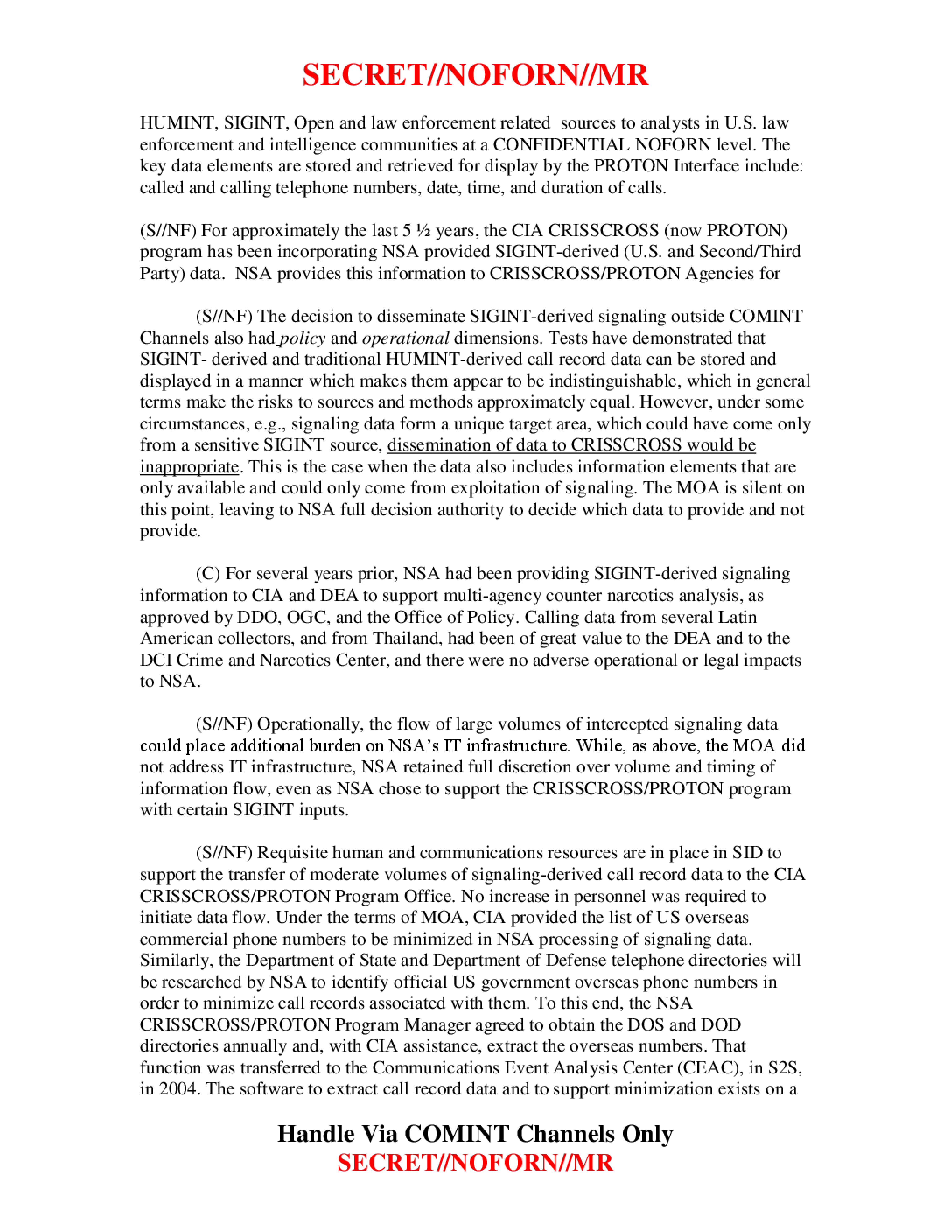
HUMINT, SIGINT, Open and law enforcement related sources to analysts in U.S. law enforcement and intelligence communities at a CONFIDENTIAL NOFORN level. The key data elements are stored and retrieved for display by the PROTON Interface include: called and calling telephone numbers, date, time, and duration of calls.
(S//NF) For approximately the last 5 ½ years, the CIA CRISSCROSS (now PROTON) program has been incorporating NSA provided SIGINT-derived (U.S. and Second/Third Party) data. NSA provides this information to CRISSCROSS/PROTON Agencies for
(S//NF) The decision to disseminate SIGINT-derived signaling outside COMINT Channels also had policy and operational dimensions. Tests have demonstrated that SIGINT- derived and traditional HUMINT-derived call record data can be stored and displayed in a manner which makes them appear to be indistinguishable, which in general terms make the risks to sources and methods approximately equal. However, under some circumstances, e.g., signaling data form a unique target area, which could have come only from a sensitive SIGINT source, dissemination of data to CRISSCROSS would be inappropriate. This is the case when the data also includes information elements that are only available and could only come from exploitation of signaling. The MOA is silent on this point, leaving to NSA full decision authority to decide which data to provide and not provide.
(C) For several years prior, NSA had been providing SIGINT-derived signaling information to CIA and DEA to support multi-agency counter narcotics analysis, as approved by DDO, OGC, and the Office of Policy. Calling data from several Latin American collectors, and from Thailand, had been of great value to the DEA and to the DCI Crime and Narcotics Center, and there were no adverse operational or legal impacts to NSA.
(S//NF) Operationally, the flow of large volumes of intercepted signaling data could place additional burden on NSA's IT infrastructure. While, as above, the MOA did not address IT infrastructure, NSA retained full discretion over volume and timing of information flow, even as NSA chose to support the CRISSCROSS/PROTON program with certain SIGINT inputs.
(S//NF) Requisite human and communications resources are in place in SID to support the transfer of moderate volumes of signaling-derived call record data to the CIA CRISSCROSS/PROTON Program Office. No increase in personnel was required to initiate data flow. Under the terms of MOA, CIA provided the list of US overseas commercial phone numbers to be minimized in NSA processing of signaling data. Similarly, the Department of State and Department of Defense telephone directories will be researched by NSA to identify official US government overseas phone numbers in order to minimize call records associated with them. To this end, the NSA CRISSCROSS/PROTON Program Manager agreed to obtain the DOS and DOD directories annually and, with CIA assistance, extract the overseas numbers. That function was transferred to the Communications Event Analysis Center (CEAC), in S2S, in 2004. The software to extract call record data and to support minimization exists on a
Handle Via COMINT Channels Only
SECRET//NOFORN//MR
SECRET//NOFORN//MR
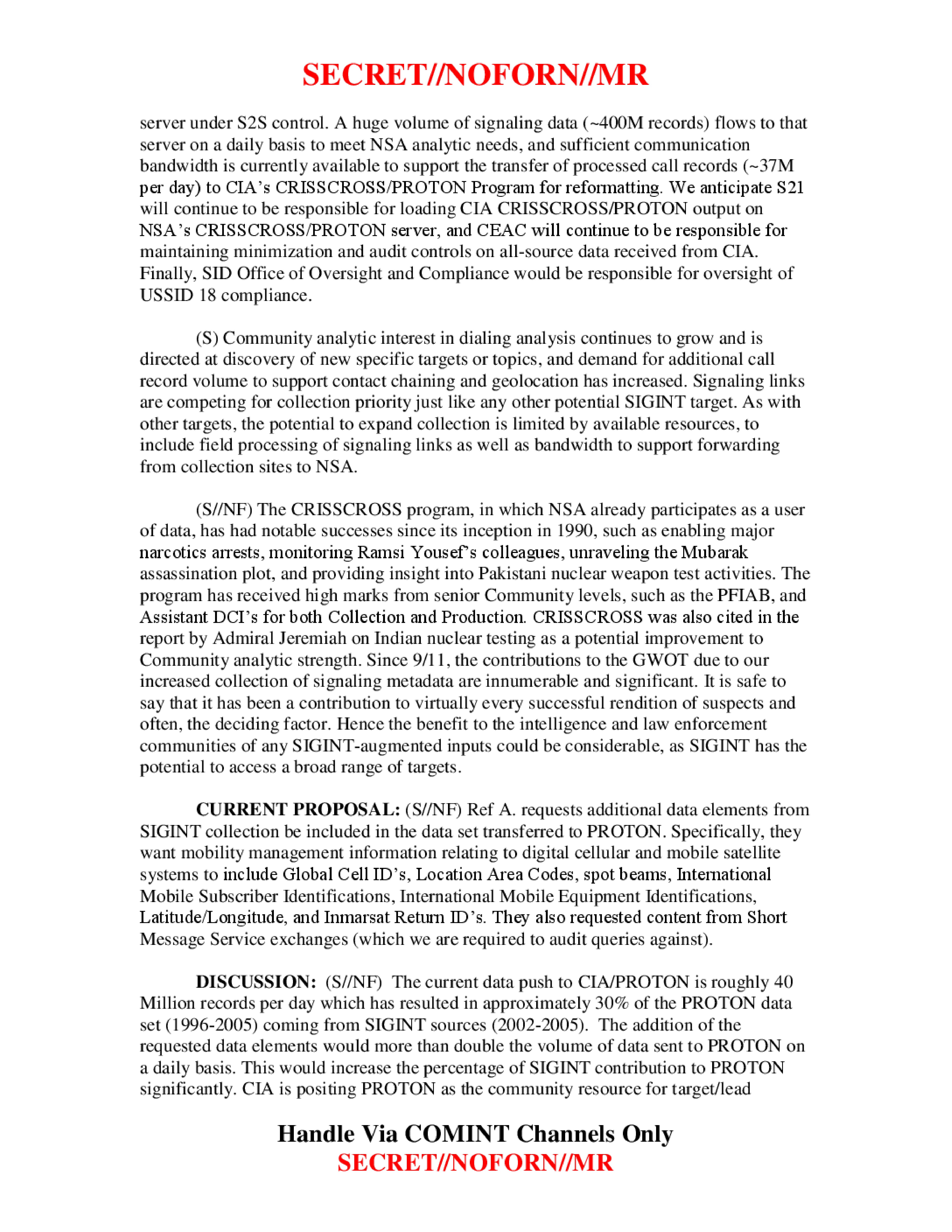
server under S2S control. A huge volume of signaling data (~400M records) flows to that server on a daily basis to meet NSA analytic needs, and sufficient communication bandwidth is currently available to support the transfer of processed call records (~37M per day) to CIA's CRISSCROSS/PROTON Program for reformatting. We anticipate S21 will continue to be responsible for loading CIA CRISSCROSS/PROTON output on NSA's CRISSCROSS/PROTON server, and CEAC will continue to be responsible for maintaining minimization and audit controls on all-source data received from CIA. Finally, SID Office of Oversight and Compliance would be responsible for oversight of USSID 18 compliance.
(S) Community analytic interest in dialing analysis continues to grow and is directed at discovery of new specific targets or topics, and demand for additional call record volume to support contact chaining and geolocation has increased. Signaling links are competing for collection priority just like any other potential SIGINT target. As with other targets, the potential to expand collection is limited by available resources, to include field processing of signaling links as well as bandwidth to support forwarding from collection sites to NSA.
(S//NF) The CRISSCROSS program, in which NSA already participates as a user of data, has had notable successes since its inception in 1990, such as enabling major narcotics arrests, monitoring Ramsi Yousef's colleagues, unraveling the Mubarak assassination plot, and providing insight into Pakistani nuclear weapon test activities. The program has received high marks from senior Community levels, such as the PFIAB, and Assistant DCI's for both Collection and Production. CRISSCROSS was also cited in the report by Admiral Jeremiah on Indian nuclear testing as a potential improvement to Community analytic strength. Since 9/11, the contributions to the GWOT due to our increased collection of signaling metadata are innumerable and significant. It is safe to say that it has been a contribution to virtually every successful rendition of suspects and often, the deciding factor. Hence the benefit to the intelligence and law enforcement communities of any SIGINT-augmented inputs could be considerable, as SIGINT has the potential to access a broad range of targets.
CURRENT PROPOSAL: (S//NF) Ref A. requests additional data elements from SIGINT collection be included in the data set transferred to PROTON. Specifically, they want mobility management information relating to digital cellular and mobile satellite systems to include Global Cell ID's, Location Area Codes, spot beams, International Mobile Subscriber Identifications, International Mobile Equipment Identifications, Latitude/Longitude, and Inmarsat Return ID's. They also requested content from Short Message Service exchanges (which we are required to audit queries against).
DISCUSSION: (S//NF) The current data push to CIA/PROTON is roughly 40 Million records per day which has resulted in approximately 30% of the PROTON data set (1996-2005) coming from SIGINT sources (2002-2005). The addition of the requested data elements would more than double the volume of data sent to PROTON on a daily basis. This would increase the percentage of SIGINT contribution to PROTON significantly. CIA is positing PROTON as the community resource for target/lead
Handle Via COMINT Channels Only
SECRET//NOFORN//MR
SECRET//NOFORN//MR
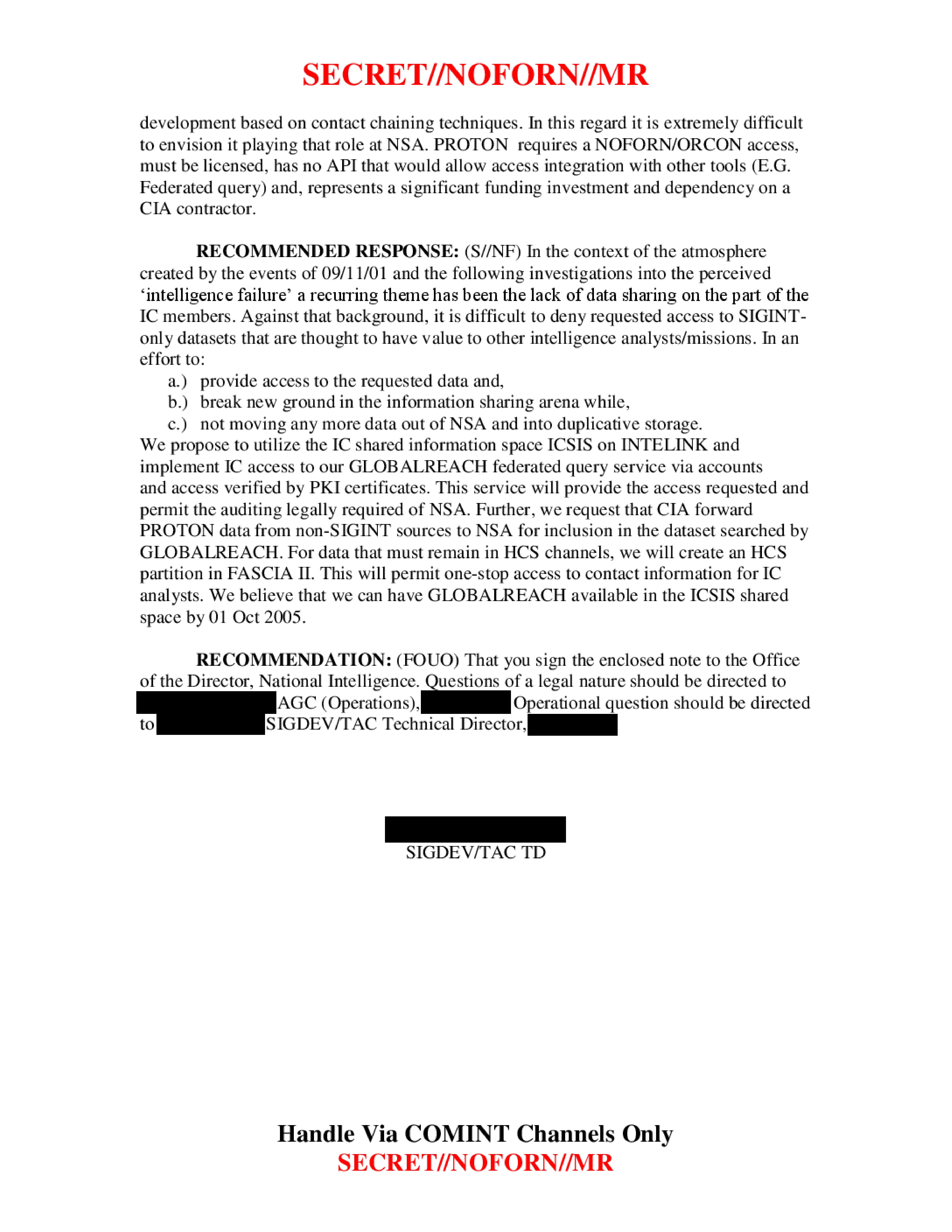
development based on contact chaining techniques. In this regard it is extremely difficult to envision it playing that role at NSA. PROTON requires a NOFORN/ORCON access, must be licensed, has no API that would allow access integration with other tools (E.G. Federated query) and, represents a significant funding investment and dependency on a CIA contractor.
RECOMMENDED RESPONSE: (S//NF) In the context of the atmosphere created by the events of 09/11/01 and the following investigations into the perceived 'intelligence failure' a recurring theme has been the lack of data sharing on the part of the IC members. Against that background, it is difficult to deny requested access to SIGINT-only datasets that are thought to have value to other intelligence analysts/missions. In an effort to:
a.) provide access to the requested data and,
b.) break new ground in the information sharing arena while,
c.) not moving any more data out of NSA and into duplicative storage.
We propose to utilize the IC shared information space ICSIS on INTELINK and implement IC access to our GLOBALREACH federated query service via accounts and access verified by PKI certificates. This service will provide the access requested and permit the auditing legally required of NSA. Further, we request that CIA forward PROTON data from non-SIGINT sources to NSA for inclusion in the dataset searched by GLOBALREACH. For data that must remain in HCS channels, we will create an HCS partition in FASCIA II. This will permit one-stop access to contact information for IC analysts. We believe that we can have GLOBALREACH available in the ICSIS shared space by 01 Oct 2005.
RECOMMENDATION: (FOUO) That you sign the enclosed note to the Office of the Director, National Intelligence. Questions of a legal nature should be directed to [REDACTED] AGC (Operations), [REDACTED] Operational question should be directed to [REDACTED] SIGDEV/TAC Technical Director, [REDACTED]
[REDACTED]
SIGDEV/TAC TD
Handle Via COMINT Channels Only
SECRET//NOFORN//MR
Published in the Same Report
(8 documents)
-
CIA Colleagues Enthusiastically Welcome NSA Training [pdf]
The NSA has successfully integrated technical training into the CIA’s workspace, providing CIA Target Analysts with the tools to use telephony metadata and GSM technology insights for HUMINT development. A key component of this initiative was the introduction of the ICREACH database, a massive metadata-sharing platform used by over 1,000 analysts across 23 U.S. intelligence agencies.
Programs: ICREACH -
CRISSCROSS/PROTON Point Paper [pdf]
Originating as a CIA/DEA joint venture in the 1990s, CRISSCROSS/PROTON is a centralized repository used by five U.S. agencies (CIA, DEA, NSA, DIA, FBI) for massive link analysis and contact chaining. The document details how the NSA provides billions of telephony records to the system to assist in capturing High Value Individuals (HVIs) but recommends transitioning to an NSA-led architecture using the GLOBALREACH federated query service.
-
Decision Memorandum for the DNI on ICREACH [pdf]
This 2006 memorandum from the Director of the NSA, Keith B. Alexander, requests that the Director of National Intelligence authorize the NSA to create ICREACH, a new Intelligence Community-wide system for sharing communications metadata. The proposal designates the NSA as the executive agent for this new structure, which would replace the older, less scalable PROTON program and grant unprecedented data access to partner agencies.
People: Alexander, Keith B. -
ICREACH Black Budget Extracts [pdf]
This document provides fiscal and strategic justifications for the continued expansion of ICREACH, detailing its role as a primary vehicle for disseminating both telephony and Digital Network Intelligence (DNI) metadata across the Intelligence Community. It outlines the platform's transition to the NSA/CSS cloud architecture, a move intended to enhance data enrichment services and ensure the system remains responsive to the evolving requirements of the National Intelligence Priorities Framework (NIPF).
Programs: ICREACH -
ICREACH Wholesale Sharing (2007) [pdf]
This document serves as an official submission by the SID Technical Director detailing the leadership and collaborative efforts required to transition ICREACH from a conceptual framework into the Intelligence Community's first wholesale metadata-sharing platform. This document emphasizes the role of the SID team in securing critical legal and policy approvals through the NSA's Office of the General Counsel and coordinating with Five Eyes partners to ensure international participation in the system.
Programs: ICREACH -
Metadata Policy Conference (2008) [pdf]
This document summarizes the high-level discussions from a 2008 conference focused on the legal, policy, and technical challenges of sharing communications metadata between the NSA, its domestic partners, and the Second Party (Five Eyes) SIGINT agencies. It highlights a strategic shift toward bulk data usage and "pattern of life" analysis, while navigating the complex legal distinctions between metadata and "content" under Executive Order 12333 and FISA.
-
Sharing Communications Metadata Across the U.S. Intelligence Community - ICREACH [pdf]
ICREACH is a "one-stop shopping" tool and federated query architecture that allows thousands of analysts across 23 U.S. agencies to search billions of communications metadata records. It consolidates telephony and digital network intelligence (DNI) from various sources—including NSA holdings, Second Party (Five Eyes) partners, and other IC databases like the CIA/FBI's PROTON—into a single, searchable interface. At its launch, the system increased shared metadata records from 50 billion to over 850 billion.
“How the NSA Built Its Own Secret Google” - The Intercept ↗ (2014-08-25) · “No Place to Hide” - Metropolitan Books ↗ (2014-05-13) · Gallagher, Ryan · Greenwald, Glenn -
ICREACH: Sharing SIGINT Comms Metadata with the Intel Community SIDtoday [pdf]
This document serves as an internal announcement marking the 2007 operational launch of ICREACH, a massive signals intelligence (SIGINT) metadata-sharing platform designed to provide real-time access to raw communication records for authorized analysts across the U.S. Intelligence Community. By consolidating telephony, cellular, and satellite data into a "one-stop shop" similar to the NSA’s internal GLOBALREACH tool, the program aimed to fulfill post-9/11 mandates for increased inter-agency collaboration and enhanced target development.

Related Documents
-
CRISSCROSS/PROTON Point Paper [pdf]
Originating as a CIA/DEA joint venture in the 1990s, CRISSCROSS/PROTON is a centralized repository used by five U.S. agencies (CIA, DEA, NSA, DIA, FBI) for massive link analysis and contact chaining. The document details how the NSA provides billions of telephony records to the system to assist in capturing High Value Individuals (HVIs) but recommends transitioning to an NSA-led architecture using the GLOBALREACH federated query service.
-
Decision Memorandum for the DNI on ICREACH [pdf]
This 2006 memorandum from the Director of the NSA, Keith B. Alexander, requests that the Director of National Intelligence authorize the NSA to create ICREACH, a new Intelligence Community-wide system for sharing communications metadata. The proposal designates the NSA as the executive agent for this new structure, which would replace the older, less scalable PROTON program and grant unprecedented data access to partner agencies.
People: Alexander, Keith B. -
Sharing Communications Metadata Across the U.S. Intelligence Community - ICREACH [pdf]
ICREACH is a "one-stop shopping" tool and federated query architecture that allows thousands of analysts across 23 U.S. agencies to search billions of communications metadata records. It consolidates telephony and digital network intelligence (DNI) from various sources—including NSA holdings, Second Party (Five Eyes) partners, and other IC databases like the CIA/FBI's PROTON—into a single, searchable interface. At its launch, the system increased shared metadata records from 50 billion to over 850 billion.
“How the NSA Built Its Own Secret Google” - The Intercept ↗ (2014-08-25) · “No Place to Hide” - Metropolitan Books ↗ (2014-05-13) · Gallagher, Ryan · Greenwald, Glenn -
ICREACH: Sharing SIGINT Comms Metadata with the Intel Community SIDtoday [pdf]
This document serves as an internal announcement marking the 2007 operational launch of ICREACH, a massive signals intelligence (SIGINT) metadata-sharing platform designed to provide real-time access to raw communication records for authorized analysts across the U.S. Intelligence Community. By consolidating telephony, cellular, and satellite data into a "one-stop shop" similar to the NSA’s internal GLOBALREACH tool, the program aimed to fulfill post-9/11 mandates for increased inter-agency collaboration and enhanced target development.
-
SSO dictionary relevant entries [pdf]
This document provides a detailed list of relevant entries related to NSA's Special Source Operations (SSO), highlighting various NSA surveillance and data collection systems used to monitor global communications. It includes descriptions of programs such as BIGBIRD and DISHFIRE, which focus on cable and SMS interception, as well as tools like LOPERS and COURIERSKILL for processing telephony metadata and refining target selection. The entries emphasize the extensive and automated nature of the NSA's intelligence-gathering operations, particularly in relation to undersea cables and telecommunication networks, and underscore the secretive and expansive scope of SSO's global surveillance activities.
Programs: ARTIFICE · BIGBIRD · FAIRVIEW · SSO · POORWILL · PINECONE · BLACKBELT · CADENCE · BLACKNIGHT · SHIPMASTER · COURIERSKILL · THEORYMASTER · WEALTHYCLUSTER · CLIFFSIDE · DISHFIRE · MARINA · MAINWAY · NUCLEON · PINWALE · FASCIA · BANYAN · LAMPSHADE · ASSOCIATION · HOMEBASE · SEDB · FRIAR · KEYCARD · TURMOIL · TURBULENCE · UTT · IRISHBEAUTY · OCTAVE · KOZYKOVE · LITHIUM · BLARNEY · LOPERS · MAILORDER · LUMBERYARD · MERLIN · NODDY · SAGUARO · NUTHATCH · CONTRAOCTAVE · XKEYSCORE · PLANK · RODEOSTAR · SAGURA · SERENADE · STARGATE · SILVERCOLLAM · SEALION · SEAGULL · SLIVER · SORA-2 · TITANPOINTE · TUBE · VPCS · STONEGATE“NSA Spying Relies on AT&T’s ‘Extreme Willingness to Help’” - ProPublica ↗ (2015-08-15) · “AT&T Helped U.S. Spy on Internet on a Vast Scale” - The New York Times ↗ (2015-08-15) · “The Wiretap Rooms: The NSA’s Hidden Spy Hubs in Eight U.S. Cities” - The Intercept ↗ (2018-06-25) · Angwin, Julia · Larson, Jeff · Savage, Charlie · Moltke, Henrik · Poitras, Laura · Risen, James · Gallagher, Ryan