Tag: beaconing 6 documents
Search documents matching “beaconing” →Free-text subjects the curators added. Unlike the other axes these are not necessarily from the documents' own vocabulary, so they are the loosest thing to browse by (and the most forgiving).
Graphs
By Banner
By Classification
Refine (combine with another filter, via search)
Sort: Title
Documents
-
Access: Vision 2013 [pdf]
This July 2010 GCHQ strategic document outlines the agency's vision for 2013 to create "the world's biggest SIGINT engine" with access to 800 10-gigabit connections (up from existing capacity), expanding overseas operations to 60% while reducing UK-based to 40%, and developing new capabilities including computer network exploitation (CNE), exfiltration, beaconry, geolocation, and collection of "Internet Pocket Litter" like cookies and browsing data. The strategy emphasizes "scale and pace," "balance," and "agility" while claiming to operate within legal frameworks of "necessity, proportionality and authorisation," and highlights partnerships with second and third parties to access "intractable and hard targets."
Marking: SECRET -
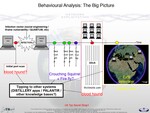
Behavioural Analysis: The Big Picture (Palantir could be used as part of a CNE) [pdf]
This diagram from GCHQ outlines the lifecycle of a CNE and identifies where Palantir fits into the intelligence workflow. The slide, titled "Behavioural Analysis: The Big Picture," illustrates a timeline of network exploitation from the initial infection of a target host to the eventual exfiltration of data. Crucially, it positions Palantir as a key "knowledge base" used for "Tipping to other systems." This indicates that Palantir’s software was used to aggregate data from successful hacks, allowing analysts to visualize connections and pivot (or "tip") that information toward further surveillance or offensive operations.
-
HIMR Data Mining Research Problem Book [pdf]
This document is a research roadmap created by GCHQ for the Heilbronn Institute for Mathematical Research (HIMR). Its purpose is to guide long-term mathematical and data-mining research that could improve signals intelligence (SIGINT) capabilities. It outlines key research problems, datasets, and collaboration plans between intelligence agencies and academic researchers. The main goal is to develop new algorithms and mathematical tools to analyze extremely large communications datasets produced by modern surveillance systems.
Programs: CLOUD · DISTILLERY · DISCOVER · PRESTON · LECKWITH · TERRAIN · BROADOAK · NGE · FIVEALIVE · CHARTBREAKER · FIRSTCONTACT · GEOFUSION · RADONSHARPEN-B · PRIMETIME · HIDDENOTTER · BAKERSDOZEN · CLASP · SALTYOTTER · BIRCH · SOLIDINK · FLUIDINK · MAMBA · GRINNINGROACH · PIRATECAREBEAR · AUTOASSOC · CROUCHINGSQUIRREL · HRMAP · KACHINA · SQUEAL · QUESTA · METEORSHOWER · SUNSTORM · GOLDMINE · HAGERAWEL · WOODY · BUZZ · SILVERLIBRARY · SILVERLINING · VALHALLA · MOUNTMCKINLEY · SEPANG · BLACKHOLE · SALAMANCA · HAGELAWEL · LUCKYSTRIKE · SPIKYROCK · MYOFIBRIL · INJUNCTION · PSYCHICSALMON · RAGINGBULLFROG · ROBOTICFISH · TIMIDTOAD · AURA · CARBONCOPY · CASK · CHORDAL · CRAN · INSTINCT · MADFORGE · SWAMP · VOLSUNGA · WHITERAVEN · MVR · PPF · JTRIG · MAPREDUCE · MAILORDERPeople: Tukey, John -
Pay attention to that man behind the curtain: Discovering aliens on CNE infrastructure [pdf]
CSEC briefing from 2010 outlines Canada’s counter–computer network exploitation efforts to detect, analyze, and pursue foreign and friendly cyber actors operating on shared CNE infrastructure. It details tools, methods, and a case study showing how hidden implants and overlapping state-sponsored operations were uncovered and attributed.
Programs: SNOWGLOBE · WARRIORPRIDE · DAREDEVIL · SLIPSTREAM · CHORDFLIER · NAMEDROPPER · WORMWOOD · REPLICANTFARM · OBELIX · SHEPHERD · CARBON · ALOOFNESS · REGBACKUP · DOGHOUSE · WALKER · CHOCOPOP · BLAZINGANGEL · WINDO · QUIVERINGSQUAB · DIESELRATTLE · CYDLL · CIVETCAT · WIDOWKEY · LASEX · PULLEDPORK · MAKERSMARK · FANNER · SEEDSPHERE · BYZANTINE · VOYEUR · SUPERDRAKE · GOSSIPGIRL · WATERMARK · DOURMAGNUM -
Tor Hidden Services - How Hidden is 'Hidden'? [pdf]
A TOP SECRET GCHQ presentation analysing the security of Tor hidden services — covering the hidden service protocol architecture, possible exploitation vectors including the Coil Attack against introduction points, a beaconing pattern discovered in idle hidden services, and the HOMING TROLL bridge discovery capability — concluding that hidden services are "near impossible" to deanonymise but noting several research avenues including PRESTON integration.
-
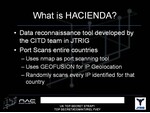
What is HACIENDA? [pdf]
This document details HACIENDA, a large-scale reconnaissance tool used by GCHQ and the Five Eyes alliance to perform automated port scanning and vulnerability mapping across entire nations. It outlines the technical process of identifying and exploiting network infrastructure, specifically for the purpose of discovering Operational Relay Boxes (ORBs) to facilitate covert "Computer Network Exploitation" (CNE).