Publication year: 2015-06 21 documents
Search documents matching “2015-06” →When a publisher first published each document. If a document is published multiple times, only the oldest one is used here.
Graphs
By document date (4 years)
Sort: Title
Documents
-
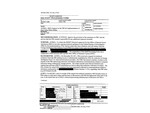
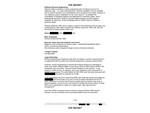
CNO Legal Authorities [pdf]
An NSA Office of General Counsel briefing on the legal authorities for computer network operations and the NTOC floor: constitutional and EO 12333 limits, NSCID 6 definitions, Wiretap Act exceptions, NSD 42, service-provider information-assurance rules (DoD 5240.1-R), and oversight and compliance.
-
Final Cyberspace Policy Review: Appendices D and E [pdf]
Appendices D and E of a secret, REL FVEY Cyberspace Policy Review. Appendix D evaluates the Comprehensive National Cybersecurity Initiative initiatives and enablers and the status of each. Appendix E argues for an international cybersecurity policy framework, covering internet governance bodies, free speech, supply chains and deterrence.
Programs: EINSTEIN -
GCHQ Application for Renewal of Warrant GPW/1160 [pdf]
GCHQ’s 2008 application to renew warrant GPW/1160 seeks blanket cover under ISA section 5 to reverse engineer and modify commercial software—explicitly breaching copyright and licensing—to enable CNE, vulnerability research, and even police forensics. It catalogues concrete ops against web forums, routers, and antivirus, and asserts a novel legal theory blessed by the Intelligence Services Commissioner to immunize intellectual‑property interference.
-
GCHQ Ministry Stakeholder Relationships Spreadsheets [pdf]
This document details GCHQ's strategic engagement and intelligence support across various UK government departments (e.g., Bank of England, FCO, MoJ, DECC) for 2008-2009, covering areas from economic stability and national security to social policy and infrastructure protection. Each departmental overview outlines specific GCHQ objectives, current headline issues, areas of impact, and intelligence products provided.
People: King, Mervyn · Gieve, John · Bailey, Andrew · Allen, Stuart · Brown, Gordon · Haywood, Jeremy · Fletcher, Tom · Catsaras, Nick · King, Simon · Cavanagh, Matt · Jacobs, Michael · Forsyth, Justin · Wood, Stuart · Hepburn, Eric · Groves, John · O'Donnell, Gus · Hannigan, Robert · McDonald, Simon · Cunliffe, Jon · Allen, Alex · Dowse, Tim · Wright, Chris · Grey, Sue · Johnson, Chris · Styles, Roger · Aldred, Margaret · Cleveland, Alexis · Taylor, Michael · Blears, Hazel · Housden, Peter · Scholefield, Susan · Williams, David · Freeman, Jonathan · Hasan, Jenan · Greaves, Daniel · Boyle, Louise · Whiting, Ed · Pyott, Ian · Usher, Peter · Balls, Ed · Bell, David · Gough, Hermione · Gibbens, Nigel · Anderson, Rodney · Anderson, Michael · Lebrecht, Andy · Cowan, Richard · Derwent, Henry · Dodwell, Chris · Thompson, Jan · Nixon, Tony · Perfect, Trevor · Miliband, Ed · O'Donnell, Rory · Wallace, Moira · Ruddock, Joan · O'Brien, Mike · White, Graham · Neve, John · Benn, Hilary · Ghosh, Helen · Alexander, Douglas · Shafik, Minouche · Lowcock, Mark · Fish, Dave · Warmington, Beverley · Manuel, Marcus · Wardell, Sue · Drummond, Jim · Conway, Gordon · Hendrie, Barb · Leigh, Andy · Dick, Kenny · Leith, Jennifer · Tilbrook, Richard · Kenningham, Andrew · Crawford, Patrick · Havelock, David · Welsh, Gordon · Gotts, Roger · Faulkner, Anthony · Johnson, Alan · Taylor, Hugh · Donaldson, Liam · Harper, David · Beavan, Penny · Ritchie, Judith · Woodall, Mike · Brain, Leon · Eckles, Graeme · McCarthy, Kraig · Eldon, Stuart · Sawers, John · Gass, Simon · Brinkley, Robert · Jenkins, John · Prentice, Christopher · Pringle, Anne · Ehrman, William · Sedwill, Mark · Phillipson, Antony · Noble, Andrew · Bethlehem, Daniel · Thomson, Adam · Johnston, Paul · Davenport, Michael · Rankin, John · Roberts, Colin · Wightman, Scott · Bronnert, Deborah · Bowman, Vicky · Hitchens, Tim · Wood, Adam · Manley, Simon · Choudhury, Anwar · Cowper-Coles, Sherard · Mather, Tony · Fraser, Simon · Grant, Mark Lyall · Leslie, Mariot · Gould, Matthew · MacFarland, David · Hickey, Stephen · Brooker, Catherine · Merron, Gillian · Flint, Caroline · Malloch-Brown · Rammell, Bill · Ricketts, Peter · Miliband, David · Sants, Hector · Robinson, Philip -
Intrusion Analysis – GCHQ [pdf]
An internal GCHQ write-up defines the Intrusion Analysis team’s remit inside the Joint Electronic Attack Cell: all‑source analysis of emerging and active electronic attacks, stewardship of electronic attack signatures, and SIGINT‑driven targeting under EITT oversight. It details sources, reporting channels, legal authorities, and auditing controls that govern how signatures are deployed and how selectors are managed.
-
Kaspersky User-Agent Strings [pdf]
This September 2008 NSA technical report reveals that the agency discovered Kaspersky antivirus software's user-agent strings contain encoded serial numbers and can function as unique machine identifiers, allowing tracking of individual computers running the Russian security software across intercepted network traffic collected through the YACHTSHOP surveillance program.
-
Malware Analysis & Reverse Engineering – ACNO Skill Levels [pdf]
A GCHQ competency profile defines the “Malware Analysis & Reverse Engineering” skill (ACNO Skill 12), detailing required knowledge, hands-on abilities, and a graded proficiency ladder from novice to community-recognized expert. It codifies tradecraft spanning exploitation, static/dynamic analysis, anti-analysis countermeasures, and tooling (including IDA Pro), aligning outcomes from detection through mitigation advice.
Marking: SECRET -
NDIST — GCHQ’s Developing Cyber Defence Mission [pdf]
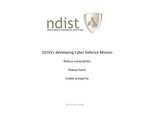
GCHQ’s NDIST sets out a developing cyber defence mission to reduce vulnerability and harm while enabling prosperity, centered on building a global-level picture of strategic threats and sharing intelligence with allies. The team anchors this work in massive telemetry, claiming roughly 100 million malware events collected per day to drive situational awareness.
-
New FAA702 Certification in the Works - Cyber Threat [pdf]
A 23 March 2012 SSO article on a draft FAA 702 certification for cyber threats. It would let analysts task selectors tied to malicious cyber activity without attributing them to a foreign government or terrorist group, and would codify tasking of IP addresses and code strings through PRISM and the upstream accesses.
-
NSA Cyber Timeline (Some Key SSO Cyber Milestone Dates Since Fall 2005) [pdf]
A one-page NSA SSO timeline of cyber-related milestones from fall 2005 to late 2012: CNCI implementation, the Protect America Act and FISA Amendments Act certifications, TURMOIL and XKEYSCORE deployments, and the August 2012 Iranian DDoS attack on Saudi Aramco.
Programs: TURMOIL · SSO · BLUESNORT · DANCINGOASIS · MADCAPOCELOT · TURBULENCE · XKEYSCORE · WEALTHYCLUSTER -
NSA's damage assessment on NYTimes 2005 article [pdf]
This internal NSA memorandum from December 2005 documents the agency's immediate response to the New York Times exposé "Bush Lets U.S. Spy on Callers Without Courts." It confirms that the article revealed classified National Security Information regarding warrantless domestic surveillance and recommends a Department of Justice investigation into the unauthorized disclosure.
Programs: STELLARWINDPeople: Cerlenko, Ariane E. · Rice, Condoleezza · Hayden, Michael · bin Laden, Osama · Bush, George W. · Faris, Iyman · Risen, James · Lichtblau, Eric · Rockefeller, Jay · Zubaydah, Abu · Cheney, Dick · Tenet, George J. · Kerry, John · Kollar-Kotelly, Colleen · Yoo, John · Mikulski, Barbara A. · Gonzales, Alberto R. · Mueller, Robert S. · Walsh, Barclay -
Operational Legalities – GCHQ Powerpoint Presentation [pdf]
GCHQ’s “Operational Legalities” deck is an internal compliance playbook that translates the UK’s surveillance laws into day‑to‑day SIGINT procedure—drilling staff on authorisation, necessity, and proportionality, and walking through warrants, targeting justifications, database queries, dissemination, and oversight. Half slides and half speaker notes, it shows how analysts are trained to document, audit, and defend operations under ISA, RIPA, HRA, and WTA while navigating edge cases like location, nationality, second‑party constraints, and “indirect targeting.”
-
PRISM planning slide (PRISM briefing 1) [pdf]
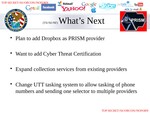
A PRISM slide headed 'What's Next': plans to add Dropbox as a PRISM provider, add a cyber threat certification, expand collection from existing providers, and change the UTT tasking system to allow phone-number tasking.
-
PRISM tasking slide (PRISM briefing 2) [pdf]
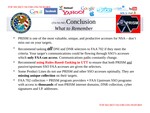
A PRISM slide headed 'Conclusion: What to Remember'. It says PRISM is among the most valuable NSA accesses, recommends tasking all DNI and DNR selectors to FAA 702 where they meet the criteria, and recommends Rules-Based Tasking in UTT so that PRISM and upstream SSO accesses both get the selectors.
-
Project CAMBERDADA [pdf]
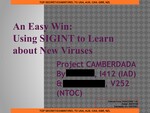
NSA presentation on Project CAMBERDADA, a programme that intercepts emails sent to antivirus companies reporting new malware, uses SIGINT collection to monitor antivirus vendor communications, and identifies opportunities to repurpose malware before vendors detect it — listing 23 antivirus companies from around the world as targets, with Kaspersky as the primary focus.
People: Picard, François -
Reverse Engineering – GCHQ Wiki [pdf]
GCHQ’s internal GCWiki page sketches the TEA Reverse Engineering unit inside the TECA Product Centre: a lab team built to dissect hardware and embedded crypto devices, defeat smartcard‑class microprocessors, and turn black boxes into SIGINT‑ready emulators. It doubles as a training hub and liaison node, with kit lists, tours, and SRE exchanges—most real work pushed behind higher‑compartment CAWiki pages.
Marking: UK SECRETPrograms: RUSSETT -
SID concur: SSO's Support to the FBI for Implementation of their Cyber FISA Orders (CATS 2012-704) [pdf]
A 2012 NSA staff processing form (CATS 2012-704) with a four-page SSO memo, concurred by the SIGINT Director on 27 March 2012. SSO would give the FBI technical help implementing FISC cyber orders (docket 11-91, which the FBI calls STYGIAN FLOW), using NSA collection and processing infrastructure (LITHIUM, ARTIFICE, TURMOIL), with the FBI responsible for the costs and for legal compliance.
People: Shea, Teresa H. -
Software Reverse Engineering – GCHQ [pdf]
GCHQ’s Network Defence unit runs software reverse engineering across both malicious and commercial code to map vulnerabilities, validate security claims, and feed CESG’s advice on electronic attack. Malicious code is fair game, but commercial RE hinges on GCHQ’s ISA s5 SRE warrant (GPW/1160), with local authorisers and audits—after a documented lapse in 2008 was retro‑authorised.
Marking: TOP SECRET -
TECA Product Centre — Wiki [pdf]
The TECA Product Centre is a GCHQ unit, within the Technical Enabling Covert Access group (TEA), whose mission is to develop and exploit specialist technologies and physical access methods to gain intelligence or SIGINT access where conventional methods fail. It works closely with SIS (MI6) on technical operations and deployment, offering bespoke managed services rather than direct products.
-
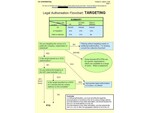
TSI — Legal Authorisation Flowcharts: Targeting & Collection [pdf]
This document contains internal GCHQ flowcharts outlining the mandatory legal authorization required for both Targeting specific entities and Collection (interception) of communications content, based primarily on the target's location, nationality, and whether the activity involves UK or "Second Party" countries, primarily referencing the Regulation of Investigatory Powers Act (RIPA).
Marking: UK CONFIDENTIAL