Program: XKEYSCORE 156 documents
Search documents matching “XKEYSCORE” →Codenames and programs recorded for each document.
Graphs
By Banner
By Classification
Refine (combine with another filter, via search)
Sort: Title
Documents
-
Full Log vs HTTP [pdf]
This 2009 NSA training presentation explains the difference between using the "Full Log" and "HTTP Activity" queries in the XKEYSCORE surveillance system, showing analysts how to use both in tandem to gain a complete picture of a target's online activities, including identifying the use of anonymizing proxies.
-
GCHQ Report on the Technical Capabilities of the Powerful Espionage Program TEMPORA, which Allows for Full Take. [pdf]
In May 2012, GCHQ introduced the TEMPORA internet buffer capability, enabling full take collection of internet communications. This innovation provides NSA and GCHQ analysts access to extensive amounts of data, enhancing their analytical capabilities significantly.
-
GCSB SIGINT Development Quarterly Report [pdf]
This GCSB quarterly report from July 2009 provides a Top Secret review of major telecommunications developments in the South West Pacific, focusing on the intelligence challenges posed by competitive deregulation and new infrastructure projects, while also detailing GCSB's efforts to enhance its collection capabilities, including the fine-tuning of GSM collection in the Solomon Islands, supporting DSD analyses in Fiji, and preparing for full-take XKEYSCORE data sharing with allies.
“New Zealand Spies on Neighbors in Secret "Five Eyes" Global Surveillance” - The Intercept ↗ (2015-03-04) · “Snowden revelations / The price of the Five Eyes club: Mass spying on friendly nations” - The New Zealand Herald ↗ (2015-03-04) · “New Zealand Spy Data Shared With Bangladeshi Human Rights Abusers” - The Intercept ↗ (2015-04-15) · “Secret documents shine light on GCSB spying in Bangladesh” - The New Zealand Herald ↗ (2015-04-16) · Gallagher, Ryan · Hager, Nicky -
GRIMPLATE - First Steps Toward Identifying Adversarial Use of BitTorrent [pdf]
This document outlines the NSA's GRIMPLATE program, which was developed to monitor and analyze BitTorrent traffic on the Department of Defense's NIPRnet to identify potentially malicious activity. The program focuses on crawling the Distributed Hash Table (DHT) of BitTorrent networks to gather data on file-sharing nodes and peer connections, in order to detect and mitigate threats while building a case for halting unauthorized P2P usage on secure networks.
-
Guide to Using Contexts in XKS Fingerprints [pdf]
This technical guide explains how NSA analysts use "contexts" within XKEYSCORE fingerprints to create highly targeted surveillance queries by restricting searches to specific scopes (e.g., web searches, document bodies, geographic locations), enabling precision targeting such as finding "all people in Kabul performing web searches on Jihad" while avoiding the overwhelming noise of broader keyword searches.
-
HAPPY TRIGGER/LOVELY HORSE/Zool/TWO FACE – Open Source for Cyber Defence/Progress [pdf]
A TOP SECRET STRAP1 COMINT GCWiki page cataloguing GCHQ's open source intelligence gathering for cyber defence, listing approved and pending data sources fed into internal databases HAPPY TRIGGER, LOVELY HORSE, ZooL and TWO FACE, covering malware tracking, vulnerability intelligence, infrastructure mapping and domain monitoring.
Programs: HAPPYTRIGGER · LOVELYHORSE · TWOFACE · ZOOL · XKEYSCORE · POSITIVEPONY · NETPLATE · HIDDENSPOTLIGHT · SNORT · FOXTRAIL · REFRIEDCHICKEN · GEOFUSION · GLOBALSURGE · SHORTFALL · JTRIG · BIRDSEED · BIRDSTRIKE · MARBLEPOLLSPeople: Stewart, Joe -
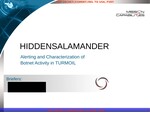
HIDDENSALAMANDER - Alerting and Characterization of Botnet Activity in TURMOIL [pdf]
This NSA briefing describes HIDDENSALAMANDER, a TURMOIL component that detects, tracks, and characterizes botnet command-and-control traffic on passive collection sensors worldwide, generating enriched metadata about bot herders, infected machines, attack commands, and malware families while providing low-latency defensive alerts when botnet activity involves high-value targets or protected networks. The system extends beyond traditional signature matching by decrypting Zeus RC4-encrypted traffic, extracting payload details like target IPs and DDoS commands, tracking C2 servers across multiple sessions, and categorizing botnet lifecycle stages (configuration, infection, reconnaissance, C&C communication, attack, exfiltration) to support both offensive attribution and defensive response.
Programs: HIDDENSALAMANDER · TURMOIL · CLOUDSHIELD · NETEZZA · TUTELAGE · GMPLACE · RONIN · CYBERCLOUD · MARINA · GHOSTMACHINE · QBOT · ASDF · MARIPOSA · XKEYSCORE · GOGADGET · TURQI · TRAFFICTHIEF · FALLOUT · POUNDSAND · BLUESMOKE · AEG · TURNABOUT · QUANTUMBOT -
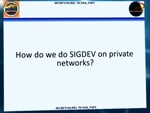
How do we do SIGDEV or private networks? [pdf]
Top Secret SIGINT Development (SIGDEV) briefing explains how analysts conduct reconnaissance on private networks, noting that many targets rely on them and that 30–40% of traffic surveyed in BLACKPEARL has at least one private endpoint. It demonstrates the ROYALNET tool and its analytics for identifying network features, NetStrings, and links likely to carry a target’s traffic, with named targets and feature sets including Google’s infrastructure, the SWIFT banking network, the French Ministry of Foreign Affairs, Brazil’s Petrobras, and Huawei.
People: Higgins, Jean -
HTTP Activity vs User Activity [pdf]
This NSA training document from June 2009 explains the distinction between HTTP Activity (general web browsing data) and User Activity (communications metadata from specific protocols like webmail and chat) within the XKEYSCORE surveillance system, demonstrating through Iranian examples how analysts combine both search types to develop comprehensive intelligence on targets.
Programs: XKEYSCORE · MARINA · FOXTRAIL · DECODEORDAIN · YACHTSHOP · BRUTUS · WINDCHASER · NKB · UIS · STARPROC -
Innov8 Experiment Profile Template [pdf]
A TOP SECRET STRAP1 joint NSA/GCHQ experiment profile documenting a 2010-2011 Joint Capability Experiment to test hardware-accelerated bulk decryption of common internet encryption technologies at scale, integrating TURMOIL's passive collection with NSA's LONGHAUL key recovery service via the ISLANDTRANSPORT messaging system, as part of the broader BULLRUN assault on internet encryption.
“Prying Eyes: Inside the NSA's War on Internet Security” - Der Spiegel ↗ (2014-12-28) · “Revealed: how US and UK spy agencies defeat internet privacy and security” - The Guardian ↗ (2013-09-05) · Appelbaum, Jacob · Gibson, Aaron · Grothoff, Christian · Müller-Maguhn, Andy · Poitras, Laura · Sontheimer, Michael · Stöcker, Christian · Ball, James · Borger, Julian · Greenwald, Glenn -
Internet Anonymity 2011 [pdf]
A TOP SECRET NSA presentation from 2011 providing a comprehensive survey of Internet Anonymity Technologies (IAT) — covering HTTP proxies, VPN anonymity providers, multi-hop networks including Tor and JAP, anonymous remailers and circumvention tools — alongside NSA's capabilities and limitations against each, including XKEYSCORE fingerprints for VPN identification, the PARTNERSNIPPET Tor deanonymisation team, GOLDENFORTIN Netflow data, and a candid assessment that Tor offers "no passive exploitation."
Programs: FOXTRAIL · NKB · NACIRONIN · PONTENTPOTABLES · RONIN · XKEYSCORE · PARTNERSNIPPET · GOLDENFORTIN · SNAPEPeople: Heap, Austin -
Intro to the VPN Exploitation Process [pdf]
NSA introduction to the VPN exploitation process from September 2010, presented by the OTP VPN Exploitation Team, covering the full workflow from initial collection through to sustained decryption of IPSec, PPTP, SSL and SSH traffic, with named exploitation successes including airlines, diplomatic missions, banks and intelligence services across Iran, Jordan, Russia, Turkey, Pakistan, Afghanistan, Somalia, Indonesia and Mexico.
Programs: BLEAKINQUIRY · TOYGRIPPE · XKEYSCORE · MAILORDER · CORALREEF · VULCANDEATHGRIP · SCISSORS · TURTLEPOWER · PINWALE · FOURSCORE · CADENCE · UTT · VULCANMINDMELD · CAPRIOS · AGILITY · NKB · FOLLOWTHEMONEY -
Introduction to Context Sensitive Scanning with X-KEYSCORE Fingerprints [pdf]
This May 2010 NSA training document introduces XKEYSCORE's context-sensitive scanning capabilities using "fingerprints"—customizable detection rules that allow analysts to surgically target specific types of Internet traffic without needing prior knowledge of email addresses or other strong selectors, using over 70 unique contexts to identify patterns in communications and behaviors.
-
Introduction to XKS Application IDs and Fingerprints [pdf]
This August 2009 NSA training document introduces XKEYSCORE's Application IDs (AppIDs) and Fingerprints system, explaining how metadata tags are automatically applied to intercepted sessions to identify and categorize different types of Internet traffic, applications, and behaviors, evolving through four generations from simple keyword matching to sophisticated code-based metadata extraction.
-
iPhone target analysis and exploitation with unique device identifiers [pdf]
A GCHQ technical paper from November 2010 describing iPhone target analysis and exploitation using the QUANTUM system — covering UDID-based target tracking and correlation across MUTANT BROTH and AUTOASSOC, a Safari PDF exploit delivering WARRIORPRIDE implants to target iPhones via QUANTUM redirection, and a confirmed successful exploitation of a jailbroken target phone yielding address book, SMS, call logs, notes, WiFi logs, browser history and images.
Programs: QUANTUM · DEBITCARD · AUTOASSOC · HARDASSOC · MUTANTBROTH · BROKER · HANDEX · WARRIORPRIDE · ABSOLINEEPILSON · BROADOAK · SOLARSHOCK · BLACKHOLE · SHORTSHEET · XKEYSCORE · MARINA · LOOKINGGLASS · OVERLIT · SLIDE · SEP · PRESTON · WHIPSAW · CROWNPRINCE · CORINTH · MVR · SOCIALANTHROPOID -
Location Cookies [pdf]
These slides contain excerpts from an April 2013 National Security Agency presentation detailing signal surveillance techniques and successes. They reveal that the NSA and its British counterpart, Government Communications Headquarters (GCHQ), use a Google-specific tracking cookie to pinpoint targets for hacking.
-
Menwith databases as of Aug 2008 [pdf]
This document outlines database access and SIGINT missions at Menwith Hill Station (MHS) as of August 2008, detailing the specific programs, language branches, and target development teams supported, including repositories like DISHFIRE, MAINWAY, and PINWALE. It also notes that U.S. personnel use the SIGINT Contact Center (SCC) process for access, with certain NOFORN restrictions, and lists additional analytic tools available to MHS analysts.
Marking: CONFIDENTIALPrograms: ASSOCIATION · DISHFIRE · HOMEBASE GEO · MAINWAY · NUCLEON · PINWALE · SPOTBEAM · XKEYSCORE · BANYAN · BROOMSTICK · CULTWEAVE II · MARINA · TRAFFICTHIEF · FASCIA · OCTSKYWARD · ROADBED · TUNNINGFORK · AGILITY · CADENCE · CONTRAOCTAVE · GAMUT · UTT · NKB · OCTAVE · PUZZLECUBE · TKB -
Menwith initiatives maximizing our access [pdf]
11 p.This document details Menwith Hill Station’s initiatives to maximize and optimize SIGINT collection, processing, and exploitation, including large-scale monitoring of internet and communications traffic, metadata analysis, and cross-platform target tracking. It describes programs and techniques for surveying, processing, and exploiting signals, enabling analysts to identify, geolocate, and track targets across multiple networks and devices.
Programs: ASPHALT · BLACKTOP · TARMAC · GTE · INDEX · ROADBED · DARKQUEST · EVIL EYE · Spider · SHAREDVISION · QUEST · NOSEYPARKER · XKEYSCORE · GRANDPIANO · FOGHORN · BASSQUEST · APPARITION · MUTANT BROTH · KARMAPOLICE · SOCIALANIMAL · MEMORY HOLE · TURBULENCE · TELLURIAN · MAILORDER · AUTO ASSOC · SLR · BLACKHOLE · JTRIG · PPF · LECKWITH · SCEPTRE · CLOUDPeople: Alexander, Keith B.“GCHQ taps fibre-optic cables for secret access to world's communications” - The Guardian ↗ (2013-06-21) · “Inside Menwith Hill: The NSA’s British Base at the Heart of U.S. Targeted Killing” - The Intercept ↗ (2016-09-06) · MacAskill, Ewen · Borger, Julian · Hopkins, Nick · Davies, Nick · Ball, James · Gallagher, Ryan -
MHS Leverages XKS for QUANTUM Against Yahoo and Hotmail [pdf]
This document describes a technical study conducted at Menwith Hill Station (MHS) in the UK. The study used XKEYSCORE (XKS) to evaluate the feasibility of launching QUANTUMTHEORY "man-on-the-side" attacks against users of Yahoo and Hotmail. Analysts developed a specialized Map/Reduce analytic called DRAGGABLEKITTEN to perform deep packet analysis on bulk internet traffic. The study concluded that 90% of Yahoo sessions and 50% of Hotmail sessions contained the specific technical "keywords" (such as unique cookies or headers) within a single data packet required to trigger a successful automated injection of malware.
-
Mobile Apps Checkpoint Meeting Archives [pdf]
This GCHQ document tracks project checkpoints from December 2009 to July 2010, focusing on the rollout and operationalization of mobile apps, TERRAIN system upgrades, GTP/GRX access, and converged event processing. Key themes include coordinating multi-team dependencies, addressing technical gaps in handset and app data characterization, and ensuring timely delivery of milestones like MIP-1.
Programs: TERRAIN · PRESTON · XKEYSCORE · BEGAL · TAMING PASTRIES · MILKWHITE · MVR · SOCIAL ANTHROPOID · INTEGER SPIN · MUTANT BROTH · GEO FUSION · MARBLED GEKO · BLACKHOLE · ACTOR ACTION · TRAFFICMASTER · HARD ASSOC · MIRTF · HEARTBEAT · SILVER LINING · GREENHEART · EREPO · MAGLITE · POKERFACE · BOSTROM · MIDDLESEX GREEN · ENCHANTERSS · HAUSTORIUM · SALAMANCA · BROADOAK · MONKEY PUZZLE · TACHO · EREPO GAMMA · NINJA · PEBBLE BED · GOLDEN EYE · STRAPROC · STARPROC · LOOKING GLASS · SORCERER · SOCIAL ANIMAL · GTE · NGE · PPF · IIB · UDAQ · MES · TERRAINS · CCDF · SINO · GDR · OSDS · LECKWITH