Document year: 2011 84 documents
Search documents matching “2011” →When each document was written, from its own dateline. Undated documents don't appear here.
Sort: Title
Documents
-
NAC 2Q 2011 Business Review [pdf]
This document, a 2011 business plan review for the Network Analysis Centre (NAC), details GCHQ's progress in developing offensive cyber capabilities. It highlights a shift from "RED" to "GREEN" status following successful network analysis supporting operations against Iran, Argentina, and Libya.
Programs: WHICHED -
NATO Civilian Intelligence Council – Cyber Panel – US Talking Points [pdf]
This 2011 US intelligence assessment for NATO identifies cyber espionage as the principal threat to Alliance networks, ranking Russia and China as the most significant nation-state actors and advocating for a shift to a consequence-based defense model that prioritizes the protection of NATO's most critical data.
-
New Contact-Chaining Procedures to Allow Better, Faster Analysis SIDtoday [pdf]
The SIGINT Management Directive 424 briefing (Jan 2011) announces a major procedural shift at the NSA, allowing analysts to conduct contact chaining and large-scale metadata analysis from any selector, regardless of nationality or location. This change removes prior restrictions on U.S. data, enabling more powerful social network mapping for foreign intelligence purposes.
Programs: GATEKEEPER -
New Operations Building at MHS Completed, Fit-Up Begins SIDtoday [pdf]
A 2011 NSA internal report describes the completion of “Project Phoenix” at Menwith Hill Station in the UK — a new operations building featuring a state-of-the-art data center, auditorium, and collaborative office spaces designed to enhance mission resilience, technological capacity, and training infrastructure. The project marks a major modernization effort, expanding Menwith Hill’s operational footprint and preparing it to support new intelligence systems and missions.
-
New Policy for the Coalition in Afghanistan Is Signed SIDtoday [pdf]
A new directive governing the Afghanistan SIGINT Coalition has been signed. The coalition is U.S.-led and shares intelligence and "operational goals in a multilateral analytic environment focused on the Afghan theater." The initial nine members were the U.S., UK, Canada, Australia, New Zealand, Norway, Denmark, France, and the Netherlands. Germany and Sweden has since joined.
“Mission Creep: How the NSA’s Game-Changing Targeting System Built for Iraq and Afghanistan Ended Up on the Mexico Border” - The Intercept ↗ (2019-05-29) · “Norges hemmelige krig i Afghanistan” - NRK ↗ (2019-05-29) · The Intercept ↗ (2019-05-29) · Moltke, Henrik · Skille, Øyvind Bye · Døvik, Olav · Hansen, Ståle Ellingsgard · Fjørtoft, Martin -
NSA Communications Hub in Europe Is Modernized SIDtoday [pdf]
This internal NSA report details the completion of "GODLIKELESION," a massive infrastructure modernization project at the European Technical Center (ETC) in Wiesbaden, Germany, which serves as the agency's primary communications and data-flow hub for Europe, Africa, and the Middle East. The project remediated critical failures in power and cooling systems while expanding capacity for 27 third-party partner data flows without interrupting mission operations.
Programs: GODLIKELESION -
NSA target package [pdf]
This 2011 target package focuses on Muhammad Tahir Shahzad (alias Abu Hamza), a Pakistan-based bomb builder and Al-Qaeda facilitator. The document was produced by the Counter IED Analysis Integration Cell (CAIC) at the NSA. Notably, the document credits the tracking of Shahzad’s 60+ digital selectors with the eventual capture of high-value targets, including himself and Bali bombing suspect Umar Patek. The accompanying Washington Post investigation uses this specific case to highlight the massive scale of "incidental collection." While Shahzad was a valid foreign target under Section 702 of the FISA Amendments Act (FAA), the investigation revealed that for every legitimate target like him, the NSA intercepted nine "non-targeted" users—many of whom were Americans—capturing deeply personal photos, medical records, and private correspondence.
-
NSA Zelda SIDtoday [pdf]
"Ask Zelda" is a popular internal advice column at the NSA, where a pseudonymous manager offers common-sense guidance on workplace issues ranging from professional dress to managing difficult supervisors. The accompanying Intercept article highlights the profound irony of a spy agency's internal column discussing themes of trust, internal surveillance, and anonymous complaints among its own staff, drawing parallels to broader surveillance concerns.
-
NSA's Offensive and Defensive Missions: The Twain Have Met SIDtoday [pdf]
The document outlines a case where NSA’s defensive malware analysis enabled offensive SIGINT teams to gain sustained access to a Chinese command-and-control server, allowing NSA to intercept intelligence China had stolen from the United Nations through a method known as fourth-party collection.
-
NWP NSA [pdf]
A January 2011 internal NSA newsletter from Yakima Research Station (YRS) covering the station's early history as the West Coast ECHELON/FROSTING satellite interception facility established in 1966 to collect INTELSAT communications, and its more recent expansion into cloud-based cyber threat discovery using FORNSAT and Special Source Operations data.
Programs: EARLYBIRD · FROSTING · TRANSIENT · ECHELON · JACKKNIFE · SAFEGUARD · STEAMS · CYBERQUEST · GINPENNANT · RUMBUCKET · CROSSBONES · SSO -
Project SANDSTORM [pdf]
This document shortly describes Project SANDSTORM, part of the Active Sigint Enabling Passive Geolocation (ASEPG) program at Menwith Hill, which uses Wi-Fi signal characterization and satellite-based Overhead capabilities to geolocate high-value targets, with geolocations of under 100 meters expected even for low-power signals in denied areas. It focuses on actively enabling SIGINT to track targets via 802.11 wireless networks.
-
RAMPART-A Sites [pdf]
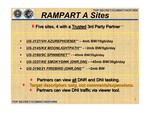
This document specifies the data throughput and operational constraints of five key RAMPART-A interception sites, including the implementation of the "DNI Throttle" to manage data volume. It also defines the "Support Hub" model for managing signals tasking and explains the role of the REDHARVEST compartment in restricting which analysts can view specific digital network categories.
Programs: RAMPART-A · AZUREPHOENIX · MOONLIGHTPATH · SPINNERET · SMOKYSINK · FIREBIRD · XKEYSCORE · PINWALE · REDHARVEST · CADENCE“How Secret Partners Expand NSA’s Surveillance Dragnet” - The Intercept ↗ (2014-06-18) · “NSA ‘third party’ partners tap the Internet backbone in global surveillance program” - Dagbladet Information ↗ (2014-06-19) · Gallagher, Ryan · Geist, Anton · Gjerding, Sebastian · Moltke, Henrik · Poitras, Laura -
Regional Command Southwest Intelligence Report June 19 2011 [pdf]
A June 2011 intelligence summary from Regional Command Southwest in Afghanistan assessing the destabilizing aftermath of the Osama bin Laden raid on U.S.-Pakistan relations, Pakistani internal security, Taliban activity along the RC(SW) border, and local governance developments in Helmand Province.
-
Regional Command Southwest Intelligence Report June 23 2011 [pdf]
A June 2011 RC Southwest intelligence summary documenting a covert ALP-Taliban collusion arrangement in Nad'Ali district, and a separate intelligence report detailing Taliban internal supply shortages, infighting, and morale deterioration across northern Helmand Province in the aftermath of Osama bin Laden's death.
-
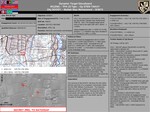
Report about Operation Doody - The Child of the Neighbor Shot By Accident [pdf]
This Dynamic Target Storyboard documents a 7 Feb 2011 UK AH‑64 engagement (Op STEN TAKAY) against “Obj DOODY” (Mullah Niaz Muhammed, IS3673), a JPEL mid‑level Taliban commander, which culminated in an AGM‑114 miss that may have killed a local child and wounded another civilian, and a follow‑on 30mm strafing run that wounded the target.
People: Muhammed, Mullah Niaz -
Report on the changing of the ESOC's name to European Cryptologic Center (ECC) including details on missions launched from there [pdf]
This 2011 document announces the renaming of the European Security Operations Center (ESOC) to the European Cryptologic Center (ECC) to reflect its significant growth and expanded mission. The change signifies NSA's long-term commitment to the center in Germany, which has become a critical partner for counter-terrorism, Africa, and Middle East intelligence.
-
Reverse Engineering – GCHQ Wiki [pdf]
GCHQ’s internal GCWiki page sketches the TEA Reverse Engineering unit inside the TECA Product Centre: a lab team built to dissect hardware and embedded crypto devices, defeat smartcard‑class microprocessors, and turn black boxes into SIGINT‑ready emulators. It doubles as a training hub and liaison node, with kit lists, tours, and SRE exchanges—most real work pushed behind higher‑compartment CAWiki pages.
Marking: UK SECRETPrograms: RUSSETT -
SDSG Integrated Analytics Workshop (14 Oct 2011) [pdf]
This document is a summary of a workshop held by the SIGINT Development Steering Group (SDSG) on October 14, 2011, evaluating and comparing the strengths, weaknesses, and potential use of advanced analytics tools, specifically Palantir and Mamba, for intelligence analysis. It discusses the tools' capabilities in data integration, collaboration, and visualization, along with concerns about security, usability, and the risks of relying on commercial software.
Marking: SECRET -
Secure key extraction by physical de-processing of Apple's A4 processor [pdf]
An abstract from the CIA Trusted Computing Base Jamboree describing a physical chip decapping and de-processing attack on Apple's A4 processor to extract the embedded Global ID cryptographic key, which if successful would enable decryption of boot firmware across all A4-based Apple devices including the iPhone 4, iPod Touch and iPad.
“The CIA Campaign to Steal Apple's Secrets” - The Intercept ↗ (2015-03-10) · Scahill, Jeremy · Begley, Josh -
SIGDEV: Is It Time for a 'Target Reboot'? SIDtoday [pdf]
This SIDtoday article from March 2011 by an NSA Transnational and Strategic Partnerships SIGDEV analyst describing how a "target reboot" of Venezuela's state oil company PDVSA accidentally revealed that NSA had been collecting the company's internal communications all along — including over 10,000 employee contact profiles and 900 username/password combinations subsequently forwarded to TAO for network exploitation.