SDSG Integrated Analytics Workshop (14 Oct 2011)
Open PDFDocument date: 2011-10-14
Pages: 3
Genre: report
Banner: SECRET
Classification: SECRET
Dissemination: -
This document is a summary of a workshop held by the SIGINT Development Steering Group (SDSG) on October 14, 2011, evaluating and comparing the strengths, weaknesses, and potential use of advanced analytics tools, specifically Palantir and Mamba, for intelligence analysis. It discusses the tools' capabilities in data integration, collaboration, and visualization, along with concerns about security, usability, and the risks of relying on commercial software.
My notes
SECRET
SDSG Integrated Analytics Workshop (14 Oct 2011)
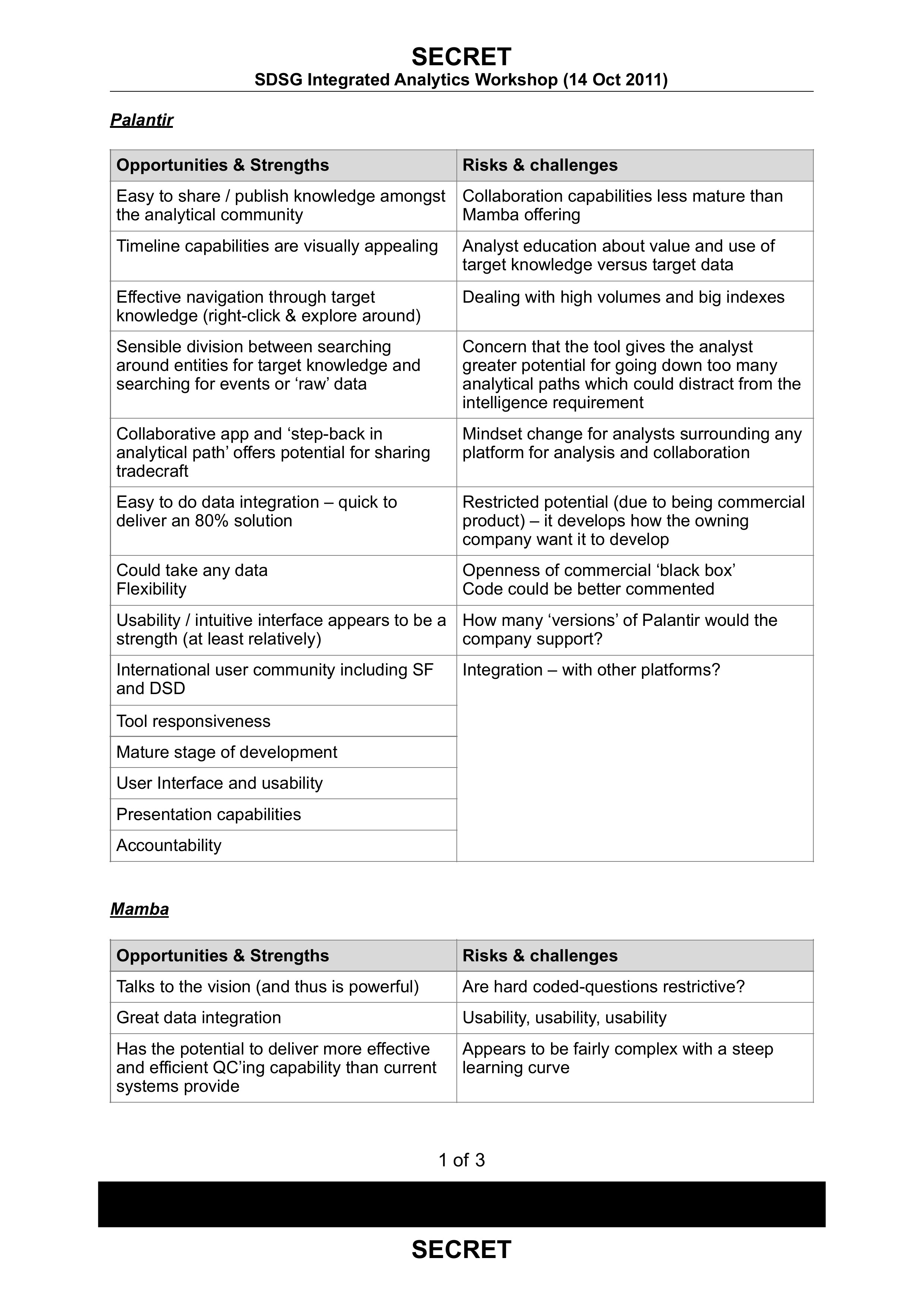
Palantir
| Opportunities & Strengths | Risks & challenges |
|---|---|
| Easy to share / publish knowledge amongst the analytical community | Collaboration capabilities less mature than Mamba offering |
| Timeline capabilities are visually appealing | Analyst education about value and use of target knowledge versus target data |
| Effective navigation through target knowledge (right-click & explore around) | Dealing with high volumes and big indexes |
| Sensible division between searching around entities for target knowledge and searching for events or 'raw' data | Concern that the tool gives the analyst greater potential for going down too many analytical paths which could distract from the intelligence requirement |
| Collaborative app and 'step-back in analytical path' offers potential for sharing tradecraft | Mindset change for analysts surrounding any platform for analysis and collaboration |
| Easy to do data integration – quick to deliver an 80% solution | Restricted potential (due to being commercial product) – it develops how the owning company want it to develop |
| Could take any data | Openness of commercial 'black box' |
| Flexibility | Code could be better commented |
| Usability / intuitive interface appears to be a strength (at least relatively) | How many 'versions' of Palantir would the company support? |
| International user community including SF and DSD | Integration - with other platforms? |
| Tool responsiveness | |
| Mature stage of development | |
| User Interface and usability | |
| Presentation capabilities | |
| Accountability |
Mamba
| Opportunities & Strengths | Risks & challenges |
|---|---|
| Talks to the vision (and thus is powerful) | Are hard coded-questions restrictive? |
| Great data integration | Usability, usability, usability |
| Has the potential to deliver more effective and efficient QC'ing capability than current systems provide | Appears to be fairly complex with a steep learning curve |
1 of 3
[REDACTED]
SECRET
SECRET
| Opportunities & Strengths | Risks & challenges |
|---|---|
| Allows the analyst to filter the data prior to importing it onto the chart - means analysts aren't wasting time deleting | Complexity - what skill levels would be necessary or could different levels of access be matched to analyst skill levels |
| Potential for very intuitive exploration of data and relationships between QFDs | Deliverability and complexity of eclipse user-interface |
| Strong on sharing of analysis | Challenge of uniform data models |
| Potential for on-line coaching via screen sharing | Relative immature progress on graph change |
| Integration agenda – flexibility and illustrates the art of the possible | |
| Open architecture | |
| Has the concept of a 'hypothesis' | |
| Offers good potential for bringing more collaborative opportunities between Ops and JTRIG | |
| Rich layered model allows unique navigation and viewing of details of the events, especially multi-participant c2c events | |
| Mamba potentially offers greater potential for closer sharing and collaboration with NSA | Though currently doesn't deliver this |
Mamba and Palantir 'summing-up' feedback
"A completely commercial product, in this instance Palantir, is clearly more polished and delivers more in terms of usability, compared with the in-house built offering (i.e. Mamba-based products) which offers complete flexibility, arguably thus more potential but 'Eclipse' doesn't sell simplicity."
- External collaboration is at least as important as internal collaboration
- Interoperability important between whatever tool(s) are progressed
- A desire where at all possible to avoid local specialism (if the applications can support that)
- Concerns over what capabilities truly work at scale
- Consider competition with tools already 'bedded in' in the business
- Attendees acknowledge the best assessment is realised through using any capability rather than demonstrations alone
- Visual representation of the data is a key component to explore
- Usability / complexity / polish will have an impact on the users
- Could whichever tool have an 'unlock' application features based on analysts skill level, hiding buttons and features until needed and capable of utilising
- Experiment with diverse range of analysts, from Skill level 0 up to L3's
- Fully understand and consider the time necessary for analysts to change / take on new tools and ways of working
Some concerns expressed that there is still a very real risk that as CDO / CDL roles continue to develop across the 4th floor that such analysts will need to become users of a vastly growing tool set and that decisions / agreements on tool choices and tool mix will be hard
2 of 3
[REDACTED]
SECRET
SECRET
A 'shared' decision going forward is needed
Concern over the data model implemented around the collated / fused data and how it supports and integrates itself with a data model around conducting actual analysis and the building of intelligence pictures
Performance of any application / tool / framework is always a key consideration
Can any tool cope with the diversity of data types?
Vision and Principals (feedback)
No broad concerns over vision or principals
Action for ADS: But simplify vision and key principles
Action for ADS: Can the principals be condensed from its current two pages?
Action for ADS: Can it be shared more broadly, perhaps on GCwiki and linked to from these workshop pages
IAC (feedback)
Requires a clear future and decisions
Generic statements that could be considered Ops requirements:
- More independence between front-end user-interfaces and the back-end data, i.e. build service tiers (helps future proofing against new capabilities)
- Easier linkages between social media (i.e. collaborative tools / applications) and the tools / applications that support analysis and data exploration
- Don't necessarily deliver the capability in the engineer's current favourite technology
- Usability for the 'whole' analyst community is key (avoid future kerfuffles)
- There is a need to really understand the user base amongst the analyst community for any capability going forward
- The CapDev community need to give quick assessments to ISD over particular new capabilities, especially to ensure the right tool choices are made and roadmaps are not stove-piped
Another concern
Concerns that the Olympic questions for Rumour Mill have not been broadly enough shared, at least some attendees had not had visibility of them
Action: ADS to circulate (included in email with these minutes) and available at:
[REDACTED]
Attendees
[REDACTED]
[REDACTED]
[REDACTED]
[REDACTED]
[REDACTED]
[REDACTED]
[REDACTED]
[REDACTED]
[REDACTED]
3 of 3
[REDACTED]
SECRET
Published in the Same Report
(6 documents)
-
-
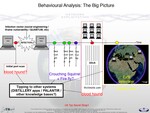
Behavioural Analysis: The Big Picture (Palantir could be used as part of a CNE) [pdf]
This diagram from GCHQ outlines the lifecycle of a CNE and identifies where Palantir fits into the intelligence workflow. The slide, titled "Behavioural Analysis: The Big Picture," illustrates a timeline of network exploitation from the initial infection of a target host to the eventual exfiltration of data. Crucially, it positions Palantir as a key "knowledge base" used for "Tipping to other systems." This indicates that Palantir’s software was used to aggregate data from successful hacks, allowing analysts to visualize connections and pivot (or "tip") that information toward further surveillance or offensive operations.
-
The Tale of Two Sources [pdf]
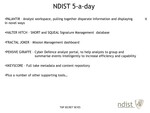
Programs: SUPERDRAKE · CROUCHINGSQUIRREL · HALTERHITCH · MVR · PPF · GORDIANKNOT · XKEYSCORE · SAMUELPEPYS · ALPINEBUTTERFLY · TRYST · FRACTALJOKER · TM · SPAY · BLACKHOLE · RAPIDTAPIR · HIDDENOTTER · SALTYOTTER · 8BALL · SORCERER · PACMAN · SNORT · WAFTER · CRIMSON · SHORTFALL · GCNET · BROADOAK · RAPTOR · GEOFUSION · MUGSHOT · HACIENDA · FOXTRAIL · FANNER · GLOBALSURGE · PENSIVEGIRAFFE · HRMAP · MUTANTBROTH · SAMPEPYS · INTEGERSPIN · MWX · MARBLEPOLLS · MOONRAKER · RT · DISTILLERY · SQUEAL · DEADSEA · GTE · WDM · TKB · TRAFFIC MASTER · CHOKEPOINT · CONTENT CLOUD · MAPREDUCE · EVENTS · CLOUD · AGILITY · PALANTIR -
TWO FACE [pdf]
This document describes the GCHQ's TWO FACE project, a part of the Cyber Defence mission, which focuses on enhancing analysis and knowledge sharing tools using Palantir software. It outlines various data sources integrated with Palantir, such as XKEYSCORE and GEOFUSION, and the project's goals to automate and improve data importation, analysis capabilities, and user interface performance. The document also discusses training, user access, and collaboration within the Five Eyes intelligence community, as well as ongoing development to address gaps in existing cyber defense tools. It provides detailed instructions for using Palantir's capabilities to analyze and visualize data from multiple sources, with a focus on cyber defense and network defense operations. Key features include handling large datasets, running complex queries, and automating data integration. The document also highlights ongoing improvements, such as the addition of new data sources and the refinement of analytic tools to better support the cyber defense mission.
Programs: TWOFACE · PALANTIR · FRACTALJOKER · FRACTALWEB · PENSIVEGIRAFFE · XKEYSCORE · LIVE · AUTOASSOC · SOCIALANTHROPOID · INFINITEMONKEYS · KARMAPOLICE · SAMPEPYS · HRMAP · MUTANTBROTH · GEOFUSION · HACIENDA · FOXTRAIL · CROUCHINGSQUIRREL · PITCHFORD · HALTERHITCH · GORDIANKNOT · SAMUELPEPYS · MUGSHOT · RAPIDTAPIR · FIVEALIVE · GOOGLEFUSION · INTEGERSPIN · DEADSEA · MOONRAKER · OBERON · DISCOVER · 8BALL · CASK -
GCHQ VisWeek 2008 Conference Report [pdf]
This GCHQ document summarizes key findings from the VisWeek 2008 visualization conference in Ohio, highlighting techniques and tools relevant to SIGINT analysis including collaborative analysis capabilities, graph visualization methods, and the Palantir Government platform. The report recommends incorporating features like analyst notebooks for tracking investigations, collaborative workspaces for multiple analysts, and various graph layout algorithms into GCHQ's MONTE VISTA visualization system.
Programs: MONTE VISTA · MAMBA · CHARTBREAKER · PIGS EAR · KNIME · RAPTOR · BROAD OAK · HAUSTORIUM · SALAMANCA · IIB · INFOVIS · PALANTIR -
XKEYSCORE Helper Notes [pdf]
This GCHQ document describes new features in the XKEYSCORE Palantir helper tool, including summary/histogram import capabilities that reduce large datasets by aggregating connection data rather than creating individual events for each entry, and data sourcing features that track which XKEYSCORE queries imported specific data into Palantir. The document provides step-by-step screenshots showing how analysts can histogram network traffic by source IP, destination IP, and ports, then import aggregated results showing metadata like total session sizes and connection counts.
Programs: XKEYSCORE


Related Documents
-
GCHQ VisWeek 2008 Conference Report [pdf]
This GCHQ document summarizes key findings from the VisWeek 2008 visualization conference in Ohio, highlighting techniques and tools relevant to SIGINT analysis including collaborative analysis capabilities, graph visualization methods, and the Palantir Government platform. The report recommends incorporating features like analyst notebooks for tracking investigations, collaborative workspaces for multiple analysts, and various graph layout algorithms into GCHQ's MONTE VISTA visualization system.
Programs: MONTE VISTA · MAMBA · CHARTBREAKER · PIGS EAR · KNIME · RAPTOR · BROAD OAK · HAUSTORIUM · SALAMANCA · IIB · INFOVIS · PALANTIR -
HIMR Data Mining Research Problem Book [pdf]
This document is a research roadmap created by GCHQ for the Heilbronn Institute for Mathematical Research (HIMR). Its purpose is to guide long-term mathematical and data-mining research that could improve signals intelligence (SIGINT) capabilities. It outlines key research problems, datasets, and collaboration plans between intelligence agencies and academic researchers. The main goal is to develop new algorithms and mathematical tools to analyze extremely large communications datasets produced by modern surveillance systems.
Programs: CLOUD · DISTILLERY · DISCOVER · PRESTON · LECKWITH · TERRAIN · BROADOAK · NGE · FIVEALIVE · CHARTBREAKER · FIRSTCONTACT · GEOFUSION · RADONSHARPEN-B · PRIMETIME · HIDDENOTTER · BAKERSDOZEN · CLASP · SALTYOTTER · BIRCH · SOLIDINK · FLUIDINK · MAMBA · GRINNINGROACH · PIRATECAREBEAR · AUTOASSOC · CROUCHINGSQUIRREL · HRMAP · KACHINA · SQUEAL · QUESTA · METEORSHOWER · SUNSTORM · GOLDMINE · HAGERAWEL · WOODY · BUZZ · SILVERLIBRARY · SILVERLINING · VALHALLA · MOUNTMCKINLEY · SEPANG · BLACKHOLE · SALAMANCA · HAGELAWEL · LUCKYSTRIKE · SPIKYROCK · MYOFIBRIL · INJUNCTION · PSYCHICSALMON · RAGINGBULLFROG · ROBOTICFISH · TIMIDTOAD · AURA · CARBONCOPY · CASK · CHORDAL · CRAN · INSTINCT · MADFORGE · SWAMP · VOLSUNGA · WHITERAVEN · MVR · PPF · JTRIG · MAPREDUCE · MAILORDERPeople: Tukey, John -
CNE End Point Requirements [pdf]
This NSA/GCHQ document outlines comprehensive requirements for an endpoint surveillance systems that enables analysts to systematically identify intelligence collection needs and discover appropriate tools for data extraction from compromised computers. The framework covers capabilities for remote data collection, cross-platform intelligence integration, query functions, tasking procedures, and visualization tools across implanted networks.
Programs: STARGATE · LOOKING GLASS · QUANTUM · GOLDENEYE · XKEYSCORE · MARINA · JTRIG · BROADOAK · UTT · GLOBALREACH · GLOBALSURGE · THUGGEE · EREPO · DANCINGBEAR · HAUSTORIUM · SHAREOWN · MUTANTBROTH · MOONRAKER · CARBONROD · RUFFLE · ROCKOPERA · QUINCEY · ECLIPSE · MUGSHOT · HIGHNOTE · UDAQ2 · EKB · TURBINE · ACNO · FLAMECARPET · FUMECUPBOARD · JACKPOT · SLIPSTREAM · B13B · PSC · QUINCY · DAREDEVIL · ROADBED -
Cyber Integration [pdf]
The leaked 2012 GCHQ JTRIG presentation detail a wide range of offensive cyber and influence operations designed to “deny, disrupt, degrade, and deceive” targets, including hackers, foreign governments, companies, and individuals. Tactics include hacking, DDOS attacks, disinformation, honey traps, credential harvesting, and psychological operations, reflecting a shift from traditional surveillance to active disruption and manipulation campaigns.
“Exclusive: Snowden Docs Show British Spies Used Sex and 'Dirty Tricks'” - NBC News ↗ (2014-02-07) · “No Place to Hide” - Metropolitan Books ↗ (2014-05-13) · Cole, Matthew · Esposito, Richard · Schone, Mark · Greenwald, Glenn -
GCHQ Analytic Cloud Challenges [pdf]
The 2012 GCHQ Analytic Cloud document outlines a sophisticated data processing infrastructure handling approximately 50 billion daily events across multiple sites, utilizing QFD databases and HADOOP clusters for various analytic capabilities targeting intelligence gathering and analysis. It describes architectural components, challenges in scaling and enabling analysts to cope with data complexity, and proposes future technology options including consolidation approaches and new cloud architectures to enhance capabilities.
Programs: EVOLVEDMUTANTBROTH · MUTANTBROTH · HARDASSOC · HRMAP · KARMAPOLICE · SOCIALANTHROPOID · AUTOASSOC · GEOFUSION · MVR · TERRAIN · SALAMANCA · BLACKHOLE · SAMUELPEPYS · BROKER · VAIL · GUIDINGLIGHT · FIRSTCONTACT · CLOUDYCOBRA · RUMOURMILL · EVERYASSOC · EVERYPOLICE · EVERYCREATURE · EVERYEAD · EVERYCIPHER · GREYFOX · SILVERFOX · GOLDENAXE · TRIBALCARNEM · PUBLICANEMONE · EPICFAIL · STERLINGMOTH · FOGHORN · LOOKINGGLASS · FIREENGINE · NGGEO · ALPHACENTAURI · CLOUDBASE · ACCUMULO · ASEM · SEM · HAKIM · STREAMING · HBASE · LAUREL · SKINNYCLOUD · HARDY · GCHQCORE