Dissemination control: REL TO USA, AUS, CAN, GBR, NZL 103 documents
Search documents matching “REL TO USA, AUS, CAN, GBR, NZL” →Handling controls assessed for each document, as component values. If a document contains multiple disseminations, the most restrictive is used here.
Graphs
By document date (11 years)
By Banner
By Classification
Refine (combine with another filter, via search)
Sort: Title
Documents
-
Advanced HTTP Activity Analysis [pdf]
This NSA training document from 2009 teaches intelligence analysts how to analyze HTTP internet traffic and exploit it using the XKEYSCORE surveillance system to monitor and identify internet users globally.
“XKEYSCORE: NSA’s Google for the World’s Private Communications” - The Intercept ↗ (2015-07-01) · “No Place to Hide” - Metropolitan Books ↗ (2014-05-13) · Marquis-Boire, Morgan · Greenwald, Glenn · Lee, Micah -
Analytic Challenges from Active-Passive Integration [pdf]
This NSA presentation examines metadata attribution challenges arising when active TAO implants exfiltrate traffic through passive TURMOIL collection infrastructure, creating conflicts where intercepted data carries dual classification markings, case notations, and legal authorities from both collection systems. The briefing highlights how existing databases and analytic tools were not designed to handle traffic with two simultaneous sets of metadata parameters, requiring enterprise-wide solutions to consistently attribute and track actively-shaped intelligence collection.
Programs: BRAVENICKEL · HAMMERMILL · APEX · MARINA · TURMOIL · PRESSUREWAVE · METROTUBE · TOYGRIPPE · HAMMERSTEIN · HAMMERSTONE · METAWAVE · TURBULENCE · SSO -
Analytic Challenges from Active-Passive Integration [pdf]
This NSA briefing addresses the technical and administrative friction caused by "shaping" operations. Shaping occurs when an active malware implant, typically situated on network infrastructure like a router, copies specific data streams and redirects them past a passive surveillance sensor such as TURMOIL. While this ensures the capture of data that might otherwise be missed, it creates a "double metadata" conflict where a single piece of intelligence carries two competing sets of identifiers: one from the active Tailored Access Operations (TAO) implant and another from the passive collection site. The document tasks analysts with finding a way to reconcile these source notations to ensure the data remains searchable and legally compliant within legacy databases.
Programs: BRAVENICKEL · HAMMERMILL · APEX · TURMOIL · HAMMERSTONE · PRESSUREWAVE · METROTUBE · TOYGRIPPE · TURBULENCE · METAWAVE · MARINA · SSO · CONVEYANCE · NUCLEON · FASCIA · HAMMERCHANT -
Analyzing Mobile/Cellular DNI in XKEYSCORE, May 2009 [pdf]
The XKEYSCORE document explains how the agency analyzes mobile/cellular device internet usage by collecting and processing both converged DNI/DNR data within cellular networks and traditional internet traffic, using various tools and indicators to identify mobile users even when their device type isn't immediately evident. The document demonstrates how the system can track mobile internet activity across applications like Yahoo Mail and identifies devices through various technical "hints" including MSISDN codes, browser fingerprints, and user agent strings.
-
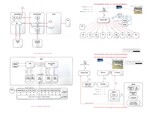
Architecture of U.S. Drone Operations [pdf]
“Germany is the Tell-Tale Heart of America's Drone War” - The Intercept ↗ (2015-04-17) · “Ramstein Air-Base: US-Drohneneinsätze aus Deutschland gesteuert” - Der Spiegel ↗ (2015-04-17) · Scahill, Jeremy · Bartsch, Matthias · Baumgärtner, Maik · Blome, Nikolaus · Darnstädt, Thomas · Gebauer, Matthias · Gude, Hubert · Rosenbach, Marcel · Schindler, Jörg · Schmid, Fidelius · Stark, Holger · Weinzierl, Alfred -
AURORAGOLD – Project Overview [pdf]
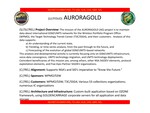
A technical briefing document outlining an NSA SIGINT initiative designed to map, monitor, and forecast the evolution of global mobile networks. It details the project's infrastructure, which aggregates both unclassified commercial data and classified intelligence intercepted from international roaming agreements to identify technical trends and exploitation opportunities.
-
BYZANTINE HADES: An Evolution of Collection [pdf]
A classified NSA SIGINT briefing from 2010 describes “BYZANTINE HADES,” a collection of Chinese computer network exploitation activities, with a focus on the BYZANTINE CANDOR actor set and U.S. efforts to analyze, attribute, and counter those intrusions. The document details targeting patterns, technical tradecraft, and a TAO-led counterintelligence operation that successfully penetrated the attackers’ infrastructure and personal systems.
Programs: BYZANTINEHADES · BYZANTINECANDOR · BYZANTINERAPTOR · BYZANTINEANCHOR · BISHOPKNIGHT · BYZANTINEVIKING · MAVERICKCHURCH · BISHOP · BYZANTINETRACE · DIESELRATTLE · BYZANTINEFOOTHOLD · BYZANTINEPRAIRIE · SEEDSPHERE · CARBONPEPTIDE · TITANRAIN · PINWALE · XKEYSCORE · CROSSBONES · TUNINGFORK · ARROWECLIPSE · CUTEBOY · POPROCKS · BYZANTINE -
Center for Content Extraction - Content Extraction Analytics, SIGDEV End-to-End Demo [pdf]
This document is a technical showcase demonstrating the capabilities of an NSA content‑extraction program, using political leaders and diplomatic figures (such as Angela Merkel) as illustrative examples. It presents how automated language technology can extract, organize, and scale intelligence data from intercepted material.
Programs: MARINA · CYBERTRANS · PAINTBALL · SYNAPSE · NYMROD · THUNDERCLOUD · JOURNEYMAN · GOLDENRETRIEVER · SOCIOPATH · LEXHOUND · HERESYITCH · HLT · TKB · EKS -
Center for Content Extraction - Nymrod Mission [pdf]
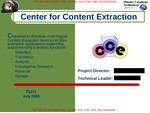
This top-secret NSA document outlines the mission and capabilities of NYMROD, a system developed by the Center for Content Extraction (CCE). It explains how NYMROD addresses analytic challenges such as linguistic variation in entity names, especially for person names, and the resolution of entity coreference problems using contextual evidence. The document discusses the multilingual content extraction services provided by NYMROD, which support various NSA enterprise applications and enhance analytic functions like selection, translation, analysis, investigative research, retrieval, and storage.
People: Ban, Ki-moon -
CLASSIFICATION GUIDE FOR ECI PAWLEYS (PAW) [pdf]
This 2006 NSA classification guide outlines the protocols for ECI PAWLEYS (PAW). PAWLEYS is an Exceptionally Compartmented Information (ECI) category designed to protect clandestine operations—both physical (HUMINT) and digital (CNE)—specifically aimed at acquiring foreign cryptographic information and material. The document confirms that the NSA actively seeks to circumvent encryption through clandestine HUMINT and computer network access aimed at cryptographic information and material, rather than relying solely on traditional codebreaking.
Programs: PAWLEYS -
Classification guide for NSA/CSS Quantum Computing Research (10-25) [pdf]
The NSA/CSS Quantum Computing Research Classification Guide (10-25) outlines how information related to the NSA’s quantum computing research should be classified, distinguishing between unclassified academic work and classified cryptanalytic programs. It defines classification levels for research activities, breakthroughs, algorithms, collaborations, and materials, with the goal of protecting U.S. cryptographic systems while advancing the agency’s offensive capabilities in quantum cryptanalysis.
-
Classification Guide Title/Number: Cuban Missile Crisis, 10-18 [pdf]
A 2008 NSA classification guide governing what may be disclosed about the agency's SIGINT activity during the Cuban Missile Crisis, showing that elements of 1960s collection against Cuba and the USSR were still controlled decades later.
-
Cryptographic Modernization (CryptoMod) Classification Guide 3-9 [pdf]
A partial NSA/CSS classification guide for the Cryptographic Modernisation (CryptoMod) programme — establishing classification levels for information about NSA's transition of US cryptographic products to modern algorithms, Positive Access Control parameters, software signing, and the association of specific algorithms with critical year and life-of-use assessments.
-
Cyber Integration [pdf]
The leaked 2012 GCHQ JTRIG presentation detail a wide range of offensive cyber and influence operations designed to “deny, disrupt, degrade, and deceive” targets, including hackers, foreign governments, companies, and individuals. Tactics include hacking, DDOS attacks, disinformation, honey traps, credential harvesting, and psychological operations, reflecting a shift from traditional surveillance to active disruption and manipulation campaigns.
“Exclusive: Snowden Docs Show British Spies Used Sex and 'Dirty Tricks'” - NBC News ↗ (2014-02-07) · “No Place to Hide” - Metropolitan Books ↗ (2014-05-13) · Cole, Matthew · Esposito, Richard · Schone, Mark · Greenwald, Glenn -
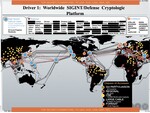
Driver 1: Worldwide SIGINT/Defense Cryptologic Platform [pdf]
A 2012 NSA management presentation slide revealing the agency's global surveillance architecture across five categories of access — covert cable taps, regional collection sites, computer network exploitation implants, foreign satellite collection, and third-party liaison relationships — including a list of cities hosting clandestine collection operations and confirmation of over 50,000 worldwide malware implants.
Programs: STELLAR · SOUNDER · SNICK · MOONPENNY · LADYLOVE · INDRA · IRONSAND · JACKKNIFE · CARBOY · TIMBERLINE“NSA infected 50,000 computer networks with malicious software” - NRC ↗ (2013-11-23) · “No Place to Hide” - Metropolitan Books ↗ (2014-05-13) · Boon, Floor · Derix, Steven · Modderkolk, Huib · Greenwald, Glenn -
ECI WHIPGENIE Classification Guide [pdf]
A 2004 NSA classification guide for ECI WHIPGENIE, covering the agency's Special Source Operations relationships with US corporate partners for cable collection and domestic wire access, including FISA-warranted collection and FBI-assisted compelled and cooperative partnerships.
Programs: WHIPGENIE · FAIRVIEW · STORMBREW · BLARNEY · POWERPLANT · TUMBRIL · WEALTHYCLUSTER · RAGTIME · PLUS · YELLOWSTONE · SSO -
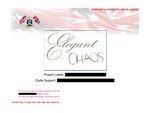
Elegant Chaos: collect it all, exploit it all [pdf]
This document outlines a classified project, "Elegant CHAOS," focused on advanced signals intelligence (SIGINT) collection, processing, and analysis using cutting-edge technologies like automated surveys and modems. It highlights goals such as real-time data analysis, collaboration with international partners, and integration with cloud-based platforms to manage massive data. See also the document with notes (by GCHQ): "Elegant-Chaos-collect-it-all-exploit-it-all-plus"
Programs: ELEGANTCHAOS · ASPHALT · ASPHALT-A · ASPHALT-A-PLUS · STORMFORCE · DARKQUEST · TORUS · XKEYSCORE · MHS CLOUD · TURMOIL · TARMAC · ASDF · SLR · POPQUIZ · WEALTHYCLUSTER2 · TRAVELLINGWAVE · BILBOBADGER · DRINKYBIRD · GLOBETROTTER · MASTERSHAKE · REST · TRAFFICTHIEF · VENUSAFFECT · FOGHORN · MATCHMAKER · ROADBED · MOONPENNY · AMULETSTELLAR · CLOUD · WEALTHYCLUSTER · MVR · TINT · IPGEOTRAP · MARINA · PLUS -
Elegant Chaos: collect it all, exploit it all (plus notes) [pdf]
GCHQ/NSA presentation describing ELEGANT CHAOS — an automated system at the Menwith Hill Station satellite interception facility that scores and ranks thousands of intercepted satellite signals by intelligence value, automatically deciding which ones deserve collection resources based on criteria like geographic location, target network hits, technology type and Computer Network Operations interest — built to implement the station's directive to "Sniff it All, Know it All, Collect it All, Process it All, Exploit it All, Partner it All" as collection capacity scaled from 100 signals to a planned 3,000 simultaneous intercepts.
Programs: ELEGANTCHAOS · ASPHALT · ASPHALT-A · ASPHALT-A-PLUS · STORMFORCE · DARKQUEST · TORUS · XKEYSCORE · MHS CLOUD · TURMOIL · TARMAC · ASDF · SLR · POPQUIZ · WEALTHYCLUSTER2 · TRAVELLINGWAVE · BILBOBADGER · DRINKYBIRD · GLOBETROTTER · MASTERSHAKE · REST · TRAFFICTHIEF · VENUSAFFECT · FOGHORN · MATCHMAKER · ROADBED · MOONPENNY · WHIZBANG · CLOUDBASE · APLUS · MAILORDER · CROSSBONES · AMULET STELLAR · MVR · TINT · WEALTHYCLUSTER · IPGEOTRAP · MARINA · CLOUD · PLUS -
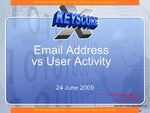
Email Address vs User Activity [pdf]
This 2009 NSA training presentation explains how to use the XKEYSCORE system to search raw SIGINT, detailing the differences between the "Email Address" query, which finds email addresses in full content, and the more flexible "User Activity" query, which can search for selectors like cookies, usernames, and phone numbers.
“XKEYSCORE: NSA’s Google for the World’s Private Communications” - The Intercept ↗ (2015-07-01) · “No Place to Hide” - Metropolitan Books ↗ (2014-05-13) · Marquis-Boire, Morgan · Greenwald, Glenn · Lee, Micah -
Exceptionally Controlled Information Compartments (January 2013) [pdf]
This document, dated January 2013, provides a list of Exceptionally Controlled Information (ECI) compartments utilized by the NSA and its Five Eyes partners. This document categorizes highly sensitive intelligence programs by their codenames, three-letter trigraphs, and the specific organizations responsible for them. The primary organizations listed include TAO, NCSC, and CES. These compartments represent the highest level of information security, designed to restrict access to sensitive technical data and specific intelligence sources even among individuals with high-level security clearances.
Programs: AMBULANT · APERIODIC · AUNTIE · BLACKANT · BLACKAXE · BLACKBALL · BLACKCLOUD · BLACKHOLE · BLACKJACK · BLACKTIE · BLACKVULTURE · BLACKWIDOW · BOXWOOD · CELESTIALGLOBE · CHIEFDOM · CLICKUMBER · CRIMSONREGENT · CRIMSTONSTEAL · CRUMPET · DECKSTOP · DEVILFISH · DIXIESPRING · DOMINATE · FASTIDIOUS · FIRESCREEN · FIRSTDOWN · FISSURESALUTE · FLYLEAF · FORBIDDEN · FORBORNE · FOXHEAT · FREELUNCH · FROTHYTWOPACK · FURTIVERELIANCE · GOLDENCALF · HELLFIRE · HISTORY · HYSSOP · INVEIGH · KESSELRUN · LIGHTNINGTHIEF · LITTLECROWN · LONGSERPENT · MAGICSTROKE · MERCURYTAO · MUSICBOX · NITEHAWK · OCELLUS · PAINTEDEAGLE · PAWLEYS · PAWNSHOP · PENDLETON · PENDRAGON · PERKYAUTUMN · PHENYLDOUR · PICARESQUE · PICAROON · PIEDMONT · PITCHFORD · PLACEBO · POMPANO · PRESSURETWIN · REDHARVEST · REEFPOINT · REFRACTOR · REVELRY · RIVERROAD · RUBIOUS · SAILWINDS · SCABBARD · SILVERCLOUD · SINKGOAL · STAIRWELL · STARCHART · SUITESWIVEL · TRICKSHOT · WAXOFF · WHIPGENIE