Dissemination control: REL TO USA, AUS, CAN, GBR, NZL 103 documents
Search documents matching “REL TO USA, AUS, CAN, GBR, NZL” →Handling controls assessed for each document, as component values. If a document contains multiple disseminations, the most restrictive is used here.
Graphs
By document date (11 years)
By Banner
By Classification
Refine (combine with another filter, via search)
Sort: Title
Documents
-
FAIRVIEW site book [pdf]
The Fairview TDY Handbook provides essential guidelines for NSA employees travelling in support of the FAIRVIEW Program, detailing required training, security protocols, and travel procedures for both CONUS and OCONUS missions. It covers travel authorization, necessary courses, cover travel considerations, vehicle usage, and operational security (OPSEC) instructions for visits to partner and collection sites. The handbook emphasizes security, confidentiality, and appropriate conduct while interacting with partner organizations and traveling to sensitive locations.
Programs: FAIRVIEW · EAGLE · EDEN · TITANPOINT · PINECONE · TITANPOINTE · BLARNEY · STORMBREW · OAKSTAR · SILVER COLLAM · SSO · LITHIUM -
Finding and Querying Document Metadata [pdf]
This 2009 NSA training guide, created by Booz Allen Hamilton, explains how analysts can use the XKEYSCORE system to track targets by searching for "non-traditional selectors" embedded within documents, such as author names, company information, or even the hash values of company logos.
Programs: XKEYSCORE · TUNINGFORK · PINWALE · FOXACID · FOXBASE · CARBOY · CARDAMON · UNITEDRAKE · CADENCE -
FISA recap [pdf]
This document is a Top Secret NSA "FISA Recap" spreadsheet detailing electronic surveillance conducted between 2005 and 2008. It tracks specific email accounts targeted under the Foreign Intelligence Surveillance Act, listing the responsible agencies (NSA, FBI, and CIA), their legal "Case Notation," and the duration of collection. Notably, the log includes prominent U.S. Persons and organizations, such as the Council on American-Islamic Relations (CAIR), and features a 2005 formatting guide that uses a racial slur as a placeholder for a target's identity.
Programs: SQF -
FOXACID SOP for Operational Management of FOXACID Infrastructure (Draft) [pdf]
This document is an NSA standard operating procedure (SOP) manual detailing how to manage and operate the FOXACID system, which delivers malware to targets through tools like SECONDDATE and BADDECISION. It provides technical instructions for tracking, deploying, and maintaining covert web-based infections used in global cyber operations.
Programs: FOXACID · FOXSEARCH · WAITAUTO · RAISEBED · FORRESTPLACE · FOXHelp · PUZZLECUBE · YACHTSHOP · SECONDDATE · MAGIC SQUIRREL · MAGICBEAN · FINKCOAT · FRUGALSHOT · QUANTUM · FERRETCANNON · BEACHHEAD · OLYMPUS · UNITERAKE · DIRESCALLOP · DEEPFREEZE · FINKDIFFERENT · DISABLEVALOR · VALIDATOR · MISTYVEAL · UNITEDRAKE · PEDDLE CHEAP · PKTWENCH · FORESTPLACE · FOXCONTACT · EASYHOOKUP · DEMENTIAWHEEL · CASTLECREEK · ROCHELP · QUANTUMINSERT · FABULOUSFABLE · WATCHER · FROZENGAZE · FABFAB · DARKFIRE · CRYPTICSENTINEL · DARKHELMET · PSP · WILLOWVIXEN -
Free File Uploaders [pdf]
This 2009 NSA training presentation for the XKEYSCORE system details how analysts can monitor Free File Uploader (FFU) websites like Zshare and RapidShare, which are difficult to track due to a lack of strong selectors. The guide introduces the "Web File Transfer" plug-in, a specialized tool designed to extract key metadata like original filenames and download/delete links from FFU web traffic.
-
Full Log vs HTTP [pdf]
This 2009 NSA training presentation explains the difference between using the "Full Log" and "HTTP Activity" queries in the XKEYSCORE surveillance system, showing analysts how to use both in tandem to gain a complete picture of a target's online activities, including identifying the use of anonymizing proxies.
-
GALLANTWAVE [pdf]
NSA presentation describing GALLANTWAVE — a LONGHAUL capability for VPN decryption — specifically its scaling architecture to handle increased collection volumes and a peering mechanism allowing partner agencies to share single-sided VPN key exchange events so that LONGHAUL can complete decryption attempts that would otherwise fail due to one-sided collection.
-
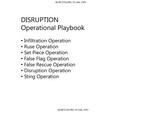
GCHQ - DISRUPTION Operational Playbook [pdf]
A JTRIG “Disruption Operational Playbook” outlines GCHQ’s online covert action toolkit to discredit people and companies, manipulate narratives, and execute false flag, sting, and infiltration operations across targets. It’s a blunt handbook for the four D’s—deny, disrupt, degrade, deceive—translating psychological warfare into clickable tactics on social platforms and forums.
Programs: JTRIG -
GCHQ Cyber Operations Against Anonymous and Hacktivist Groups [pdf]
The leaked 2012 GCHQ presentation reveals that the agency’s JTRIG unit conducted offensive cyber operations against Anonymous and other hacktivist groups, including DDOS attacks (codenamed “Rolling Thunder”), online infiltration, and covert intelligence collection to disrupt their communications and identify key members.
-
GCHQ – Making network sense of the encryption problem (2011) [pdf]
GCHQ’s Network Analysis Centre convened a 2011 roundtable on “making network sense” of encryption, pushing a metadata-first strategy to triage SSL/TLS, IKE, OpenVPN, and SSH flows, pivot from “seed” indicators, and zero in on targets and subnets worth decrypting. The playbook leans on enrichment, AS-level scoping (explicitly citing Belgacom AS6774 GRX VPNs), and “access optimisation” to collect data pre‑encryption—passively or actively.
Programs: SQUEAL · BEARDEDPIGGY · CLOUD · IRASCIBLEHARE · IRASCIBLERABBIT · IRASCIBLEMOOSE · IRASCIBLEEMITT“Operation Socialist: The Inside Story of How British Spies Hacked Belgium’s Largest Telco” - The Intercept ↗ (2014-12-13) · “Lees hier hoe de Britse geheime dienst GCHQ Belgacom aanviel” - NRC ↗ (2014-12-13) · “Britse geheime dienst bespioneerde jarenlang Belgacom-klanten” - De Standaard ↗ (2014-12-13) · Gallagher, Ryan · Modderkolk, Huib · Vanhecke, Nikolas · Eeckhaut, Mark -
GCSB access, XKEYSCORE [pdf]
4 p.These documents confirm that GCSB's Waihopai base (IRONSAND) provides Five Eyes partners, including the UK, with both "strong selected data" and a "full-take feed" of communications from the South Pacific via the NSA's XKEYSCORE system, confirming New Zealand's deep integration into the U.S.-led surveillance network despite facing internal issues with GCSB analysts accessing their own national data within NSA databases.
-
GCSB SIGINT Development Quarterly Report [pdf]
This GCSB quarterly report from July 2009 provides a Top Secret review of major telecommunications developments in the South West Pacific, focusing on the intelligence challenges posed by competitive deregulation and new infrastructure projects, while also detailing GCSB's efforts to enhance its collection capabilities, including the fine-tuning of GSM collection in the Solomon Islands, supporting DSD analyses in Fiji, and preparing for full-take XKEYSCORE data sharing with allies.
“New Zealand Spies on Neighbors in Secret "Five Eyes" Global Surveillance” - The Intercept ↗ (2015-03-04) · “Snowden revelations / The price of the Five Eyes club: Mass spying on friendly nations” - The New Zealand Herald ↗ (2015-03-04) · “New Zealand Spy Data Shared With Bangladeshi Human Rights Abusers” - The Intercept ↗ (2015-04-15) · “Secret documents shine light on GCSB spying in Bangladesh” - The New Zealand Herald ↗ (2015-04-16) · Gallagher, Ryan · Hager, Nicky -
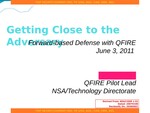
Getting Close to the Adversary – Forward-based Defense with QFIRE (June 3, 2011) [pdf]
This document describes the QFIRE project which is designed to give the NSA a global, low-latency platform for “forward-based defense”, enabling real-time detection and manipulation of Internet traffic close to its source. By co-locating passive sensors (TURMOIL), decision logic (TURBINE), and injection capabilities, QFIRE can rapidly reset connections, redirect targets for exploitation, inject malicious payloads, and even seize control of botnets. It operates as part of the broader QUANTUMTHEORY architecture, leveraging both cooperative and non-cooperative infrastructure worldwide to enable CNE/CND/CNA effects with minimal delay.
Programs: QFIRE · QUANTUMTHEORY · TURBULENCE · TURMOIL · TURBINE · TUTELAGE · QUANTUM · QUANTUMSKY · QUANTUMINSERT · QUANTUMBOT · QUANTUMCOPPER · STRAIGHTBIZARRE · BLINDDATE · TUMULT · ISLANDTRANSPORT · SURPLUSHANGAR · MIDDLEMAN · SCSnet · WEALTHYCLUSTER · SSO -
Ghosthunter and the geolocating of internet cafes [pdf]
This document announces an NSA “R Spotlight” webcast introducing GHOSTHUNTER, a multi-agency geolocation program designed to locate Time Division Multiple Access (TDMA) VSAT Internet access points, particularly internet cafés across the Middle East and North Africa in support of U.S. military operations. By mid-2009, GHOSTHUNTER had successfully geolocated over 5,000 VSAT terminals across Middle East demonstrating its operational effectiveness and integration with broader intelligence efforts.
Programs: GHOSTHUNTER -
GHOSTHUNTER Goes Global [pdf]
This document announces that GHOSTHUNTER, operated from Menwith Hill Station (MHS), is being used to geolocate terminals associated with high-value targets in Iraq and surrounding Middle Eastern countries. It references a hyperlinked article in the station’s Horizon newsletter for further details, which requires a secure NTS-PKI certificate to access due to its classification. The title suggests that GHOSTHUNTER has achieved global reach.
Programs: GHOSTHUNTER -
Guide to Using Contexts in XKS Fingerprints [pdf]
This technical guide explains how NSA analysts use "contexts" within XKEYSCORE fingerprints to create highly targeted surveillance queries by restricting searches to specific scopes (e.g., web searches, document bodies, geographic locations), enabling precision targeting such as finding "all people in Kabul performing web searches on Jihad" while avoiding the overwhelming noise of broader keyword searches.
-
How the NSA Pinpoints a Mobile Device [pdf]
This document is an internal National Security Agency classification guide outlining the agency's abilities to intercept cellular communications.
Programs: ARCVIEW -
How to configure category throttling in XKEYSCORE [pdf]
An NSA technical guide explains how to configure "category throttling" in XKEYSCORE—a feature that automatically stops forwarding intercepted communications once analyst-defined collection targets hit predetermined data volume or session count limits, allowing the surveillance system to continue processing but prevent overflow from high-volume targets.
-
HTTP Activity in XKEYSCORE [pdf]
This training presentation from March 2009 provides NSA and Five Eyes analysts with detailed instructions on exploiting HTTP web browsing activity collected by XKEYSCORE, explaining how to differentiate client-to-server requests (GET/POST) from server-to-client responses, extract metadata like search terms, URLs, cookies, language, and browser types, and use this data to discover new surveillance targets, track individuals' online behavior, and conduct "pattern of life" analysis.
-
HTTP Activity vs User Activity [pdf]
This NSA training document from June 2009 explains the distinction between HTTP Activity (general web browsing data) and User Activity (communications metadata from specific protocols like webmail and chat) within the XKEYSCORE surveillance system, demonstrating through Iranian examples how analysts combine both search types to develop comprehensive intelligence on targets.
Programs: XKEYSCORE · MARINA · FOXTRAIL · DECODEORDAIN · YACHTSHOP · BRUTUS · WINDCHASER · NKB · UIS · STARPROC