Classification: SI 265 documents
Search documents matching “SI” →Each document's classification level, as component values. If a document contains multiple classifications, the highest is used here.
Graphs
By Banner
Refine (combine with another filter, via search)
Sort: Title
Documents
-
Black Budget: Cryptanalysis & Exploitation Services – Analysis of Target Systems [pdf]
This document is a budget justification for the NSA's Cryptanalysis & Exploitation Services project, which develops capabilities to defeat commercial encryption systems, exploit emerging communications technologies, and conduct vulnerability analysis against both foreign and domestic security products.
“The CIA Campaign to Steal Apple's Secrets” - The Intercept ↗ (2015-03-10) · Scahill, Jeremy · Begley, Josh -
Black Budget: Special Source Access - Foreign Partner Access [pdf]
This document provides a detailed financial and operational breakdown from the NSA’s FY 2013 Congressional Budget Justification for the SSO's Foreign Partner Access project. It outlines the strategic funding for the RAMPART-A and WINDSTOP programs, which leverage international partnerships to intercept massive volumes of global communications traffic from long-haul fiber-optic cables and integrated 2nd Party architectures.
“How Secret Partners Expand NSA’s Surveillance Dragnet” - The Intercept ↗ (2014-06-18) · “NSA ‘third party’ partners tap the Internet backbone in global surveillance program” - Dagbladet Information ↗ (2014-06-19) · Gallagher, Ryan · Geist, Anton · Gjerding, Sebastian · Moltke, Henrik · Poitras, Laura · Jensen, Kristian -
“Black Budget” — FY 2013 Congressional Budget Justification/National Intelligence Program, p. 262 (February 2012) [pdf]
This excerpt from the Fiscal Year 2013 Congressional Budget Justification (the "Black Budget") details the NSA's financial and performance metrics for "Analytics Modernization," specifically focusing on the transition to high-volume, automated speech-to-text systems. It records the decommissioning of legacy voice processing systems (VoiceRT) in favor of more robust, scalable capabilities aimed at rendering millions of intercepted voice files searchable via text queries and paired dialogue transcription.
Programs: VoiceRT -
“Black Budget” — FY 2013 Congressional Budget Justification/National Intelligence Program, pp. 360-364 (February 2012) [pdf]
The "Human Language Technology (HLT) Research" section of the FY 2013 "Black Budget" details a specialized research project focused on creating "force multipliers" for the NSA workforce through automated speech-to-text, machine translation, and content extraction. With a requested budget of $29.4 million, the project aims to bridge the gap between foundational academic research (via Johns Hopkins University) and the practical exploitation of the volume and velocity of global SIGINT.
Programs: HLT -
BLARNEY Exploits the Social Network via Expanded Facebook Collection [pdf]
An SSO highlight of 14 March 2011 announcing substantially expanded Facebook collection under FISA and FAA authorities — chat, private messages, profile information, subscriber videos and geolocation from IP addresses — built with the FBI over six months, with PRINTAURA writing the new software.
-
BLARNEY program overview [pdf]
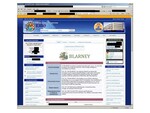
The document is an NSA Special Source Operations (SSO) portal page screenshot for the BLARNEY program, describing it as a top-secret collection initiative established in the 1970s that leverages government and commercial partnerships to intercept foreign intelligence under FISA authority. It highlights BLARNEY’s major intelligence value—contributing heavily to counterterrorism reporting and the President’s Daily Brief—and lists its primary targets as diplomatic, economic, foreign government, and counterterrorism communications.
-
BLARNEY Team Provides Outstanding Support to Enable UN Security Council Collection [pdf]
An SSO item describing how the BLARNEY team, NSA lawyers and the FBI obtained four FISA court orders in days — for Gabon, Uganda, Nigeria and Bosnia — after Ambassador Susan Rice asked for SIGINT on undecided countries ahead of the June 2010 UN Security Council vote on sanctions against Iran.
Programs: BLARNEYPeople: Rice, Susan -
BOUNDLESSINFORMANT - Describing Mission Capabilities from Metadata Records [pdf]
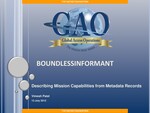
This presentation on the Boundless Informant program (BOUNDLESSINFORMANT), which uses big data tools to analyze and visualize global SIGINT metadata collection in near real time. It explains how the system replaced older manual methods, enabling the NSA to track collection volumes, coverage, and trends for specific countries or sites through cloud-based infrastructure.
People: Patel, Vimesh“NSA-files repeatedly show collection of data «against countries» - not «from»” - Dagbladet ↗ (2013-11-22) · “Boundless Informant: the NSA's secret tool to track global surveillance data” - The Guardian ↗ (2013-06-08) · “Claves y giros del espionaje masivo en España” - El Mundo ↗ (2013-11-04) · Greenwald, Glenn · MacAskill, Ewen · Aranda, Germán -
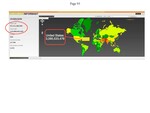
BOUNDLESSINFORMANT Chart on United States [pdf]
The BOUNDLESSINFORMANT global overview screen with the United States selected: 97,111,188,358 DNI and 124,808,692,959 DNR records over the last 30 days across 504 SIGADs, of which 3,095,533,478 are attributed to the United States.
Programs: BOUNDLESSINFORMANT -
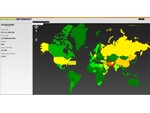
BOUNDLESSINFORMANT Overview [pdf]
World map view from the Boundless Informant program, with "CNE" (Computer Network Exploitation) selected from the dropdown.
Programs: BOUNDLESSINFORMANT -
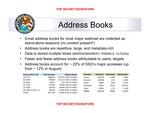
Bulk collection of webmail address books and emerging protocols [pdf]
TOP SECRET NSA document details the large-scale collection of email address books and contact lists from major webmail and social media providers, emphasizing their metadata value despite low attribution rates to known targets. It also highlights ongoing efforts to identify and analyze emerging communication protocols, such as those used by Hotmail Messenger.
-
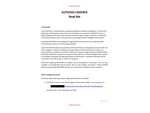
CADENCE Read Me [pdf]
This NSA engineering manual details how to configure XKEYSCORE—the agency's sprawling surveillance system—to integrate with CADENCE, an automated keyword scanning tool that filters intercepted communications and routes intelligence based on search terms submitted by analysts.
-
Classification Guide for FISA, the Protect America Act and the FISA Amendments Act [pdf]
The Foreign Intelligence Surveillance Act regulates spying for national security purposes on domestic soil. This guide lays out secrecy restrictions for various aspects of those programs. Among other things, it mentions the Large Content FISA order, a term that has not previously been disclosed.
-
Classification guide for NSA/CSS Quantum Computing Research (10-25) [pdf]
The NSA/CSS Quantum Computing Research Classification Guide (10-25) outlines how information related to the NSA’s quantum computing research should be classified, distinguishing between unclassified academic work and classified cryptanalytic programs. It defines classification levels for research activities, breakthroughs, algorithms, collaborations, and materials, with the goal of protecting U.S. cryptographic systems while advancing the agency’s offensive capabilities in quantum cryptanalysis.
-
CLASSIFICATION GUIDE FOR THE NSA/CSS TARGET EXPLOITATION (TAREX) PROGRAM [pdf]
A 2012 NSA/CSS classification guide for the TAREX program — the agency's clandestine human intelligence and close-access signals intelligence unit — establishing what information about TAREX's operations, locations, methodologies, and interagency relationships must be protected, revealing forward-based presences in Germany, South Korea, and Beijing, and confirming that TAREX personnel operate undercover at U.S. embassies worldwide.
Programs: TAREXPeople: Shea, Teresa H. -
CNE Analysis in XKEYSCORE [pdf]
This document is an NSA training presentation from October 2009 demonstrating how XKEYSCORE integrates with Computer Network Exploitation (CNE) operations, allowing analysts to search and analyze data extracted from compromised computers including keystrokes, browser history, registry files, documents, emails, and directory structures collected through implants like UNITEDRAKE and OLYMPUS.
Programs: XKEYSCORE · OLYMPUS · UNITEDRAKE · PINWALE · TUNINGFORK · TURBOCHASER · MARINA · JOLLYROGER · TREASUREMAP · TURBINE · PRESSUREWAVE · MAD · TUCKER · EXPANDINGPULLY · UNIX · SEARCHLIGHT · KEYLOGGER · PILBEAM · FOXACID · WAYTIDE · SHADOWQUEST · SEAGULLFARO · DARKHELMET · LUTEUSICARUS · FOGGYBOTTOM · GREENCHAOS · RADIUS · NKB · VALIDATOR -
Come to SID's Identity Intelligence (I2) Day Conference and See Your Target in a Whole New Light! SIDtoday [pdf]
This SIDtoday article promotes NSA's Identity Intelligence (I2) Day Conference, highlighting the importance of using SIGINT tools and techniques to track individuals across time and space. It emphasizes the growing role of biometrics, biographic data, and digital footprints in identifying and targeting foreign persons of interest, with insights from key speakers and case studies.
-
Computer Network Exploitation (CNE) Classification Guide / 2-59 [pdf]
A NSA/TAO classification guide establishing the precise classification level for 41 categories of information about computer network exploitation operations — covering remote and physical subversion methods, CNE tools and techniques, supply chain operations, hardware implants, off-net field operations, zero-day vulnerabilities, and cryptographic material acquired through CNE.
“Core Secrets: NSA Saboteurs in China and Germany” - The Intercept ↗ (2014-10-10) · “The Digital Arms Race: NSA Preps America for Future Battle” - Der Spiegel ↗ (2015-01-17) · Maass, Peter · Poitras, Laura · Appelbaum, Jacob · Gibson, Aaron · Guarnieri, Claudio · Müller-Maguhn, Andy · Rosenbach, Marcel · Ryge, Leif · Schmundt, Hilmar · Sontheimer, Michael -
COMPUTER NETWORK OPERATIONS - GENIE [pdf]
A TOP SECRET Congressional Budget Justification entry for the NSA/CSS GENIE project — the Tailored Access Operations programme underpinning all endpoint Computer Network Operations — requesting $651.7 million and 1,870 military and civilian positions for FY2013, with plans to maintain 85,000-96,000 implant points-of-presence worldwide and 9,000-10,000 active accesses, including $25.1 million for covert purchase of software vulnerabilities and a $3.4 million supply chain implant operation targeting al-Qaeda.
-
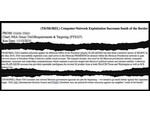
Computer-Network Exploitation Successes South of the Border [pdf]
Pena Nieto's predecessor as president, Felipe Calderon, was also targeted. This image shows an excerpt from an NSA document classified as "top secret," from November 2010. The National Security Agency (NSA) has a division for particularly difficult cases. Called "Tailored Access Operations," or TAO for short, this department devises special methods for special targets. In May 2010, the division reported mission accomplished. A report classified as "top secret" said: "TAO successfully exploited a key mail server in the Mexican Presidencia domain within the Mexican Presidential network to gain first-ever access to President Felipe Calderon's public email account." According to the NSA, this email domain was also used by cabinet members, and contained "diplomatic, economic and leadership communications which continue to provide insight into Mexico's political system and internal stability."
Programs: FLATLIQUID