Come to SID's Identity Intelligence (I2) Day Conference and See Your Target in a Whole New Light!
Open PDFDocument date: 2010-08-12
Type: SIDtoday
Pages: 2
Genre: newsletter
Banner: DYNAMIC PAGE -- HIGHEST POSSIBLE CLASSIFICATION IS TOP SECRET // SI / TK // REL TO USA AUS CAN GBR NZL
Classification: SECRET SI
Dissemination: REL
This SIDtoday article promotes NSA's Identity Intelligence (I2) Day Conference, highlighting the importance of using SIGINT tools and techniques to track individuals across time and space. It emphasizes the growing role of biometrics, biographic data, and digital footprints in identifying and targeting foreign persons of interest, with insights from key speakers and case studies.
My notes

DYNAMIC PAGE
HIGHEST POSSIBLE CLASSIFICATION IS
TOP SECRET // SI / TK // REL TO USA AUS CAN GBR NZL
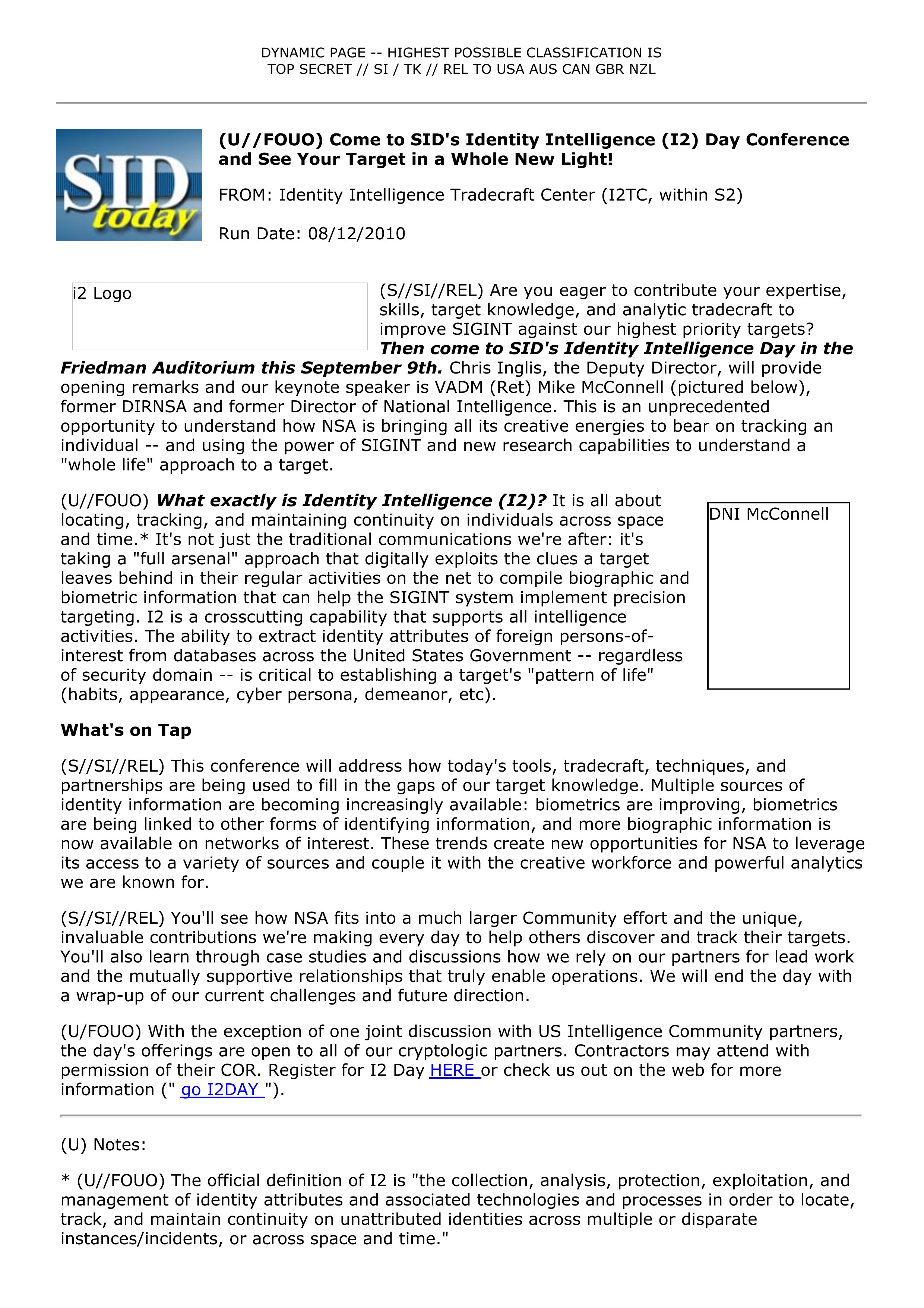
(U//FOUO) Come to SID's Identity Intelligence (I2) Day Conference and See Your Target in a Whole New Light!
FROM: Identity Intelligence Tradecraft Center (I2TC, within S2)
Run Date: 08/12/2010
i2 Logo
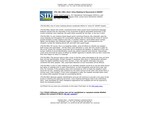
(S//SI//REL) Are you eager to contribute your expertise, skills, target knowledge, and analytic tradecraft to improve SIGINT against our highest priority targets? Then come to SID's Identity Intelligence Day in the Friedman Auditorium this September 9th. Chris Inglis, the Deputy Director, will provide opening remarks and our keynote speaker is VADM (Ret) Mike McConnell (pictured below), former DIRNSA and former Director of National Intelligence. This is an unprecedented opportunity to understand how NSA is bringing all its creative energies to bear on tracking an individual -- and using the power of SIGINT and new research capabilities to understand a "whole life" approach to a target.
(U//FOUO) What exactly is Identity Intelligence (I2)? It is all about locating, tracking, and maintaining continuity on individuals across space and time.* It's not just the traditional communications we're after: it's taking a "full arsenal" approach that digitally exploits the clues a target leaves behind in their regular activities on the net to compile biographic and biometric information that can help the SIGINT system implement precision targeting. I2 is a crosscutting capability that supports all intelligence activities. The ability to extract identity attributes of foreign persons-of-interest from databases across the United States Government -- regardless of security domain -- is critical to establishing a target's "pattern of life" (habits, appearance, cyber persona, demeanor, etc).
DNI McConnell
What's on Tap
(S//SI//REL) This conference will address how today's tools, tradecraft, techniques, and partnerships are being used to fill in the gaps of our target knowledge. Multiple sources of identity information are becoming increasingly available: biometrics are improving, biometrics are being linked to other forms of identifying information, and more biographic information is now available on networks of interest. These trends create new opportunities for NSA to leverage its access to a variety of sources and couple it with the creative workforce and powerful analytics we are known for.
(S//SI//REL) You'll see how NSA fits into a much larger Community effort and the unique, invaluable contributions we're making every day to help others discover and track their targets. You'll also learn through case studies and discussions how we rely on our partners for lead work and the mutually supportive relationships that truly enable operations. We will end the day with a wrap-up of our current challenges and future direction.
(U//FOUO) With the exception of one joint discussion with US Intelligence Community partners, the day's offerings are open to all of our cryptologic partners. Contractors may attend with permission of their COR. Register for I2 Day HERE or check us out on the web for more information (" go I2DAY ").
(U) Notes:
- (U//FOUO) The official definition of I2 is "the collection, analysis, protection, exploitation, and management of identity attributes and associated technologies and processes in order to locate, track, and maintain continuity on unattributed identities across multiple or disparate instances/incidents, or across space and time."
"(U//FOUO) SIDtoday articles may not be republished or reposted outside NSANet without the consent of S0121 (DL sid_comms)."
DYNAMIC PAGE -- HIGHEST POSSIBLE CLASSIFICATION IS
TOP SECRET // SI / TK // REL TO USA AUS CAN GBR NZL
DERIVED FROM: NSA/CSSM 1-52, DATED 08 JAN 2007 DECLASSIFY ON: 20320108
Published in the Same Report
(10 of 21 documents)
-
RT10 Initiative Overview [pdf]
Overview document for RT10, "Real-time, distributed architecture for mobile (tactical) and fixed (national) operational environments"
Programs: RT10 · COBRA FOCUS · GREENDRAGON · GOLDMINER · JUGGERNAUT · MATTERHORN · OBELISK · SORTINGHAT · INFOVIS · SHARPFOCUS2 · TOGA · SORTINGLEAD · GLOBALREACH · VOICERT · QUADRASPECTRE · RENOIR · ANALYSTSNOTEBOOK · OCTAVE · HLT · DRT · GEOT · InnoVisions -
NSA Georgia Opens New Audio-Forensics Lab SIDtoday [pdf]
The document discusses the launch of a new audio-forensics lab at NSAG (National Security Agency Georgia) designed to enhance the processing and analysis of intercepted voice communications. The lab, funded through the Senior Language Technology Authority (SLTA), will focus on resolving language processing challenges for language analysts by improving the intelligibility and quality of foreign-language voice intercepts.
People: Mercer, Marti Hix -
Alert: Voice Masking Is Discovered in SIGINT SIDtoday [pdf]
This March 2007 post from the internal NSA newsletter SIDToday draws attention to voice-masking technology used by subjects of surveillance to frustrate the agency’s voice-recognition efforts.
-
Tips for a Successful Quick Reaction Capability SIDtoday [pdf]
In response to Iranian President Ahmadinejad’s 2007 visit to New York, the NSA’s Iran Government and Leadership branches launched a Quick Reaction Capability (QRC) to gather time-sensitive intelligence. The QRC focused on enhanced collection techniques, collaboration across departments, and efficient data management to analyze the extensive communications traffic during the event, resulting in valuable leads on Iranian leadership activities and diplomatic plans.
People: Ahmadinejad, Mahmoud -
New RT-RG Overview Video Available on NSANet SIDtoday [pdf]
The NSA's Meade Operations Center released a 10-minute video overview of the Real-Time Regional Gateway (RT-RG), a tool suite designed for forward-deployed analysts. The suite enables faster access to real-time metadata and reporting, improving tactical support for military operations, with new functionalities being developed for use in Afghanistan and beyond.
-
Voice Biometrics Capability Proven During Recent Technology Demonstration SIDtoday [pdf]
The Coordinate Operational Resources for Voice Exploitation Technology (CORVET) project, managed by the Expeditionary SIGINT Services Office (ESSO), demonstrated a promising capability for voice biometrics that could be used in security operations to identify individuals based on voice characteristics. Similar to the long-established method of fingerprinting, CORVET aims to create a database of voice models that could be used for identification in various contexts, such as detention and force-protection scenarios.
-
Alvin, Simon, and... Al Qaeda? Finding Modified Voice in SIGINT Traffic SIDtoday [pdf]
This SIDtoday article discusses the use of voice modification technology by Al-Qaeda and other extremist groups to evade identification in SIGINT traffic. It highlights the development of the HLT Lite software by R64, which can automatically detect modified voices in intercepted communications, enabling the identification of targets even when traditional voice recognition fails.
-
SIGINTers Use Human Language Technology to Great Advantage, Isolate Conversation about Threat to US Official SIDtoday [pdf]
In 2010, the Special Collection Service in Mexico City began using Human Language Technology (HLT) to streamline voice collection and analysis, significantly improving efficiency. By rapidly filtering through large volumes of audio data, HLT helped isolate critical intelligence, such as identifying a conversation related to a bomb threat targeting a U.S. Embassy official, all within minutes instead of hours.
Programs: HLT -
Innov8 Voice Analytics Experiment Profile [pdf]
This document outlines Phase 1 of a Voice Analytics experiment conducted by GCHQ in partnership with the NSA, testing the ingestion and processing of voice data through the DISTILLERY platform on GHOSTMACHINE hardware. The experiments evaluate independent, parallel, and linked analytics (SAD, GID, LID), as well as dynamic resource management, to ensure accurate, scalable, and compliant voice processing in a Joint Collaboration Environment.
Marking: TOP SECRET -
Voice Fax User Group Minutes December 2010 [pdf]
This GCHQ document is a NSA/GCHQ meeting record from December 2010 detailing the deployment of voice analytics, including speech activity detection, speaker identification, and language identification, integrated with tools like Google Earth to map locations of target communications. It outlines ongoing and planned speaker ID operations against specific targets, including militant leaders and foreign officials, demonstrating the operational use of voice recognition for intelligence collection and geolocation.
Related Documents
-
Identity Intelligence: Image Is Everything [pdf]
This document is a highly classified NSA/CSS briefing detailing Identity Intelligence (i2), a comprehensive methodology for exploiting unique fragments of information to track, identify, and exploit targets of interest. It outlines an expansive architecture for data collection that spans Biometric/Biologic, Biographic, and Contextual/Behavioral domains, essentially mapping every conceivable data point of an individual's physical existence and digital/social footprint.
-
How Does Your Target Use the Internet? A New Tool Can Help You Find Out SIDtoday [pdf]
A new tool combines open-source and commercial data with signals intelligence to track how targets access the internet. Possible uses include tracking target movement and steering collection “towards links with higher intelligence potential.”
Programs: DNOC Spiral IIThe Intercept ↗ (2018-03-01) -
How to Change the Intelligence Community Without Leaving Your Desk! SIDtoday [pdf]
New strategic plans from the Director of National Intelligence are worth reading because they show the direction of the intelligence community, open up career opportunities, and lead to new tools and techniques.
Programs: GWOTPeople: Negroponte, John D.The Intercept ↗ (2019-05-29) -
Sharing Communications Metadata Across the U.S. Intelligence Community - ICREACH [pdf]
ICREACH is a "one-stop shopping" tool and federated query architecture that allows thousands of analysts across 23 U.S. agencies to search billions of communications metadata records. It consolidates telephony and digital network intelligence (DNI) from various sources—including NSA holdings, Second Party (Five Eyes) partners, and other IC databases like the CIA/FBI's PROTON—into a single, searchable interface. At its launch, the system increased shared metadata records from 50 billion to over 850 billion.
“How the NSA Built Its Own Secret Google” - The Intercept ↗ (2014-08-25) · “No Place to Hide” - Metropolitan Books ↗ (2014-05-13) · Gallagher, Ryan · Greenwald, Glenn -
New Technique Geolocates Targets Active at Yemeni Cafes SIDtoday [pdf]
A 2010 NSA document from Menwith Hill Station details a new geolocation technique used in Yemen that combines HUMINT café surveys with SIGINT data — including RADIUS logs, passive collection tools, and TAO access — to track targets frequenting internet cafés linked to Al Qaeda. The method, integrating systems like MORK, WINDCHASER, MARINA, and SPARKLEPONY, enabled analysts to identify and monitor dozens of cafés and correlate user activity with high-priority targets.
Programs: GHOSTHUNTER · MORK · RADIUS · WINDCHASER · MARINA · XKEYSCORE · SPARKLEPONY · GHOSTWOLF · TELIR