Classification: COMINT 287 documents
Search documents matching “COMINT” →Each document's classification level, as component values. If a document contains multiple classifications, the highest is used here.
Graphs
By document date (13 years)
By Banner
Refine (combine with another filter, via search)
Sort: Title
Documents
-
OAKSTAR Weekly Update - Program Highlights Week of: March 2-8, 2013 [pdf]
The document is a NSA weekly operations update from March 2-8, 2013, detailing technical issues, maintenance, and intelligence activities within the OAKSTAR and MONKEYROCKET programs—surveillance systems used for data collection. It notes collection outages, system adjustments, and that analysts were using MONKEYROCKET access to track Bitcoin transactions and investigate organized crime and cyber targets using e-currency for money laundering.
-
OAKSTAR Weekly Update - Program Highlights Week of: March 23-29, 2013 [pdf]
The document is a NSA weekly operations update from March 23-29, 2013, it details equipment handoffs, script tweaks to improve data flow, metadata collection metrics, and ongoing MONKEYROCKET use for tracking Bitcoin-related targets, including sharing detailed user and session data with analysts for intelligence purposes.
-
OAKSTAR Weekly Update - Program Highlights Week of: March 30 - April 5, 2013 [pdf]
The document is a NSA weekly operations update from March 30 - April 5, 2013, reporting hardware failures and server issues with XKeyscore, efforts to reroute data and replace components, ongoing metadata collection metrics, and continued intelligence production, with OAKSTAR's 2013 serialized product totals at 430 reports and 2,641 GISTs (MONKEYROCKET: 1 report).
-
OAKSTAR Weekly Update - Program Highlights Week of: March 9-15, 2013 [pdf]
The document is a NSA weekly operations update from March 9-15, 2013, detailing technical issues, maintenance, and intelligence activities within the OAKSTAR and MONKEYROCKET programs—surveillance systems used for data collection. It notes collection outages, system adjustments, and that analysts were using MONKEYROCKET access to track Bitcoin transactions and investigate organized crime and cyber targets using e-currency for money laundering.
-
Offsensive Session: the Boundaries and Against Hacktivism [pdf]
GCHQ slides on “effects” operations against hacktivists: disruption in place of traditional law enforcement, denial-of-service attacks on key communications outlets during Op WEALTH in summer 2011, and a disruption playbook of infiltration, ruse, set-piece, false-flag, false-rescue, disruption and sting operations.
-
OP HIGHLAND FLING - Event Log [pdf]
A TOP SECRET operational event log from GCHQ's GCWiki documenting a January 2011 operation targeting Gemalto employees in France, Poland and elsewhere, using MUTANT BROTH cookie analysis, Facebook credentials, LinkedIn profiles and Computer Network Exploitation to identify and implant targets as part of the operation to steal SIM card encryption keys.
-
Op MULLENIZE and beyond - Staining machines 10/10/12 [pdf]
This 2012 report from the NSA's British counterpart, the GCHQ, describes a method of "staining" electronic traffic to distinguish otherwise anonymous users. It is used to unmask Tor users and devices on networks in which many computers share the same Internet address. The method relies on planting code in a web browser to change the "user agent," which is the way the browser identifies itself on the web. In a two month period, the report says, GCHQ managed to implant about 200 computers with uniquely identifying stains.
-
OSINT FUSION PROJECT [pdf]
A TOP SECRET//COMINT//REL TO USA, FVEY presentation by Lockheed Martin's Intelligence and Global Solutions division describing the OSINT Fusion Project — a programme to collect and weaponise open source intelligence from hacker forums, malicious email traffic, botnet data and commercial threat feeds to generate XKEYSCORE fingerprints for CNE targeting and fourth party collection.
-
OTR encrypted messages can't be decrypted by the NSA [pdf]
Three intercepted chat sessions from 16 March 2012 collected under PRISM, showing a target switching mid-conversation from unencrypted to OTR-encrypted messaging — with NSA able to collect the session metadata and unencrypted portions but unable to decrypt the OTR messages, each annotated "No decrypt available for this OTR encrypted message."
Programs: PRISM -
Pages From Denial and Deception Except Redacted [pdf]
This document is a TOP SECRET X1 NSA report listing unauthorized disclosures of signals intelligence over the previous three years, noting that some—including coverage of the 1967 Israeli attack on the USS Liberty—had potential operational impacts but did not change targeting or intelligence priorities. It highlights that such leaks can harm U.S. intelligence capabilities and details one specific instance involving a 2000 Wall Street Journal letter discussing the incident.
-
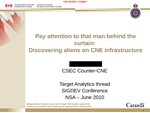
Pay attention to that man behind the curtain: Discovering aliens on CNE infrastructure [pdf]
CSEC briefing from 2010 outlines Canada’s counter–computer network exploitation efforts to detect, analyze, and pursue foreign and friendly cyber actors operating on shared CNE infrastructure. It details tools, methods, and a case study showing how hidden implants and overlapping state-sponsored operations were uncovered and attributed.
Programs: SNOWGLOBE · WARRIORPRIDE · DAREDEVIL · SLIPSTREAM · CHORDFLIER · NAMEDROPPER · WORMWOOD · REPLICANTFARM · OBELIX · SHEPHERD · CARBON · ALOOFNESS · REGBACKUP · DOGHOUSE · WALKER · CHOCOPOP · BLAZINGANGEL · WINDO · QUIVERINGSQUAB · DIESELRATTLE · CYDLL · CIVETCAT · WIDOWKEY · LASEX · PULLEDPORK · MAKERSMARK · FANNER · SEEDSPHERE · BYZANTINE · VOYEUR · SUPERDRAKE · GOSSIPGIRL · WATERMARK · DOURMAGNUM -
Peeling Back the Layers of TOR with EGOTISTICALGIRAFFE [pdf]
An NSA Tailored Access Operations presentation describing EGOTISTICALGIRAFFE and EGOTISTICALGOAT — Firefox browser exploits targeting Tor Browser Bundle users — covering fingerprinting Tor users via the TorButton BuildID, the EGOTISTICALGOAT type confusion vulnerability in Firefox's E4X implementation enabling remote code execution, and the FINKDIFFERENT/FUNNELOUT callback infrastructure used to exfiltrate data from exploited targets.
Programs: EGOTISTICALGIRAFFE · EGOTISTICALGOAT · ERRONEOUSINGENUITY · ERIN · EGGO · FINKDIFFERENT · FIDI · EGGI · FUNNELOUT -
PGP encrypted email can't be decrypted by the NSA [pdf]
Two intercepted Yahoo email messages collected under FAA counterterrorism authority through PRISM (SIGAD US-984XN), both containing PGP-encrypted content that NSA was unable to decrypt — published by Der Spiegel as direct evidence that PGP encryption defeated NSA collection at the time of interception in January 2012.
Programs: PRISM -
PHANTOM PARROT [pdf]
This document discusses PHANTOM PARROT, a GTAC tool used for querying mobile phone data collected from individuals stopped at UK ports as part of the ITT Op WILDWAY initiative. The tool allows intelligence analysts to access phonebook, SMS, and call log data from these stops, which can be used for counter-terrorism efforts. Data is obtained under the Terrorism Act 2000, and the tool is part of a broader intelligence-gathering effort, eventually to be integrated into the LUCKY STRIKE project.
Programs: PHANTOM PARROT · WILDWAY · RANNOCH MOOR · LUCKY STRIKE · LOOKING GLASS · DISHFIRE · CORINTH · MOONRAKER · RUSSETT -
Phone Number Extractor [pdf]
A top secret XKEYSCORE training document from October 2009 describing the Phone Number Extractor capability, which automatically identifies and extracts telephone numbers from intercepted internet traffic including website content, email signature blocks, HTTP GET requests from mobile devices, HTTP POST submissions, and converged DNR/DNI collection — with operational examples targeting Iran, Lebanon, and Pakistan.
-
PINWALE: Transnational DNI Training [pdf]
This presentation is a classified NSA training guide on PINWALE, a SIGINT database used for the storage, retrieval, and analysis of intercepted digital network intelligence (DNI) communications. It outlines system capabilities, query creation, search tools, and interfaces such as NEXUS, UIS, and AGILITY, explaining how analysts search, retrieve, and analyze both content and metadata — including FISA-partitioned data — within the Five Eyes intelligence framework.
-
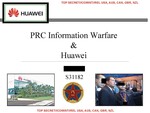
PRC Information Warfare & Huawei [pdf]
This NSA intelligence briefing on Huawei analyzes Huawei’s global telecommunications presence and its potential links to the People’s Liberation Army (PLA) and Chinese government intelligence activities. It highlights concerns that Huawei’s international market expansion — including its subcontracted 2008 upgrade of the TAT-14 transatlantic cable carrying U.S. and defense communications — could be exploited by China for signals intelligence (SIGINT) purposes.
People: Chávez, Hugo -
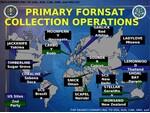
PRIMARY FORNSAT COLLECTION OPERATIONS [pdf]
This document is a TOP SECRET NSA/CSS slide mapping the global locations of primary FORNSAT (foreign satellite) collection operations, showing U.S. and second-party ground stations used to intercept satellite communications worldwide. It illustrates the geographic spread and allied integration of NSA satellite surveillance infrastructure rather than specific technical capabilities.
-
Procedures Used By The National Security Agency For Targeting Non-United States Persons Reasonably Believed To Be Located Outside The United States To Acquire Foreign Intelligence Court Information Pursuant To Section 702 Of The Foreign Intelligence Surveillance Act Of 1978 [pdf]
The NSA’s 2009 Section 702 targeting procedures lay out how analysts decide who can be surveilled without a warrant, supposedly limiting spying to foreigners abroad. In reality, the rules give the agency wide latitude to presume people are foreign, rely on vague “totality of the circumstances” tests, and allow broad technical methods like IP filters and metadata checks. Oversight is mostly internal and after-the-fact, creating significant potential for U.S. communications to be swept up with little accountability.
People: Holder, Eric H. Jr. -
Project CAMBERDADA [pdf]
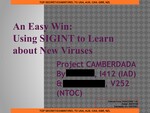
NSA presentation on Project CAMBERDADA, a programme that intercepts emails sent to antivirus companies reporting new malware, uses SIGINT collection to monitor antivirus vendor communications, and identifies opportunities to repurpose malware before vendors detect it — listing 23 antivirus companies from around the world as targets, with Kaspersky as the primary focus.
People: Picard, François