Agency: NSA National Security Agency (US) 557 documents
Search documents matching “NSA” →The agency that WROTE each document.
Graphs
By document date (13 years)
By Banner
By Classification
Refine (combine with another filter, via search)
Sort: Title
Documents
-
Intellipedia – BIOS Threats [pdf]
This from an internal wiki for the U.S. intelligence community, titled “BIOS Threats” details the use of malicious BIOS implants as a means of achieving persistent system compromise for cyber espionage and attack purposes. It discusses the history, technical challenges, detection limitations, and global development of BIOS-based malware by both state and non-state actors, including U.S. and Chinese cyber units.
-
Intellipedia – Supply Chain Cyber Threats [pdf]
This document on Supply Chain Cyber Threats, from an internal wiki for the U.S. intelligence community, outlines vulnerabilities in hardware and firmware components such as power supplies, NICs, RAID controllers, GPUs, and peripheral devices that could be exploited by adversaries through the supply chain. It details assessments from U.S. intelligence agencies (CIA, DIA, FBI, CYBERCOM) highlighting risks from foreign companies, insider threats, and malicious modifications that could compromise critical U.S. government and military systems.
Programs: A-SPACE -
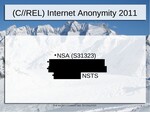
Internet Anonymity 2011 [pdf]
A TOP SECRET NSA presentation from 2011 providing a comprehensive survey of Internet Anonymity Technologies (IAT) — covering HTTP proxies, VPN anonymity providers, multi-hop networks including Tor and JAP, anonymous remailers and circumvention tools — alongside NSA's capabilities and limitations against each, including XKEYSCORE fingerprints for VPN identification, the PARTNERSNIPPET Tor deanonymisation team, GOLDENFORTIN Netflow data, and a candid assessment that Tor offers "no passive exploitation."
Programs: FOXTRAIL · NKB · NACIRONIN · PONTENTPOTABLES · RONIN · XKEYSCORE · PARTNERSNIPPET · GOLDENFORTIN · SNAPEPeople: Heap, Austin -
Interview with a SID "Hacker" -- Part 1: How Does TAO Do Its Work? SIDtoday [pdf]
A SIDToday interview from July 2012 with a counterterrorism subject-matter expert in TAO's Requirements and Targeting organisation, explaining how TAO plans and executes computer network exploitation operations.
“The Digital Arms Race: NSA Preps America for Future Battle” - Der Spiegel ↗ (2015-01-17) · “Arbeiten mit geheimen Snowden-Dokumenten” - Der Spiegel ↗ (2015-07-03) · Appelbaum, Jacob · Gibson, Aaron · Guarnieri, Claudio · Müller-Maguhn, Andy · Poitras, Laura · Rosenbach, Marcel · Ryge, Leif · Schmundt, Hilmar · Sontheimer, Michael · Eckert, Svea · Stark, Holger -
Interview with a SID "Hacker" -- Part 2: Hacker Culture and Worker Retention SIDtoday [pdf]
A SIDtoday internal NSA newsletter interview with a redacted TAO employee discussing hacker culture within the agency's offensive cyber unit, worker retention challenges, and the team's role in operations including the raid that killed Osama bin Laden.
Programs: SCQAWKPeople: bin Laden, Osama -
INTOLERANT – Who Else Is Targeting Your Target? Collecting Data Stolen by Hackers – SIDtoday SIDtoday [pdf]
A TOP SECRET SIDToday article from Menwith Hill Station describing how NSA and CSEC discovered and began exploiting INTOLERANT — a sophisticated email-stealing hacking operation targeting Indian diplomats, Central Asian diplomats, Chinese human rights defenders, Tibetan pro-democracy activists, Uighur activists and European officials — by intercepting the stolen emails as they transited satellite links, a technique internally called "fourth party collection" or "outsourcing SIGINT."
Programs: INTOLERANT -
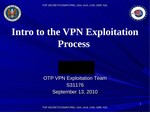
Intro to the VPN Exploitation Process [pdf]
NSA introduction to the VPN exploitation process from September 2010, presented by the OTP VPN Exploitation Team, covering the full workflow from initial collection through to sustained decryption of IPSec, PPTP, SSL and SSH traffic, with named exploitation successes including airlines, diplomatic missions, banks and intelligence services across Iran, Jordan, Russia, Turkey, Pakistan, Afghanistan, Somalia, Indonesia and Mexico.
Programs: BLEAKINQUIRY · TOYGRIPPE · XKEYSCORE · MAILORDER · CORALREEF · VULCANDEATHGRIP · SCISSORS · TURTLEPOWER · PINWALE · FOURSCORE · CADENCE · UTT · VULCANMINDMELD · CAPRIOS · AGILITY · NKB · FOLLOWTHEMONEY -
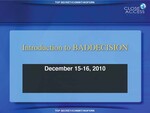
Introduction to BADDECISION [pdf]
This presentation details the use of the NSA program BADDECISION, which is a computer network exploitation tool (CNE) that uses a frame injection technique to redirect the target client to a FOXACID server.
-
Introduction to Context Sensitive Scanning with X-KEYSCORE Fingerprints [pdf]
This May 2010 NSA training document introduces XKEYSCORE's context-sensitive scanning capabilities using "fingerprints"—customizable detection rules that allow analysts to surgically target specific types of Internet traffic without needing prior knowledge of email addresses or other strong selectors, using over 70 unique contexts to identify patterns in communications and behaviors.
-
Introduction to WLAN / 802.11 Active CNE Operations [pdf]
This NSA powerpoint introduces computer network exploitation (CNE) criteria and assesment as well as active CNE operations. It also introduces the FOXACID program, which is a program to deliver content based exploits to web browsers.
-
Introduction to XKS Application IDs and Fingerprints [pdf]
This August 2009 NSA training document introduces XKEYSCORE's Application IDs (AppIDs) and Fingerprints system, explaining how metadata tags are automatically applied to intercepted sessions to identify and categorize different types of Internet traffic, applications, and behaviors, evolving through four generations from simple keyword matching to sophisticated code-based metadata extraction.
-
IR.21 – A Technology Warning Mechanism [pdf]
This 2010 TOP SECRET NSA briefing defines the IR.21 roaming document as a critical tool for "horizon scanning" and "forecasting" global telecommunications shifts. The document outlines how the NSA uses these technical files to proactively identify emerging 3G and 4G technologies, pinpointing vulnerabilities for exploitation before new systems are even fully deployed.
-
Iran – Current Topics, Interaction with GCHQ [pdf]
This NOFORN top secret April 2013 NSA document, shows how Iran significantly improved its offensive cyber capabilities by learning from cyberattacks against it, such as the April 2012 attack on its own oil industry, subsequently launching its own destructive attacks against Saudi Aramco and U.S. financial institutions.
-
Is It the End of the SIGINT World as We Have Come to Know It? [pdf]
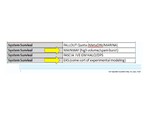
Two excerpts from a 2012 NSA presentation titled "Is It the End of the SIGINT World as We Have Come to Know It?" prepared by a member of the Large-Access Exploitation Group. The table excerpt lists MAINWAY among the systems at highest risk of being overwhelmed by the volume of data the agency was ingesting. The diagram excerpt shows MAINWAY feeding into the Graph-in-Memory (alongside WESTERNSTAR), illustrating how MAINWAY's continuous contact-chaining pushed its precomputed results into the in-memory graph database that analysts actually queried.
Programs: FALLOUT · METADNI · MARINA · MAINWAY · FASCIA · GMHALO · DPS · EKS · WESTERNSTAR · GRAPH-IN-MEMORY -
Is there "fifth party" collection? [pdf]
This NSA internal Q&A forum discussion reveals "fifth party collection"—where the NSA passively intercepts data from one intelligence service (South Korea) that has compromised another service's (North Korea) computer network exploitation operations, creating a three-layer chain where NSA exploits Actor One's access to Actor Two's CNE activities against shared targets. The thread provides concrete examples including NSA leveraging South Korean implants on North Korean officials' computers (who themselves were conducting CNE operations) and stealing zero-day exploits from unidentified foreign intelligence services by passively monitoring their successful attacks.
-
Is There a Sustainable Ops Tempo in S2? How Can Analysts Deal with the Flood of Collection? SIDtoday [pdf]
The NSA's Deputy Director for Analysis and Production discusses the unsustainable operational tempo caused by overwhelming data collection volumes, advocating for "Analytic Modernization" that would shift from treating SIGINT as "radioactive" NSA-only material to sharing raw intelligence with other agencies for collaborative exploitation.
Programs: A-SPACE -
Israel targets the U.S. government for invasive electronic surveillance [pdf]
Israel targets the U.S. government for invasive electronic surveillance, and does so more aggressively and threateningly than almost any other country in the world. Indeed, so concerted and aggressive are Israeli efforts against the U.S. that some key U.S. government documents — including the top secret 2013 intelligence budget — list Israel among the U.S.’s most threatening cyber-adversaries and as a “hostile” foreign intelligence service.
-
Japan provided with XKEYSCORE [pdf]
This document outlines a request for approval to provide training to the Japanese Directorate for SIGINT (DFS) on using advanced SIGINT systems, including XKEYSCORE, to enhance Japan's cyber network defense capabilities. This training, scheduled for April 2013, aligns with U.S. strategic goals to bolster the cyber defense abilities of allied nations, highlighting ongoing NSA collaboration with Japan on surveillance and cybersecurity.
“Japan Made Secret Deals With the NSA That Expanded Global Surveillance” - The Intercept ↗ (2017-04-24) · “アメリカに監視される日本 ~スノーデン“未公開ファイル”の衝撃” - NHK ↗ (2017-04-24) · Gallagher, Ryan · Ikegami, Akira -
Japan: Eternal Land of the Rising Sun SIDtoday [pdf]
This document contains the NSA's SIGINT Deputy Director's reflections on his experiences in Japan, both during and after the devastating 2011 earthquake and tsunami. It highlights the resilience of the Japanese people, the swift recovery of U.S. personnel stationed in Japan, and their contributions to humanitarian efforts. The author also emphasizes the importance of SIGINT operations in the region and encourages others to consider field assignments in Japan, praising the country’s cultural richness and the strong sense of community among U.S. personnel stationed there.
Programs: SCQAWK -
JFK Assassination Records Classification/Declassification Guide Number: 385-00 [pdf]
A 2000 NSA guide setting what may be released from records responsive to the President John F. Kennedy Assassination Records Collection Act of 1992, keeping intercept details classified at SECRET//SI or TOP SECRET//SI while declassifying the fact of Cuban and Soviet collection.
Programs: SERAFINPeople: Kennedy, John F.