VoIP NSA alias
Open PDFDocument date: -
Pages: 5
Genre: wiki
Banner: TOP SECRET STRAP1 COMINT
Classification: UK TOP SECRET
Dissemination: -
A GCHQ GCWiki record of SAMESHEET — the joint NSA/GCHQ working group on media over packet and VoIP interception — containing meeting notes and IETF trip reports documenting NSA's monitoring of internet standards development, including the passage cited in Der Spiegel's December 2014 encryption article showing an NSA attendee at the IETF San Diego meeting reporting that "new session policy extensions may improve our ability to passively target two sided communications."
My notes
VoIP NSA alias - GCWiki
UK TOP SECRET
The maximum classification allowed on GCWiki is TOP SECRET STRAP1 COMINT.
VoIP NSA alias
From GCWiki
Jump to: navigation, search
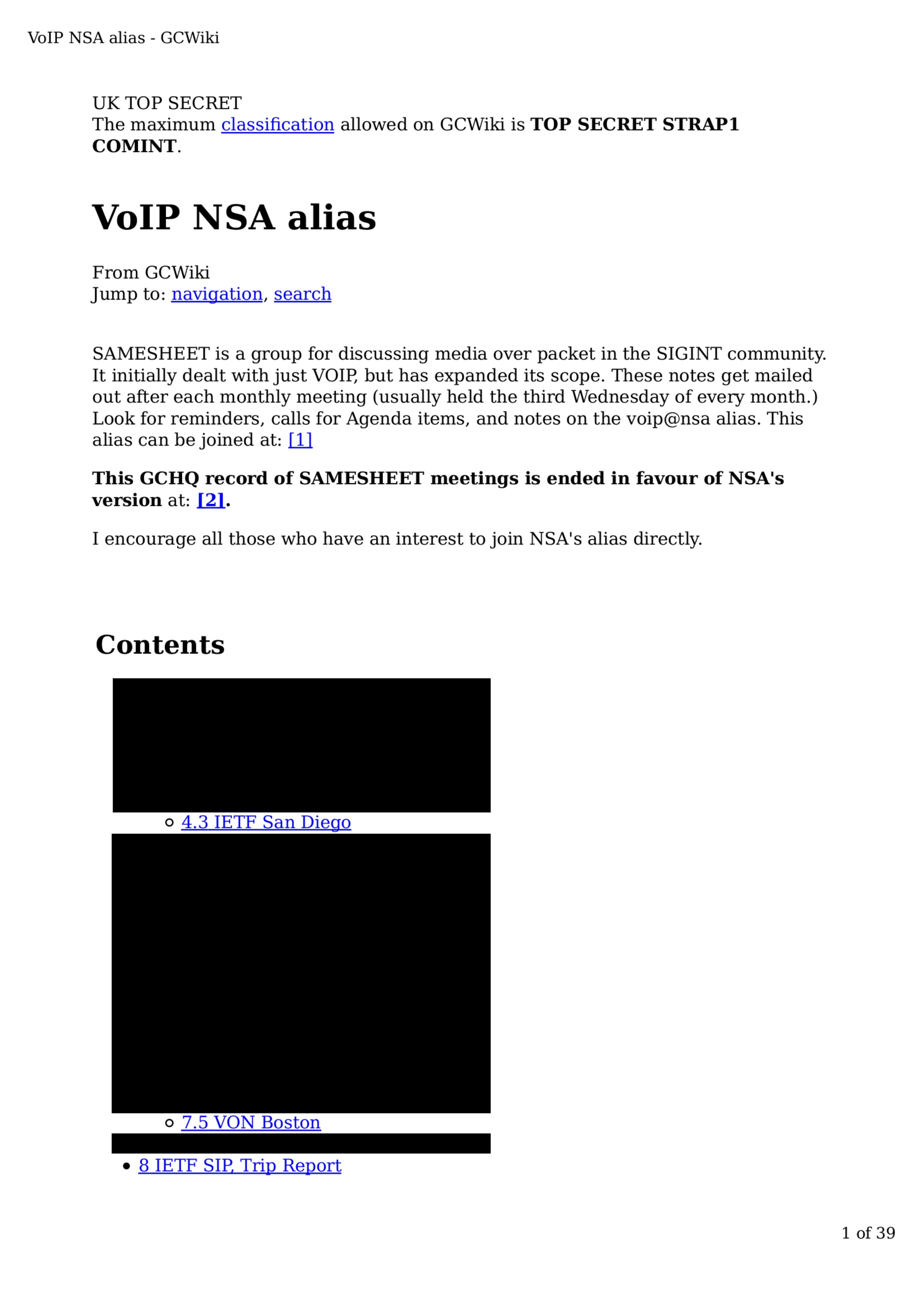
SAMESHEET is a group for discussing media over packet in the SIGINT community. It initially dealt with just VOIP, but has expanded its scope. These notes get mailed out after each monthly meeting (usually held the third Wednesday of every month.) Look for reminders, calls for Agenda items, and notes on the voip@nsa alias. This alias can be joined at: [1]
This GCHQ record of SAMESHEET meetings is ended in favour of NSA's version at: [2].
I encourage all those who have an interest to join NSA's alias directly.
Contents
[REDACTED]
- 4.3 IETF San Diego
[REDACTED] - 7.5 VON Boston
[REDACTED] - 8 IETF SIP, Trip Report
1 of 39
VoIP NSA alias - GCWiki
[REDACTED]
[edit] IETF San Diego
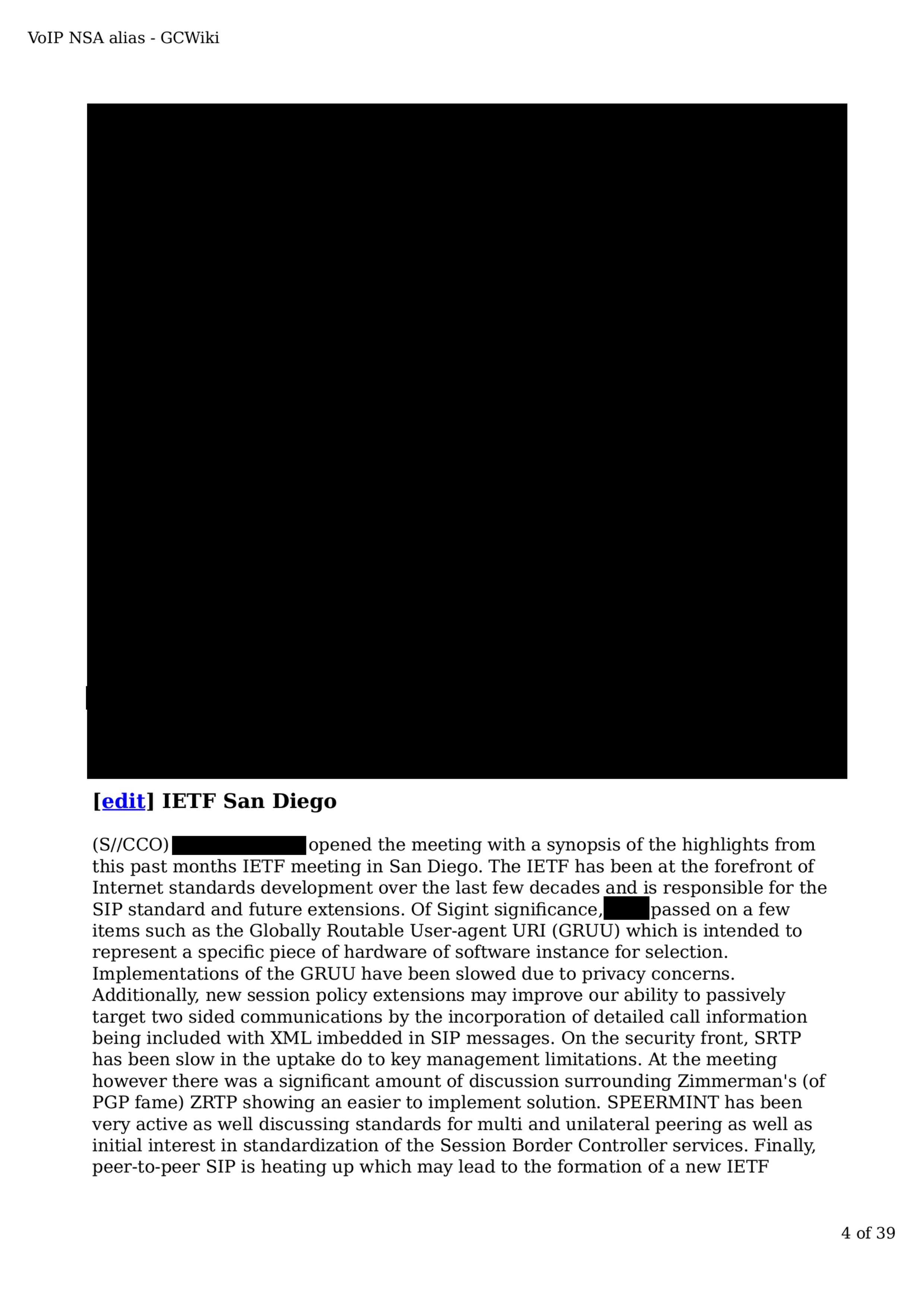
(S//CCO) [REDACTED] opened the meeting with a synopsis of the highlights from this past months IETF meeting in San Diego. The IETF has been at the forefront of Internet standards development over the last few decades and is responsible for the SIP standard and future extensions. Of Sigint significance, [REDACTED] passed on a few items such as the Globally Routable User-agent URI (GRUU) which is intended to represent a specific piece of hardware of software instance for selection. Implementations of the GRUU have been slowed due to privacy concerns. Additionally, new session policy extensions may improve our ability to passively target two sided communications by the incorporation of detailed call information being included with XML imbedded in SIP messages. On the security front, SRTP has been slow in the uptake do to key management limitations. At the meeting however there was a significant amount of discussion surrounding Zimmerman's (of PGP fame) ZRTP showing an easier to implement solution. SPEERMINT has been very active as well discussing standards for multi and unilateral peering as well as initial interest in standardization of the Session Border Controller services. Finally, peer-to-peer SIP is heating up which may lead to the formation of a new IETF
4 of 39
VoIP NSA alias - GCWiki
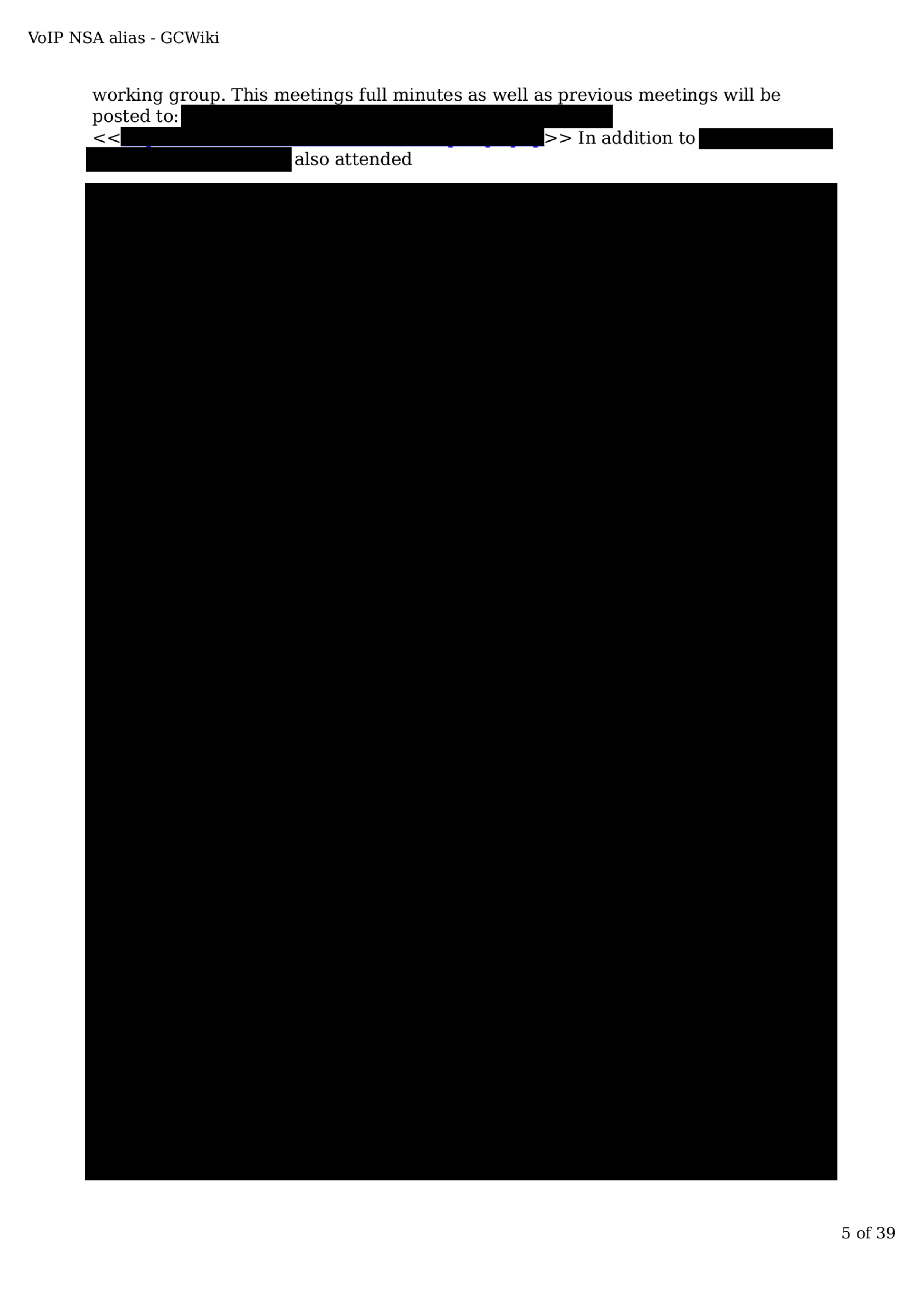
working group. This meetings full minutes as well as previous meetings will be posted to: [REDACTED]
<<[REDACTED]>> In addition to [REDACTED] also attended
[REDACTED]
5 of 39
VoIP NSA alias - GCWiki
[REDACTED]
[edit] VON Boston
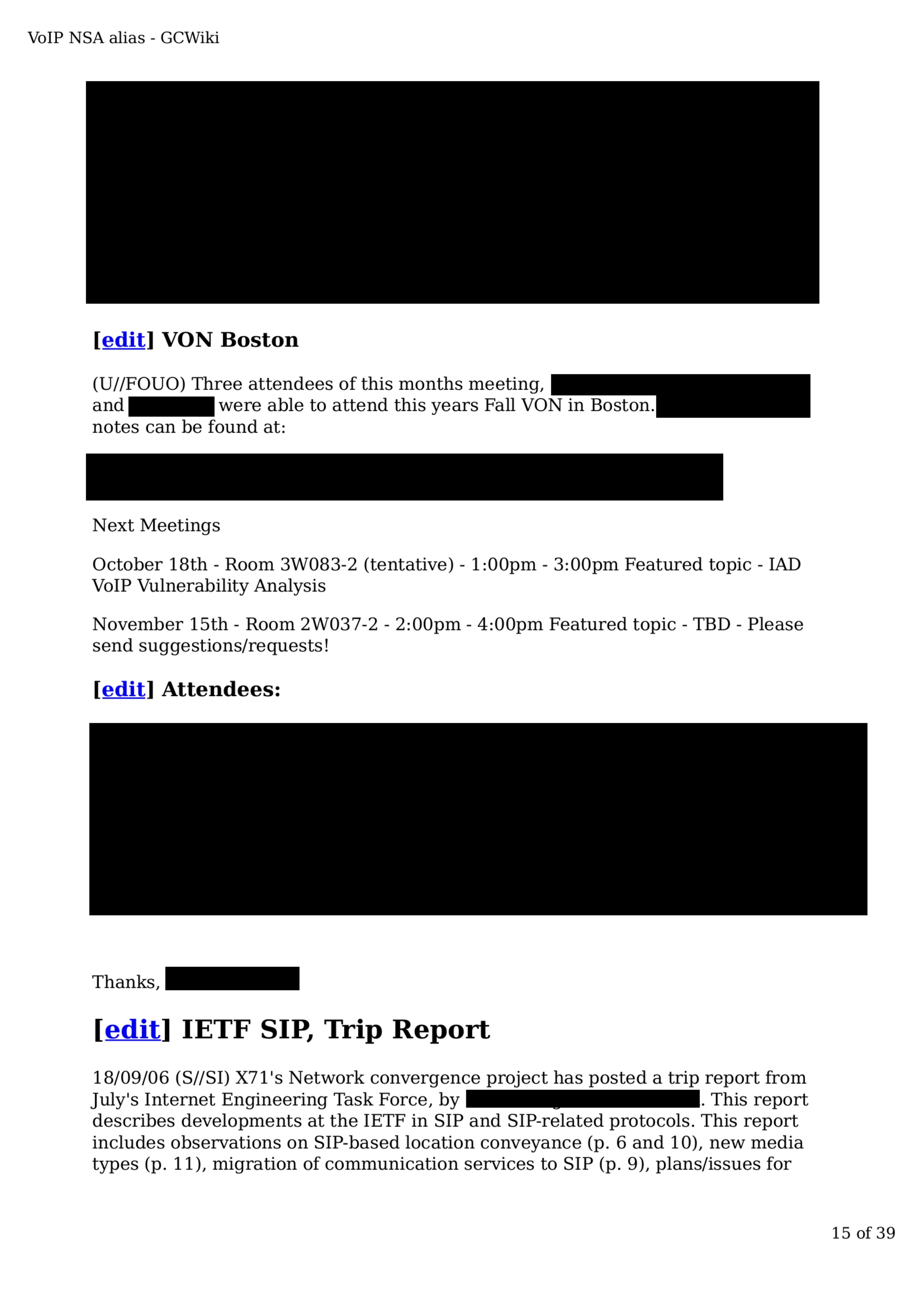
(U//FOUO) Three attendees of this months meeting, [REDACTED] and [REDACTED] were able to attend this years Fall VON in Boston. [REDACTED] notes can be found at: [REDACTED]
Next Meetings
October 18th - Room 3W083-2 (tentative) - 1:00pm - 3:00pm Featured topic - IAD VoIP Vulnerability Analysis
November 15th - Room 2W037-2 - 2:00pm - 4:00pm Featured topic - TBD - Please send suggestions/requests!
[edit] Attendees:
[REDACTED]
Thanks, [REDACTED]
[edit] IETF SIP, Trip Report
18/09/06 (S//SI) X71's Network convergence project has posted a trip report from July's Internet Engineering Task Force, by [REDACTED]. This report describes developments at the IETF in SIP and SIP-related protocols. This report includes observations on SIP-based location conveyance (p. 6 and 10), new media types (p. 11), migration of communication services to SIP (p. 9), plans/issues for
15 of 39
VoIP NSA alias - GCWiki
media encryption (p. 12-14), and information on pace of service provider adoption of SIP for presence and instant messaging (p.15-16). Sprinkled throughout are observations on how user identifiers may be changing (p.5,7,8). The executive summary gives thumbnail sketches of each of these.
(U) The report is available on the "trip reports" section of our web site:
[REDACTED]
[REDACTED]
[REDACTED]
16 of 39
Published in the Same Report
(10 of 43 documents)
-
BULLRUN CoI - Briefing Sheet [pdf]
A GCHQ briefing sheet introducing the BULLRUN Community of Interest — the access control framework protecting Five Eyes capabilities to defeat encryption across TLS/SSL, HTTPS, SSH, VPNs, IPSec, encrypted chat and encrypted VoIP — covering the classification structure, handling procedures and protective marking guidance for intelligence derived from cryptanalytic exploitation.
“N.S.A. Able to Foil Basic Safeguards of Privacy on Web” - The New York Times ↗ (2013-09-05) · “Revealed: The NSA's Secret Campaign to Crack, Undermine Internet Security” - ProPublica ↗ (2013-09-05) · “Prying Eyes: Inside the NSA's War on Internet Security” - Der Spiegel ↗ (2014-12-28) · Perlroth, Nicole · Larson, Jeff · Shane, Scott · Appelbaum, Jacob · Gibson, Aaron · Grothoff, Christian · Müller-Maguhn, Andy · Poitras, Laura · Sontheimer, Michael · Stöcker, Christian -
CLASSIFICATION GUIDE FOR CRYPTANALYSIS, 2-12 [pdf]
An NSA/CSS classification guide for cryptanalysis establishing the precise classification level for each type of information about NSA's capabilities to exploit commercial and indigenous encryption systems — from the unclassified acknowledgement that NSA exploits cryptographic devices, through to the Top Secret protection of cryptographic modifications made to commercial products to render them exploitable and industry relationships used to obtain cryptographic details.
“Revealed: how US and UK spy agencies defeat internet privacy and security” - The Guardian ↗ (2013-09-05) · “Prying Eyes: Inside the NSA's War on Internet Security” - Der Spiegel ↗ (2014-12-28) · Ball, James · Borger, Julian · Greenwald, Glenn · Appelbaum, Jacob · Gibson, Aaron · Grothoff, Christian · Müller-Maguhn, Andy · Poitras, Laura · Sontheimer, Michael · Stöcker, Christian -
Innov8 Experiment Profile Template [pdf]
A TOP SECRET STRAP1 joint NSA/GCHQ experiment profile documenting a 2010-2011 Joint Capability Experiment to test hardware-accelerated bulk decryption of common internet encryption technologies at scale, integrating TURMOIL's passive collection with NSA's LONGHAUL key recovery service via the ISLANDTRANSPORT messaging system, as part of the broader BULLRUN assault on internet encryption.
“Prying Eyes: Inside the NSA's War on Internet Security” - Der Spiegel ↗ (2014-12-28) · “Revealed: how US and UK spy agencies defeat internet privacy and security” - The Guardian ↗ (2013-09-05) · Appelbaum, Jacob · Gibson, Aaron · Grothoff, Christian · Müller-Maguhn, Andy · Poitras, Laura · Sontheimer, Michael · Stöcker, Christian · Ball, James · Borger, Julian · Greenwald, Glenn -
TLS Trends: A roundtable discussion on current usage and future directions [pdf]
A presentation by Canada's Communications Security Establishment describing their TLS trend analysis programme, which systematically tracked SSL/TLS encryption parameters across warranted collection and Special Source access to identify cryptanalytic opportunities, monitor target behaviour and collaborate with GCHQ on exploiting weaknesses in widely-used encryption implementations.
-
Secure Sockets Layer (SSL) / Transport Layer Security (TLS) [pdf]
A classified NSA Network Security Products training presentation providing a comprehensive technical overview of SSL/TLS protocol mechanics and NSA's exploitation approaches, including observed usage statistics from intercepted traffic, RSA key exchange decryption methodology, exploitation of the Debian OpenSSL RNG weakness, and the practical challenges of decrypting millions of SSL sessions per day at scale.
Programs: SCARLETFEVER -
TLS trends at GCHQ [pdf]
A GCHQ presentation describing their TLS trends analysis programme, which processed approximately 10 billion SSL/TLS Server Hello events per week from Special Source cable tapping and COMSAT collection to produce weekly trend reports, alongside two operational tools — TargeTLS for matching TLS events against BROAD OAK target profiles, and FLYING PIG, a TLS knowledge base enabling analysts to query certificate, IP and client data across the full intercept base.
-
TURMOIL/APEX/APEX High Level Description Document [pdf]
NSA WikiInfo page providing the high-level design description of APEX — the Active-Passive Integration capability integrating HAMMERMILL router implants with TURMOIL passive collection — enabling real-time exfiltration of targeted VPN (HAMMERSTEIN) and VoIP (HAMMERCHANT) traffic from compromised routers directly into NSA's passive collection and cryptanalytic attack infrastructure, with TURBINE providing automated command and control of the combined active-passive system.
Programs: TURMOIL · APEX · HAMMERMILL · HAMMERCHANT · HAMMERSTEIN · FASHIONCLEFT · TURBINE · TOYGRIPPE · METROTUBE · CHIMNEYPOOL · PIQBLADE · KEYCARD · FASCIA · ISLANDTRANSPORT · PRESSUREWAVE · ASDF · CONVEYANCE · TURBULENCE -
GALLANTWAVE [pdf]
NSA presentation describing GALLANTWAVE — a LONGHAUL capability for VPN decryption — specifically its scaling architecture to handle increased collection volumes and a peering mechanism allowing partner agencies to share single-sided VPN key exchange events so that LONGHAUL can complete decryption attempts that would otherwise fail due to one-sided collection.
-
Intro to the VPN Exploitation Process [pdf]
NSA introduction to the VPN exploitation process from September 2010, presented by the OTP VPN Exploitation Team, covering the full workflow from initial collection through to sustained decryption of IPSec, PPTP, SSL and SSH traffic, with named exploitation successes including airlines, diplomatic missions, banks and intelligence services across Iran, Jordan, Russia, Turkey, Pakistan, Afghanistan, Somalia, Indonesia and Mexico.
Programs: BLEAKINQUIRY · TOYGRIPPE · XKEYSCORE · MAILORDER · CORALREEF · VULCANDEATHGRIP · SCISSORS · TURTLEPOWER · PINWALE · FOURSCORE · CADENCE · UTT · VULCANMINDMELD · CAPRIOS · AGILITY · NKB · FOLLOWTHEMONEY -
Analytic Challenges from Active-Passive Integration [pdf]
This NSA briefing addresses the technical and administrative friction caused by "shaping" operations. Shaping occurs when an active malware implant, typically situated on network infrastructure like a router, copies specific data streams and redirects them past a passive surveillance sensor such as TURMOIL. While this ensures the capture of data that might otherwise be missed, it creates a "double metadata" conflict where a single piece of intelligence carries two competing sets of identifiers: one from the active Tailored Access Operations (TAO) implant and another from the passive collection site. The document tasks analysts with finding a way to reconcile these source notations to ensure the data remains searchable and legally compliant within legacy databases.
Programs: BRAVENICKEL · HAMMERMILL · APEX · TURMOIL · HAMMERSTONE · PRESSUREWAVE · METROTUBE · TOYGRIPPE · TURBULENCE · METAWAVE · MARINA · SSO · CONVEYANCE · NUCLEON · FASCIA · HAMMERCHANT
Related Documents
-
TURMOIL/APEX/APEX High Level Description Document [pdf]
NSA WikiInfo page providing the high-level design description of APEX — the Active-Passive Integration capability integrating HAMMERMILL router implants with TURMOIL passive collection — enabling real-time exfiltration of targeted VPN (HAMMERSTEIN) and VoIP (HAMMERCHANT) traffic from compromised routers directly into NSA's passive collection and cryptanalytic attack infrastructure, with TURBINE providing automated command and control of the combined active-passive system.
Programs: TURMOIL · APEX · HAMMERMILL · HAMMERCHANT · HAMMERSTEIN · FASHIONCLEFT · TURBINE · TOYGRIPPE · METROTUBE · CHIMNEYPOOL · PIQBLADE · KEYCARD · FASCIA · ISLANDTRANSPORT · PRESSUREWAVE · ASDF · CONVEYANCE · TURBULENCE -
TOR deanonymisation research (MIP) [pdf]
A TOP SECRET GCHQ wiki page documenting the research task on Tor deanonymisation — the project page linking the entry-exit correlation attack described in the OPC-MCR presentation to its formal research output, confirming the attack was successfully documented in OPC-M/TECH.B/61, presented at SANAR11, and planned for prototyping in the REMATION II workshop.
-
PGP encrypted email can't be decrypted by the NSA [pdf]
Two intercepted Yahoo email messages collected under FAA counterterrorism authority through PRISM (SIGAD US-984XN), both containing PGP-encrypted content that NSA was unable to decrypt — published by Der Spiegel as direct evidence that PGP encryption defeated NSA collection at the time of interception in January 2012.
Programs: PRISM -
SIGDEV Conference 2012 - Making Things Measureable: Technology Trending Challenges and Approaches [pdf]
An NSA presentation from the 2012 SIGDEV Conference describing NSA's technology trending methodology — a framework for identifying which encryption and communications technologies targets are adopting, measuring the SIGINT risk they pose, and prioritising capabilities development responses — notable for containing the risk matrix that was later cited in Der Spiegel's December 2014 encryption investigation showing NSA's difficulty levels against specific technologies including Tor, TrueCrypt, OTR and ZRTP.
Programs: XKEYSCORE · SEEKER · BIONICTURTLE · JEMA · JOLLYROGER · MARINA · TUNINGFORK · STARPROC · MICROEXPANSE · ECHOBASE · PRISM · GMHALO · UTT · TKB · LAE · FAMT · WPMO · AMOD · FORTREND · GAMBIT · DATAEXPLORER · MYNOC -
TLS Trends: A roundtable discussion on current usage and future directions [pdf]
A presentation by Canada's Communications Security Establishment describing their TLS trend analysis programme, which systematically tracked SSL/TLS encryption parameters across warranted collection and Special Source access to identify cryptanalytic opportunities, monitor target behaviour and collaborate with GCHQ on exploiting weaknesses in widely-used encryption implementations.