Tag: target analysis 17 documents
Search documents matching “target analysis” →Free-text subjects the curators added. Unlike the other axes these are not necessarily from the documents' own vocabulary, so they are the loosest thing to browse by (and the most forgiving).
Graphs
By Banner
By Classification
Refine (combine with another filter, via search)
Sort: Title
Documents
-
SIGINT Development: the Target Analysis Center (TAC) SIDtoday [pdf]
Description of the Target Analysis Center, whose mission is to "develop corporate-level analytic tools and techniques" against networked systems.
People: Plunkett, DeboraThe Intercept ↗ (2016-12-07) -
AND THEY SAID TO THE TITANS: « WATCH OUT OLYMPIANS IN THE HOUSE! » [pdf]
This Top Secret CSEC “Olympia” document details a Canadian intelligence program that analyzed and tracked the Brazilian Ministry of Mines and Energy’s telecommunications, mapping IPs, servers, proxies, and mobile devices while automating data collection and network analysis to develop actionable intelligence. It outlines tools, workflows, and contacts used for surveillance, though the presentation does not explain the specific purpose of the operation.
Programs: OLYMPIA · QUOVA · PROMETHEUS · PEITHO · SLINGSHOT · LEVITATE · STRATOS · EVILOLIVE · GCHQ Geofusion · ATLAS · HYPERION · ATHENA · DANAUS · TIDALSURGE · BLACKPEARL · MARINA · STARSEARCH · PEPPERBOX · TRITON · PACKAGEDGOODS · ARK · TOYGRIPPE · FRIARTUCK · MASTERSHAKE · COEUS · STALKER · MAINWAY · FASCIA · SEDB · OCTSKYWARD · FASTBAT · TWINSERPENT · EONBLUE · DISHFIRE · GNDB“Read a CSEC document that was first acquired by Edward Snowden” - The Globe and Mail ↗ (2013-11-30) · “Ministério de Minas e Energia está na mira de espiões americanos e canadenses” - O Globo ↗ (2013-10-06) · “No Place to Hide” - Metropolitan Books ↗ (2014-05-13) · Freeze, Colin · Bridi, Sônia · Greenwald, Glenn -
AURORAGOLD Working Aid [pdf]
This document is a technical reference guide for analysts that categorizes the specific data fields extracted from mobile network documents (IR.21s) and commercial databases. It serves as a manual for translating telecommunications infrastructure data—such as encryption types, network layer protocols, and hardware versions—into actionable intelligence for target development and cyber exploitation.
Programs: AURORAGOLD -
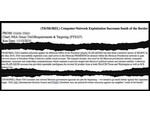
Computer-Network Exploitation Successes South of the Border [pdf]
Pena Nieto's predecessor as president, Felipe Calderon, was also targeted. This image shows an excerpt from an NSA document classified as "top secret," from November 2010. The National Security Agency (NSA) has a division for particularly difficult cases. Called "Tailored Access Operations," or TAO for short, this department devises special methods for special targets. In May 2010, the division reported mission accomplished. A report classified as "top secret" said: "TAO successfully exploited a key mail server in the Mexican Presidencia domain within the Mexican Presidential network to gain first-ever access to President Felipe Calderon's public email account." According to the NSA, this email domain was also used by cabinet members, and contained "diplomatic, economic and leadership communications which continue to provide insight into Mexico's political system and internal stability."
Programs: FLATLIQUID -
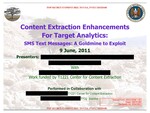
Content Extraction Enhancements For Target Analytics: SMS Text Messages: A Goldmine to Exploit (9 June 2011) [pdf]
The document describes the NSA’s Dishfire program, which collects hundreds of millions of global SMS messages daily, and the PREFER system, which extracts detailed metadata—including contacts, geolocation, travel, and financial information—from these messages for analytic purposes. It highlights the scale, operational processes, and types of data exploited to support intelligence and target analysis.
-
Graph theory in the operational environment – GCHQ [pdf]
This document details GCHQ’s research on identifying “closed loops” of communication, where targets use a small set of phones to communicate exclusively among themselves, often with cheap, disposable handsets like the Nokia 1100. It explains the methodology for analyzing anonymized metadata, constructing contact graphs, and extracting non-giant, non-tree components to discover operationally relevant closed loops for intelligence and counterterrorism purposes.
Programs: VOICESAILPeople: Rumsfeld, Donald -
GSM Temporary Selectors - Breakthroughs in Automated Identification SIDtoday [pdf]
It has always frustrated analysts when GSM cellular networks implement Temporary Mobile Subscriber Identities, which obscure a code, known as IMSI, that uniquely and persistently identifies the cellphone. The "ASSOCIATION" program has solved this problem by mapping TMSI to IMSI.
The Intercept ↗ (2018-03-01) -
Job Vacancy: More Than a Mission...A Challenge! SIDtoday [pdf]
Job posting for 120-day deployment with the Document Exploitation mission in Qatar, with a focus on documents from Iraq. "DOCEX includes tons of physical documentation that is being collected throughout Iraq, physical media confiscated, as well as interrogations."
People: Speicher, ScottThe Intercept ↗ (2016-12-07) -
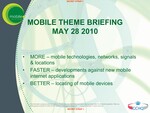
Mobile Theme Briefing (May 28, 2010) [pdf]
This 2010 GCHQ briefing document outlines the “Mobile Applications Project,” which aims to expand intelligence capabilities to exploit the growing shift from fixed to mobile internet usage. It details objectives for targeting mobile apps and roaming network traffic (GRX), enabling converged analysis of voice, text, command-and-control, and geolocation data across multiple mobile platforms such as iPhone, Symbian, Android, and Windows Mobile. See also: EFF_-_20140128-guard-leaky_phone_apps_0 (includes other slides from the same slideset)
Programs: Mobile Applications Project -
Network Shaping 101 [pdf]
An NSA top-secret training presentation that uses Yemen as a case study to explain how to "shape" a nation's Internet traffic by exploiting Autonomous Systems, upstream providers, BGP routing, and physical link topology to redirect or collect communications. The slide deck walks through practical router/IP/link details, passive SIGINT collection points and limitations, and warns that many assumptions are fabricated for the lesson and that real-world capabilities and link behavior can vary.
-
SIGINT Development: A Network of Discovery Networks SIDtoday [pdf]
An article describes the mission and recent activities of SIGINT Development, an expanding mission of NSA.
The Intercept ↗ (2016-05-16) -
Summary of DNR and DNI Co-Travel Analytics [pdf]
The document outlines the NSA’s development and testing of multiple “co-traveler” analytics—sophisticated tools that analyze bulk mobile location data to identify people who travel together or follow similar patterns, even if they are not known intelligence targets. It details various analytic systems, their data sources (such as FASCIA, VLR, GCID), architectures, scoring methods, and future enhancements, illustrating a large-scale surveillance framework for mapping human movement and relationships.
Programs: CO-TRAVELER · CHALKFUN · TMI · PACT · RT-RG · SORTINGLEAD · FASCIA · Hectic Snare · DRT · Juggernaut · GM-PLACE · Fast Follower · MGSC · ELKPRINTS · VOICESAIL · CULTWEAVE · OCTAVE · OCTSKYWARD · SEDB · JEMA · The Café · UTT · ASDF · GHOSTMACHINE · CLOUDBASE · FASTSCOPE · GOLDMINER · CHET · GEOT · TMAC · SPCMA · MAPREDUCE · ACCUMULO · GAMBIT · ICREACH -
The TAC's Social Network Analysis Workcenter (SNAW) SIDtoday [pdf]
Social network analysis is an "analytic approach that uses sociology, graph theory, and statistics to characterize the structure and behavior of networks and individuals." It can be used to pick out key individuals for further targeting.
The Intercept ↗ (2016-12-07) -
TLS Trends: A roundtable discussion on current usage and future directions [pdf]
A presentation by Canada's Communications Security Establishment describing their TLS trend analysis programme, which systematically tracked SSL/TLS encryption parameters across warranted collection and Special Source access to identify cryptanalytic opportunities, monitor target behaviour and collaborate with GCHQ on exploiting weaknesses in widely-used encryption implementations.
-
Tools for the Mission SIDtoday [pdf]
Two scenarios in which the Target Knowledge Branch - a collection of data processing tools and services - can help analysts locate a cellphone or a wifi access point.
Programs: RETURNSPRING · FASCIA · MAINWAY · PILOTHOUSE · EAGLEVIEW · BELLVIEW · CELLFINDER · NETWIZ · SOFFITPORT · ASSOCIATION · TETLEY · NEMO · DRAGONVIEW · GIS · TKBThe Intercept ↗ (2019-05-29) -
Tracking Targets Through Proxies & Anonymizers [pdf]
This NSA presentation details methods for tracking and de-anonymizing internet users who employ privacy tools like Tor, proxies, and VPN services such as AnchorFree's Hotspot Shield. The document explains how the agency reverse-engineers anonymization tools, creates "fingerprints" to identify their traffic in surveillance systems, and correlates encrypted connections to reveal users' real IP addresses and locations—acknowledging this work "makes for sad analysts" when targets successfully obscure their identities.
-
We are Moving to NTs Windows...Where, Oh, Where Can Our Working Aids Go? SIDtoday [pdf]
Descriptions of two new systems that come with Desktop Modernization: Document Management System a "document management and analytic knowledge sharing system" that can be personalized; and eWorkSpace is "collaboration tool that help[s] analysts share, collect, analyze and report on targets of interest through a single data broker."
The Intercept ↗ (2017-04-24)