NSA First-Ever Collect of High-Interest 4G Cellular Signal
Open PDFDocument date: 2010-02-23
Pages: 1
Genre: newsletter
Banner: DYNAMIC PAGE -- HIGHEST POSSIBLE CLASSIFICATION IS TOP SECRET // SI / TK // REL TO USA AUS CAN GBR NZL
Classification: TOP SECRET SI
Dissemination: REL
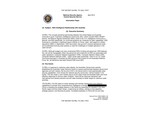
The memorandum documents a technical milestone achieved in January 2010: the first successful interception of Time Division-Long Term Evolution (TD-LTE) 4G communications. This collection was conducted at the RAINFALL site (the unclassified cover term for the Joint Defence Facility Pine Gap in Australia) and marked the transition of intelligence priority from 2G/3G systems to all-Internet Protocol (IP) 4G networks.
My notes
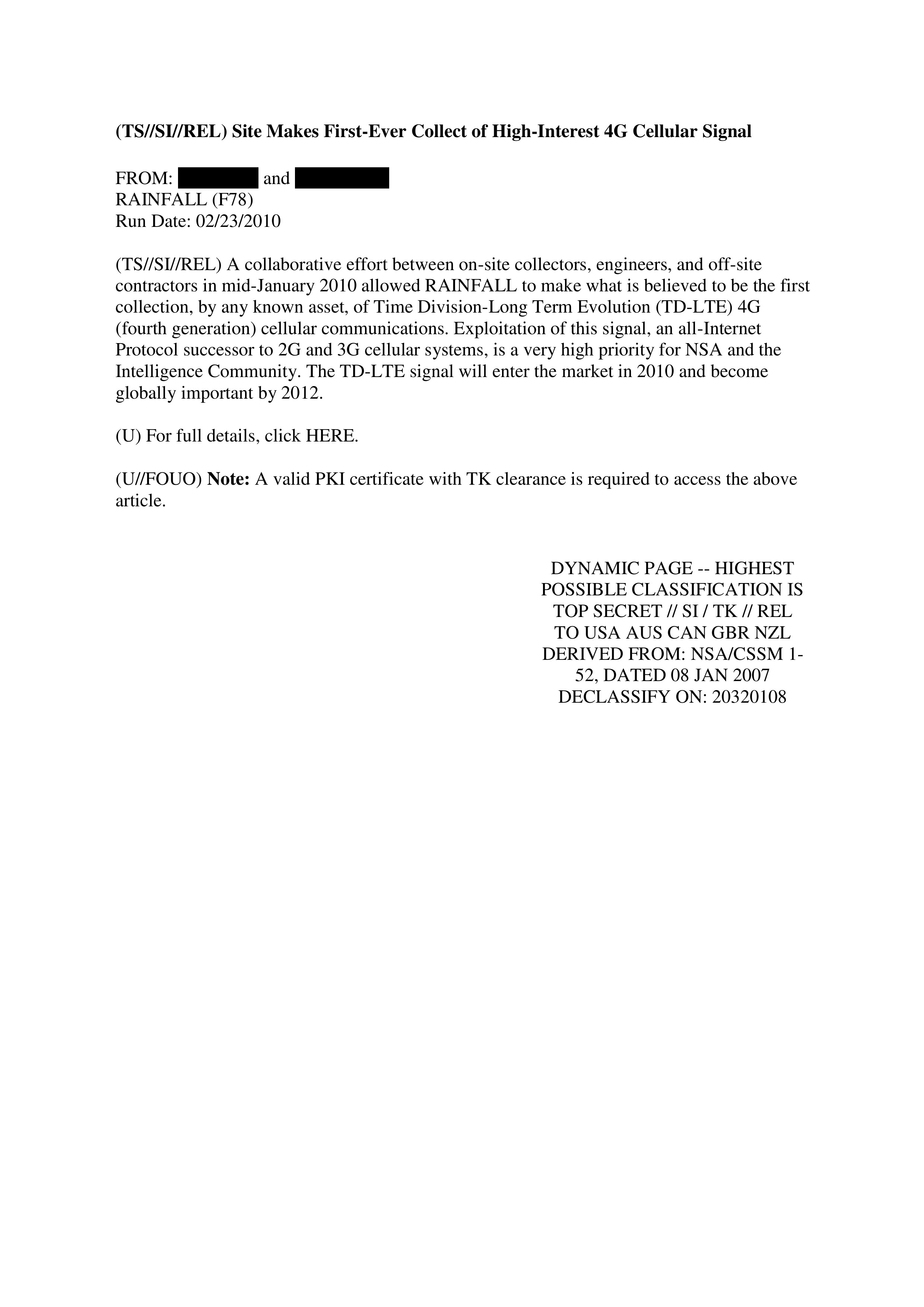
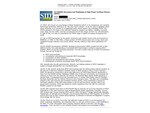
(TS//SI//REL) Site Makes First-Ever Collect of High-Interest 4G Cellular Signal
FROM: [REDACTED] and [REDACTED]
RAINFALL (F78)
Run Date: 02/23/2010
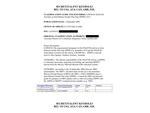
(TS//SI//REL) A collaborative effort between on-site collectors, engineers, and off-site contractors in mid-January 2010 allowed RAINFALL to make what is believed to be the first collection, by any known asset, of Time Division-Long Term Evolution (TD-LTE) 4G (fourth generation) cellular communications. Exploitation of this signal, an all-Internet Protocol successor to 2G and 3G cellular systems, is a very high priority for NSA and the Intelligence Community. The TD-LTE signal will enter the market in 2010 and become globally important by 2012.
(U) For full details, click HERE.
(U//FOUO) Note: A valid PKI certificate with TK clearance is required to access the above article.
DYNAMIC PAGE -- HIGHEST
POSSIBLE CLASSIFICATION IS
TOP SECRET // SI / TK // REL
TO USA AUS CAN GBR NZL
DERIVED FROM: NSA/CSSM 1-
52, DATED 08 JAN 2007
DECLASSIFY ON: 20320108
Published in the Same Report
(8 documents)
-
AURORAGOLD – Project Overview [pdf]
A technical briefing document outlining an NSA SIGINT initiative designed to map, monitor, and forecast the evolution of global mobile networks. It details the project's infrastructure, which aggregates both unclassified commercial data and classified intelligence intercepted from international roaming agreements to identify technical trends and exploitation opportunities.
-
AURORAGOLD – Target Technology Trends Center support to WPMO [pdf]
This briefing details the technical architecture and data pipeline used to process global cellular network information. It specifically highlights the synergy between data gathering on GSM/UMTS networks and the implementation of "Auto-Minimization" to ensure the resulting SIGINT reporting complies with NSA legal and policy requirements.
-
AURORAGOLD Working Aid [pdf]
This document is a technical reference guide for analysts that categorizes the specific data fields extracted from mobile network documents (IR.21s) and commercial databases. It serves as a manual for translating telecommunications infrastructure data—such as encryption types, network layer protocols, and hardware versions—into actionable intelligence for target development and cyber exploitation.
Programs: AURORAGOLD -
AURORAGOLD Working Group [pdf]
The "AURORAGOLD Working Group" briefing is a highly classified SIGINT development presentation from June 2012 that outlines the NSA's progress in mapping the global mobile landscape (GSM/UMTS/LTE). It focuses on the project's "value proposition": providing an exhaustive database of network identifiers and technical configurations—often obtained by intercepting internal company documents—to support tactical military operations and long-term surveillance forecasting.
Programs: AURORAGOLD · UTT · XKEYSCORE · CADENCE · JUBILEECORONA · RONIN · NKB · GLOBALTIPPER · PINWALE -
NSA/GCHQ/CSEC Network Tradecraft Advancement Team [pdf]
The "NSA/GCHQ/CSEC Network Tradecraft Advancement Team (NTAT) 2010" document describes a collaborative mission between the US, UK, and Canada to synchronize and advance SIGINT techniques. The NTAT focused on "Network Analysis Tradecraft," specifically integrating analysis tools such as IRASCIABLE RABBIT and TOYGRIPPE into CSEC's OLYMPIA and developing standardized "use cases" for tracking mobile networks and virtual private networks (VPNs).
-
IR.21 – A Technology Warning Mechanism [pdf]
This 2010 TOP SECRET NSA briefing defines the IR.21 roaming document as a critical tool for "horizon scanning" and "forecasting" global telecommunications shifts. The document outlines how the NSA uses these technical files to proactively identify emerging 3G and 4G technologies, pinpointing vulnerabilities for exploitation before new systems are even fully deployed.
-
OPULENT PUP Encryption Attack [pdf]
"OPULENT PUP encryption attack (GCHQ)" is a 2009 technical planning document from the British intelligence agency GCHQ. It outlines a "proof-of-concept demonstrator" for a new capability to intercept and decrypt GSM communications protected by the A5/3 algorithm, requiring a complete overhaul of the existing processing chain used for the older A5/1 standard.
Programs: OPULENTPUP -
WOLFRAMITE Encryption Attack [pdf]
The "WOLFRAMITE Encryption Attack" is a GCHQ strategic annex from March 2011 detailing a joint effort with the NSA to compromise the A5/3 encryption standard. The document outlines a specialized research and development program aimed at scaling up handset exploitation and securing funding—estimated at approximately £4 million—to prototype a functional decryption attack against modern mobile broadband security.
Related Documents
-
SIGDEV Successes and Challenges of High Power Cordless Phones (HPCP) SIDtoday [pdf]
The High Power Cordless Phone Analysis cell was founded in 2003 after use of these "poor man's cellular" phones proliferated in the early 2000s. Analysts with this cell provide training about HPCP communication to other NSA staff, analyze intercepted communications, and develop new tools for working with this technology.
People: Alexander, BonifaceThe Intercept ↗ (2017-04-24) -
NSA’s intelligence relationship with Australia [pdf]
This document summarizes the close intelligence partnership between the U.S. NSA and Australia’s Defence Signals Directorate (DSD), highlighting collaboration on cyber operations, SIGINT collection, and military support. It emphasizes Australia’s contributions through satellite access, geolocation, and terrorism-related communications, particularly in the Pacific region, while noting shared focus on China and joint participation in multinational intelligence coalitions.
-
Site Profile G – (U) RAINFALL [pdf]
This site profile document for RAINFALL (Joint Defence Facility Pine Gap) outlines its role as a joint U.S.-Australian signals intelligence base supporting global satellite surveillance, geolocation, and data collection for military and intelligence operations. It also notes that Pine Gap’s public mission statement serves as a cover story, concealing its true involvement with NSA, CIA, and NRO satellite programs.
Programs: RAINFALL · Mission 7600 · Mission 8300 · Mission 7605 · Mission 7606 · Mission 7607 · Mission 8301 · Mission 8303 · IBS -
AURORAGOLD Working Group [pdf]
The "AURORAGOLD Working Group" briefing is a highly classified SIGINT development presentation from June 2012 that outlines the NSA's progress in mapping the global mobile landscape (GSM/UMTS/LTE). It focuses on the project's "value proposition": providing an exhaustive database of network identifiers and technical configurations—often obtained by intercepting internal company documents—to support tactical military operations and long-term surveillance forecasting.
Programs: AURORAGOLD · UTT · XKEYSCORE · CADENCE · JUBILEECORONA · RONIN · NKB · GLOBALTIPPER · PINWALE -
Pine Gap classification guide [pdf]
This document is a classification guide for NSA/CSS activities at the Joint Defense Facility Pine Gap (JDFPG) in Australia, outlining which information about the site, its SIGINT missions, organizational structure, and training is classified and at what level. It specifies that sensitive details, including the site’s SIGINT mission, Producer Designator Digraph, SIGAD, and support to military operations, are protected to safeguard national security and allied interests.