WOLFRAMITE Encryption Attack
Open PDFDocument date: 2011-03-09
Pages: 1
Genre: other
Banner: TOP SECRET STRAP1
Classification: TOP SECRET STRAP 1
Dissemination: -
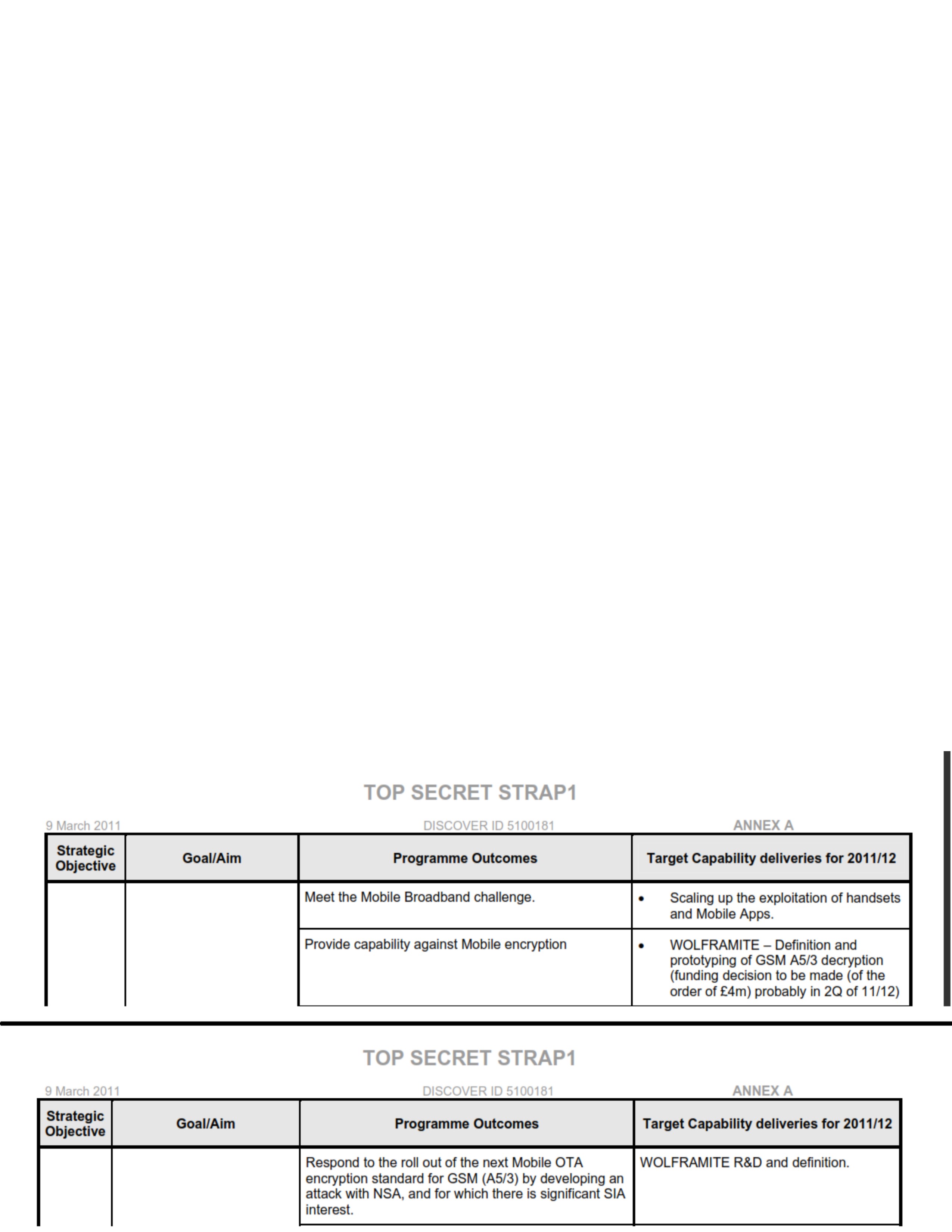
The "WOLFRAMITE Encryption Attack" is a GCHQ strategic annex from March 2011 detailing a joint effort with the NSA to compromise the A5/3 encryption standard. The document outlines a specialized research and development program aimed at scaling up handset exploitation and securing funding—estimated at approximately £4 million—to prototype a functional decryption attack against modern mobile broadband security.
My notes
TOP SECRET STRAP1
9 March 2011
DISCOVER ID 5100181
ANNEX A
| Strategic Objective | Goal/Aim | Programme Outcomes | Target Capability deliveries for 2011/12 |
|---|
| | | Meet the Mobile Broadband challenge. | * Scaling up the exploitation of handsets and Mobile Apps.
| Provide capability against Mobile encryption | * WOLFRAMITE – Definition and prototyping of GSM A5/3 decryption (funding decision to be made (of the order of £4m) probably in 2Q of 11/12) |
|---|
9 March 2011
DISCOVER ID 5100181
ANNEX A
| Strategic Objective | Goal/Aim | Programme Outcomes | Target Capability deliveries for 2011/12 |
|---|---|---|---|
| Respond to the roll out of the next Mobile OTA encryption standard for GSM (A5/3) by developing an attack with NSA, and for which there is significant SIA interest. | WOLFRAMITE R&D and definition. |
Published in the Same Report
(8 documents)
-
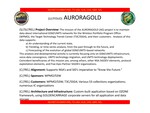
AURORAGOLD – Project Overview [pdf]
A technical briefing document outlining an NSA SIGINT initiative designed to map, monitor, and forecast the evolution of global mobile networks. It details the project's infrastructure, which aggregates both unclassified commercial data and classified intelligence intercepted from international roaming agreements to identify technical trends and exploitation opportunities.
-
AURORAGOLD – Target Technology Trends Center support to WPMO [pdf]
This briefing details the technical architecture and data pipeline used to process global cellular network information. It specifically highlights the synergy between data gathering on GSM/UMTS networks and the implementation of "Auto-Minimization" to ensure the resulting SIGINT reporting complies with NSA legal and policy requirements.
-
AURORAGOLD Working Aid [pdf]
This document is a technical reference guide for analysts that categorizes the specific data fields extracted from mobile network documents (IR.21s) and commercial databases. It serves as a manual for translating telecommunications infrastructure data—such as encryption types, network layer protocols, and hardware versions—into actionable intelligence for target development and cyber exploitation.
Programs: AURORAGOLD -
AURORAGOLD Working Group [pdf]
The "AURORAGOLD Working Group" briefing is a highly classified SIGINT development presentation from June 2012 that outlines the NSA's progress in mapping the global mobile landscape (GSM/UMTS/LTE). It focuses on the project's "value proposition": providing an exhaustive database of network identifiers and technical configurations—often obtained by intercepting internal company documents—to support tactical military operations and long-term surveillance forecasting.
Programs: AURORAGOLD · UTT · XKEYSCORE · CADENCE · JUBILEECORONA · RONIN · NKB · GLOBALTIPPER · PINWALE -
NSA/GCHQ/CSEC Network Tradecraft Advancement Team [pdf]
The "NSA/GCHQ/CSEC Network Tradecraft Advancement Team (NTAT) 2010" document describes a collaborative mission between the US, UK, and Canada to synchronize and advance SIGINT techniques. The NTAT focused on "Network Analysis Tradecraft," specifically integrating analysis tools such as IRASCIABLE RABBIT and TOYGRIPPE into CSEC's OLYMPIA and developing standardized "use cases" for tracking mobile networks and virtual private networks (VPNs).
-
IR.21 – A Technology Warning Mechanism [pdf]
This 2010 TOP SECRET NSA briefing defines the IR.21 roaming document as a critical tool for "horizon scanning" and "forecasting" global telecommunications shifts. The document outlines how the NSA uses these technical files to proactively identify emerging 3G and 4G technologies, pinpointing vulnerabilities for exploitation before new systems are even fully deployed.
-
OPULENT PUP Encryption Attack [pdf]
"OPULENT PUP encryption attack (GCHQ)" is a 2009 technical planning document from the British intelligence agency GCHQ. It outlines a "proof-of-concept demonstrator" for a new capability to intercept and decrypt GSM communications protected by the A5/3 algorithm, requiring a complete overhaul of the existing processing chain used for the older A5/1 standard.
Programs: OPULENTPUP -
NSA First-Ever Collect of High-Interest 4G Cellular Signal [pdf]
The memorandum documents a technical milestone achieved in January 2010: the first successful interception of Time Division-Long Term Evolution (TD-LTE) 4G communications. This collection was conducted at the RAINFALL site (the unclassified cover term for the Joint Defence Facility Pine Gap in Australia) and marked the transition of intelligence priority from 2G/3G systems to all-Internet Protocol (IP) 4G networks.
Programs: RAINFALL

Related Documents
-
OPULENT PUP Encryption Attack [pdf]
"OPULENT PUP encryption attack (GCHQ)" is a 2009 technical planning document from the British intelligence agency GCHQ. It outlines a "proof-of-concept demonstrator" for a new capability to intercept and decrypt GSM communications protected by the A5/3 algorithm, requiring a complete overhaul of the existing processing chain used for the older A5/1 standard.
Programs: OPULENTPUP -
Mobile Theme Briefing (May 28, 2010) [pdf]
This 2010 GCHQ briefing document outlines the “Mobile Applications Project,” which aims to expand intelligence capabilities to exploit the growing shift from fixed to mobile internet usage. It details objectives for targeting mobile apps and roaming network traffic (GRX), enabling converged analysis of voice, text, command-and-control, and geolocation data across multiple mobile platforms such as iPhone, Symbian, Android, and Windows Mobile. See also: EFF_-_20140128-guard-leaky_phone_apps_0 (includes other slides from the same slideset)
Programs: Mobile Applications Project -
Cyber Defence Operations Legal Policy [pdf]
GCHQ's internal wiki laying out the legal plumbing for its Cyber Defence Operations (formerly NDIST)—detailing warrant types (RIPA, ISA, CNE), data retention schedules, targeting rules for UK/Five Eyes infrastructure, XKEYSCORE query protocols, and the bureaucratic hoops analysts must jump through to search attacker IPs, fingerprint UK networks, and share malware intelligence without tripping over location/nationality safeguards or commercial sensitivities.
Programs: JTRIG · SPAY · GORDIANKNOT · CHORDAL · DISCOVER · EVENTS · CASPORT · XKEYSCORE · CONTENT CLOUD · SQUEAL · MIRAGE · MUTANTBROTH · ANXIOUS · HALTERHITCH · BROADOAK · DONKEYKONG · ZOOL · PALANTIR · OVERLINK · RT · GATEKEEPER · IRONHAND · HARUSPEX · B3M · LOOKINGGLASS · GOLDENEYE · BLAZINGSADDLES · MOONRAKER · TRITON -
Digby geolocation [pdf]
The document reveals that RAF Digby was equipped with advanced profiling and analytics tools to enable (near) real-time co-location of GSM handsets, supporting intelligence operations across the Middle East and North Africa. It highlights the operational use of the RUM PUNCH algorithm on the DISTILLERY framework, which was jointly developed through an NSA–IBM–GCHQ partnership, allowing large-scale stream mining and independent analyst-led tracking operations. Enhancements at Digby extended beyond communications interception to include a new cyber mission, with capabilities to geo-locate emitters linked to IED arming and detonation under the FLAKJACKET mission, expanding the site’s role from surveillance to active battlefield support.
-
NSA/GCHQ/CSEC Network Tradecraft Advancement Team [pdf]
The "NSA/GCHQ/CSEC Network Tradecraft Advancement Team (NTAT) 2010" document describes a collaborative mission between the US, UK, and Canada to synchronize and advance SIGINT techniques. The NTAT focused on "Network Analysis Tradecraft," specifically integrating analysis tools such as IRASCIABLE RABBIT and TOYGRIPPE into CSEC's OLYMPIA and developing standardized "use cases" for tracking mobile networks and virtual private networks (VPNs).