What’s the worst that could happen?
Open PDFDocument date: 2010-03
Pages: 3
Genre: other
Banner: TOP SECRET STRAP 1
Classification: TOP SECRET STRAP 1
Dissemination: -
This GCHQ document from March 2010 presents a checklist of factors analysts should consider before going ahead with an operation to infiltrate a communications network, by physical or other means.
My notes
TOP SECRET STRAP 1
What’s the worst that could happen?
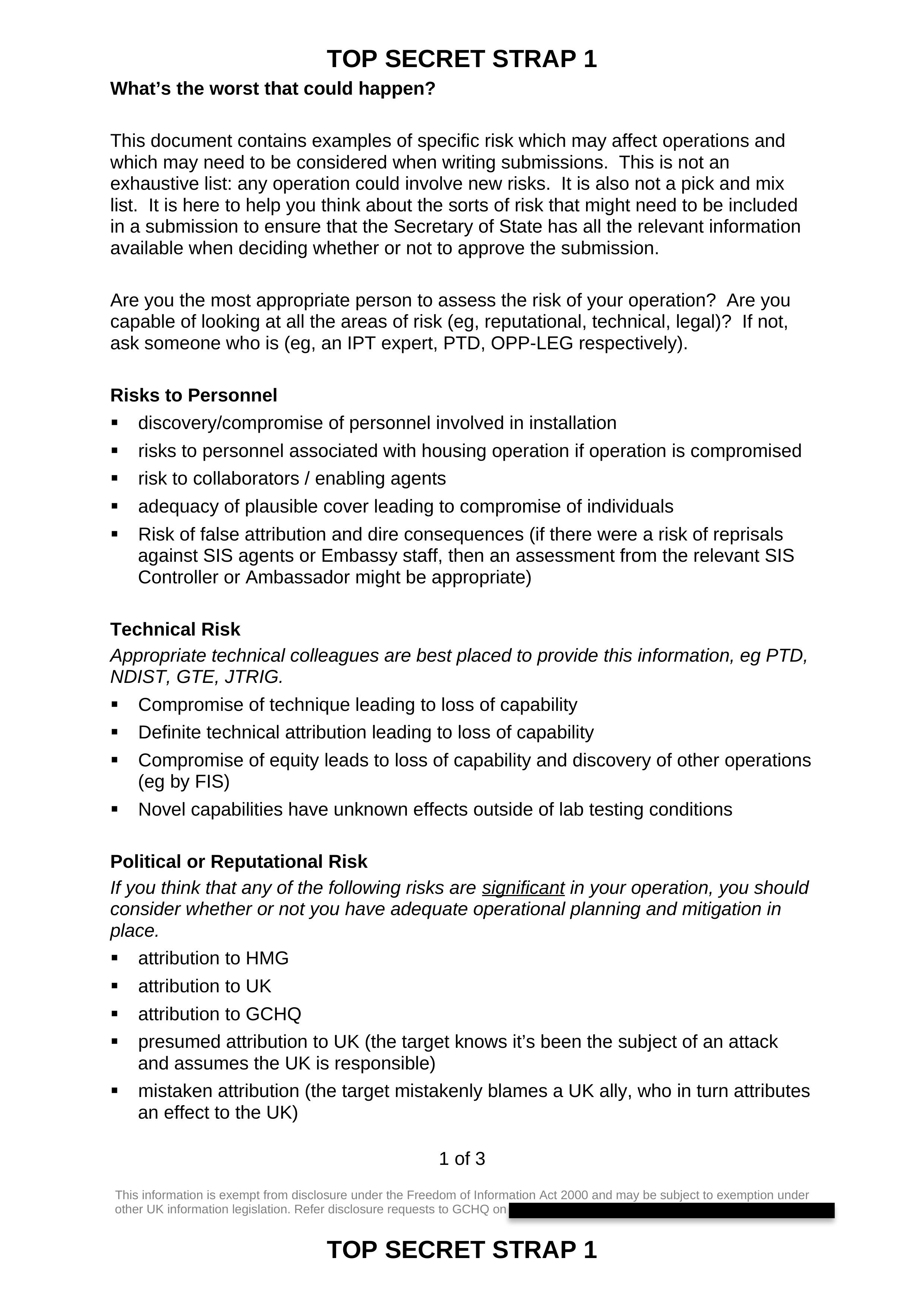
This document contains examples of specific risk which may affect operations and
which may need to be considered when writing submissions. This is not an
exhaustive list: any operation could involve new risks. It is also not a pick and mix
list. It is here to help you think about the sorts of risk that might need to be included
in a submission to ensure that the Secretary of State has all the relevant information
available when deciding whether or not to approve the submission.
Are you the most appropriate person to assess the risk of your operation? Are you
capable of looking at all the areas of risk (eg, reputational, technical, legal)? If not,
ask someone who is (eg, an IPT expert, PTD, OPP-LEG respectively).
Risks to Personnel
- discovery/compromise of personnel involved in installation
- risks to personnel associated with housing operation if operation is compromised
- risk to collaborators / enabling agents
- adequacy of plausible cover leading to compromise of individuals
- Risk of false attribution and dire consequences (if there were a risk of reprisals
against SIS agents or Embassy staff, then an assessment from the relevant SIS
Controller or Ambassador might be appropriate)
Technical Risk
Appropriate technical colleagues are best placed to provide this information, eg PTD,
NDIST, GTE, JTRIG.
- Compromise of technique leading to loss of capability
- Definite technical attribution leading to loss of capability
- Compromise of equity leads to loss of capability and discovery of other operations
(eg by FIS) - Novel capabilities have unknown effects outside of lab testing conditions
Political or Reputational Risk
If you think that any of the following risks are significant in your operation, you should
consider whether or not you have adequate operational planning and mitigation in
place.
- attribution to HMG
- attribution to UK
- attribution to GCHQ
- presumed attribution to UK (the target knows it's been the subject of an attack
and assumes the UK is responsible) - mistaken attribution (the target mistakenly blames a UK ally, who in turn attributes
an effect to the UK)
1 of 3
This information is exempt from disclosure under the Freedom of Information Act 2000 and may be subject to exemption under
other UK information legislation. Refer disclosure requests to GCHQ on [REDACTED]
TOP SECRET STRAP 1
TOP SECRET STRAP 1
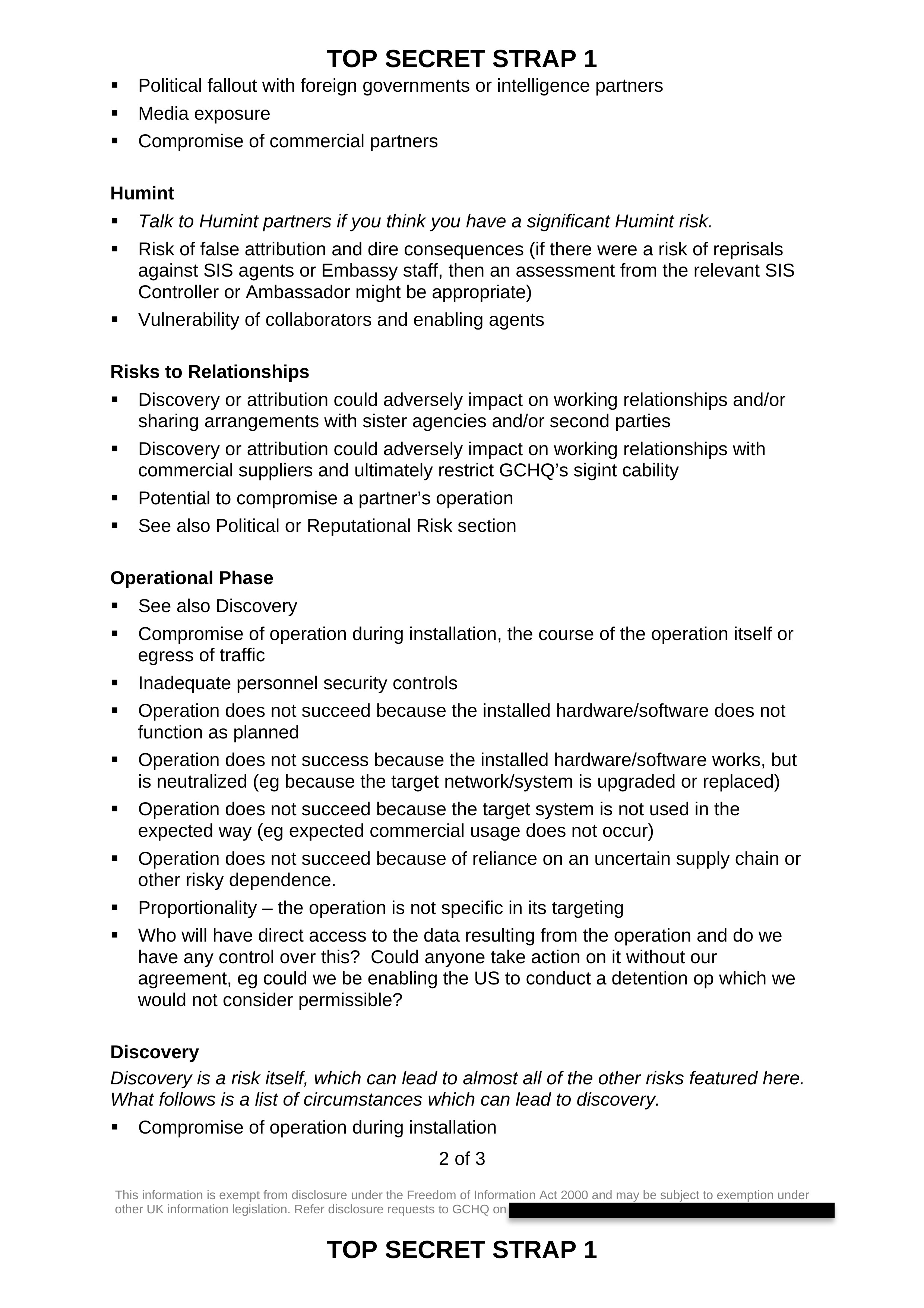
- Political fallout with foreign governments or intelligence partners
- Media exposure
- Compromise of commercial partners
Humint
- Talk to Humint partners if you think you have a significant Humint risk.
- Risk of false attribution and dire consequences (if there were a risk of reprisals
against SIS agents or Embassy staff, then an assessment from the relevant SIS
Controller or Ambassador might be appropriate) - Vulnerability of collaborators and enabling agents
Risks to Relationships
- Discovery or attribution could adversely impact on working relationships and/or
sharing arrangements with sister agencies and/or second parties - Discovery or attribution could adversely impact on working relationships with
commercial suppliers and ultimately restrict GCHQ's sigint cability - Potential to compromise a partner's operation
- See also Political or Reputational Risk section
Operational Phase
- See also Discovery
- Compromise of operation during installation, the course of the operation itself or
egress of traffic - Inadequate personnel security controls
- Operation does not succeed because the installed hardware/software does not
function as planned - Operation does not success because the installed hardware/software works, but
is neutralized (eg because the target network/system is upgraded or replaced) - Operation does not succeed because the target system is not used in the
expected way (eg expected commercial usage does not occur) - Operation does not succeed because of reliance on an uncertain supply chain or
other risky dependence. - Proportionality - the operation is not specific in its targeting
- Who will have direct access to the data resulting from the operation and do we
have any control over this? Could anyone take action on it without our
agreement, eg could we be enabling the US to conduct a detention op which we
would not consider permissible?
Discovery
Discovery is a risk itself, which can lead to almost all of the other risks featured here.
What follows is a list of circumstances which can lead to discovery.
- Compromise of operation during installation
2 of 3
This information is exempt from disclosure under the Freedom of Information Act 2000 and may be subject to exemption under
other UK information legislation. Refer disclosure requests to GCHQ on [REDACTED]
TOP SECRET STRAP 1
TOP SECRET STRAP 1
- Inadequate personnel security controls and subsequent information leak
- Discover of installed hardware (including post-operation)
- Forensic discovery of installed software
- Discovery of a suspicious audit trail/logs/registry
- Discovery of suspicious RF energy
- Suspicious profile caused by hardware/software malfunction
- Discovery of egressed traffic
- Discovery through other IT leakage
- Vulnerability to HIS or other monitoring
- Inadequate monitoring of profile generated by operation
- Inadequate review of risks during the lifetime of the operation
- Reliance on an uncertain supply chain or other risky dependencies
- Failure by operators to cover tracks, including clearing logs/changing read status
of emails - Novel capabilities and techniques having unknown effects outside of lab testing
conditions - Unforeseen changes to hardware or software leading to compromise of
techniques or installation - Hardware/software malfunctions leading change in target behaviour, potentially
including forensic investigation (and potential discovery) and/or loss of target
access
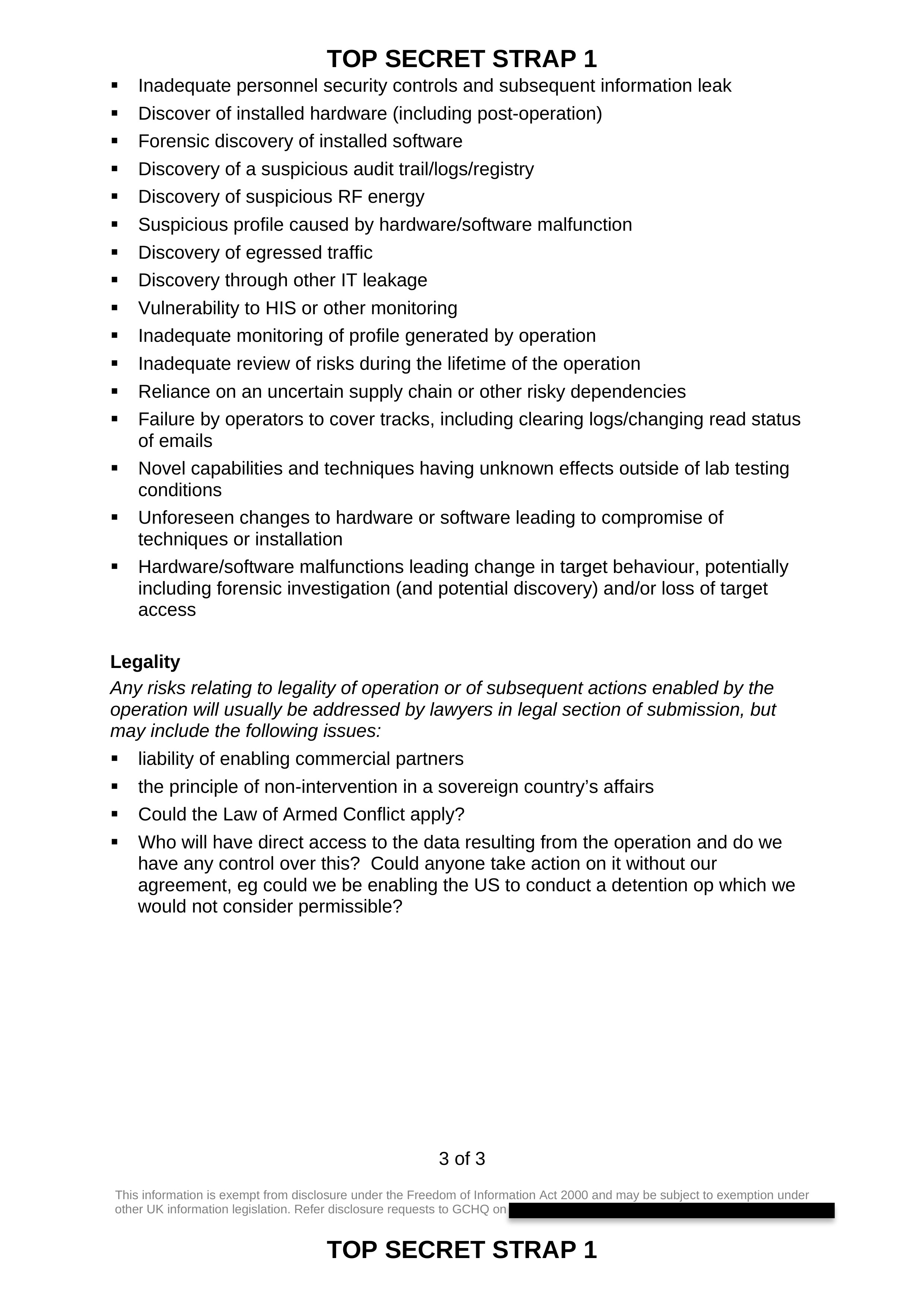
Legality
Any risks relating to legality of operation or of subsequent actions enabled by the
operation will usually be addressed by lawyers in legal section of submission, but
may include the following issues:
- liability of enabling commercial partners
- the principle of non-intervention in a sovereign country's affairs
- Could the Law of Armed Conflict apply?
- Who will have direct access to the data resulting from the operation and do we
have any control over this? Could anyone take action on it without our
agreement, eg could we be enabling the US to conduct a detention op which we
would not consider permissible?
3 of 3
This information is exempt from disclosure under the Freedom of Information Act 2000 and may be subject to exemption under
other UK information legislation. Refer disclosure requests to GCHQ on [REDACTED]
TOP SECRET STRAP 1
Published in the Same Report
(1 documents)
-
HIMR Data Mining Research Problem Book [pdf]
This document is a research roadmap created by GCHQ for the Heilbronn Institute for Mathematical Research (HIMR). Its purpose is to guide long-term mathematical and data-mining research that could improve signals intelligence (SIGINT) capabilities. It outlines key research problems, datasets, and collaboration plans between intelligence agencies and academic researchers. The main goal is to develop new algorithms and mathematical tools to analyze extremely large communications datasets produced by modern surveillance systems.
Programs: CLOUD · DISTILLERY · DISCOVER · PRESTON · LECKWITH · TERRAIN · BROADOAK · NGE · FIVEALIVE · CHARTBREAKER · FIRSTCONTACT · GEOFUSION · RADONSHARPEN-B · PRIMETIME · HIDDENOTTER · BAKERSDOZEN · CLASP · SALTYOTTER · BIRCH · SOLIDINK · FLUIDINK · MAMBA · GRINNINGROACH · PIRATECAREBEAR · AUTOASSOC · CROUCHINGSQUIRREL · HRMAP · KACHINA · SQUEAL · QUESTA · METEORSHOWER · SUNSTORM · GOLDMINE · HAGERAWEL · WOODY · BUZZ · SILVERLIBRARY · SILVERLINING · VALHALLA · MOUNTMCKINLEY · SEPANG · BLACKHOLE · SALAMANCA · HAGELAWEL · LUCKYSTRIKE · SPIKYROCK · MYOFIBRIL · INJUNCTION · PSYCHICSALMON · RAGINGBULLFROG · ROBOTICFISH · TIMIDTOAD · AURA · CARBONCOPY · CASK · CHORDAL · CRAN · INSTINCT · MADFORGE · SWAMP · VOLSUNGA · WHITERAVEN · MVR · PPF · JTRIG · MAPREDUCE · MAILORDERPeople: Tukey, John
Related Documents
-
Behavioural Science Support for JTRIG’S Effects and Online HUMINT Operations [pdf]
A top‑secret 2011 paper by psychologist Mandeep K. Dhami operationalizes behavioral science for GCHQ’s JTRIG, turning social‑psychology playbooks into a menu of cyber “effects” and online HUMINT to discredit, deceive, disrupt, and deter targets. It recommends training, profiling, measurement, and a bespoke ethics code to systematize influence operations across social platforms and covert personas.
Marking: TOP SECRETPrograms: JTRIGPeople: Dhami, Mandeep K. · Wortley, Richard · Mazerolle, Lorraine · Hall, Gordon C. Nagayama · Barongan, Christy · Mann, Ian · Maio, Gregory R. · Haddock, Geoffrey · Lewicki, Roy J. · McAllister, Daniel J. · Bies, Robert J. · Kahle, Lynn R. · Kim, Chung-Hyun · Horowitz, Leonard M. · Strack, Stephen · Hogg, Michael A. · Vaughan, Graham M. · Garcia-Retamero, Rocio · Forgas, Joseph P. · Cooper, Joel · Crano, William D. · Fiske, Susan T. · Gilbert, Daniel T. · Lindzey, Gardner · Mandel, David R. · Clow, Kenneth E. · Baack, Donald E. · Cialdini, Robert B. · Bachmann, Reinhard · Zaheer, Akbar · Adams, Barbara D. · Sartori, Jessica A. · Yun, Minwoo · Hirsch, Andrew Von · Bottoms, Anthony E. · Burney, Elizabeth · Wikstrom, P-O · Tunnell, Kenneth D. · Piquero, Alex R. · Tibbets, Stephen G. · Snook, Brent · Eastwood, Joseph · Gendreau, Paul · Goggin, Claire · Cullen, R. M. · Kavanagh, Jennifer M. · Smith, Peter B. · Bond, Michael Harris · Slovic, Paul · Knol, Anne B. · Slottje, Pauline · Sluijs, Jeroen P. van der · Savage, Leonard J. · Postmes, Tom · Spears, Russell · Sakhel, Khaled · Groot, Daphne de · Pettigrew, Thomas Fraser · Tropp, Linda R. · Newman, Graeme R. · Mischel, Walter · Miller, Michael D. · Brunner, C. Cryss · McDaniels, Timothy L. · Marcus, Aaron · Perez, Angel · Lee, Eun-Ju · Knight, Frank H. · King, Sara B. · Payne, John W. · Johnson, Eric · Hui, Pan · Buchegger, Sonja · Huffaker, David A. · Furby, Lita · Beyth-Marom, Ruth · Freilich, Joshua D. · Chermak, Steven M. · Fischhoff, Baruch · Lichtenstein, Sarah · Derby, Steven L. · Keeney, Ralph · Felson, Marcus · Clarke, Ronald V. · Wallsten, Thomas S. · Crandall, David · Cosley, Dan · Huttenlocher, Daniel · Kleinberg, Jon · Suri, Siddharth · Carroll, John · Weaver, Frances · Becker, Gary S.“Britain Used Spy Team to Shape Latin American Public Opinion on Falklands” - The Intercept ↗ (2015-04-02) · “Controversial GCHQ Unit Engaged in Domestic Law Enforcement, Online Propaganda, Psychology Research” - The Intercept ↗ (2015-06-22) · “#EspiadosPorLosIngleses: los nuevos documentos de Snowden revelan un plan de espionaje de Gran Bretaña en Argentina por Malvinas” - Todo Noticias ↗ (2015-04-02) · Fishman, Andrew · Greenwald, Glenn -
Computer Network Exploitation (CNE) Classification Guide / 2-59 [pdf]
A NSA/TAO classification guide establishing the precise classification level for 41 categories of information about computer network exploitation operations — covering remote and physical subversion methods, CNE tools and techniques, supply chain operations, hardware implants, off-net field operations, zero-day vulnerabilities, and cryptographic material acquired through CNE.
“Core Secrets: NSA Saboteurs in China and Germany” - The Intercept ↗ (2014-10-10) · “The Digital Arms Race: NSA Preps America for Future Battle” - Der Spiegel ↗ (2015-01-17) · Maass, Peter · Poitras, Laura · Appelbaum, Jacob · Gibson, Aaron · Guarnieri, Claudio · Müller-Maguhn, Andy · Rosenbach, Marcel · Ryge, Leif · Schmundt, Hilmar · Sontheimer, Michael -
CSEC Cyber Threat Capabilities [pdf]
This document details CSEC’s full-spectrum cyber operations architecture, integrating SIGINT and IT Security to conduct both defensive and offensive activities under the guise of “information superiority.” While early sections emphasize detection, anomaly analysis, and collaboration with Five Eyes partners, later portions reveal active measures including network infiltration (implant deployment), command-and-control tracking, traffic manipulation and redirection, DNS interference, and potential disruption or deception operations—illustrating CSEC’s capacity not only to defend Canadian networks but also to surveil, exploit, and influence foreign and domestic digital infrastructure.
Programs: EONBLUE · CYBERDMZ · SEEDSPHERE · PHOTONICPRISM · SPECIALSOURCE · SUPERDRAKE · DARKSPACE · QUANTUM · MANDATE · STREAMING SENTRY · SSO · TKB · COVENANT -
CSEC SIGINT Cyber Discovery: Summary of the current effort [pdf]
This document provides a overview of the Communications Security Establishment Canada (CSEC) cyber operations, detailing its SIGINT, CNE (Computer Network Exploitation), and cyber counterintelligence programs, including tools like WARRIORPRIDE, REPLICANTFARM, and EONBLUE for threat detection, anomaly discovery, and metadata production. It outlines operational procedures, analytic methodologies, and collaborative frameworks with domestic and Five Eyes partners for sharing intelligence, tipping/cueing, and integrating cyber and traditional counterintelligence efforts.
Programs: REPLICANTFARM · SLIPSTREAM · WARRIORPRIDE · DAREDEVIL · CHORDFLIER · NAMEDROPPER · WORMWOOD · OBELIX · SHEPHERD · CARBON · REGBACKUP · DOGHOUSE · WALKER · ALOOFNESS · BLAZINGANGEL · TINYWEB · QUIVERINGSQUAB · WINDO · DIESELRATTLE · WIDOWKEY · CIVETCAT · WINBEE · SSLINST · PULLEDPORK · EONBLUE · SNIFFLE · QUANTUM · XKEYSCORE · HALTERHITCH · FASTFLUX · DEADSEA · NSPACES · PPF · SSO · TKB“The Digital Arms Race: NSA Preps America for Future Battle” - Der Spiegel ↗ (2015-01-17) · “Communication Security Establishment's cyberwarfare toolbox revealed” - CBC News ↗ (2015-03-23) · “Documents Reveal Canada’s Secret Hacking Tactics” - The Intercept ↗ (2015-03-23) · Appelbaum, Jacob · Gibson, Aaron · Guarnieri, Claudio · Müller-Maguhn, Andy · Poitras, Laura · Rosenbach, Marcel · Ryge, Leif · Schmundt, Hilmar · Sontheimer, Michael · Seglins, Dave · Hildebrandt, Amber · Pereira, Michael · Greenwald, Glenn · Gallagher, Ryan -
Behavioural Analysis: The Big Picture (Palantir could be used as part of a CNE) [pdf]
This diagram from GCHQ outlines the lifecycle of a CNE and identifies where Palantir fits into the intelligence workflow. The slide, titled "Behavioural Analysis: The Big Picture," illustrates a timeline of network exploitation from the initial infection of a target host to the eventual exfiltration of data. Crucially, it positions Palantir as a key "knowledge base" used for "Tipping to other systems." This indicates that Palantir’s software was used to aggregate data from successful hacks, allowing analysts to visualize connections and pivot (or "tip") that information toward further surveillance or offensive operations.