Banner: TOP SECRET STRAP 1 11 documents
Search documents matching “TOP SECRET STRAP 1” →The marking line each document prints.
Graphs
Refine (combine with another filter, via search)
Sort: Title
Documents
-
-
GSM tower geolocation [pdf]
This TOP SECRET STRAP 1 note describes DYMO, a prototype GSM-tower geolocation system that combines RUFIS-bis (which demodulates co-channel GSM ARFCN streams per cell-ID) with WHAMI Fast Image (WFI) to remodulate and correlate signals to produce high-quality tower geolocation and matching metadata. The remodulated “synthetic geolocation” improves accuracy and is under development in the NMDC/Midas studies.
-
JTRIG Wiki Highlights – August 2009 [pdf]
This August 2009 JTRIG report outlines the advanced planning phase of Operation QUITO, a pioneering "effects" operation led by GCHQ’s TSI unit. The mission was designed to support the UK Foreign and Commonwealth Office (FCO) in achieving strategic goals regarding Argentina and the Falkland Islands.
-
Next Generation Events [pdf]
A 2009 TOP SECRET briefing outlines the “Next Generation Events” program to scale internet metadata and content analysis across Five Eyes, addressing explosive growth in data volume and the limits of legacy ingest systems. It presents a phased roadmap combining cloud infrastructure, large‑scale event processing, and enhanced profiling to enable bulk analytics and contact chaining.
Programs: NGE · HAUSTORIUM · BLAZINGSADDLES · HARBOURPILOT · MUTANTBROTH · AUTOASSOC · KARMAPOLICE · SOCIALANIMAL · INFINITEMONKEYS · HRMAP · MEMORYHOLE · MARBLEDGECKO · SIMMER · ROCKRIDGE · SAMUELPEPYS · CAFFEINEHIT · LAUGHINGHYENA · SALAMANCA · CLOUD · MONTEVISTA · LOOKINGGLASS · XKEYSCORE · FUMECUPBOARD · IIB · MoaG -
PRESTON Study [pdf]
This GCHQ document details the PRESTON surveillance program, revealing that over a six-month period, 97% of intercepted communications—including calls, texts, and internet data—were not viewed by analysts despite being fully warranted, highlighting systemic challenges in processing and exploiting the vast volume of collected intelligence. It underscores the reliance on traditional PRESTON sources for events like the London G20, while noting gaps in data feeds from other repositories, reflecting both operational scale and limitations in effective oversight.
-
Real Life Stats from GPRS work [pdf]
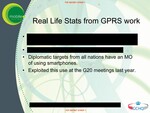
GCHQ’s TOP SECRET briefing touts real-time interception of diplomats’ smartphone traffic at the 2009 G20—especially BlackBerry—feeding live messages and newly discovered selectors to analysts and UK ministers to shape summit outcomes. It’s a snapshot of summit espionage turned into a policy tool: exploit the smartphone dependence of foreign delegations, deliver actionable SIGINT on demand.
“GCHQ intercepted foreign politicians' communications at G20 summits” - The Guardian ↗ (2013-06-16) · “For the NSA, espionage was a means to strengthen the US position in climate negotiations” - Dagbladet Information ↗ (2014-01-30) · MacAskill, Ewen · Davies, Nick · Hopkins, Nick · Borger, Julian · Ball, James · Gjerding, Sebastian · Geist, Anton · Moltke, Henrik · Poitras, Laura -
Summary of GCHQ Info Wrt OC TSS1 Excerpt [pdf]
GCHQ Summary of RTRG (or RT-TG). The RTRG program provides real-time intelligence support for global operations, particularly in the context of the Global War on Terrorism, using tailored systems that integrate multiple data sources to enhance target identification and analysis. The success of RT-RG in support of Operation Iraqi Freedom led to an expansion of the programme to support operations in Korea and Afghanistan, with new applications for keyword-based selection and alerting on voice intercept being trialled.
“Mission Creep: How the NSA’s Game-Changing Targeting System Built for Iraq and Afghanistan Ended Up on the Mexico Border” - The Intercept ↗ (2019-05-29) · “Norges hemmelige krig i Afghanistan” - NRK ↗ (2019-05-29) · Moltke, Henrik · Skille, Øyvind Bye · Døvik, Olav · Hansen, Ståle Ellingsgard · Fjørtoft, Martin -
Tor: Overview of Existing Techniques [pdf]
A TOP SECRET GCHQ presentation summarising existing Tor exploitation techniques and 2012/13 plans documenting GCHQ's Tor-related programmes, naming QUICK ANT, HOMING TROLL, NEWTONS CRADLE, TRIBAL CARNEM, EPIC FAIL, THEMP, NATURAL SELECTION and HAKIM alongside the MCR deanonymisation research, traffic shaping, hidden service investigation and bridge discovery work.
Programs: HOMINGTROLL · NEWTONSCRADLE · JTRIG · TRIBALCARNEM · EPICFAIL · QUICKANT · NATURALSELECTION · REMATION · HAKIM · THEMP -
Voice Fax User Group Minutes December 2010 [pdf]
This GCHQ document is a NSA/GCHQ meeting record from December 2010 detailing the deployment of voice analytics, including speech activity detection, speaker identification, and language identification, integrated with tools like Google Earth to map locations of target communications. It outlines ongoing and planned speaker ID operations against specific targets, including militant leaders and foreign officials, demonstrating the operational use of voice recognition for intelligence collection and geolocation.
-
What’s the worst that could happen? [pdf]
This GCHQ document from March 2010 presents a checklist of factors analysts should consider before going ahead with an operation to infiltrate a communications network, by physical or other means.
-
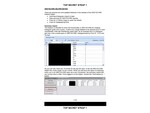
XKEYSCORE Helper Notes [pdf]
This GCHQ document describes new features in the XKEYSCORE Palantir helper tool, including summary/histogram import capabilities that reduce large datasets by aggregating connection data rather than creating individual events for each entry, and data sourcing features that track which XKEYSCORE queries imported specific data into Palantir. The document provides step-by-step screenshots showing how analysts can histogram network traffic by source IP, destination IP, and ports, then import aggregated results showing metadata like total session sizes and connection counts.
Programs: XKEYSCORE