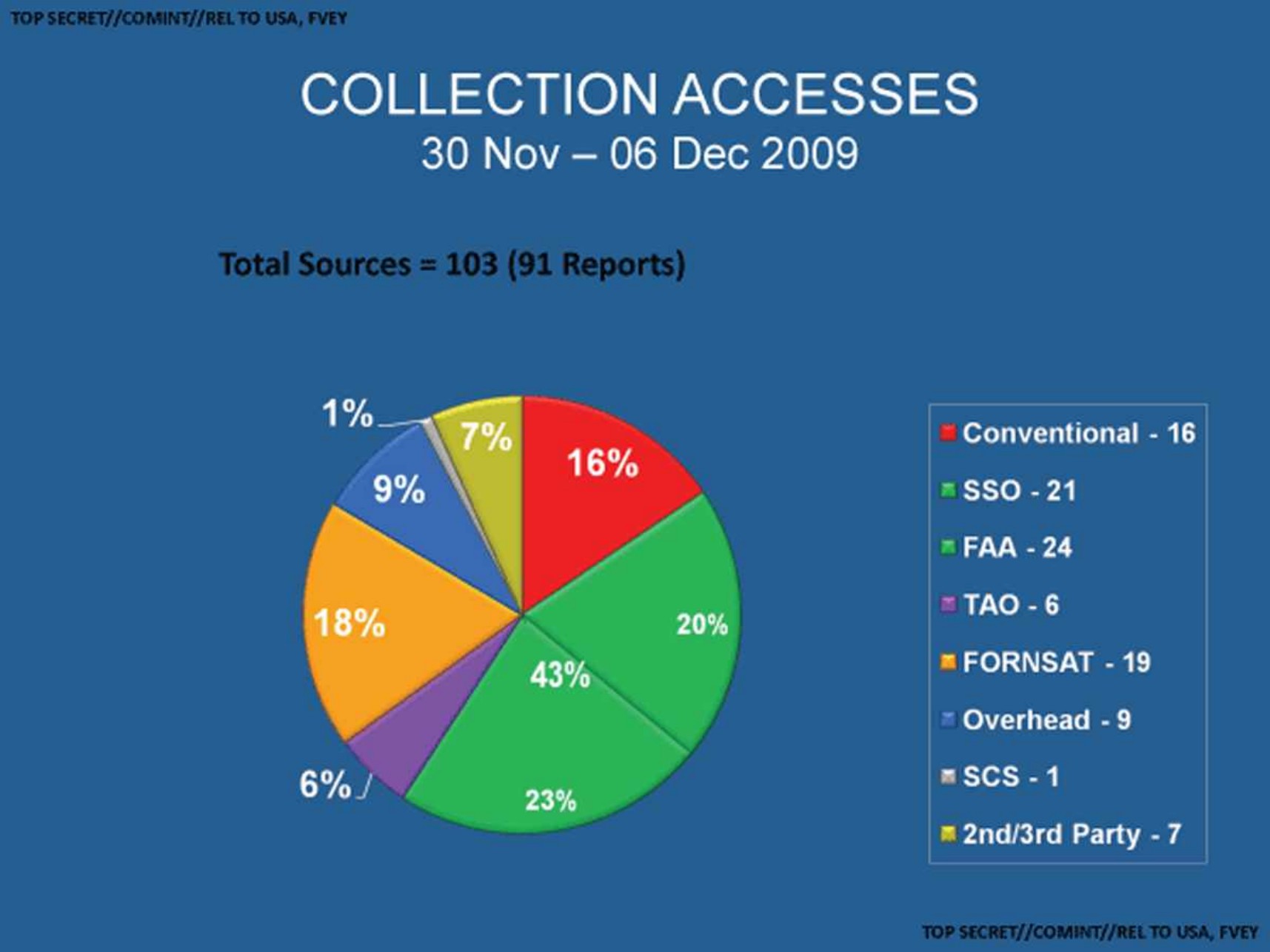
Collection Accesses 30 Nov - 06 Dec 2009
Open PDFDocument date: -
Pages: 1
Genre: slides
Banner: TOP SECRET//COMINT//REL TO USA, FVEY
Classification: TOP SECRET COMINT
Dissemination: REL TO USA, FVEY
This National Security Agency chart shows the varied sources of 103 “accesses” to communications or computers collected in a single week in 2009 at the N.S.A.’s big station in San Antonio, Texas.
My notes
TOP SECRET//COMINT//REL TO USA, FVEY
COLLECTION ACCESSES
30 Nov – 06 Dec 2009
Total Sources = 103 (91 Reports)
16%
21%
24%
6%
19%
9%
1%
7%
43%
Conventional 16
SSO 21
FAA 24
TAO 6
FORNSAT 19
Overhead 9
SCS 1
2nd/3rd Party 7
TOP SECRET//COMINT//REL TO USA, FVEY
Published in the Same Report
(2 documents)
-
United States SIGINT System January 2007 Strategic Mission List [pdf]
This 2007 list of the National Security Agency’s major missions illustrates the sweep of the agency’s goals for signals intelligence (Sigint) or electronic eavesdropping, which include not only such obvious targets as terrorist groups and Iran’s nuclear program, but the diplomacy and economic policy of friendly countries.
-
SIGINT Mission Strategic Plan FY2008-2013 [pdf]
This five-year mission plan for the National Security Agency shows how the agency’s leaders view its mission and culture.
Related Documents
-
Special Collection Service - Pacific SIGDEV Conference March 2011 [pdf]
This document is a TOP SECRET briefing describing the Special Collection Service (SCS)—its organizational structure, global posture and strategic partnerships—and how SCS leverages advanced SIGINT and cyber capabilities (microwave, cellular, satellite, VPN/Internet exploitation, tools like INTERQUAKE/Einstein/Castanet/Birdwatcher) from embassy/PoP sites to collect, analyze and support intelligence and covert operations. It also outlines SCS modernization goals (unified IT core, cloud/virtualization, expanded cyber presence), operational authorities and mission advantages for enabling both SIGINT and HUMINT activities. See also Spiegel's 2013 reporting based on the same presentation (back then they only published two slides from this presentation): https://www.spiegel.de/international/germany/cover-story-how-nsa-spied-on-merkel-cell-phone-from-berlin-embassy-a-930205.html
-
Project CAMBERDADA [pdf]
NSA presentation on Project CAMBERDADA, a programme that intercepts emails sent to antivirus companies reporting new malware, uses SIGINT collection to monitor antivirus vendor communications, and identifies opportunities to repurpose malware before vendors detect it — listing 23 antivirus companies from around the world as targets, with Kaspersky as the primary focus.
People: Picard, François -
Getting Close to the Adversary – Forward-based Defense with QFIRE (June 3, 2011) [pdf]
This document describes the QFIRE project which is designed to give the NSA a global, low-latency platform for “forward-based defense”, enabling real-time detection and manipulation of Internet traffic close to its source. By co-locating passive sensors (TURMOIL), decision logic (TURBINE), and injection capabilities, QFIRE can rapidly reset connections, redirect targets for exploitation, inject malicious payloads, and even seize control of botnets. It operates as part of the broader QUANTUMTHEORY architecture, leveraging both cooperative and non-cooperative infrastructure worldwide to enable CNE/CND/CNA effects with minimal delay.
Programs: QFIRE · QUANTUMTHEORY · TURBULENCE · TURMOIL · TURBINE · TUTELAGE · QUANTUM · QUANTUMSKY · QUANTUMINSERT · QUANTUMBOT · QUANTUMCOPPER · STRAIGHTBIZARRE · BLINDDATE · TUMULT · ISLANDTRANSPORT · SURPLUSHANGAR · MIDDLEMAN · SCSnet · WEALTHYCLUSTER · SSO -
Exploiting Foreign Lawful Intercept (LI) Roundtable [pdf]
Top-secret PowerPoint presentation, "Exploiting Foreign Lawful Intercept Roundtable," highlights the agency’s strategy to exploit vulnerabilities in lawful intercept systems from telecom companies, such as Ericsson, Motorola, and Nokia, in countries like Mexico, Indonesia, and Egypt. The presentation also discusses NSA's use of various "Fingerprints" for identifying data and its collaboration with industry players and foreign lawful intercept systems.
“A Death in Athens” - The Intercept ↗ (2015-09-28) · “Americans and Greeks started the 2004 wiretaps together” - Kathimerini ↗ (2015-09-29) · Bamford, James · Petropoulos, Aggelos -
Special Source Collection - March 2013 [pdf]
A March 2013 NSA Special Source Operations briefing for the NSA Threat Operations Center outlining SSO's portfolio of surveillance programs, their legal authorities, and operational constraints — revealing that SSO accounts for approximately 60% of NSA content collection and 75% of metadata collection, and mapping all major collection programs across three access categories: foreign partner, corporate, and unilateral.