Exploiting Foreign Lawful Intercept (LI) Roundtable
Open PDFDocument date: 2012-01-01
Pages: 12
Genre: slides
Banner: TOP SECRET//SI//REL TO USA, FVEY
Classification: TOP SECRET SI
Dissemination: REL TO USA, FVEY
Top-secret PowerPoint presentation, "Exploiting Foreign Lawful Intercept Roundtable," highlights the agency’s strategy to exploit vulnerabilities in lawful intercept systems from telecom companies, such as Ericsson, Motorola, and Nokia, in countries like Mexico, Indonesia, and Egypt. The presentation also discusses NSA's use of various "Fingerprints" for identifying data and its collaboration with industry players and foreign lawful intercept systems.
My notes
TOP SECRET//SI//REL TO USA, FVEY
(S//SI//REL) Exploiting Foreign Lawful Intercept (LI) Roundtable
[REDACTED] S31122
TOP SECRET//SI//REL TO USA, FVEY
TOP SECRET//SI//REL TO USA, FVEY
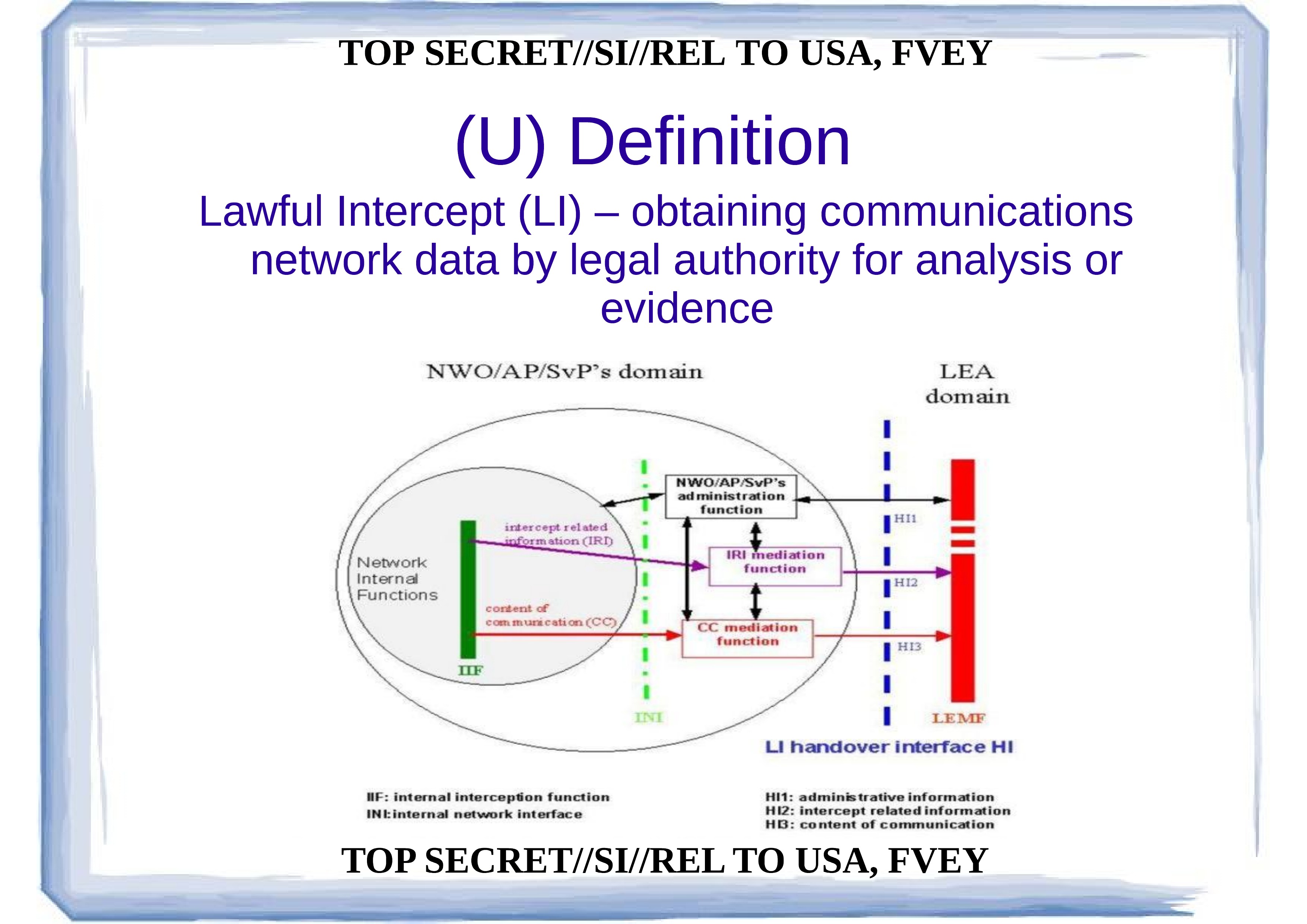
(U) Definition
Lawful Intercept (LI) – obtaining communications network data by legal authority for analysis or evidence
NWO/AP/SvP's domain
LEA
domain
NWO/AP/SvP's
administration
function
HI1
intercept related
information (IRI)
Network
Internal
Functions
IRI mediation
function
HI2
content of
IIF
communication (CC)
INI
CC mediation
function
HI3
LEMF
LI handover interface HI

IIF: internal interception function
INI:internal network interface
HI1: administrative information
HI2: intercept related information
HI3: content of communication
TOP SECRET//SI//REL TO USA, FVEY
TOP SECRET//SI//REL TO USA, FVEY
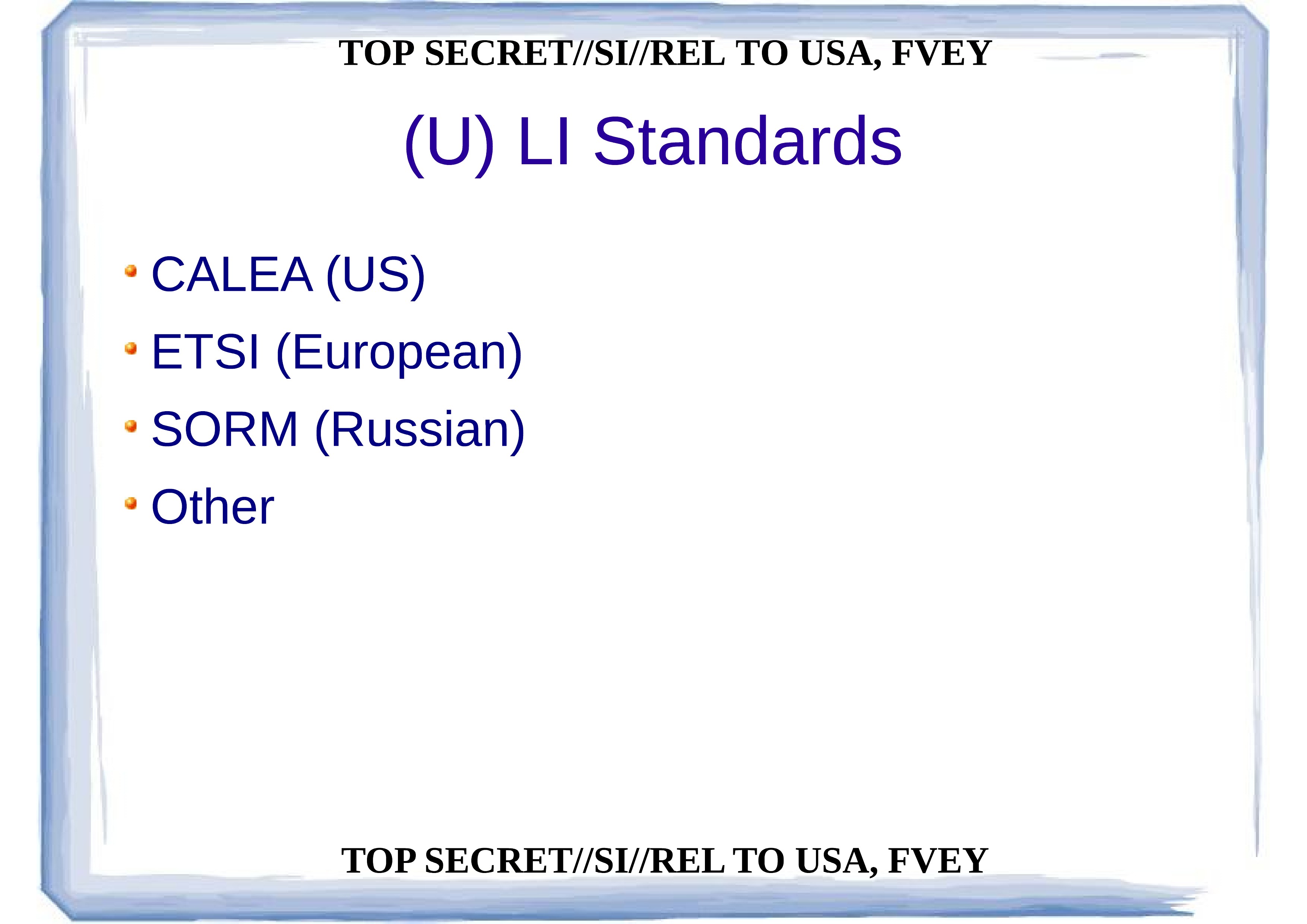
(U) LI Standards
- CALEA (US)
- ETSI (European)
- SORM (Russian)
- Other
TOP SECRET//SI//REL TO USA, FVEY
TOP SECRET//SI//REL TO USA, FVEY
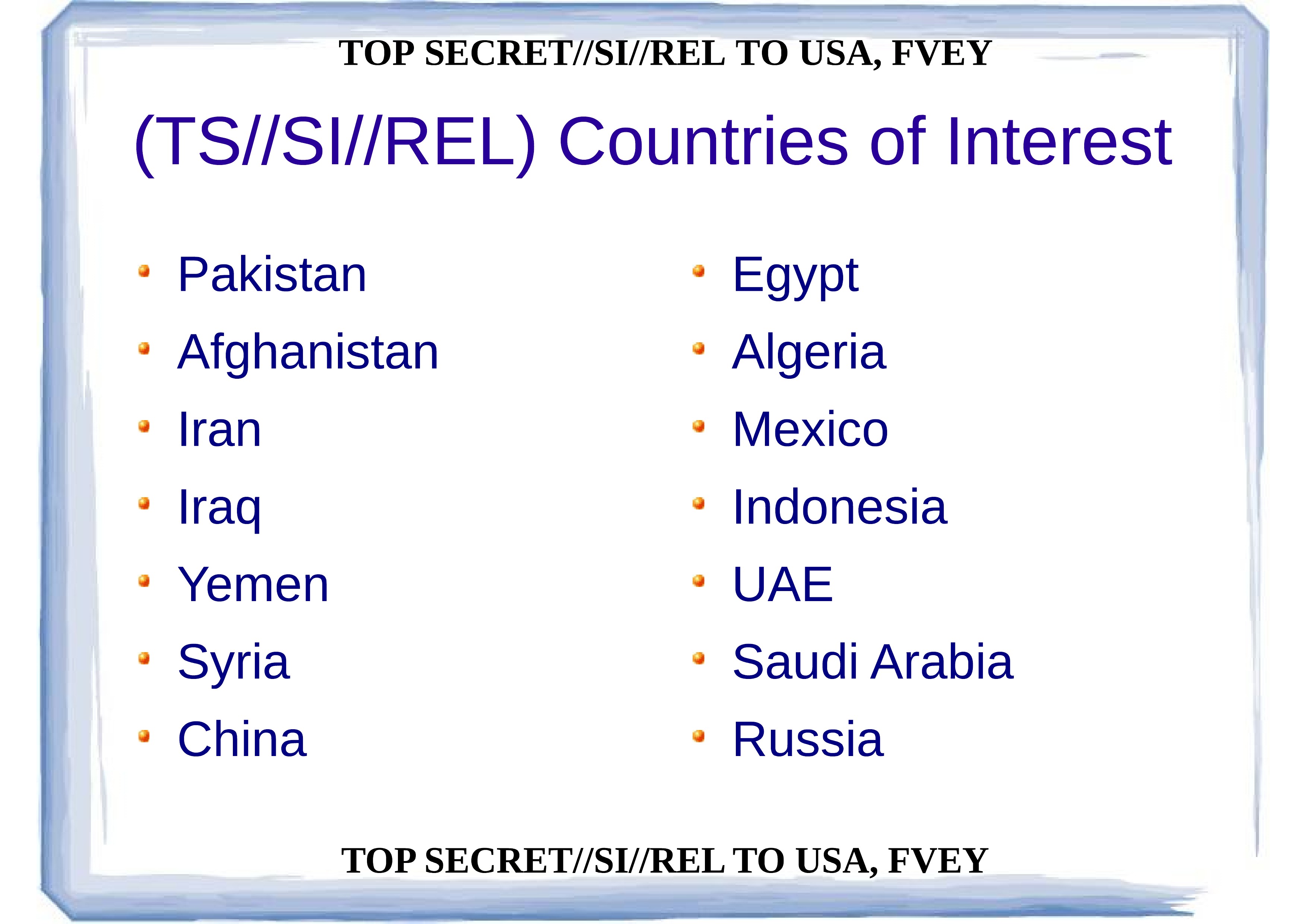
(TS//SI//REL) Countries of Interest
- Pakistan
- Afghanistan
- Iran
- Iraq
- Yemen
- Syria
- China
- Egypt
- Algeria
- Mexico
- Indonesia
- UAE
- Saudi Arabia
- Russia
TOP SECRET//SI//REL TO USA, FVEY
TOP SECRET//SI//REL TO USA, FVEY
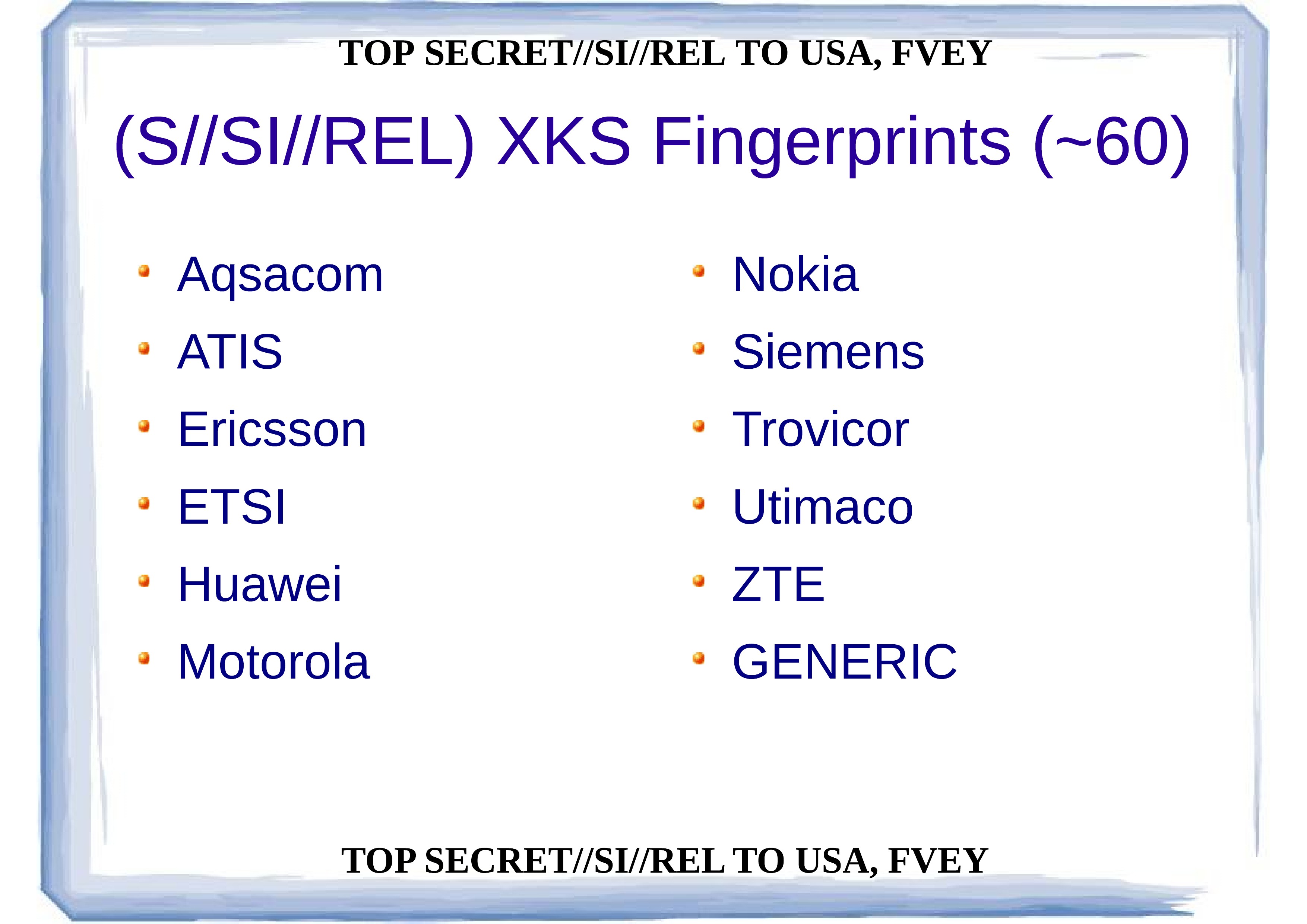
(S//SI//REL) XKS Fingerprints (~60)
- Aqsacom
- ATIS
- Ericsson
- ETSI
- Huawei
- Motorola
- Nokia
- Siemens
- Trovicor
- Utimaco
- ZTE
- GENERIC
TOP SECRET//SI//REL TO USA, FVEY
TOP SECRET//SI//REL TO USA, FVEY
(U//FOUO) Access Methods
- FORNSAT
- Microwave (F6)
- Special Source Operations (SSO)
- Tailored Access Operations (TAO)
TOP SECRET//SI//REL TO USA, FVEY
TOP SECRET//SI//REL TO USA, FVEY
(S//SI//REL) Taplists
- Developing advanced analytics to determine patterns in numbers being tasked
- Creating database to store LI-related information
- Discovering informal tasking
TOP SECRET//SI//REL TO USA, FVEY
TOP SECRET//SI//REL TO USA, FVEY
(S//SI//REL) Mapping Networks
- Telecommunication and Internet Service Providers in a region
- LI vendors/service providers
- IP addresses/ports of usage
- Likely transmission medium
TOP SECRET//SI//REL TO USA, FVEY
TOP SECRET//SI//REL TO USA, FVEY
(S//SI//REL) Processing Solution
- KITTYBINGE
- TAO custom solutions
- STARPROC
TOP SECRET//SI//REL TO USA, FVEY
TOP SECRET//SI//REL TO USA, FVEY
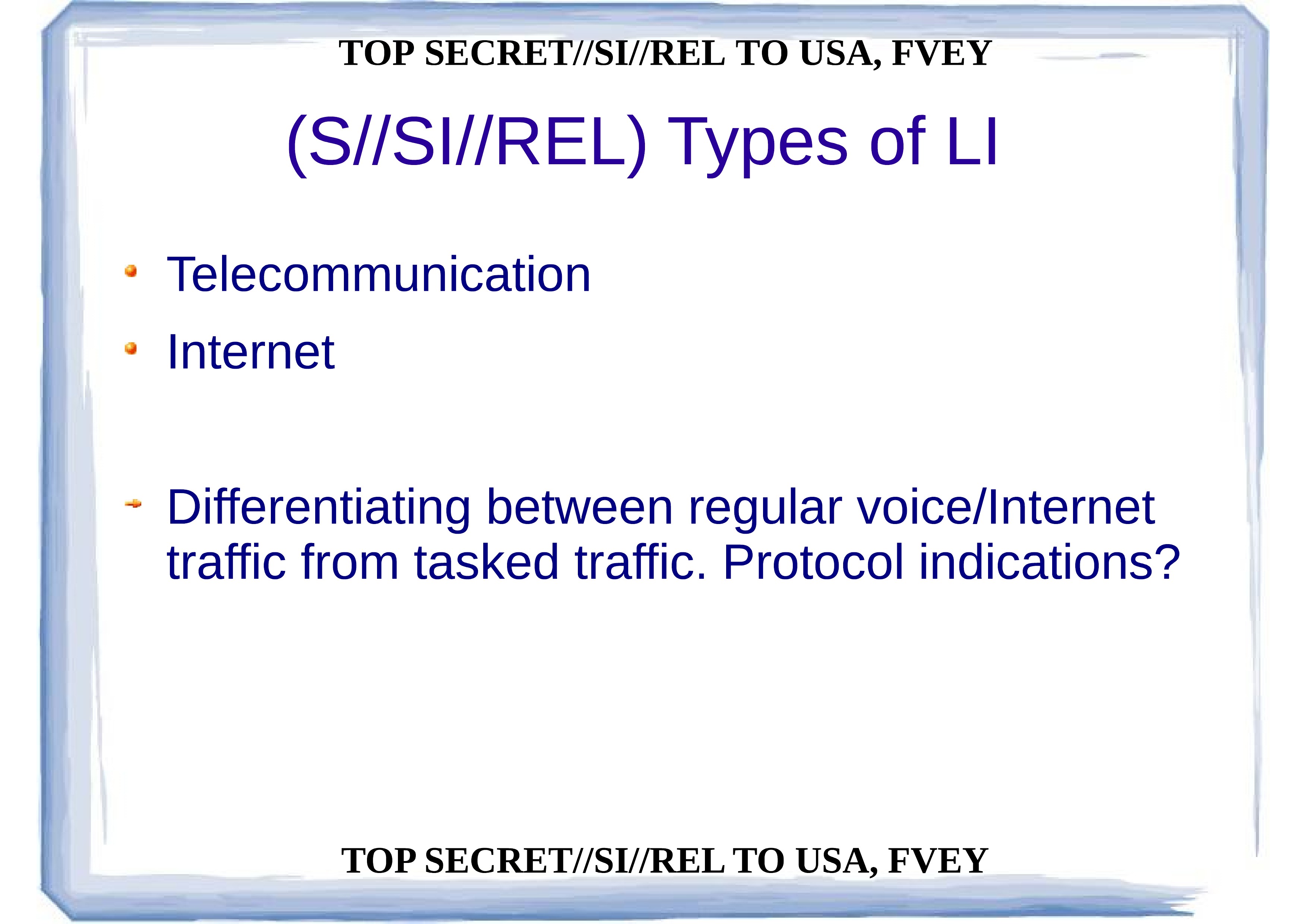
(S//SI//REL) Types of LI
- Telecommunication
- Internet
- Differentiating between regular voice/Internet traffic from tasked traffic. Protocol indications?
TOP SECRET//SI//REL TO USA, FVEY
TOP SECRET//SI//REL TO USA, FVEY
(S//SI//REL) LI Pod
TOP SECRET//SI//REL TO USA, FVEY
TOP SECRET//SI//REL TO USA, FVEY
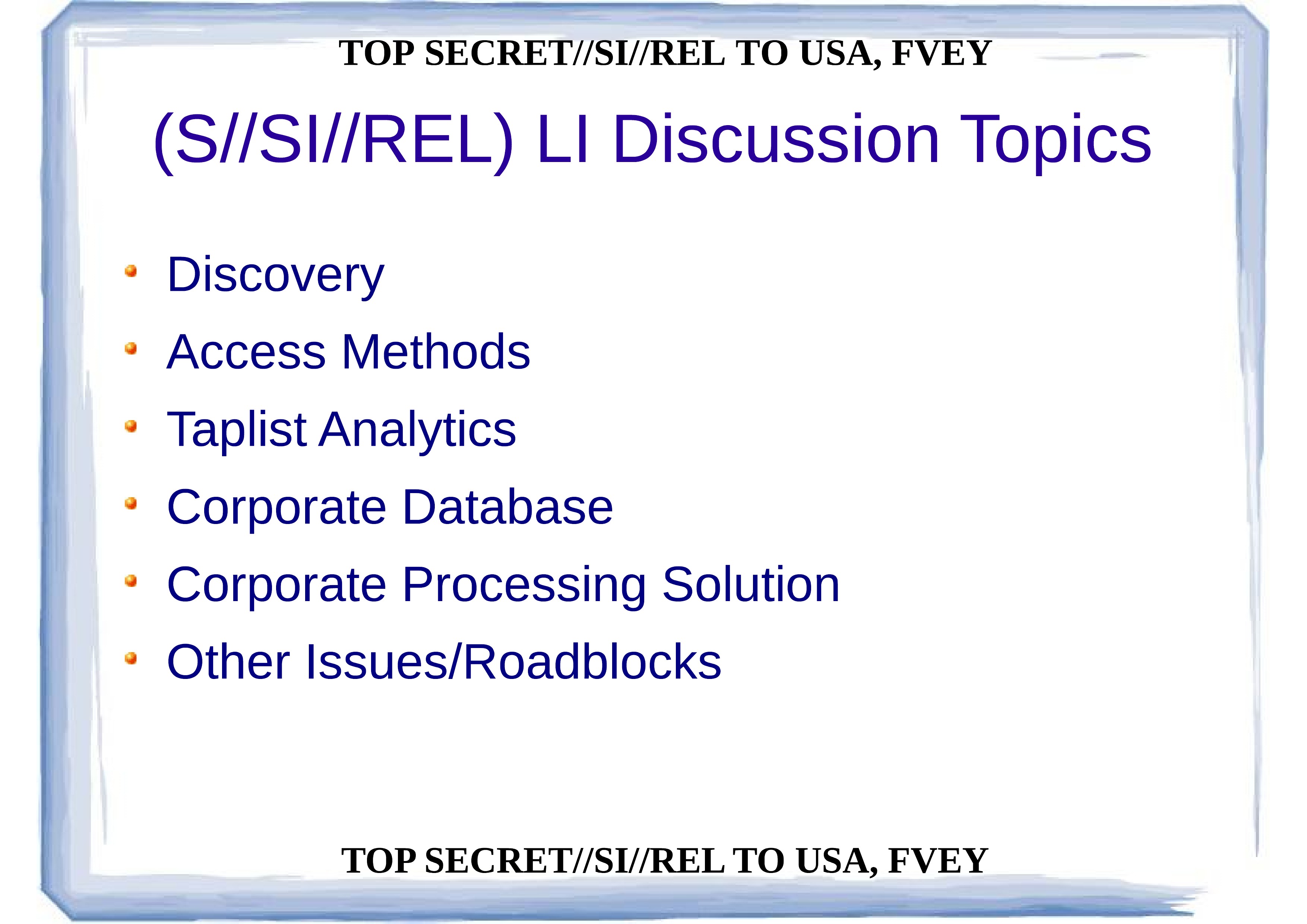
(S//SI//REL) LI Discussion Topics
- Discovery
- Access Methods
- Taplist Analytics
- Corporate Database
- Corporate Processing Solution
- Other Issues/Roadblocks
TOP SECRET//SI//REL TO USA, FVEY
Published in the Same Report
(4 documents)
-
SID Trains for Athens Olympics SIDtoday [pdf]
The NSA has had an active role in the Olympics since the 1984 Los Angeles Games. For the 2004 Games in Athens, NSA will support the Greek intelligence service with a team of 10 analysts.
“A Death in Athens” - The Intercept ↗ (2015-09-28) · “Americans and Greeks started the 2004 wiretaps together” - Kathimerini ↗ (2015-09-29) · The Intercept ↗ (2016-08-10) · Bamford, James · Petropoulos, Aggelos -
NSA Team Selected for Olympics Support SIDtoday [pdf]
SID had many openings for analytic support for the 2004 Summer Olympics in Greece, and the response was “overwhelming.” The article lists eight people selected out of 300 applicants.
Programs: SIGDASYS“A Death in Athens” - The Intercept ↗ (2015-09-28) · “Americans and Greeks started the 2004 wiretaps together” - Kathimerini ↗ (2015-09-29) · The Intercept ↗ (2016-08-10) · Bamford, James · Petropoulos, Aggelos -
Gold Medal Support to the Summer Games SIDtoday [pdf]
NSA personnel worked 24-hour watches and operations while providing support at the 2004 Summer Olympics in Athens.
“A Death in Athens” - The Intercept ↗ (2015-09-28) · “Americans and Greeks started the 2004 wiretaps together” - Kathimerini ↗ (2015-09-29) · The Intercept ↗ (2017-04-24) · Bamford, James · Petropoulos, Aggelos -
Another Successful Olympics Story SIDtoday [pdf]
SID spent more than a year planning for the 2004 Summer Olympics in Athens, collaborating across different areas of SID and with other intelligence agencies to gain access to communications systems and providers in Greece.
“A Death in Athens” - The Intercept ↗ (2015-09-28) · “Americans and Greeks started the 2004 wiretaps together” - Kathimerini ↗ (2015-09-29) · The Intercept ↗ (2017-04-24) · Bamford, James · Petropoulos, Aggelos
Related Documents
-
Analyzing Mobile/Cellular DNI in XKEYSCORE, May 2009 [pdf]
The XKEYSCORE document explains how the agency analyzes mobile/cellular device internet usage by collecting and processing both converged DNI/DNR data within cellular networks and traditional internet traffic, using various tools and indicators to identify mobile users even when their device type isn't immediately evident. The document demonstrates how the system can track mobile internet activity across applications like Yahoo Mail and identifies devices through various technical "hints" including MSISDN codes, browser fingerprints, and user agent strings.
-
Using XKEYSCORE to Enable TAO [pdf]
A TOP SECRET training presentation from 2009, authored by a Booz Allen Hamilton contractor, teaching NSA analysts how to use XKeyscore to harvest the login credentials, router configurations, browser versions and server software details that the Tailored Access Operations hacking unit needs to break into foreign computer networks — with worked examples stealing Cisco router passwords, Iranian government webmail logins and jihadi web forum credentials directly from intercepted internet traffic.
-
X-KEYSCORE as a SIGDEV tool 2009 [pdf]
A 2009 TOP SECRET NSA presentation describing XKeyscore as a SIGINT development tool — explaining how it captures and temporarily stores the full content of internet traffic (the 95%+ that was previously dropped because it didn't match any target) across 125 sites worldwide, "slowing down the internet" so analysts can retroactively reconstruct a target's entire online session, discover new targets, and search the content of documents, web searches, emails and chats that contain no tasked selector.
Programs: XKEYSCORE · PINWALE · TRAFFICTHIEF · MARINA · AGILITY · PILBEAM · MAILORDER · CADENCE · NKB · PSC · SSO · UIS“XKEYSCORE: NSA’s Google for the World’s Private Communications” - The Intercept ↗ (2015-07-01) · “No Place to Hide” - Metropolitan Books ↗ (2014-05-13) · “FRA has access to controversial surveillance system” - SVT Nyheter ↗ (2013-12-11) · Marquis-Boire, Morgan · Greenwald, Glenn · Lee, Micah · Bergman, Sven · Dyfvermark, Joachim · Gallagher, Ryan · Laurin, Fredrik · Struwe, Filip -
XKEYSCORE intro [pdf]
A TOP SECRET NSA presentation from 2008 introducing XKeyscore — one of the earliest overview documents in the archive — describing the system as a globally distributed Linux cluster across approximately 150 sites and 700+ servers that stores a ~3-day rolling buffer of all unfiltered internet traffic, and demonstrating its core capabilities for finding previously unknown targets by mining metadata, tracking documents by embedded image hashes, detecting encryption and VPN use, and language tracking.
Programs: XKEYSCORE · TURMOIL · TURBULENCE · TRAFFICTHIEF · WEALTHYCLUSTER · MOONSHINE · SEARCHLIGHT · MARINA · PSC · SSO · TIMBERLINEPeople: bin Laden, Osama“'Brasil é um grande alvo', diz jornalista sobre vigilância dos EUA” - O Globo ↗ (2013-07-07) · “XKeyscore: NSA tool collects 'nearly everything a user does on the internet'” - The Guardian ↗ (2013-07-31) · “No Place to Hide” - Metropolitan Books ↗ (2014-05-13) · “XKEYSCORE: NSA’s Google for the World’s Private Communications” - The Intercept ↗ (2015-07-01) · Greenwald, Glenn · Bridi, Sônia · Marquis-Boire, Morgan · Lee, Micah -
Project CAMBERDADA [pdf]
NSA presentation on Project CAMBERDADA, a programme that intercepts emails sent to antivirus companies reporting new malware, uses SIGINT collection to monitor antivirus vendor communications, and identifies opportunities to repurpose malware before vendors detect it — listing 23 antivirus companies from around the world as targets, with Kaspersky as the primary focus.
People: Picard, François