Tools for the Mission
Open PDFDocument date: 2006-07-10
Type: SIDtoday
Pages: 2
Genre: newsletter
Banner: DYNAMIC PAGE -- HIGHEST POSSIBLE CLASSIFICATION IS TOP SECRET // SI / TK // REL TO USA AUS CAN GBR NZL
Classification: SECRET SI
Dissemination: -
Two scenarios in which the Target Knowledge Branch - a collection of data processing tools and services - can help analysts locate a cellphone or a wifi access point.
My notes
DYNAMIC PAGE -- HIGHEST POSSIBLE CLASSIFICATION IS
TOP SECRET // SI / TK // REL TO USA AUS CAN GBR NZL
SIDtoday
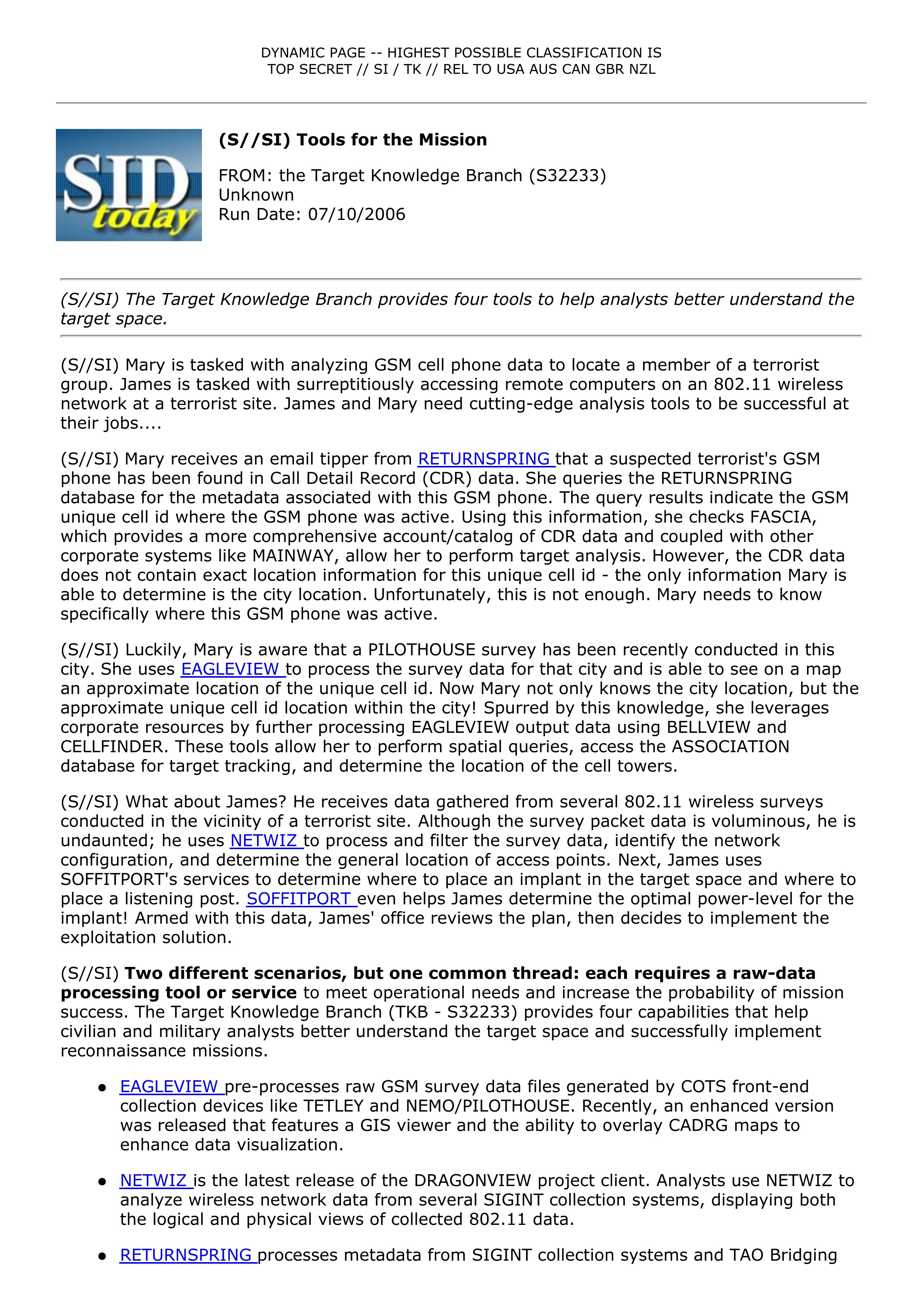
(S//SI) Tools for the Mission
FROM: the Target Knowledge Branch (S32233)
Unknown
Run Date: 07/10/2006
(S//SI) The Target Knowledge Branch provides four tools to help analysts better understand the
target space.
(S//SI) Mary is tasked with analyzing GSM cell phone data to locate a member of a terrorist
group. James is tasked with surreptitiously accessing remote computers on an 802.11 wireless
network at a terrorist site. James and Mary need cutting-edge analysis tools to be successful at
their jobs....
(S//SI) Mary receives an email tipper from RETURNSPRING that a suspected terrorist's GSM
phone has been found in Call Detail Record (CDR) data. She queries the RETURNSPRING
database for the metadata associated with this GSM phone. The query results indicate the GSM
unique cell id where the GSM phone was active. Using this information, she checks FASCIA,
which provides a more comprehensive account/catalog of CDR data and coupled with other
corporate systems like MAINWAY, allow her to perform target analysis. However, the CDR data
does not contain exact location information for this unique cell id - the only information Mary is
able to determine is the city location. Unfortunately, this is not enough. Mary needs to know
specifically where this GSM phone was active.
(S//SI) Luckily, Mary is aware that a PILOTHOUSE survey has been recently conducted in this
city. She uses EAGLEVIEW to process the survey data for that city and is able to see on a map
an approximate location of the unique cell id. Now Mary not only knows the city location, but the
approximate unique cell id location within the city! Spurred by this knowledge, she leverages
corporate resources by further processing EAGLEVIEW output data using BELLVIEW and
CELLFINDER. These tools allow her to perform spatial queries, access the ASSOCIATION
database for target tracking, and determine the location of the cell towers.
(S//SI) What about James? He receives data gathered from several 802.11 wireless surveys
conducted in the vicinity of a terrorist site. Although the survey packet data is voluminous, he is
undaunted; he uses NETWIZ to process and filter the survey data, identify the network
configuration, and determine the general location of access points. Next, James uses
SOFFITPORT's services to determine where to place an implant in the target space and where to
place a listening post. SOFFITPORT even helps James determine the optimal power-level for the
implant! Armed with this data, James' office reviews the plan, then decides to implement the
exploitation solution.
(S//SI) Two different scenarios, but one common thread: each requires a raw-data
processing tool or service to meet operational needs and increase the probability of mission
success. The Target Knowledge Branch (TKB - S32233) provides four capabilities that help
civilian and military analysts better understand the target space and successfully implement
reconnaissance missions.
- EAGLEVIEW pre-processes raw GSM survey data files generated by COTS front-end collection devices like TETLEY and NEMO/PILOTHOUSE. Recently, an enhanced version was released that features a GIS viewer and the ability to overlay CADRG maps to enhance data visualization.
- NETWIZ is the latest release of the DRAGONVIEW project client. Analysts use NETWIZ to analyze wireless network data from several SIGINT collection systems, displaying both the logical and physical views of collected 802.11 data.
- RETURNSPRING processes metadata from SIGINT collection systems and TAO Bridging Missions for the purpose of display and analysis. It ensures that valuable target data is made available and stored in corporate agency systems and in some cases, in TKB's databases.
- SOFFITPORT provides services supporting geolocation and the selection and placement of RF data-bridging devices. SOFFITPORT can be used to model the target environment based on customer specifications and to determine the best locations for transmitters and receivers.
(S//SI) If you are interested in using any of these capabilities for your mission, or if you'd
simply like to learn more, go to the TKB website ("go tkbranch" or
[REDACTED] or contact [REDACTED] [REDACTED]) at [REDACTED] -
[REDACTED](s). While there, you can view our overview video, get in-depth information on these
capabilities, and much more. Visit us - we'd love to help you make your mission a success!
"(U//FOUO) SIDtoday articles may not be republished or reposted outside NSANet
without the consent of S0121 (DL sid_comms)."
DYNAMIC PAGE -- HIGHEST POSSIBLE CLASSIFICATION IS
TOP SECRET // SI / TK // REL TO USA AUS CAN GBR NZL
DERIVED FROM: NSA/CSSM 1-52, DATED 08 JAN 2007 DECLASSIFY ON: 20320108
Related Documents
-
EAGLEVIEW -- A Data Processing Tool for GSM Cellular Networks SIDtoday [pdf]
A system called "EAGLEVIEW" helps analysts map out GSM cellular phone networks. The system takes information collected in the field and plots out network coverage.
The Intercept ↗ (2017-09-13) -
Learn About Cutting-Edge Analysis Tools SIDtoday [pdf]
New analysis tools developed by Tailored Access Operations help locate and visualize target devices.
The Intercept ↗ (2018-08-15) -
O Where, O Where Has My Target Gone? SIDtoday [pdf]
The Metadata Analysis Center is trying to build technology to pinpoint the location of GSM cellphone users based on metadata. The author explains several terms related to GSM networks and describes how they fit together in the metadata that's collected, along with the challenges of laying it all out on a map. In order to solve this challenge, they requested that people submit geolocation data about GSM networks.
Marking: SECRETPrograms: PILOTHOUSE · ASSOCIATION · OCTSKYWARD · BELLVIEW · THORNYHOSTILE · DEEPSKY · GAMIRA · TAREX · GNDBThe Intercept ↗ (2017-09-13) -
GSM Temporary Selectors - Breakthroughs in Automated Identification SIDtoday [pdf]
It has always frustrated analysts when GSM cellular networks implement Temporary Mobile Subscriber Identities, which obscure a code, known as IMSI, that uniquely and persistently identifies the cellphone. The "ASSOCIATION" program has solved this problem by mapping TMSI to IMSI.
The Intercept ↗ (2018-03-01) -
SKYNET: Applying Advanced Cloud-based Behavior Analytics [pdf]
A classified NSA SIGINT Development presentation detailing SKYNET, a cloud-based machine learning system that analyzes bulk Pakistani call data records to identify suspected couriers and terrorists through automated travel pattern analysis, behavioral profiling, and social network mapping — with the goal of supporting targeting operations against groups including the Haqqani Network.
Programs: SKYNET · DEMONSPIT · TMAC · FASTSCOPE · TUSKATTIRE · GMHALO · GMPLACE · BULLDOZER · MDR2 · CINEPLEX · JEMA · FASCIA · CLOUD · DPS · SEDB · SMARTTRACKER · SORTINGLEAD · ASSOCIATION · BANYAN · RT-RG · SNOWHAZE · MASTERSHAKE · MAINWAY