Tag: encryption 49 documents
Search documents matching “encryption” →Free-text subjects the curators added. Unlike the other axes these are not necessarily from the documents' own vocabulary, so they are the loosest thing to browse by (and the most forgiving).
Graphs
By Banner
By Classification
Refine (combine with another filter, via search)
Sort: Title
Documents
-
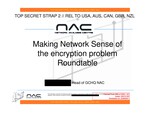
GCHQ – Making network sense of the encryption problem (2011) [pdf]
GCHQ’s Network Analysis Centre convened a 2011 roundtable on “making network sense” of encryption, pushing a metadata-first strategy to triage SSL/TLS, IKE, OpenVPN, and SSH flows, pivot from “seed” indicators, and zero in on targets and subnets worth decrypting. The playbook leans on enrichment, AS-level scoping (explicitly citing Belgacom AS6774 GRX VPNs), and “access optimisation” to collect data pre‑encryption—passively or actively.
Programs: SQUEAL · BEARDEDPIGGY · CLOUD · IRASCIBLEHARE · IRASCIBLERABBIT · IRASCIBLEMOOSE · IRASCIBLEEMITT“Operation Socialist: The Inside Story of How British Spies Hacked Belgium’s Largest Telco” - The Intercept ↗ (2014-12-13) · “Lees hier hoe de Britse geheime dienst GCHQ Belgacom aanviel” - NRC ↗ (2014-12-13) · “Britse geheime dienst bespioneerde jarenlang Belgacom-klanten” - De Standaard ↗ (2014-12-13) · Gallagher, Ryan · Modderkolk, Huib · Vanhecke, Nikolas · Eeckhaut, Mark -
OPULENT PUP Encryption Attack [pdf]
"OPULENT PUP encryption attack (GCHQ)" is a 2009 technical planning document from the British intelligence agency GCHQ. It outlines a "proof-of-concept demonstrator" for a new capability to intercept and decrypt GSM communications protected by the A5/3 algorithm, requiring a complete overhaul of the existing processing chain used for the older A5/1 standard.
Programs: OPULENTPUP -
WOLFRAMITE Encryption Attack [pdf]
The "WOLFRAMITE Encryption Attack" is a GCHQ strategic annex from March 2011 detailing a joint effort with the NSA to compromise the A5/3 encryption standard. The document outlines a specialized research and development program aimed at scaling up handset exploitation and securing funding—estimated at approximately £4 million—to prototype a functional decryption attack against modern mobile broadband security.
-
A Tough Targeting Challenge: Skype SIDtoday [pdf]
At the end of 2005, the NSA faced a serious challenge in spying on Skype calls. Compared to traditional phone calls, Skype introduces issues with target identification, collection, tracking, and decryption. “At this time, SIGINT targets have a method to freely obscure their communications on the global Internet, thus hindering our ability to collect vital communications intelligence.”
People: Berson, TomThe Intercept ↗ (2018-03-01) -
About the Virtual Private Network SIGDev Working Group... SIDtoday [pdf]
A brief description of a working group focused on monitoring and helping to exploit virtual private networks, or VPNs. Established in 2004, the working group publishes regular "VPN Target Activity Reports" on dozens of countries and organizations around the world. "These reports may help you exploit targets' VPNs more successfully," the chair of the working group writes.
The Intercept ↗ (2017-09-13) -
Apple A4/A5 Application Processors Analysis [pdf]
This document appears in a collection of presentations from a secret CIA-sponsored conference called the "Jamboree," where security researchers shared methods for exploiting vulnerabilities in consumer electronics. The presentation focused on analyzing Apple's A4 and A5 processors, which were used in iPhones and iPads, as part of broader intelligence agency efforts to extract encryption keys and find security weaknesses in Apple devices.
“The CIA Campaign to Steal Apple's Secrets” - The Intercept ↗ (2015-03-10) · Scahill, Jeremy · Begley, Josh -
AURORAGOLD – Project Overview [pdf]
A technical briefing document outlining an NSA SIGINT initiative designed to map, monitor, and forecast the evolution of global mobile networks. It details the project's infrastructure, which aggregates both unclassified commercial data and classified intelligence intercepted from international roaming agreements to identify technical trends and exploitation opportunities.
-
Black Budget: Cryptanalysis & Exploitation Services – Analysis of Target Systems [pdf]
This document is a budget justification for the NSA's Cryptanalysis & Exploitation Services project, which develops capabilities to defeat commercial encryption systems, exploit emerging communications technologies, and conduct vulnerability analysis against both foreign and domestic security products.
“The CIA Campaign to Steal Apple's Secrets” - The Intercept ↗ (2015-03-10) · Scahill, Jeremy · Begley, Josh -
CLASSIFICATION GUIDE FOR ECI PAWLEYS (PAW) [pdf]
This 2006 NSA classification guide outlines the protocols for ECI PAWLEYS (PAW). PAWLEYS is an Exceptionally Compartmented Information (ECI) category designed to protect clandestine operations—both physical (HUMINT) and digital (CNE)—specifically aimed at acquiring foreign cryptographic information and material. The document confirms that the NSA actively seeks to circumvent encryption through clandestine HUMINT and computer network access aimed at cryptographic information and material, rather than relying solely on traditional codebreaking.
Programs: PAWLEYS -
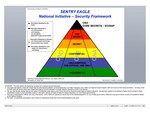
CNO Core Secrets Security Structure [pdf]
A 3-slide NSA presentation outlining the classification architecture of Sentry Eagle, a national cyber operations initiative, showing how its most sensitive components — covering network hacking, encryption sabotage, and covert industry relationships — are locked behind ECI and SAP designations accessible only to a tiny circle of government officials.
Programs: SENTRYEAGLE · SENTRYHAWK · SENTRYFALCON · SENTRYOSPREY · SENTRYRAVEN · SENTRYCONDOR · SENTRYOWL -
Crypt Discovery Joint Collaboration Activity 20 January 2011 [pdf]
A TOP SECRET NSA/GCHQ joint collaboration activity plan from January 2011 describing a research programme to understand and mitigate the threat that rising encryption adoption poses to target discovery and development — measuring encryption prevalence across SIGINT collection, assessing the impact on metadata-based targeting tradecraft, and developing new techniques for identifying targets behind encrypted traffic using a joint cloud environment fed by MUTANT BROTH, BEARDED PIGGY, KARMA POLICE, MEMORY HOLE, MARBLED GECKO, SOCIAL ANIMAL and ASDF metadata.
Marking: TOP SECRETPrograms: TICKETWINDOW · MUTANTBROTH · BEARDEDPIGGY · KARMAPOLICE · MEMORYHOLE · MARBLEDGECKO · SOCIALANIMAL · XKEYSCORE · ASDF“Prying Eyes: Inside the NSA's War on Internet Security” - Der Spiegel ↗ (2014-12-28) · “Profiled: From Radio to Porn, British Spies Track Web Users' Online Identities” - The Intercept ↗ (2015-09-25) · Appelbaum, Jacob · Gibson, Aaron · Grothoff, Christian · Müller-Maguhn, Andy · Poitras, Laura · Sontheimer, Michael · Stöcker, Christian · Gallagher, Ryan -
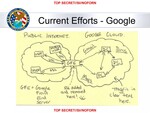
Current Efforts - Google [pdf]
The famous NSA slide from the MUSCULAR program showing where Google's encryption is stripped away — a hand-drawn diagram of Google's cloud architecture annotated with "SSL Added and removed here!" beside a smiley face, marking the exact point where NSA and GCHQ intercepted Google user data flowing unencrypted between Google's data centers.
-
DAPINO GAMMA Gemalto Yuaawaa Wiki [pdf]
This document details the identification of Yuaawaa, a secure file-sharing service sold and used by Gemalto employees, and assesses several of these employees as potential future intelligence targets. Key individuals are noted based on their roles, locations, and observed activities, such as sending PGP-encrypted files.
-
Digital Network Exploitation (DNE), Digital Network Intelligence (DNI) and Computer Network Exploitation (CNE) SIDtoday [pdf]
Explanation of the differences between Digital Network Exploitation, Digital Network Intelligence, and Computer Network Exploitation: DNE is extracting intelligence from a device on the global network; DNI is the intelligence produced by DNE; and CNE is hacking end-point devices (mentions “subtly weakening encryption”). Article acknowledges that “our targets communications are increasingly buried by millions of non-target communications.”
The Intercept ↗ (2016-08-10) -
DNE, DNI, and CNE (repost) SIDtoday [pdf]
(Repost) Explanation of the differences between Digital Network Exploitation, Digital Network Intelligence, and Computer Network Exploitation: DNE is extracting intelligence from a device on the global network; DNI is the intelligence produced by DNE; and CNE is hacking end-point devices (mentions “subtly weakening encryption”). Article acknowledges that “our targets communications are increasingly buried by millions of non-target communications.”
The Intercept ↗ (2016-08-10) -
Excerpt from Hpc Overview 1011 [pdf]
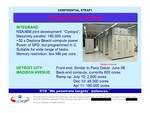
This document outlines the development of a highly advanced, massively parallel computing system, referred to as "Cyclops", a joint project between NSA and IBM. It is designed to perform complex tasks related to signals intelligence and code-breaking, with significant computing power, ramping up to 180,000 cores, and is referenced as a critical tool in penetrating target defenses.
-
Exploiting Terrorists' Passwords SIDtoday [pdf]
The SIGINT Forensics Lab discovered that computer disks seized by the government not only contain intelligence, but are also a "rich source of passwords and related information." Researchers created special tools and harvested "hundreds of thousands of occurrences of passwords," which they used to attack encrypted files.
Programs: JUMBLEDPETPeople: O'Hara, MikeThe Intercept ↗ (2016-12-07) -
FASHIONCLEFT - Interface Control Document (15 June 2009) [pdf]
This 2009 NSA Interface Control Document provides comprehensive technical specifications for FASHIONCLEFT, the protocol that acts as a covert shipping system enabling TAO malware implants to send stolen network data back to NSA collection servers with minimal computer processing requirements—using multiple encryption layers (RSA-1024 and RC6-128) to disguise the traffic as it travels across the internet while allowing NSA's Common Data Receptor to reassemble and authenticate the original intercepted packets. The document details how implants make modified copies of captured network traffic (changing destination addresses to point toward NSA instead of legitimate recipients), apply various levels of encryption or scrambling ("munging") depending on how powerful the infected computer is, attach metadata instructions explaining how to reconstruct the original packets, and use pattern-matching algorithms to ensure NSA systems can identify which stolen packets belong to which collection operation.
Programs: FASHIONCLEFT · FLAXENPRECEPT · SHELLGREY · SURPASSPIN · SEAGULLFARO · ROOTKNOT · FIGBUILD · OPTICPINCH · VINYLSEAT · OLYMPUS · UNITEDRAKE · HOGTECH · SWEEPFORWARD · CONVEY · PINWALE · TREBLECLEF · FOGYNULL · FUNNELAPS · FLASHHANDLE -
Going on TDY to Help Protect a VIP SIDtoday [pdf]
During Dick Cheney's visit to Lithuania, an NSA team working out of the US embassy unsuccessfully tries to break local cell phone networks' encryption. They do, however, find 'relevant' airport and local police communications to exploit.
People: Cheney, DickThe Intercept ↗ (2019-05-29) -
HIGHTIDE Switching Over to PKI SIDtoday [pdf]
November 20, 2004 is the when NSA's new public key infrastructure system comes to HIGHTIDE, a reporting tool that will use the new system for end-to-end encrypted email. Thanks to this new system, NSA "will have achieved an unprecedented level of information security."
The Intercept ↗ (2017-04-24)