Tag: botnets 21 documents
Search documents matching “botnets” →Free-text subjects the curators added. Unlike the other axes these are not necessarily from the documents' own vocabulary, so they are the loosest thing to browse by (and the most forgiving).
Graphs
By Banner
By Classification
Refine (combine with another filter, via search)
Sort: Title
Documents
-
2009 SigDev Conference SIDtoday [pdf]
Internal NSA document describing the annual SIGDEV conference, which includes eighty-six representatives from the wider US Intelligence Community.
-
Behavioural Science Support for JTRIG’S Effects and Online HUMINT Operations [pdf]
A top‑secret 2011 paper by psychologist Mandeep K. Dhami operationalizes behavioral science for GCHQ’s JTRIG, turning social‑psychology playbooks into a menu of cyber “effects” and online HUMINT to discredit, deceive, disrupt, and deter targets. It recommends training, profiling, measurement, and a bespoke ethics code to systematize influence operations across social platforms and covert personas.
Marking: TOP SECRETPrograms: JTRIGPeople: Dhami, Mandeep K. · Wortley, Richard · Mazerolle, Lorraine · Hall, Gordon C. Nagayama · Barongan, Christy · Mann, Ian · Maio, Gregory R. · Haddock, Geoffrey · Lewicki, Roy J. · McAllister, Daniel J. · Bies, Robert J. · Kahle, Lynn R. · Kim, Chung-Hyun · Horowitz, Leonard M. · Strack, Stephen · Hogg, Michael A. · Vaughan, Graham M. · Garcia-Retamero, Rocio · Forgas, Joseph P. · Cooper, Joel · Crano, William D. · Fiske, Susan T. · Gilbert, Daniel T. · Lindzey, Gardner · Mandel, David R. · Clow, Kenneth E. · Baack, Donald E. · Cialdini, Robert B. · Bachmann, Reinhard · Zaheer, Akbar · Adams, Barbara D. · Sartori, Jessica A. · Yun, Minwoo · Hirsch, Andrew Von · Bottoms, Anthony E. · Burney, Elizabeth · Wikstrom, P-O · Tunnell, Kenneth D. · Piquero, Alex R. · Tibbets, Stephen G. · Snook, Brent · Eastwood, Joseph · Gendreau, Paul · Goggin, Claire · Cullen, R. M. · Kavanagh, Jennifer M. · Smith, Peter B. · Bond, Michael Harris · Slovic, Paul · Knol, Anne B. · Slottje, Pauline · Sluijs, Jeroen P. van der · Savage, Leonard J. · Postmes, Tom · Spears, Russell · Sakhel, Khaled · Groot, Daphne de · Pettigrew, Thomas Fraser · Tropp, Linda R. · Newman, Graeme R. · Mischel, Walter · Miller, Michael D. · Brunner, C. Cryss · McDaniels, Timothy L. · Marcus, Aaron · Perez, Angel · Lee, Eun-Ju · Knight, Frank H. · King, Sara B. · Payne, John W. · Johnson, Eric · Hui, Pan · Buchegger, Sonja · Huffaker, David A. · Furby, Lita · Beyth-Marom, Ruth · Freilich, Joshua D. · Chermak, Steven M. · Fischhoff, Baruch · Lichtenstein, Sarah · Derby, Steven L. · Keeney, Ralph · Felson, Marcus · Clarke, Ronald V. · Wallsten, Thomas S. · Crandall, David · Cosley, Dan · Huttenlocher, Daniel · Kleinberg, Jon · Suri, Siddharth · Carroll, John · Weaver, Frances · Becker, Gary S.“Britain Used Spy Team to Shape Latin American Public Opinion on Falklands” - The Intercept ↗ (2015-04-02) · “Controversial GCHQ Unit Engaged in Domestic Law Enforcement, Online Propaganda, Psychology Research” - The Intercept ↗ (2015-06-22) · “#EspiadosPorLosIngleses: los nuevos documentos de Snowden revelan un plan de espionaje de Gran Bretaña en Argentina por Malvinas” - Todo Noticias ↗ (2015-04-02) · Fishman, Andrew · Greenwald, Glenn -
CSEC Cyber Threat Capabilities [pdf]
This document details CSEC’s full-spectrum cyber operations architecture, integrating SIGINT and IT Security to conduct both defensive and offensive activities under the guise of “information superiority.” While early sections emphasize detection, anomaly analysis, and collaboration with Five Eyes partners, later portions reveal active measures including network infiltration (implant deployment), command-and-control tracking, traffic manipulation and redirection, DNS interference, and potential disruption or deception operations—illustrating CSEC’s capacity not only to defend Canadian networks but also to surveil, exploit, and influence foreign and domestic digital infrastructure.
Programs: EONBLUE · CYBERDMZ · SEEDSPHERE · PHOTONICPRISM · SPECIALSOURCE · SUPERDRAKE · DARKSPACE · QUANTUM · MANDATE · STREAMING SENTRY · SSO · TKB · COVENANT -
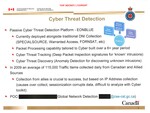
CSEC Cyber Threat Detection [pdf]
This document details the Communications Security Establishment’s (CSEC) cyber threat detection and intelligence infrastructure, including systems like EONBLUE, CROSSBOW, CRUCIBLE, and LODESTONE, which enable passive monitoring, anomaly detection, and botnet identification through metadata and deep packet inspection. It outlines how CSEC integrates SIGINT, cryptanalysis, and network forensics to detect and mitigate cyber intrusions using both SIGINT and domestic sensors, while collaborating with Five Eyes partners to enhance Canada’s cyber defense and situational awareness. The presentation is duplicated from page 7 onwards - one of the duplicated slide has internal CSE comments.
Programs: EONBLUE · SPECIALSOURCE · WARRANTEDACCESS · COVENANT · SEEDSPHERE · DIESELRATTLE · SIENNABLUE · DOWNGRADE · CROSSBOW · CRUCIBLE · LODESTONE -
-
DEFIANTWARRIOR and the NSA's Use of Bots [pdf]
This TOP SECRET NSA presentation from 2010 documents the DEFIANTWARRIOR effort to identify, seize, and operate botnets using SIGINT-enabled infrastructure, detailing both early failures and subsequent operational successes. The document reveals how bot herding was integrated into broader offensive cyber and intelligence collection strategies across the Five Eyes.
Programs: DEFIANTWARRIOR · OLYMPUS · UNITEDRAKE · TURBULENCE · QUANTUMBOT · TURMOIL · TURBINE · SNIPERS · XKEYSCORE · INCENSER · STELLABLUE · SMOKYSINK · STOVEPIPES · ISLANDTRANSPORT · FESTIVEWRAPPER · FREEFLOW · PRESSUREWAVE · HANGARSURPLUS · SURPLUSHANGER · WAITAUTO · DEEPFRIEDPIG · SEAGULLFARO · COLOSSUS · STORMPIG · YELLPIG · PASTEPIG · SHOUTPIG · ZORPIG · MAILORDER · TREASUREMAP · MARINA · WARNVOLCANO · STRAITBIZARRE · BOTINSTANCES · PUZZLECUBE · SEEKER · SURPLUSHANGAR -
Discovery SIGINT Targeting Scenarios and Compliance [pdf]
This document is a top-secret NSA guidance manual detailing SIGINT targeting scenarios, compliance procedures, and legal guidance for querying foreign actors, malware, and potentially U.S.-linked systems, including considerations for minimizing incidental collection of U.S. persons’ communications. It outlines specific rules, approvals, and exceptions for using SIGINT tools, foreign intelligence tasks, and cases involving ambiguous or dual-use selectors like WikiLeaks, The Pirate Bay, and foreign actors operating through U.S. infrastructure.
-
Getting Close to the Adversary – Forward-based Defense with QFIRE (June 3, 2011) [pdf]
This document describes the QFIRE project which is designed to give the NSA a global, low-latency platform for “forward-based defense”, enabling real-time detection and manipulation of Internet traffic close to its source. By co-locating passive sensors (TURMOIL), decision logic (TURBINE), and injection capabilities, QFIRE can rapidly reset connections, redirect targets for exploitation, inject malicious payloads, and even seize control of botnets. It operates as part of the broader QUANTUMTHEORY architecture, leveraging both cooperative and non-cooperative infrastructure worldwide to enable CNE/CND/CNA effects with minimal delay.
Programs: QFIRE · QUANTUMTHEORY · TURBULENCE · TURMOIL · TURBINE · TUTELAGE · QUANTUM · QUANTUMSKY · QUANTUMINSERT · QUANTUMBOT · QUANTUMCOPPER · STRAIGHTBIZARRE · BLINDDATE · TUMULT · ISLANDTRANSPORT · SURPLUSHANGAR · MIDDLEMAN · SCSnet · WEALTHYCLUSTER · SSO -
Hackers are Humans too - Cyber leads to CI leads [pdf]
This document from Canada’s Communications Security Establishment (CSE) analyzes the Russian hacking team MAKERSMARK, highlighting how its operators misused technically sophisticated but poorly secured infrastructure, mixing personal and operational activity, which made them traceable despite their advanced tools. It details CSE’s methods for attributing cyber intrusions, monitoring malware-infected systems, and exploiting operational security lapses to gain intelligence on Russian cyber operations.
-
HIDDENSALAMANDER - Alerting and Characterization of Botnet Activity in TURMOIL [pdf]
This NSA briefing describes HIDDENSALAMANDER, a TURMOIL component that detects, tracks, and characterizes botnet command-and-control traffic on passive collection sensors worldwide, generating enriched metadata about bot herders, infected machines, attack commands, and malware families while providing low-latency defensive alerts when botnet activity involves high-value targets or protected networks. The system extends beyond traditional signature matching by decrypting Zeus RC4-encrypted traffic, extracting payload details like target IPs and DDoS commands, tracking C2 servers across multiple sessions, and categorizing botnet lifecycle stages (configuration, infection, reconnaissance, C&C communication, attack, exfiltration) to support both offensive attribution and defensive response.
Programs: HIDDENSALAMANDER · TURMOIL · CLOUDSHIELD · NETEZZA · TUTELAGE · GMPLACE · RONIN · CYBERCLOUD · MARINA · GHOSTMACHINE · QBOT · ASDF · MARIPOSA · XKEYSCORE · GOGADGET · TURQI · TRAFFICTHIEF · FALLOUT · POUNDSAND · BLUESMOKE · AEG · TURNABOUT · QUANTUMBOT -
HIMR Data Mining Research Problem Book [pdf]
This document is a research roadmap created by GCHQ for the Heilbronn Institute for Mathematical Research (HIMR). Its purpose is to guide long-term mathematical and data-mining research that could improve signals intelligence (SIGINT) capabilities. It outlines key research problems, datasets, and collaboration plans between intelligence agencies and academic researchers. The main goal is to develop new algorithms and mathematical tools to analyze extremely large communications datasets produced by modern surveillance systems.
Programs: CLOUD · DISTILLERY · DISCOVER · PRESTON · LECKWITH · TERRAIN · BROADOAK · NGE · FIVEALIVE · CHARTBREAKER · FIRSTCONTACT · GEOFUSION · RADONSHARPEN-B · PRIMETIME · HIDDENOTTER · BAKERSDOZEN · CLASP · SALTYOTTER · BIRCH · SOLIDINK · FLUIDINK · MAMBA · GRINNINGROACH · PIRATECAREBEAR · AUTOASSOC · CROUCHINGSQUIRREL · HRMAP · KACHINA · SQUEAL · QUESTA · METEORSHOWER · SUNSTORM · GOLDMINE · HAGERAWEL · WOODY · BUZZ · SILVERLIBRARY · SILVERLINING · VALHALLA · MOUNTMCKINLEY · SEPANG · BLACKHOLE · SALAMANCA · HAGELAWEL · LUCKYSTRIKE · SPIKYROCK · MYOFIBRIL · INJUNCTION · PSYCHICSALMON · RAGINGBULLFROG · ROBOTICFISH · TIMIDTOAD · AURA · CARBONCOPY · CASK · CHORDAL · CRAN · INSTINCT · MADFORGE · SWAMP · VOLSUNGA · WHITERAVEN · MVR · PPF · JTRIG · MAPREDUCE · MAILORDERPeople: Tukey, John -
ICTR Cloud Efforts [pdf]
A GCHQ presentation details how the agency developed cloud-based big data analytics to achieve "population scale" surveillance—processing trillions of internet events to build geographic and behavioral profiles on every online identifier worldwide, enabling discovery of unknown targets through pattern analysis rather than traditional keyword searches.
Programs: EVERYASSOC · PROBABILITYCLOUD · SILVERLINING · CULTWEAVE · KARMAPOLICE · EVERYPOLICE · AWKWARDTURTLE · GORDIANKNOT · SANDIA · BLOODHOUND · FIVEALIVE · NGE · MAPREDUCE -
Introduction to Context Sensitive Scanning with X-KEYSCORE Fingerprints [pdf]
This May 2010 NSA training document introduces XKEYSCORE's context-sensitive scanning capabilities using "fingerprints"—customizable detection rules that allow analysts to surgically target specific types of Internet traffic without needing prior knowledge of email addresses or other strong selectors, using over 70 unique contexts to identify patterns in communications and behaviors.
-
OSINT FUSION PROJECT [pdf]
A TOP SECRET//COMINT//REL TO USA, FVEY presentation by Lockheed Martin's Intelligence and Global Solutions division describing the OSINT Fusion Project — a programme to collect and weaponise open source intelligence from hacker forums, malicious email traffic, botnet data and commercial threat feeds to generate XKEYSCORE fingerprints for CNE targeting and fourth party collection.
-
QUANTUMTHEORY (2010 SIGINT Development Conference) [pdf]
This 2010 NSA presentation reveals QUANTUMTHEORY, a suite of "man-on-the-side" network attack technologies that enable real-time injection and manipulation of TCP/IP connections through passive surveillance infrastructure. The system encompasses multiple specialized attack techniques including HTML redirection, DNS hijacking, botnet takeover, and database injection, deployed at Five Eyes surveillance sites worldwide.
Programs: QUANTUMTHEORY · TRAFFICTHIEF · TURMOIL · TURBINE · QUANTUM · NINJANIC · ISLANDTRANSPORT · SURPLUSHANGER · DAREDEVIL · STRAIGHTBIZARRE · QUANTUMINSERT · QUANTUMSKY · QUANTUMBOT · QUANTUMBISCUIT · QUANTUMDNS · QUANTUMBOT2 · QUANTUMCOPPER · QUANTUMMUSH · HUFFMUSH · QUANTUMSPIM · QUANTUMSQUEEL · QUANTUMSQUIRREL · INCENSOR · SMOKEYSINK · SARATOGA · QUANTUMDEFENSE · TURBULENCE“How the NSA Plans to Infect ‘Millions’ of Computers with Malware” - The Intercept ↗ (2014-03-12) · “The Digital Arms Race: NSA Preps America for Future Battle” - Der Spiegel ↗ (2015-01-17) · Gallagher, Ryan · Greenwald, Glenn · Appelbaum, Jacob · Gibson, Aaron · Guarnieri, Claudio · Müller-Maguhn, Andy · Poitras, Laura · Rosenbach, Marcel · Ryge, Leif · Schmundt, Hilmar · Sontheimer, Michael -
SEBACIUM - GCWiki [pdf]
This GCWiki document outlines SEBACIUM, a suite of tools developed for monitoring and exploiting peer-to-peer (P2P) networks, particularly eMule and BitTorrent, to track and target users sharing or downloading specific content, such as extremist material, for intelligence and operational purposes. It also details various tools within the system, including DIRTY RAT for tracking file-sharing activities and PLAGUE RAT for altering search results in P2P networks.
-
Special Collection Service – Pacific SIGDEV Conference March 2011 – Supply Chain Excepts [pdf]
This top-secret 2011 NSA presentation outlines how the Special Collection Service—a joint NSA–CIA program operating from U.S. embassies—leverages its global network of “points of presence” to conduct human-enabled SIGINT and cyber operations directly inside “adversary space.” Framed as a “home field advantage,” it portrays U.S. diplomatic sites as launchpads for infiltration, surveillance, and even supply chain attacks, blurring the line between diplomacy and digital espionage.
-
Tailored Access Operations, FOXACID, QUANTUM [pdf]
These NSA presentation slides detail "QUANTUM," a sophisticated system that allows the agency to intercept internet traffic and inject malware onto target computers with up to 80% success rates, far exceeding traditional spam-based methods. The system works by monitoring internet traffic for specific identifiers (like Yahoo or Facebook cookies), then racing to inject malicious code before legitimate web servers can respond, thereby compromising targets' computers without their knowledge and establishing persistent backdoor access.
Programs: FOXACID · QUANTUM · QUANTUMTHEORY · QUANTUMBISCUIT · VALIDATOR · OLYMPUS · UNITEDRAKE · OLYMPUSFIRE · SSO · FORESTPLACE -
TUTELAGE 411 [pdf]
TUTELAGE is a SIGINT-driven cyber defense and counterintelligence platform that enables NSA to observe, intercept, redirect, block, and manipulate adversary network activity at DoD gateways, transforming intrusion response from post-incident reporting into real-time mitigation and intelligence generation.
Programs: TUTELAGE · CYBERQUEST · XKEYSCORE · GNOMEVISION · POPQUIZ · BISHOPKNIGHT · BLACKENERGY · BLINDMARKSMEN · BYZANTINEFOOTHOLD · BYZANTINEVIKING · CARBONPEPTIDE · CONFICKER · DANCING PANDA · DISCOVERY · GNOMEFISHER · MAKERSMARK · MAVERICKCHURCH · NATIVEDANCER · WEASELWAGGLE · SUBTLESNOW · WIDOWKEY · ZEUS · GHOSTMACHINE · PANDORASMAYHEM · TURBINE · QUANTUM · BYZANTINEHADES · AMULETSTELLAR · TURNABOUT -
Writing XKS Fingerprints [pdf]
This internal NSA training manual serves as a technical guide for analysts using the X-KEYSCORE (XKS) system. It provides a comprehensive breakdown of how to write, name, and test "fingerprints"—the specific code signatures used to identify, tag, and categorize various types of internet traffic across the agency's global collection points. The manual transitions from basic naming conventions to advanced Boolean logic and context-sensitive scanning, illustrating how the NSA automates the discovery of high-value targets, such as those using specific encryption tools or those involved in weapons procurement.