Tag: FISA 44 documents
Search documents matching “FISA” →Free-text subjects the curators added. Unlike the other axes these are not necessarily from the documents' own vocabulary, so they are the loosest thing to browse by (and the most forgiving).
Graphs
By Banner
By Classification
Refine (combine with another filter, via search)
Sort: Title
Documents
-
FAA702 Glossary - Section 702 of the Fisa Amendments Act (FAA) [pdf]
This document outlines NSA rules under Section 702 of the FISA Amendments Act, which prohibit directly targeting U.S. persons or individuals inside the U.S., but quietly note a 2011 rule change allowing analysts to use U.S. person identifiers to query data already collected under 702—pending internal oversight. This effectively establishes a “backdoor search” capability enabling warrantless searches of Americans’ communications stored in NSA databases. Section 702 also gives the NSA authority to target without warrant the communications of foreign targets.
-
FISA Amendments Act Certifications and Operations [pdf]
This document exposes how, after the FISA Court found flaws in NSA’s upstream surveillance in 2011, the agency pushed through new certifications on schedule the following year and quietly used taxpayer money to cover millions in compliance costs for PRISM companies like Google and Yahoo. Rather than scaling back unconstitutional collection, the NSA treated the ruling as a logistical hurdle to manage with corporate partners, underscoring its deep financial and operational entanglement with major tech firms. Check also the document "FAA Certification Renewals with Caveats"
Programs: PRISM -
FISA Amendments Act of 2008 Section 702 summary document [pdf]
This document summarizes the way the law works and describes the three types of certifications used to permit the surveillance, as well as targeting and minimization procedures. The three certification are for foreign governments, counterterrorism and WMD/proliferation.
-
FISA dataflow [pdf]
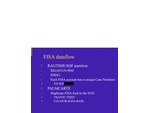
This document describes the technical SIGINT architecture for FISA data processing, specifically detailing how the RAGTIME/SQF partition and PALMCARTE system utilize unique case notations and metadata tools to route and track intercepted communications.
-
FISA judge's order authorizing surveillance of foreign governments and organizations [pdf]
With this order dated Aug. 19, 2010, John D. Bates, then-Chief Judge of the Foreign Intelligence Surveillance Court, approved an annual certification permitting the National Security Agency to conduct surveillance about 193 foreign governments, foreign factions, foreign-based political organizations and foreign entities such as the World Bank. Each year, a new certification must be approved by the court to permit such surveillance under Section 702 of the FISA Amendments Act.
Marking: SECRETPeople: Bates, John D. -
FISA recap [pdf]
This document is a Top Secret NSA "FISA Recap" spreadsheet detailing electronic surveillance conducted between 2005 and 2008. It tracks specific email accounts targeted under the Foreign Intelligence Surveillance Act, listing the responsible agencies (NSA, FBI, and CIA), their legal "Case Notation," and the duration of collection. Notably, the log includes prominent U.S. Persons and organizations, such as the Council on American-Islamic Relations (CAIR), and features a 2005 formatting guide that uses a racial slur as a placeholder for a target's identity.
Programs: SQF -
N.S.A. Memo Expands Access to FISA Information [pdf]
In 2006, the National Security Agency sought to expand access to Foreign Intelligence Surveillance Act information — previously limited to its headquarters in Fort Meade, Md. — to its code-breakers in Georgia, Texas and Hawaii. Part of the deliberations focused on a problem that raised the possibility that the agency had violated rules the surveillance court established for handling the information.
-
Re: Ehsanul Sadequee FISA Request [pdf]
This NSA email chain from April 2006 shows NSA analysts urgently requesting FBI FISA authorization documents for Ehsanul Sadequee so they could conduct a "TAO operation" (Tailored Access Operations hack) to retrieve a file he had shared, racing against the FBI's impending arrest which would invalidate their surveillance authority. The emails reveal the NSA's dependence on FBI-obtained FISA warrants to justify their operations and their need to complete the hack before Sadequee's arrest made their authorization "invalid."
Programs: CADENCEPeople: Sadequee, Ehsanul Islam -
SID concur: SSO's Support to the FBI for Implementation of their Cyber FISA Orders (CATS 2012-704) [pdf]
A 2012 NSA staff processing form (CATS 2012-704) with a four-page SSO memo, concurred by the SIGINT Director on 27 March 2012. SSO would give the FBI technical help implementing FISC cyber orders (docket 11-91, which the FBI calls STYGIAN FLOW), using NSA collection and processing infrastructure (LITHIUM, ARTIFICE, TURMOIL), with the FBI responsible for the costs and for legal compliance.
People: Shea, Teresa H. -
Analyzing Mobile/Cellular DNI in XKEYSCORE, May 2009 [pdf]
The XKEYSCORE document explains how the agency analyzes mobile/cellular device internet usage by collecting and processing both converged DNI/DNR data within cellular networks and traditional internet traffic, using various tools and indicators to identify mobile users even when their device type isn't immediately evident. The document demonstrates how the system can track mobile internet activity across applications like Yahoo Mail and identifies devices through various technical "hints" including MSISDN codes, browser fingerprints, and user agent strings.
-
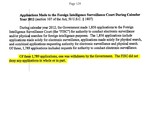
Applications Made to the Foreign Intelligence Surveillance Court During Calendar Year 2012 [pdf]
The statutory report on applications to the Foreign Intelligence Surveillance Court in calendar year 2012: 1,856 applications, 1,789 of them seeking electronic surveillance, one withdrawn by the government and none denied in whole or in part.
-
Ashcroft Memo on Intelligence Sharing Procedures [pdf]
In August 2002, citing a recent surveillance court ruling, then-Attorney General John Ashcroft issued new procedures that lowered safeguards on providing to foreign governments information about Americans that was deemed relevant intelligence about terrorism issues. Under procedures disclosed in a 1984 report on the Foreign Intelligence Surveillance Act, the attorney general had to approve any international dissemination; the new procedures have allowed the National Security Agency to share such information without Justice Department clearance.
People: Ashcroft, John -
BLARNEY Exploits the Social Network via Expanded Facebook Collection [pdf]
An SSO highlight of 14 March 2011 announcing substantially expanded Facebook collection under FISA and FAA authorities — chat, private messages, profile information, subscriber videos and geolocation from IP addresses — built with the FBI over six months, with PRINTAURA writing the new software.
-
BLARNEY program overview [pdf]
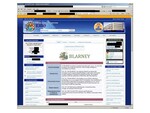
The document is an NSA Special Source Operations (SSO) portal page screenshot for the BLARNEY program, describing it as a top-secret collection initiative established in the 1970s that leverages government and commercial partnerships to intercept foreign intelligence under FISA authority. It highlights BLARNEY’s major intelligence value—contributing heavily to counterterrorism reporting and the President’s Daily Brief—and lists its primary targets as diplomatic, economic, foreign government, and counterterrorism communications.
-
BLARNEY Team Provides Outstanding Support to Enable UN Security Council Collection [pdf]
An SSO item describing how the BLARNEY team, NSA lawyers and the FBI obtained four FISA court orders in days — for Gabon, Uganda, Nigeria and Bosnia — after Ambassador Susan Rice asked for SIGINT on undecided countries ahead of the June 2010 UN Security Council vote on sanctions against Iran.
Programs: BLARNEYPeople: Rice, Susan -
CNE Presence in CT10 Status Report [pdf]
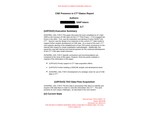
A TOP SECRET NSA status report from April 2008 describing how a counterterrorism analysis team began importing data from the agency's hacking operations into their tracking system — specifically logs from FOXACID, an NSA tool that infects targets' computers mainly through their web browsers — enabling real-time alerts when new targets were successfully hacked, with plans to expand into tracking four named surveillance implants (VALIDATOR, UNITEDRAKE, OLYMPUS and STRAITBIZARRE) as they phone home to NSA servers for instructions and stolen data.
-
DNI, attorney general certify surveillance targets 'reasonably believed' to be outside U.S. [pdf]
In this document, the director of national intelligence and the attorney general certify that there are procedures in place to ensure that surveillance conducted under Section 702 of the FISA Amendments Act will be limited to targeting people "reasonably believed to be located outside the United States." They state that the foreign intelligence to be collected "concerns foreign powers" as defined by statute. The list of foreign powers is in Exhibit F.
-
FAA Certification Renewals with Caveats [pdf]
This NSA document shows that after the FISA Court found NSA’s upstream internet collection unconstitutional and illegal, the agency’s response was less about reform and more about finding technical and procedural workarounds to keep surveillance running as usual. While the court ordered changes within 30 days, NSA officials planned to sequester and filter “higher-risk” data to appease the judge—not halt collection—revealing a mindset focused on preserving operations rather than addressing legal violations.
-
FAA702 comms memo [pdf]
This document details NSA's response to concerns raised by the FISA Court over the collection of non-targeted data in FAA-702 upstream collection. To mitigate the risk of continued acquisition, NSA is implementing temporary measures, including cautionary banners and updated processes, to prevent misuse of data that may not be directly related to tasked selectors.
People: Shea, Teresa H. -
How the NSA verifies a target's location [pdf]
This is an excerpt from a transcript of National Security Agency training videos that describe how to verify the location of a targeted device. It explains how the NSA monitors different types of mobile signaling information known as HLR and VLR registrations in order to locate individuals. It also makes clear that the agency is able to use location tracking to ascertain whether a target is in the United States.