Tag: Al-Qaeda 78 documents
Search documents matching “Al-Qaeda” →Free-text subjects the curators added. Unlike the other axes these are not necessarily from the documents' own vocabulary, so they are the loosest thing to browse by (and the most forgiving).
Graphs
By Banner
By Classification
Refine (combine with another filter, via search)
Sort: Title
Documents
-
NSA posture on Syria [pdf]
This document outlines the NSA’s intelligence assessment and operational posture regarding the Syrian civil war in 2013, emphasizing ongoing SIGINT cooperation with GCHQ to monitor both the Syrian government and its military and opposition forces. It highlights limited insight into communications, stronger access to opposition networks, and joint U.S.–U.K. efforts—particularly from GCHQ sites like Digby and Mt. Troodos—to track regional instability and chemical weapons security.
-
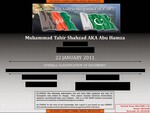
NSA target package [pdf]
This 2011 target package focuses on Muhammad Tahir Shahzad (alias Abu Hamza), a Pakistan-based bomb builder and Al-Qaeda facilitator. The document was produced by the Counter IED Analysis Integration Cell (CAIC) at the NSA. Notably, the document credits the tracking of Shahzad’s 60+ digital selectors with the eventual capture of high-value targets, including himself and Bali bombing suspect Umar Patek. The accompanying Washington Post investigation uses this specific case to highlight the massive scale of "incidental collection." While Shahzad was a valid foreign target under Section 702 of the FISA Amendments Act (FAA), the investigation revealed that for every legitimate target like him, the NSA intercepted nine "non-targeted" users—many of whom were Americans—capturing deeply personal photos, medical records, and private correspondence.
-
NSA Tipper Alerts Allies to Terrorist Threat SIDtoday [pdf]
NSA tipped off Norway to an al Qaeda threat to the Norwegian Embassy in Cairo, Egypt, on January 6, 2004. NSA SIGINT was Norway's only source of this threat information.
The Intercept ↗ (2016-12-07) -
NSA's damage assessment on NYTimes 2005 article [pdf]
This internal NSA memorandum from December 2005 documents the agency's immediate response to the New York Times exposé "Bush Lets U.S. Spy on Callers Without Courts." It confirms that the article revealed classified National Security Information regarding warrantless domestic surveillance and recommends a Department of Justice investigation into the unauthorized disclosure.
Programs: STELLARWINDPeople: Cerlenko, Ariane E. · Rice, Condoleezza · Hayden, Michael · bin Laden, Osama · Bush, George W. · Faris, Iyman · Risen, James · Lichtblau, Eric · Rockefeller, Jay · Zubaydah, Abu · Cheney, Dick · Tenet, George J. · Kerry, John · Kollar-Kotelly, Colleen · Yoo, John · Mikulski, Barbara A. · Gonzales, Alberto R. · Mueller, Robert S. · Walsh, Barclay -
NSA, Ethiopians Take SIGINT Partnership to New Level SIDtoday [pdf]
At a May 2006 planning conference between NSA and the Ethiopian partner it was decided to “take the partnership to a new level” and expand the mission beyond HF voice communications to conduct a high-powered cordless phone (HPCP) survey near the Somalia border.
Programs: LION'S PRIDE“How the NSA Built a Secret Surveillance Network for Ethiopia” - The Intercept ↗ (2017-09-13) · The Intercept ↗ (2019-05-29) · Turse, Nick -
Open Source Signals Analysis: Not Your Grandfather's SIGINT! SIDtoday [pdf]
Using a combination of expert analysis and voice recognition tools that were developed by the Massachusetts Institute of Technology, the NSA was able to confirm that a set of publicly released recordings, ostensibly made by Iraq-based Al Qaeda figure Abu Musab al-Zarqawi, were indeed in al-Zarqawi's voice.
-
Pattern and Social Network Analysis SIDtoday [pdf]
Article describes social network analysis (who actually communicates with whom, which may be different from formal hierarchies) and pattern analysis (looking at patterns of behavior to find unknown targets). It says conventional wisdom that terrorists operate in isolated cells was wrong in the case of Abu Zubaida and claims most of the 9/11 hijackers were not known to the intelligence community.
Programs: FOLLOWTHEPEOPLEPeople: Zubaydah, AbuThe Intercept ↗ (2016-08-10) -
Public Enemy No. 1 Speaks! SIDtoday [pdf]
A new Osama bin Laden audio broadcast by Al Jazeera was run through various voice analysis software and showed a perfect match. One of pieces of software used was known as the “Speaker Watchlist Tool.”
The Intercept ↗ (2018-08-15) -
QUANTUMTHEORY CT Successes [pdf]
This document details a successful NSA counterterrorism cyber operation in which analysts used QUANTUM techniques to deploy the UNITEDRAKE implant—equipped with keylogging and USB collection tools—against Al-Qaeda coordinator Muhsin al-Fadhli in Iran, even after detecting Kaspersky antivirus software on the target system. The operation yielded significant intelligence on Al-Qaeda communications, document forgery activities, and associated operatives.
Programs: QUANTUMTHEORY · ANCIENTBREW · VALIDATOR · QUANTUM · QUANTUMCOWBOY · UNITEDRAKE · GROK · SALVAGERABBITPeople: al-Fadhli, Muhsin -
Re: Ehsanul Sadequee FISA Request [pdf]
This NSA email chain from April 2006 shows NSA analysts urgently requesting FBI FISA authorization documents for Ehsanul Sadequee so they could conduct a "TAO operation" (Tailored Access Operations hack) to retrieve a file he had shared, racing against the FBI's impending arrest which would invalidate their surveillance authority. The emails reveal the NSA's dependence on FBI-obtained FISA warrants to justify their operations and their need to complete the hack before Sadequee's arrest made their authorization "invalid."
Programs: CADENCEPeople: Sadequee, Ehsanul Islam -
Reflections from an American in Paris SIDtoday [pdf]
The SIGINT liaison officer in the U.S. Embassy in Paris reflects on a four-year assignment there with a simple: “Folks, it truly doesn't get any better than this.” Arriving a the job a few days before the 9/11 attacks, the officer describes how the station jumped into action, including by continuing an investigation of an Al Qaeda cell that was reportedly planning to blow up the embassy.
The Intercept ↗ (2018-03-01) -
Regional Command Southwest Intelligence Report June 23 2011 [pdf]
A June 2011 RC Southwest intelligence summary documenting a covert ALP-Taliban collusion arrangement in Nad'Ali district, and a separate intelligence report detailing Taliban internal supply shortages, infighting, and morale deterioration across northern Helmand Province in the aftermath of Osama bin Laden's death.
-
SIGDEV Conference 2012 - Making Things Measureable: Technology Trending Challenges and Approaches [pdf]
An NSA presentation from the 2012 SIGDEV Conference describing NSA's technology trending methodology — a framework for identifying which encryption and communications technologies targets are adopting, measuring the SIGINT risk they pose, and prioritising capabilities development responses — notable for containing the risk matrix that was later cited in Der Spiegel's December 2014 encryption investigation showing NSA's difficulty levels against specific technologies including Tor, TrueCrypt, OTR and ZRTP.
Programs: XKEYSCORE · SEEKER · BIONICTURTLE · JEMA · JOLLYROGER · MARINA · TUNINGFORK · STARPROC · MICROEXPANSE · ECHOBASE · PRISM · GMHALO · UTT · TKB · LAE · FAMT · WPMO · AMOD · FORTREND · GAMBIT · DATAEXPLORER · MYNOC -
SIGINT Contribution to Operation CREVICE SIDtoday [pdf]
NSA SIGINT contributed intelligence that was key to thwarting an al Qaeda-linked attack in the U.K. in March 2004.
The Intercept ↗ (2016-12-07) -
SIGINT Forensics: A Look Inside Terrorists' Computers SIDtoday [pdf]
The SIGINT Forensics Lab was established in September 2001. It analyzes information from seized target computers to provide leads to NSA and pass along to other agencies. It is also able to exploit encryption and steganography found on the target computers.
People: Merritt, AdeleThe Intercept ↗ (2016-08-10) -
SIGINT Forensics: A Look Inside Terrorists' Computers (repost) SIDtoday [pdf]
(Repost) The SIGINT Forensics Lab was established in September 2001. It analyzes information from seized target computers to provide leads to NSA and pass along to other agencies. It is also able to exploit encryption and steganography found on the target computers.
People: Merritt, AdeleThe Intercept ↗ (2016-08-10) -
SIGINT Leads to Capture of al-Qa'ida Terrorist SIDtoday [pdf]
The CIA passed on kudos to SID for a key role in capture of Al Qaeda operative Umar Baziyani in Iraq. SIGINT elements helped geolocate the terrorist, who was using internet cafes in Baghdad.
Programs: KEYSCOREThe Intercept ↗ (2017-04-24) -
SIGINT Mission Strategic Plan FY2008-2013 [pdf]
This five-year mission plan for the National Security Agency shows how the agency’s leaders view its mission and culture.
-
SIGINT Obtains Details of Usama bin Laden Message to Top al-Qa'ida Leader in Iraq SIDtoday [pdf]
A 2007 NSA SIDtoday article describing how SIGINT analysts intercepted and decoded a message from Osama bin Laden to al-Qaeda's leader in Iraq, revealing bin Laden's strategic thinking on the Iraq war, his anger toward the UAE, and the communications pathway used by senior al-Qaeda figures between Pakistan, Iran, and Iraq.
Programs: SCQAWK -
SIGINT Year in Review, November 2011 SIDtoday [pdf]
A 2011 year-in-review message from NSA SIGINT Director Teresa Shea summarizing the directorate's major operational and capability accomplishments over the past year, including SIGINT contributions to the killing of Osama bin Laden, operations against Anwar al-Awlaki and other al-Qaeda figures, and support for military campaigns and crises across the Middle East.
Programs: SCQAWK