Tag: Al-Qaeda 78 documents
Search documents matching “Al-Qaeda” →Free-text subjects the curators added. Unlike the other axes these are not necessarily from the documents' own vocabulary, so they are the loosest thing to browse by (and the most forgiving).
Graphs
By Banner
By Classification
Refine (combine with another filter, via search)
Sort: Title
Documents
-
SIGINTers Become Mock Terrorists SIDtoday [pdf]
An Intelligence Analysis intern goes to a mock terrorist training camp in North Carolina where he is indoctrinated into mock al Qaeda, rises early for Islamic prayer, and fires live ammunition out of an AK-47 while conducting mock assassinations and village raids. He calls the Blackwater facility a "good start to my career at NSA."
The Intercept ↗ (2018-08-15) -
SINIO Strategic Intelligence Seminar: Terrorism in Southeast Asia SIDtoday [pdf]
Announcement of a “Terrorism in Southeast Asia” seminar about Jemaah Islamiyah and terrorist groups in the Philippines.
Marking: CONFIDENTIALThe Intercept ↗ (2016-05-16) -
SKYNET: Courier Detection via Machine Learning [pdf]
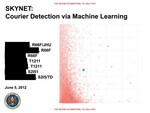
A June 2012 NSA research presentation detailing the machine learning methodology behind SKYNET's courier detection system, which applies a Random Forest classifier to 55 million Pakistani phone records to identify individuals exhibiting courier-like behavioral patterns — with one of the highest-scoring results being Ahmed Zaidan, Al Jazeera journalist flagged as a suspected al-Qaeda courier.
People: Zaidan, Ahmad Muaffaq -
Sunni Extremists and Short Message Service (SMS) SIDtoday [pdf]
Islamic extremists are increasingly using SMS messaging. This document details counterterrorism SIGINT development efforts to target and collect SMS traffic.
Programs: SODThe Intercept ↗ (2016-08-10) -
Targeted Killing: Policy, Legal and Ethical Controversy [pdf]
Intellipedia article surveying the policy, legal, and ethical controversy surrounding targeted killing, drone strikes, and related counterterrorism practices by the US, Israel, and NATO, outlining the international and domestic legal justifications offered by officials alongside the growing opposition from human rights groups, the UN, the ACLU, and international law experts. It catalogs key legal cases, government defenses, and debates—from the Awlaki lawsuits and the bin Ladin raid to challenges against CIA and British intelligence personnel—while noting related controversies over surveillance, detention, and interrogation.
People: Shehada, Salah · Sharon, Ariel · Alston, Phillip · Panetta, Leon · Koh, Harold · Leiter, Michael · Obama, Barack · Holder, Eric · Romero, Anthony D. · al-Awlaki, Anwar · Gates, Robert M. · Bates, John · Khan, Samir · Gaddafi, Aisha · Gaddafi, Muammar · Brossollet, Luc · Gaddafi, Saif al-Arab · Mastoura · Seif · Carthage · Heyns, Christof · Scheinin, Martin · Bouchard, Charles · Fox, Liam · Rizzo, John · Stafford Smith, Clive · Sadaullah · Khan, Kareem · Khan, Noor · Moses, Alan · Calderon · Eichensehr, Kristen · Melzer, Nils · bin Laden, Osama -
Targeting Rationale (TAR) [pdf]
An NSA document describing how analysts should explain their targeting decisions under the FISA Amendments Act.
-
The 'Regruntlement' of a SIGINT Collector SIDtoday [pdf]
A jaded veteran signals intelligence collection officer found himself reinvigorated after a 17-month tour at the National Security Operations Center, where he was assigned to a Navy unit and served on duty during many key events in the war on terror, including the first night of the U.S. invasion of Iraq.
The Intercept ↗ (2017-09-13) -
The 'Regruntlement' of a SIGINT Collector (repost) SIDtoday [pdf]
(Repost) A jaded veteran signals intelligence collection officer found himself reinvigorated after a 17-month tour at the National Security Operations Center, where he was assigned to a Navy unit and served on duty during many key events in the war on terror, including the first night of the U.S. invasion of Iraq.
The Intercept ↗ (2017-09-13) -
The March 11 Train Bombings in Madrid -- Two Years Later SIDtoday [pdf]
An update on the trial following the 2004 Madrid train bombings. The attack was aimed at influencing Spain to pull out of the Iraq War and was inspired by — but not directed by — Al Qaeda.
The Intercept ↗ (2018-08-15) -
The NAC's Advanced Network Development & Analysis (ANDA) Division SIDtoday [pdf]
Profile of the Network Analysis Center's ANDA division, which helped capture suspected al Qaeda operative Husam al-Yemeni, improved understanding of the Pakistani Army Defense Network, and spied on a network associated with the leader of Venezuela (erroneously referred to as "Victor Chavez").
The Intercept ↗ (2016-12-07) -
The Network Analysis Center SIDtoday [pdf]
This article is a near-identical version (including the inaccurate reference to "Victor" Chavez) of a March 24, 2004, SIDtoday article entitled "The NAC's Advanced Network Development & Analysis (ANDA) Division." Here is the summary of the original version of this article: Profile of the Network Analysis Center's ANDA division, which helped capture suspected Al Qaeda operative Husam al-Yemeni, improved understanding of the Pakistani Army Defense Network, and spied on a network associated with the leader of Venezuela (erroneously referred to as "Victor Chavez").
The Intercept ↗ (2017-04-24) -
The Other Side of Open Source SIDtoday [pdf]
Analysts are making greater use of publicly available intelligence, which the NSA calls "open source." According to a "Terrorist Training Manual" found in the home of a suspected Al Qaeda member, terrorists can learn "at least 80%" of their enemy's plans using only open source information. "By using operational security, or OPSEC, NSA can still identify and design countermeasures to protect its most critical information."
People: Speight, CharlieThe Intercept ↗ (2017-09-13) -
The Rewards of Metadata SIDtoday [pdf]
By January 2004, the NSA's FASCIA II database held over 85 billion metadata records from telephone, wireless, billing data, and high-powered cordless phones. This data helped find Abu Zubaydah and Khalid Sheikh Mohamed.
Programs: FASCIAThe Intercept ↗ (2016-12-07) -
The Special Operations Command Takes the Lead on Planning the Defeat of Terrorism SIDtoday [pdf]
The Special Operations Command leads the military’s efforts against Al Qaeda high-value targets. When it receives intelligence about the movements of such targets, the command issues special alerts called “brown-moose” messages to begin a process to “find, fix, and finish fleeting terrorist targets.” All of the combatant commands and intelligence agencies are involved in this process.
People: Rumsfeld, DonaldThe Intercept ↗ (2018-03-01) -
'Top 5' SIDtoday Articles of December SIDtoday [pdf]
Links to the top five SIDtoday articles from December 2005.
Marking: UNCLASSIFIEDThe Intercept ↗ (2018-08-15) -
United States SIGINT System January 2007 Strategic Mission List [pdf]
This 2007 list of the National Security Agency’s major missions illustrates the sweep of the agency’s goals for signals intelligence (Sigint) or electronic eavesdropping, which include not only such obvious targets as terrorist groups and Iran’s nuclear program, but the diplomacy and economic policy of friendly countries.
-
Voice Fax User Group Minutes December 2010 [pdf]
This GCHQ document is a NSA/GCHQ meeting record from December 2010 detailing the deployment of voice analytics, including speech activity detection, speaker identification, and language identification, integrated with tools like Google Earth to map locations of target communications. It outlines ongoing and planned speaker ID operations against specific targets, including militant leaders and foreign officials, demonstrating the operational use of voice recognition for intelligence collection and geolocation.
-
What Does the Death of Usama bin Laden Mean? SIDtoday [pdf]
A 2011 NSA SIDtoday interview with SID's Associate Deputy Director for Counterterrorism assessing the significance of Osama bin Laden's death, revealing that NSA played a central role in identifying his compound and providing force-protection support during the SEAL raid, while also disclosing that bin Laden had been invisible to SIGINT since 1998.
Programs: SCQAWK