Open Source Signals Analysis: Not Your Grandfather's SIGINT!
Open PDFDocument date: 2006-06-09
Type: SIDtoday
Pages: 2
Genre: newsletter
Banner: DYNAMIC PAGE -- HIGHEST POSSIBLE CLASSIFICATION IS TOP SECRET // SI / TK // REL TO USA AUS CAN GBR NZL
Classification: SECRET SI
Dissemination: -
Using a combination of expert analysis and voice recognition tools that were developed by the Massachusetts Institute of Technology, the NSA was able to confirm that a set of publicly released recordings, ostensibly made by Iraq-based Al Qaeda figure Abu Musab al-Zarqawi, were indeed in al-Zarqawi's voice.
My notes

DYNAMIC PAGE -- HIGHEST POSSIBLE CLASSIFICATION IS
TOP SECRET // SI / TK // REL TO USA AUS CAN GBR NZL
SIDtoday
(S//SI) Open Source Signals Analysis: Not Your Grandfather's
SIGINT!
FROM: Adolf Cusmariu
Technical Director, Operational Technologies (S202B11)
Run Date: 06/09/2006
(S//SI) Samples of terrorists' voices can be obtained from open sources and subjected to voice
and signals analysis. In the below example, a speech by Iraq-based terrorist al-Zarqawi was
obtained and analyzed. (Coincidentally, al-Zarqawi was killed just this Wednesday by Coalition
forces in an air strike, as widely reported in press.)
(U//FOUO) On 1 June 2006 the website of a UK-based Saudi dissident group, Islamic Renewal
Organization, posted three audiofiles allegedly by Al'Qaida's no. 3 leader, Abu-Mus'ab al-Zarqawi
(AMZ), extolling - for a change - sectarian violence.
(S//SI) Thanks to [REDACTED] 202A4 (Center for Digital Content), all three files were
downloaded from the official website "opensource.gov", and made available for technical
analysis by the S202B11 TD in one day. The tapings were unusually long, lasting some 90
minutes, 87 minutes, and 58 minutes respectively, including introductions containing music,
military sound effects, and echoed mixings of the leader's voice. Once AMZ began his lectures in
earnest, signal quality and integrity was excellent.
(S//SI) Mathematical voice comparison using MIT's powerful tools (see earlier article ) first
involved analysis of the three tapings themselves, producing indeed a maximum-confidence
match; thus the speaker in the three audiofiles claimed to be AMZ was the same.
(S//SI) Next, comparison with two older files on AMZ - one from an excellent release in early
2005 and another from a special source obtained through CT (Counterterrorism) - again
produced excellent correlation with all three June 2006 tapings. To test robustness, the
matching analysis was actually performed both in one-on-one and in modeling mode, the voice
model being built from last week's releases.
(S//SI) There's full mathematical confirmation that indeed the speaker posted on the Islamic
website early this month was Zarqawi. A language analyst familiar with AMZ's voice - [REDACTED]
[REDACTED] S2I05 (CT Analytic Services) - has concurred with these findings. Now, as [REDACTED]
readily admits, speaker verification by listening is a complex and subjective art, involving
recognition of intonation, dialect, and accent cues. Mathematical methods, driven by empirical
models tested on large corpora, therefore serve as an independent - though not errorless -
corroboration.
(S//SI) It was a matter of some interest to examine the spectra, or frequency content, of the
three tapings and attempt to determine channel similarities. Short segments from each audiofile
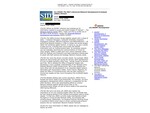
were over-sampled at 44.1 KHz CD-quality rate. The figure below displays spectral content:
(S//SI) Because of their evidently similar features, the three tapings most likely involved
common set-ups; note also the retention of significant energy only below 7,500 Hz, easily
achievable with a standard PC microphone. Upon closer inspection, however, a few puzzling
spectral peaks were observed at higher frequencies: 9,480 Hz, 12,000 Hz, 12,909 Hz, 18,281
Hz, and 21,548 Hz. Readers are invited to submit feedback on the technical meaning of these
measurements.
(U//FOUO) If you would like to comment on this article, visit the SID today blog .
"(U//FOUO) SIDtoday articles may not be republished or reposted outside NSANet
without the consent of S0121 (DL sid comms)."
DYNAMIC PAGE -- HIGHEST POSSIBLE CLASSIFICATION IS
TOP SECRET // SI / TK // REL TO USA AUS CAN GBR NZL
DERIVED FROM: NSA/CSSM 1-52, DATED 08 JAN 2007 DECLASSIFY ON: 20320108
Published in the Same Report
(10 of 21 documents)
-
RT10 Initiative Overview [pdf]
Overview document for RT10, "Real-time, distributed architecture for mobile (tactical) and fixed (national) operational environments"
Programs: RT10 · COBRA FOCUS · GREENDRAGON · GOLDMINER · JUGGERNAUT · MATTERHORN · OBELISK · SORTINGHAT · INFOVIS · SHARPFOCUS2 · TOGA · SORTINGLEAD · GLOBALREACH · VOICERT · QUADRASPECTRE · RENOIR · ANALYSTSNOTEBOOK · OCTAVE · HLT · DRT · GEOT · InnoVisions -
NSA Georgia Opens New Audio-Forensics Lab SIDtoday [pdf]
The document discusses the launch of a new audio-forensics lab at NSAG (National Security Agency Georgia) designed to enhance the processing and analysis of intercepted voice communications. The lab, funded through the Senior Language Technology Authority (SLTA), will focus on resolving language processing challenges for language analysts by improving the intelligibility and quality of foreign-language voice intercepts.
People: Mercer, Marti Hix -
Alert: Voice Masking Is Discovered in SIGINT SIDtoday [pdf]
This March 2007 post from the internal NSA newsletter SIDToday draws attention to voice-masking technology used by subjects of surveillance to frustrate the agency’s voice-recognition efforts.
-
Tips for a Successful Quick Reaction Capability SIDtoday [pdf]
In response to Iranian President Ahmadinejad’s 2007 visit to New York, the NSA’s Iran Government and Leadership branches launched a Quick Reaction Capability (QRC) to gather time-sensitive intelligence. The QRC focused on enhanced collection techniques, collaboration across departments, and efficient data management to analyze the extensive communications traffic during the event, resulting in valuable leads on Iranian leadership activities and diplomatic plans.
People: Ahmadinejad, Mahmoud -
New RT-RG Overview Video Available on NSANet SIDtoday [pdf]
The NSA's Meade Operations Center released a 10-minute video overview of the Real-Time Regional Gateway (RT-RG), a tool suite designed for forward-deployed analysts. The suite enables faster access to real-time metadata and reporting, improving tactical support for military operations, with new functionalities being developed for use in Afghanistan and beyond.
-
Voice Biometrics Capability Proven During Recent Technology Demonstration SIDtoday [pdf]
The Coordinate Operational Resources for Voice Exploitation Technology (CORVET) project, managed by the Expeditionary SIGINT Services Office (ESSO), demonstrated a promising capability for voice biometrics that could be used in security operations to identify individuals based on voice characteristics. Similar to the long-established method of fingerprinting, CORVET aims to create a database of voice models that could be used for identification in various contexts, such as detention and force-protection scenarios.
-
Alvin, Simon, and... Al Qaeda? Finding Modified Voice in SIGINT Traffic SIDtoday [pdf]
This SIDtoday article discusses the use of voice modification technology by Al-Qaeda and other extremist groups to evade identification in SIGINT traffic. It highlights the development of the HLT Lite software by R64, which can automatically detect modified voices in intercepted communications, enabling the identification of targets even when traditional voice recognition fails.
-
Come to SID's Identity Intelligence (I2) Day Conference and See Your Target in a Whole New Light! SIDtoday [pdf]
This SIDtoday article promotes NSA's Identity Intelligence (I2) Day Conference, highlighting the importance of using SIGINT tools and techniques to track individuals across time and space. It emphasizes the growing role of biometrics, biographic data, and digital footprints in identifying and targeting foreign persons of interest, with insights from key speakers and case studies.
-
SIGINTers Use Human Language Technology to Great Advantage, Isolate Conversation about Threat to US Official SIDtoday [pdf]
In 2010, the Special Collection Service in Mexico City began using Human Language Technology (HLT) to streamline voice collection and analysis, significantly improving efficiency. By rapidly filtering through large volumes of audio data, HLT helped isolate critical intelligence, such as identifying a conversation related to a bomb threat targeting a U.S. Embassy official, all within minutes instead of hours.
Programs: HLT -
Innov8 Voice Analytics Experiment Profile [pdf]
This document outlines Phase 1 of a Voice Analytics experiment conducted by GCHQ in partnership with the NSA, testing the ingestion and processing of voice data through the DISTILLERY platform on GHOSTMACHINE hardware. The experiments evaluate independent, parallel, and linked analytics (SAD, GID, LID), as well as dynamic resource management, to ensure accurate, scalable, and compliant voice processing in a Joint Collaboration Environment.
Marking: TOP SECRET

Related Documents
-
The Other Side of Open Source SIDtoday [pdf]
Analysts are making greater use of publicly available intelligence, which the NSA calls "open source." According to a "Terrorist Training Manual" found in the home of a suspected Al Qaeda member, terrorists can learn "at least 80%" of their enemy's plans using only open source information. "By using operational security, or OPSEC, NSA can still identify and design countermeasures to protect its most critical information."
People: Speight, CharlieThe Intercept ↗ (2017-09-13) -
Al-Zawahiri: At It Again! SIDtoday [pdf]
Analysis of a new video from Al Qaeda leader Ayman al-Zawahiri shows near-perfect voice matching. The NSA is exploring a hand-held voice recognizer for use in “detention centers and guard posts in conflict regions.”
The Intercept ↗ (2018-08-15) -
Brown Bag Session: Open Source Enriches SIGINT - A SIGDEV Perspective SIDtoday [pdf]
A brown bag session will take place to discuss how open-source information can illuminate the trends and potential future technologies that affect the signals intelligence collection process.
Programs: ELMThe Intercept ↗ (2018-08-15) -
The NAC's Advanced Network Development & Analysis (ANDA) Division SIDtoday [pdf]
Profile of the Network Analysis Center's ANDA division, which helped capture suspected al Qaeda operative Husam al-Yemeni, improved understanding of the Pakistani Army Defense Network, and spied on a network associated with the leader of Venezuela (erroneously referred to as "Victor Chavez").
The Intercept ↗ (2016-12-07) -
Alvin, Simon, and... Al Qaeda? Finding Modified Voice in SIGINT Traffic SIDtoday [pdf]
This SIDtoday article discusses the use of voice modification technology by Al-Qaeda and other extremist groups to evade identification in SIGINT traffic. It highlights the development of the HLT Lite software by R64, which can automatically detect modified voices in intercepted communications, enabling the identification of targets even when traditional voice recognition fails.