Dissemination control: NOFORN 168 documents
Search documents matching “NOFORN” →Handling controls assessed for each document, as component values. If a document contains multiple disseminations, the most restrictive is used here.
Graphs
By document date (12 years)
By Banner
By Classification
Refine (combine with another filter, via search)
Sort: Title
Documents
-
Iran – Current Topics, Interaction with GCHQ [pdf]
This NOFORN top secret April 2013 NSA document, shows how Iran significantly improved its offensive cyber capabilities by learning from cyberattacks against it, such as the April 2012 attack on its own oil industry, subsequently launching its own destructive attacks against Saudi Aramco and U.S. financial institutions.
-
Israel targets the U.S. government for invasive electronic surveillance [pdf]
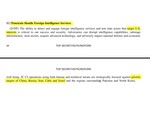
Israel targets the U.S. government for invasive electronic surveillance, and does so more aggressively and threateningly than almost any other country in the world. Indeed, so concerted and aggressive are Israeli efforts against the U.S. that some key U.S. government documents — including the top secret 2013 intelligence budget — list Israel among the U.S.’s most threatening cyber-adversaries and as a “hostile” foreign intelligence service.
-
Japan official NSA visit, cyber briefing [pdf]
This document outlines cooperation between the NSA and Japan’s Directorate for SIGINT (DFS) to develop Japan’s capabilities for providing signals intelligence (SIGINT) support to cyber defense operations, particularly against Chinese cyber activities. It details meetings, training, and data-sharing efforts from 2012–2013 aimed at enhancing Japan’s cyber intelligence capacity under U.S. guidance.
“Japan Made Secret Deals With the NSA That Expanded Global Surveillance” - The Intercept ↗ (2017-04-24) · “アメリカに監視される日本 ~スノーデン“未公開ファイル”の衝撃” - NHK ↗ (2017-04-24) · Gallagher, Ryan · Ikegami, Akira -
Japan official NSA visit, HF briefing [pdf]
The document describes ongoing NSA efforts to renew high-frequency direction-finding (HFDF) collaboration with Japan’s Directorate for SIGINT (DFS) after Japan withdrew from the CROSSHAIR network in 2009. By 2012–2013, both sides were manually exchanging HFDF data, and the NSA sought to advance toward automated data sharing via its BORESIGHT system while reassuring Japan that it would not replace or override its existing technology.
“Japan Made Secret Deals With the NSA That Expanded Global Surveillance” - The Intercept ↗ (2017-04-24) · “アメリカに監視される日本 ~スノーデン“未公開ファイル”の衝撃” - NHK ↗ (2017-04-24) · Gallagher, Ryan · Ikegami, Akira -
-
Legal issues UK regarding Sweden and Quantum [pdf]
An internal NSA document from April 2013 that describes the status of the relationship with a number of partners. It takes up a three-party agreement regarding the hacker programme Quantum, between the Swedish FRA, American NSA and British GCHQ, initiated by NSA chief Keith Alexander. The document shows that the project has so far resulted in a “proof of concept” – i.e., the system works, but it has not yet generated any substantial intelligence results. It also shows that the GCHQ are doubtful about continuing in the project because of restrictions in British legislation, but that the NSA’s intention all along has been to carry out the project with the Swedish FRA rather than GCHQ.
Programs: QUANTUM -
List of foreign governments and organizations authorized for surveillance [pdf]
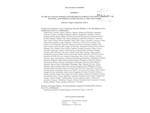
This exhibit lists the 193 foreign governments as well as foreign factions, political organizations and other entities that were part of a 2010 certification approved by the Foreign Intelligence Surveillance Court. These are the entities about which the NSA may conduct surveillance, for the purpose of gathering foreign intelligence. Each year a new certification must be approved by the court to permit such surveillance under Section 702 of the FISA Amendments Act.
-
Lobban NSA Visit Précis [pdf]
This document is a formal briefing for a April 2013 visit by GCHQ Director Sir Iain Lobban to the NSA. The visit aimed to reinforce the Five Eyes partnership by discussing sensitive topics including supervised access to FAA Section 702 data ("Triage 2.0"), coordinated cyber and SIGINT strategies for Syria and Iran, and the implementation of the Global Collaboration Environment (GCE).
-
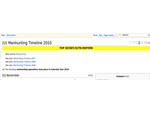
Manhunting Timeline 2010 [pdf]
The Intellipedia manhunting timeline for 2010, recording the United States urging Australia, the United Kingdom and Germany on 10 August to consider criminal charges against WikiLeaks founder Julian Assange — described as focusing the legal element of national power on Assange and the network supporting WikiLeaks.
-
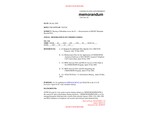
Metadata Sharing Memorandum (2005) [pdf]
This 2005 NSA memorandum outlines plans to expand and formalize intelligence community–wide sharing of SIGINT-derived metadata beyond NSA, centering on the CRISSCROSS/PROTON program while balancing legal, operational, and source-protection concerns. It proposes a federated query model to increase access without further duplicating sensitive data outside NSA.
-
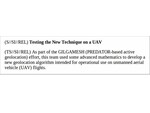
Metadata-Driven Drone Strikes SIDtoday [pdf]
These documents describe the NSA and CIA’s use of geolocation technology, particularly via UAV-mounted systems like GILGAMESH and VICTORYDANCE, to track mobile devices for targeted drone strikes, including operations that killed U.S. citizen Anwar Nasser Aulaqi. These programs rely heavily on signals intelligence rather than human confirmation, raising concerns about reliability, civilian casualties, and the accuracy of targeting. See also: SIDtoday/documents/2005/2005-01-18_SIDToday_-_New_Tactical_Collection_System_Joins_the_War_on_Terroris
-
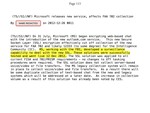
Microsoft releases new service, affects FAA 702 collection [pdf]
An SSO item on Microsoft's new outlook.com service encrypting web chat from 31 July 2012 and cutting off FAA 702 collection, and on the surveillance solution Microsoft built with the FBI, which went live on 12 December 2012 and needed no change to UTT tasking.
-
Minimization Procedures Used By The National Security Agency In Connection With Acquisitions Of Foreign Intelligence, Information Pursuant To Section 702 Of The Foreign Intelligence Court Surveillance Act Of 1978 [pdf]
The NSA’s Section 702 minimization rules expose how the agency can collect, keep, and use Americans’ communications without warrants, despite claiming to target only foreigners. While the document sets out procedures for handling U.S. data, it includes broad loopholes—like keeping “inadvertently” collected domestic messages for years, sharing unfiltered data with the FBI, CIA, and even foreign governments, and giving NSA analysts wide discretion over who gets surveilled—all under secret FISA Court approval.
People: Holder, Eric H. Jr. -
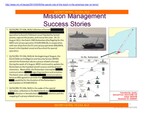
Mission Management Success Stories [pdf]
This document details a joint intelligence operation between the NSA and the Dutch Defense Intelligence and Security Service (MIVD) targeting Somali piracy. This document outlines how the NSA provided the Dutch flagship HMS Rotterdam with specialized intercept capabilities during Operation OCEAN SHIELD in 2012. This collaboration directly facilitated a successful special operation on 13 August 2012, which resulted in the rescue of a hijacked Pakistani vessel's crew and the capture of several pirates.
-
MYSTIC [pdf]
These excerpts provide foundational details on the MYSTIC program, including its inception in 2009 and its structural organization. It defines MYSTIC as a program managed by the Special Source Operations (SSO) division, focusing on "embedded collection systems" within foreign wireless and mobile networks. The document confirms a deceptive operational model: the equipment is overtly installed to provide "commercial services" for telecommunications companies, while its secret purpose is to provide SIGINT (Signals Intelligence) to U.S. agencies.
-
N.S.A. Memo Expands Access to FISA Information [pdf]
In 2006, the National Security Agency sought to expand access to Foreign Intelligence Surveillance Act information — previously limited to its headquarters in Fort Meade, Md. — to its code-breakers in Georgia, Texas and Hawaii. Part of the deliberations focused on a problem that raised the possibility that the agency had violated rules the surveillance court established for handling the information.
-
New FAA702 Certification in the Works - Cyber Threat [pdf]
A 23 March 2012 SSO article on a draft FAA 702 certification for cyber threats. It would let analysts task selectors tied to malicious cyber activity without attributing them to a foreign government or terrorist group, and would codify tasking of IP addresses and code strings through PRISM and the upstream accesses.
-
New Skype Stored Comms Capability For PRISM [pdf]
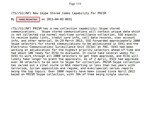
An SSO item on PRISM's new Skype stored-communications capability — buddy lists, credit card details, call data records and account information — with roughly 2,000 Skype selectors sent for FBI adjudication on 29 March 2013 and over 2,800 reports issued from PRISM Skype collection since April 2011.
-
New Zealand SPEARGUN Phase 1 [pdf]
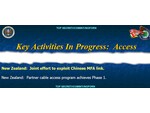
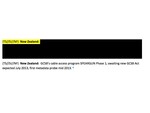
This document snippet provides a concise technical timeline for Project SPEARGUN, the New Zealand Government Communications Security Bureau's (GCSB) mass surveillance initiative. It confirms that the physical tapping of undersea cables (Phase 1) was completed and that the program was strategically synchronized with domestic political and legal developments. Specifically, the document reveals that the deployment of "metadata probes" (real-time automated data extraction) was contingent upon the passage of the GCSB Act in July 2013. This snippet is a critical piece of evidence showing that the legislative changes in New Zealand were tied by the NSA to GCSB's first metadata probe, planned for mid-2013 once the new GCSB Act was passed.
Programs: SPEARGUN -
NSA BOUNDLESSINFORMANT Chart on Netherlands [pdf]
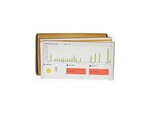
The Netherlands BOUNDLESSINFORMANT chart covering Dec 10, 2012 to Jan 8, 2013 shows that Dutch intelligence collected and shared about 1.8 million cellphone metadata records with the NSA, primarily through CERF CALL systems. According to the Dutch government, the records were collected by the Dutch National SIGINT Organisation (NSO) for counterterrorism and military operations abroad, with Dutch phone numbers filtered out before sharing, and were not interception of calls in the Netherlands.