Country: Saudi Arabia 79 documents
Search documents matching “Saudi Arabia” →Countries mentioned in each document. A country may be mentioned directly (e.g., France) or inferred from a related reference, such as a city (Paris -> France) or a domain name (.fr -> France).
Graphs
By document date (11 years)
By Banner
By Classification
Refine (combine with another filter, via search)
Sort: Title
Documents
-
Discovery SIGINT Targeting Scenarios and Compliance [pdf]
This document is a top-secret NSA guidance manual detailing SIGINT targeting scenarios, compliance procedures, and legal guidance for querying foreign actors, malware, and potentially U.S.-linked systems, including considerations for minimizing incidental collection of U.S. persons’ communications. It outlines specific rules, approvals, and exceptions for using SIGINT tools, foreign intelligence tasks, and cases involving ambiguous or dual-use selectors like WikiLeaks, The Pirate Bay, and foreign actors operating through U.S. infrastructure.
-
Disseminating the Identity of a U.S. Person When an Imminent Threat Exists SIDtoday [pdf]
Under USSID SP0018, a signals intelligence organization can publicly disclose a U.S. person mentioned in an intercepted communication if there is an “imminent or immediate threat” to a person’s safety. “Imminent and immediate” means within a 24-hour period, so an agent could reveal the identity of someone who has just been kidnapped, but not someone who could be kidnapped in two weeks.
The Intercept ↗ (2018-03-01) -
DTX 600 Load Sharing Carriers R.O.W (via UK) to IRAQ plus RLEs [pdf]
A GCHQ informal report dated 15 October 2008 on IRAQ/UK load sharing DTX600 carriers and their return link ends, with redacted JSS7 hits and technical details of four carriers.
“Turkey Is 'Partner and Target' for the NSA” - Der Spiegel ↗ (2014-08-31) · “How the NSA Helped Turkey Kill Kurdish Rebels” - The Intercept ↗ (2014-08-31) · Poitras, Laura · Rosenbach, Marcel · Sontheimer, Michael · Stark, Holger -
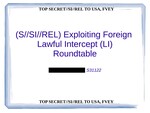
Exploiting Foreign Lawful Intercept (LI) Roundtable [pdf]
Top-secret PowerPoint presentation, "Exploiting Foreign Lawful Intercept Roundtable," highlights the agency’s strategy to exploit vulnerabilities in lawful intercept systems from telecom companies, such as Ericsson, Motorola, and Nokia, in countries like Mexico, Indonesia, and Egypt. The presentation also discusses NSA's use of various "Fingerprints" for identifying data and its collaboration with industry players and foreign lawful intercept systems.
“A Death in Athens” - The Intercept ↗ (2015-09-28) · “Americans and Greeks started the 2004 wiretaps together” - Kathimerini ↗ (2015-09-29) · Bamford, James · Petropoulos, Aggelos -
'Foreign Releases' Pay Off in War on Terrorism SIDtoday [pdf]
Foreign releases — U.S. signals intelligence reports released to governments cooperating on a “mutually beneficial activity” — have lead to arrests linked to foreign fighter networks outside Iraq, in countries such as Algeria, Saudi Arabia, and Syria.
The Intercept ↗ (2018-08-15) -
Fusing Signals Data, with WARGODDESS SIDtoday [pdf]
WARGODDESS is a system that fuses multiple sources of signal data to help characterize targets and threats and produce estimates about targets and their intentions.
Programs: WARGODDESSThe Intercept ↗ (2016-05-16) -
GCHQ - PCS Harvesting [pdf]
A TOP SECRET STRAP1 report details how GCHQ industrialized the theft of GSM subscriber authentication keys (Ki) by automating trawls of bulk “C2C” content to extract IMSI/Ki pairs from emails and FTP transfers between SIM personalisation centers and mobile operators. It shows the program scaling key harvesting across networks and countries, complementing computer network exploitation against core mobile infrastructure to suppress billing and lift authentication secrets.
-
GCHQ Intelligence Production Head Outlines Present and Future Priorities SIDtoday [pdf]
According to a talk recently given at NSA's UK base in Menwith Hill, counterterrorism absorbs most (30%) of GCHQ's resources. Afghanistan and China are given increasing attention, while Russia gets less. Long term, GCHQ foresees challenges in keeping up with the internet and "huge amounts of data", while peace is expected in Iraq.
People: Ashton, JonThe Intercept ↗ (2019-05-29) -
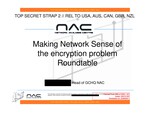
GCHQ – Making network sense of the encryption problem (2011) [pdf]
GCHQ’s Network Analysis Centre convened a 2011 roundtable on “making network sense” of encryption, pushing a metadata-first strategy to triage SSL/TLS, IKE, OpenVPN, and SSH flows, pivot from “seed” indicators, and zero in on targets and subnets worth decrypting. The playbook leans on enrichment, AS-level scoping (explicitly citing Belgacom AS6774 GRX VPNs), and “access optimisation” to collect data pre‑encryption—passively or actively.
Programs: SQUEAL · BEARDEDPIGGY · CLOUD · IRASCIBLEHARE · IRASCIBLERABBIT · IRASCIBLEMOOSE · IRASCIBLEEMITT“Operation Socialist: The Inside Story of How British Spies Hacked Belgium’s Largest Telco” - The Intercept ↗ (2014-12-13) · “Lees hier hoe de Britse geheime dienst GCHQ Belgacom aanviel” - NRC ↗ (2014-12-13) · “Britse geheime dienst bespioneerde jarenlang Belgacom-klanten” - De Standaard ↗ (2014-12-13) · Gallagher, Ryan · Modderkolk, Huib · Vanhecke, Nikolas · Eeckhaut, Mark -
GSM tower mapping made easier and more accurate with new tool SIDtoday [pdf]
This document details DYMO, a prototype developed at the NSA’s Menwith Hill Station—the agency’s large British base operated in close cooperation with GCHQ—for highly accurate GSM tower geolocation. It highlights DYMO’s superior performance in mapping accuracy and metadata integrity, its extensive operational use across regions such as Iraq, Iran, and Somalia, and its integration with tools like GOLDENEYE and the Integrated COMINT System (ICS) to streamline analysis and intelligence fusion.
-
Guide to Using Contexts in XKS Fingerprints [pdf]
This technical guide explains how NSA analysts use "contexts" within XKEYSCORE fingerprints to create highly targeted surveillance queries by restricting searches to specific scopes (e.g., web searches, document bodies, geographic locations), enabling precision targeting such as finding "all people in Kabul performing web searches on Jihad" while avoiding the overwhelming noise of broader keyword searches.
-
Guidelines for the classification of NSA SIGINT details (1945-1967) [pdf]
This document is an NSA classification guide that defines how and why historical SIGINT material from 1945–1967 remains classified, in many cases for 75 years. It systematically explains which intelligence activities, targets, partnerships, and technical methods must stay protected because they still reveal sensitive sources, methods, and diplomatic equities.
-
How SIGINT Helped Liberate an American Hostage in Iraq SIDtoday [pdf]
A cryptologic support team identified mobile phone handsets involved in kidnappings in Iraq, which allowed special forces to capture and interrogate individuals with information regarding the hostage Roy Hallums, leading to his rescue.
The Intercept ↗ (2018-03-01) -
HTTP Activity in XKEYSCORE [pdf]
This training presentation from March 2009 provides NSA and Five Eyes analysts with detailed instructions on exploiting HTTP web browsing activity collected by XKEYSCORE, explaining how to differentiate client-to-server requests (GET/POST) from server-to-client responses, extract metadata like search terms, URLs, cookies, language, and browser types, and use this data to discover new surveillance targets, track individuals' online behavior, and conduct "pattern of life" analysis.
-
Improving Our Capability to Collect Against the Thuraya Satellite SIDtoday [pdf]
An upgraded system targeting the Thuraya satellite phone network has been installed in 23 sites across Europe, the Middle East and Central Asia. On an average day the systems collected "over 500,000 call events", including "20,000 calls of potential interest to NSA analysts."
The Intercept ↗ (2019-05-29) -
InSIDer's View of History: Resourceful NCOs at Goodfellow SIDtoday [pdf]
A funny anecdote about over-preparing for a general's visit.
The Intercept ↗ (2016-12-07) -
Intelligently filtering your data: Brazil and Mexico case studies [pdf]
These documents reveal that the NSA conducted targeted surveillance operations against high-profile Brazilian and Mexican figures, including President Dilma Rousseff and presidential candidate Enrique Peña Nieto, using advanced contact-graph filtering and data analysis techniques to extract relevant intelligence from intercepted communications. These documents show how NSA analysts systematically developed intelligence on foreign leaders during election periods and diplomatic activities, framing it as “target development,” but in practice enabling deep political espionage under the guise of analytical innovation.
“Veja os documentos ultrassecretos que comprovam espionagem a Dilma” - O Globo ↗ (2013-09-02) · “No Place to Hide” - Metropolitan Books ↗ (2014-05-13) · Greenwald, Glenn -
Internet Anonymity 2011 [pdf]
A TOP SECRET NSA presentation from 2011 providing a comprehensive survey of Internet Anonymity Technologies (IAT) — covering HTTP proxies, VPN anonymity providers, multi-hop networks including Tor and JAP, anonymous remailers and circumvention tools — alongside NSA's capabilities and limitations against each, including XKEYSCORE fingerprints for VPN identification, the PARTNERSNIPPET Tor deanonymisation team, GOLDENFORTIN Netflow data, and a candid assessment that Tor offers "no passive exploitation."
Programs: FOXTRAIL · NKB · NACIRONIN · PONTENTPOTABLES · RONIN · XKEYSCORE · PARTNERSNIPPET · GOLDENFORTIN · SNAPEPeople: Heap, Austin -
Intro to the VPN Exploitation Process [pdf]
NSA introduction to the VPN exploitation process from September 2010, presented by the OTP VPN Exploitation Team, covering the full workflow from initial collection through to sustained decryption of IPSec, PPTP, SSL and SSH traffic, with named exploitation successes including airlines, diplomatic missions, banks and intelligence services across Iran, Jordan, Russia, Turkey, Pakistan, Afghanistan, Somalia, Indonesia and Mexico.
Programs: BLEAKINQUIRY · TOYGRIPPE · XKEYSCORE · MAILORDER · CORALREEF · VULCANDEATHGRIP · SCISSORS · TURTLEPOWER · PINWALE · FOURSCORE · CADENCE · UTT · VULCANMINDMELD · CAPRIOS · AGILITY · NKB · FOLLOWTHEMONEY -
'Leadership and Intelligence' SIGINT Assessments - A Breakthrough Waiting to Happen SIDtoday [pdf]
Assessment Reports bundle all available signals intelligence alongside an analyst’s interpretation of these intercepts as evidence. A report produced by the NSA’s Libya team in 2002 zeroed in on a Libyan intelligence officer, Mohamed Ismail. Years later, the report proved crucial when he was implicated in a plot to assassinate the Saudi crown prince, which in turn led to the conviction of an American co-conspirator, Abdurahman al-Amoudi.
People: Isma'il, Muhammad · Gaddafi, Muammar · Abdullah, bin Abdulaziz Al Saud · Alamoudi, Abdurahman · Ciccolo, ChrisThe Intercept ↗ (2018-03-01)